❌

Normal view

Verifying and optimizing post-quantum cryptography at Amazon

7 April 2026 at 15:00
Today, secure online communication is enabled by public-key cryptography, primarily RSA and elliptic-curve cryptography (ECC), whose security depends on the assumption that certain computational problems are intractable. However, while believed to be intractable for conventional computers, the problems underlying RSA and ECC may be tractable for sufficiently large quantum computers. “Store now, decrypt later” attacks — which intercept encrypted information and hold onto it until quantum computers can decrypt it — require protection against these attacks long before they become technically feasible. Post-quantum cryptography (PQC) is cryptography running on classical computers but secure in the face of quantum computing. In 2024, following an eight-year standardization effort, the US National Institute of Standards and Technology (NIST) published standard FIPS-203, which specifies the Module-Lattice-Based Key Encapsulation Mechanism, or ML-KEM, as a mechanism for key agreement believed to be secure against attacks from quantum computers. In this post, we describe how Amazon’s Automated Reasoning Group, AWS Cryptography, and the open-source community have collaborated to create an open-source, formally verified, and optimized implementation of ML-KEM, protecting customers against store-now-decrypt-later attacks with the highest assurance and minimal cost. What is good cryptographic engineering? In keeping with Amazon’s customer obsession, we prioritize three goals when working on cryptographic solutions: The security of the customer’s data: Cryptography is notoriously hard to implement securely, and any flaw can endanger the customer’s privacy; The customer experience: Cryptography is a computational tax that we minimize to ensure the lowest cost and best experience for our customers; Our ability to maintain the solution going forward: The less time we need to spend on maintenance, the more we can innovate on behalf of our customers. There are, however, tensions between these goals: Simple code is easiest to maintain and write securely but tends to be slow. Fast code tends to be more difficult to audit and prone to errors. Automated reasoning allows us to resolve these tensions and provide our customers with cryptographic solutions that are secure, fast, and maintainable, all at once. Yet another implementation of ML-KEM? ML-KEM — formerly known as Kyber — is well studied from an implementation perspective: On the one hand, the Kyber reference code provides a clean C implementation that has been scrutinized for years. On the other hand, numerous research papers describe how to optimize ML-KEM for various metrics and platforms. The challenge faced by AWS Cryptography and the Automated Reasoning Group in 2024 was to combine the simplicity of the reference implementation and the optimization potential revealed in the research works in a single production-ready implementation. Around the same time, AWS became a founding member of the Linux Foundation’s Post-Quantum Cryptography Alliance (PQCA), which created the Post-Quantum Cryptography Package (PQCP), “a collection of open-source projects aiming to build high-assurance software implementations of standards-track post-quantum cryptography algorithms”. Therefore, rather than brewing our own code, members of our team joined the PQCP and soon after launched mlkem-native, a high-assurance, high-performance C implementation of ML-KEM aiming to combine the ML-KEM reference implementation with research on optimization and formal verification. Coding, fast and slow Mlkem-native’s modular design combines a frontend covering the high-level logic of ML-KEM with a backend responsible for all performance-critical subroutines. Each subroutine — including the Keccak permutation underlying SHA3 and the number-theoretic transform (NTT) underlying fast polynomial arithmetic — has multiple, highly efficient implementations written natively for specific hardware. In addition to the default C implementation, mlkem-native provides assembly/intrinsics backends for AArch64, x86_64, and RISC-V64. Importantly for maintainability, the interface between frontend and backend is fixed: a developer adding optimizations for a new target architecture implements select backend functionality against the backend specification, while the frontend stays the same. The development of the backend specification turned out to be less obvious than it sounds, as we explain below. Knowing your limits Memory safety A well-known challenge with the C programming language is the risk of buffer overflows: writing past the designated limits of a memory region can corrupt data structures and, when maliciously exploited, lead to unprivileged code execution. The umbrella term for such issues is memory safety. Memory-safe languages such as Rust can limit the impact of out-of-bounds accesses — by, for example, panicking instead of exhibiting undefined behavior — but they don’t prevent the mistake itself. Type safety Another well-known challenge, this time with implementing ML-KEM, is the risk of integer overflows — an aspect of type safety. Like RSA and ECC, ML-KEM relies on modular arithmetic, in which the results of operations are divided by a particular number — in ML-KEM’s case, the prime 3,329, designated MLKEM_Q or just q — and only the remainder is carried forward. The modulo operator is represented by the percentage symbol, %. Logically, if two numbers x and y need adding or multiplying in ML-KEM, one needs to compute (x + y) % q and (x * y) % q; for example, (294 * 38) % q = 11,172 % q = 1,185. Such “eager” arithmetic modulo q, which constantly applies modular reduction to represent data in the “canonical” range {0, 1, 2, … , q-1}, is prohibitively slow. Efficient ML-KEM implementations instead use “lazy” arithmetic modulo q: data is operated on without modular reduction for as long as possible, and only once there is a worst-case risk of overflow does reduction happen. Further, this allows the use of imperfect reduction algorithms such as Montgomery reduction, which are fast but don’t always give fully reduced outputs. In the case of ML-KEM, data modulo q = 3,329 is typically stored in signed 16-bit integers. When dealing with lazy arithmetic across the numerous arithmetic routines in ML-KEM, it is therefore essential to track the worst-case bounds of the data and insert modular reductions where those bounds would exceed the limits of 16-bit integers. Small mistakes in this domain can evade testing — because average bounds tend to be much smaller than worst-case bounds — and then randomly surface in production. Tracking buffer bounds and especially arithmetic bounds is time consuming and error prone: for example, weakening the output bounds of a low-level arithmetic function might lead to a rare arithmetic overflow in an entirely different function. Checking this by hand not only requires meticulous documentation and skilled auditors but also slows down development. In mlkem-native, we use a tool called the C Bounded Model Checker (CBMC) to automatically verify memory safety and type safety at the C level: for every function, we add machine- and human-readable contracts to the source code to specify the bounds of buffers and arithmetic data, and we have CBMC automatically verify that, with respect to those bounds, no buffer overflow or arithmetic overflow can happen. Let’s look at a simple example of modular reduction: Focusing on the relevant parts one at a time: First, note the __contract__( ... ) . Slightly simplified, the memory_no_alias and memory_slice lines specify which memory the code can read and write; this relates to memory safety. The ensures(array_bound(...)) clause relates to type safety: it specifies that the function will guarantee that upon return, the data is within the interval [0, 1, …, q). In the proof, you see the __loop__(invariant(...)), specifying how the loop gradually establishes this bound: in the ith iteration, it holds up to the ith coefficient. Finally, the implementation effectively composes mlk_barrett_reduce and mlk_scalar_signed_to_unsigned_q. CBMC does not look inside these but replaces them with their contracts: You can see that mlk_barrett_reduce first establishes a symmetric output interval (-q/2, …, q/2), and then mlk_scalar_signed_to_unsigned_q maps it to [0,1, …, q). In this instance, it is easy to confirm by eye that the specifications line up in the desired way, but for more complex examples, this is less obvious. Either way, CBMC checks it for us automatically. Going fast, staying safe The CBMC proofs described above establish memory safety and type safety for mlkem-native's C code. However, the most performance-critical parts of mlkem-native — the Keccak permutation and number theoretic transform — are implemented in hand-optimized assembly for AArch64 and x86_64. To gain assurance for the assembly implementations in mlkem-native while maintaining high performance, we use three components: SLOTHY, an assembly superoptimizer; HOL Light, a theorem prover; and s2n-bignum, a verification infrastructure for assembly built on HOL Light. Together, they enable a workflow where developers write clean, maintainable assembly, while deployed code achieves peak performance with formal guarantees of correctness. Writing high-performance assembly by hand creates a fundamental tension: clean, auditable code that clearly expresses the computation is slow, while fast code is dense, microarchitecture specific, and difficult to maintain. SLOTHY resolves this tension by automating microarchitecture-specific optimizations: it converts an assembly program into a constraint satisfaction problem, finds optimal instruction schedules and register allocations using a constraint solver, and outputs optimized assembly. Developers write clean code emphasizing the logic of the computation, and SLOTHY generates the fast code. We prove functional correctness for all AArch64 and x86_64 assembly routines using HOL Light and s2n-bignum. Where SLOTHY is used, the proofs are written to be agnostic to the specific instruction ordering and register allocation; we can therefore reoptimize the code for a specific microarchitecture without having to adjust the proofs. This “post-hoc” verification approach establishes the mathematical correctness of the computation represented by the assembly regardless of how it came about; in particular, SLOTHY is removed from the trusted computing base. Keeping it honest Formal verification is never absolute. Every proof links formal objects — specifications and models — to informal, real-world requirements and systems, and these links introduce gaps. Does the formal specification capture what we actually need? Does the formal model faithfully reflect the real system? Is the proof infrastructure itself sound? Earning and maintaining customer trust requires being transparent about these limits. We therefore developed and published a document titled SOUNDNESS.md, where we map out what is proved in mlkem-native, what is assumed, and where the residual risks lie — from the fidelity of the hardware models used in HOL Light proofs, to the larger trusted computing base of CBMC, to the manual bridge between the two verification stacks. For each gap, we describe mitigations in place and outline future work. Our goal is not to claim perfection but to earn trust through transparency. We encourage the community to read SOUNDNESS.md critically, challenge our assumptions, and help us close the remaining gaps. Getting on the road Mlkem-native is integrated into AWS-LC, Amazon's open-source cryptographic library, which underpins secure communication across AWS services. The integration uses an automated importer that pulls mlkem-native source code directly from the upstream repository, ensuring that AWS-LC stays synchronized with the latest verified implementation. The integration is designed for minimal friction: mlkem-native's modular architecture allows AWS-LC to import the core ML-KEM logic while providing its own implementations of platform-specific components. For example, AWS-LC maps mlkem-native's cryptographic primitives to its existing FIPS-202 (SHA-3) implementation, uses AWS-LC's random-number generation and memory zeroization functions, and enables FIPS-mode features like pairwise consistency tests when required. Enabling this is a thin compatibility layer that bridges mlkem-native's API to AWS-LC's infrastructure without modifying the verified code. Critically, the CBMC contracts that prove memory safety and type safety are preserved in the imported source code. While the preprocessor removes them from compiled binaries, they remain in the source as machine-checkable documentation of the code's guarantees — a form of "living proof" that travels with the implementation. Moreover, because both mlkem-native and AWS-LC are open source and permissively licensed, their benefits extend beyond AWS. Anyone can integrate mlkem-native into their systems and gain the same combination of performance and assurance. The formal verification artifacts — CBMC contracts and HOL Light proofs — are part of the repository, all tools involved are open source, and scripts are provided for setup and proof checking, inviting an independent validation of our security claims. Impact The development of mlkem-native demonstrates that the three goals of cryptographic engineering — security, performance, and maintainability — are not in conflict when automated reasoning is applied systematically. CBMC freed us from manually tracking bounds through complex arithmetic, catching errors that would evade testing and surface randomly in production. The annotations stay in the source code as machine-checkable documentation, making the code simultaneously more maintainable and more secure. HOL Light and s2n-bignum allowed us to deploy aggressive assembly optimizations with mathematical certainty of correctness. SLOTHY let us write clean, auditable code while achieving peak performance for specific microarchitectures. And because the proofs are written to be optimization agnostic, we can retarget the code without redoing the verification. The result is an implementation that is simultaneously more secure, faster, and easier to maintain than what traditional development could achieve. We didn't compromise between customer security, customer experience, and our ability to innovate: automated reasoning delivered all three. AWS-LC-FIPS releasePlatformOperation3.14.0Ratioc7iKeygen30899651462.1Encaps30623612332.0Decaps25141515452.0c7gKeygen29617711342.4Encaps28482668742.3Decaps23919647652.3Performance impact of switching from the ML-KEM reference implementation to mlkem-native in Amazon’s cryptography library AWS-LC. ML-KEM-768 performance is measured on c7i and c7g EC2 instances. The numbers represent operations per second (higher is better). The baseline is an AWS-LC-FIPS 3.1 release that contains the ML-KEM C reference implementation. The AWS-LC-FIPS 4 release is built with mlkem-native. The platforms are c7i with Intel(R) Xeon(R) Platinum 8488C and c7g with Graviton 3 processor. Acknowledgments We thank our colleague John Harrison, senior principal applied scientist at the Automated Reasoning Group, for providing the bulk of the AArch64 assembly proofs in HOL Light and for maintaining the HOL Light interactive theorem prover and the s2n-bignum verification infrastructure. Mlkem-native is a collaborative effort involving not only AWS but many members of the open-source community. Foremost, we thank our co-maintainer Matthias Kannwischer from zeroRISC, who started mlkem-native with us and has since been instrumental in the success of the project.

Harshita Arora Joins YC as General Partner

6 April 2026 at 16:00
Harshita Arora Joins YC as General Partner

We're thrilled to announce that Harshita Arora is joining Y Combinator as a General Partner.

Harshita has been a Visiting Partner at YC since the Summer 2025 batch, making her the youngest visiting partner in YC's history.

Harshita discovered coding at 13, dropped out of school at 15 to pursue it full-time, and by 16 had built Crypto Price Tracker, a crypto portfolio management app that was featured by Apple, which was subsequently acquired, and earned her India's Bal Shakti Puraskar, one of the country's highest honors for young achievers. She then received an O-1 visa, moved to San Francisco, and co-founded AtoB (YC S20).

Harshita and her co-founder came into YC with an idea that got killed by Covid, and with zero background in trucking or payments, they spent weeks visiting truck stops until they found the idea that would become AtoB. Today, AtoB is a Series-C stage company building financial infrastructure for the trucking industry. Often described as "Stripe for Trucking," it offers fleet cards, instant payouts, and modern financial tools, serving over 30,000 fleets across the US.

As a General Partner, Harshita will work directly with YC founders at every stage of their companies. She brings deep fintech and infrastructure experience, a founder's instinct for product, and the perspective of someone who's been building companies since she was a teenager.

We're super excited to have her on the team. Welcome, Harshita!

Harshita Arora Joins YC as General Partner

Components of A Coding Agent

4 April 2026 at 11:45

In this article, I want to cover the overall design of coding agents and agent harnesses: what they are, how they work, and how the different pieces fit together in practice. Readers of my Build a Large Language Model (From Scratch) and Build a Large Reasoning Model (From Scratch) books often ask about agents, so I thought it would be useful to write a reference I can point to.

More generally, agents have become an important topic because much of the recent progress in practical LLM systems is not just about better models, but about how we use them. In many real-world applications, the surrounding system, such as tool use, context management, and memory, plays as much of a role as the model itself. This also helps explain why systems like Claude Code or Codex can feel significantly more capable than the same models used in a plain chat interface.

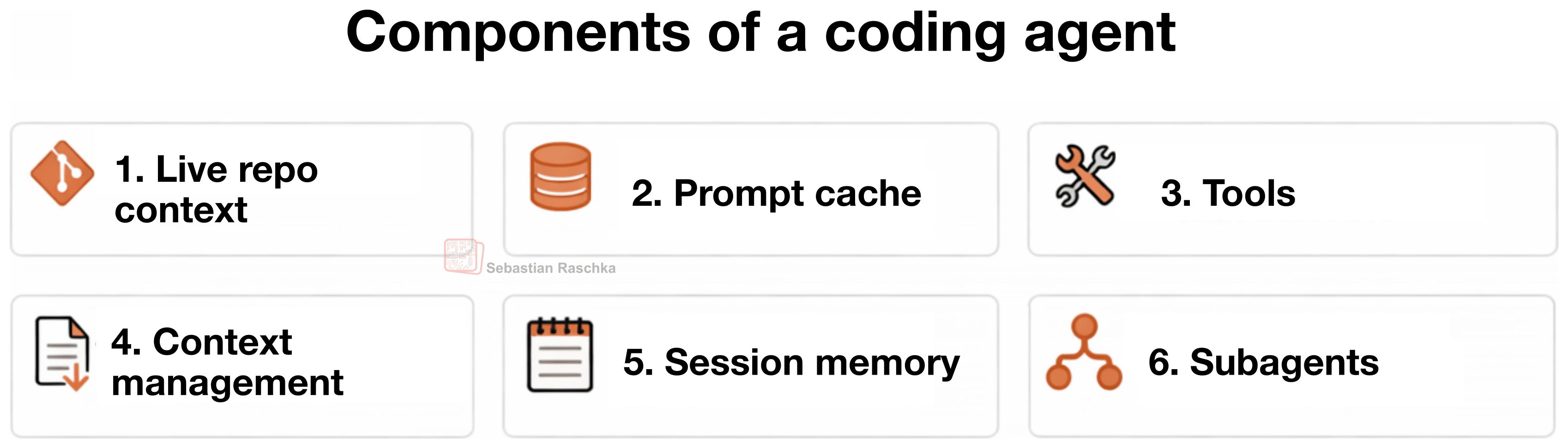
In this article, I lay out six of the main building blocks of a coding agent.

Claude Code, Codex CLI, and Other Coding Agents

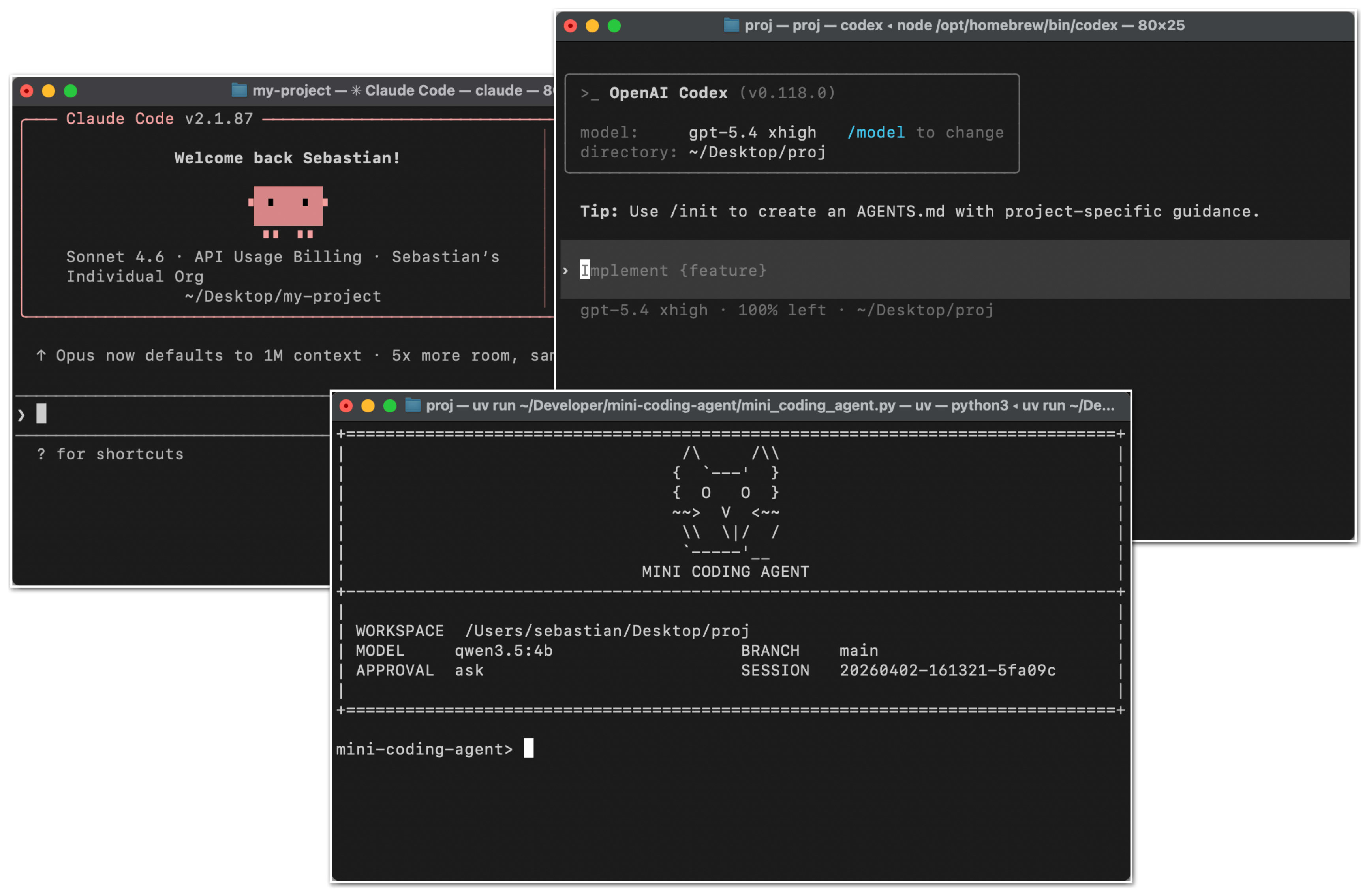
You are probably familiar with Claude Code or the Codex CLI, but just to set the stage, they are essentially agentic coding tools that wrap an LLM in an application layer, a so-called agentic harness, to be more convenient and better-performing for coding tasks.

Figure 1: Claude Code CLI, Codex CLI, and my Mini Coding Agent.

Coding agents are engineered for software work where the notable parts are not only the model choice but the surrounding system, including repo context, tool design, prompt-cache stability, memory, and long-session continuity.

That distinction matters because when we talk about the coding capabilities of LLMs, people often collapse the model, the reasoning behavior, and the agent product into one thing. But before getting into the coding agent specifics, let me briefly provide a bit more context on the difference between the broader concepts, the LLMs, reasoning models, and agents.

On The Relationship Between LLMs, Reasoning Models, and Agents

An LLM is the core next-token model. A reasoning model is still an LLM, but usually one that was trained and/or prompted to spend more inference-time compute on intermediate reasoning, verification, or search over candidate answers.

An agent is a layer on top, which can be understood as a control loop around the model. Typically, given a goal, the agent layer (or harness) decides what to inspect next, which tools to call, how to update its state, and when to stop, etc.

Roughly, we can think about the relationship as this: the LLM is the engine, a reasoning model is a beefed-up engine (more powerful, but more expensive to use), and an agent harness helps us the model. The analogy is not perfect, because we can also use conventional and reasoning LLMs as standalone models (in a chat UI or Python session), but I hope it conveys the main point.

Figure 2: The relationship between conventional LLM, reasoning LLM (or reasoning model), and an LLM wrapped in an agent harness.

In other words, the agent is the system that repeatedly calls the model inside an environment.

So, in short, we can summarize it like this:

  • LLM: the raw model

  • Reasoning model: an LLM optimized to output intermediate reasoning traces and to verify itself more

  • Agent: a loop that uses a model plus tools, memory, and environment feedback

  • Agent harness: the software scaffold around an agent that manages context, tool use, prompts, state, and control flow

  • Coding harness: a special case of an agent harness; i.e., a task-specific harness for software engineering that manages code context, tools, execution, and iterative feedback

As listed above, in the context of agents and coding tools, we also have the two popular terms agent harness and (agentic) coding harness. A coding harness is the software scaffold around a model that helps it write and edit code effectively. And an agent harness is a bit broader and not specific to coding (e.g., think of OpenClaw). Codex and Claude Code can be considered coding harnesses.

Anyways, A better LLM provides a better foundation for a reasoning model (which involves additional training), and a harness gets more out of this reasoning model.

Sure, LLMs and reasoning models are also capable of solving coding tasks by themselves (without a harness), but coding work is only partly about next-token generation. A lot of it is about repo navigation, search, function lookup, diff application, test execution, error inspection, and keeping all the relevant information in context. (Coders may know that this is hard mental work, which is why we don’t like to be disrupted during coding sessions :)).

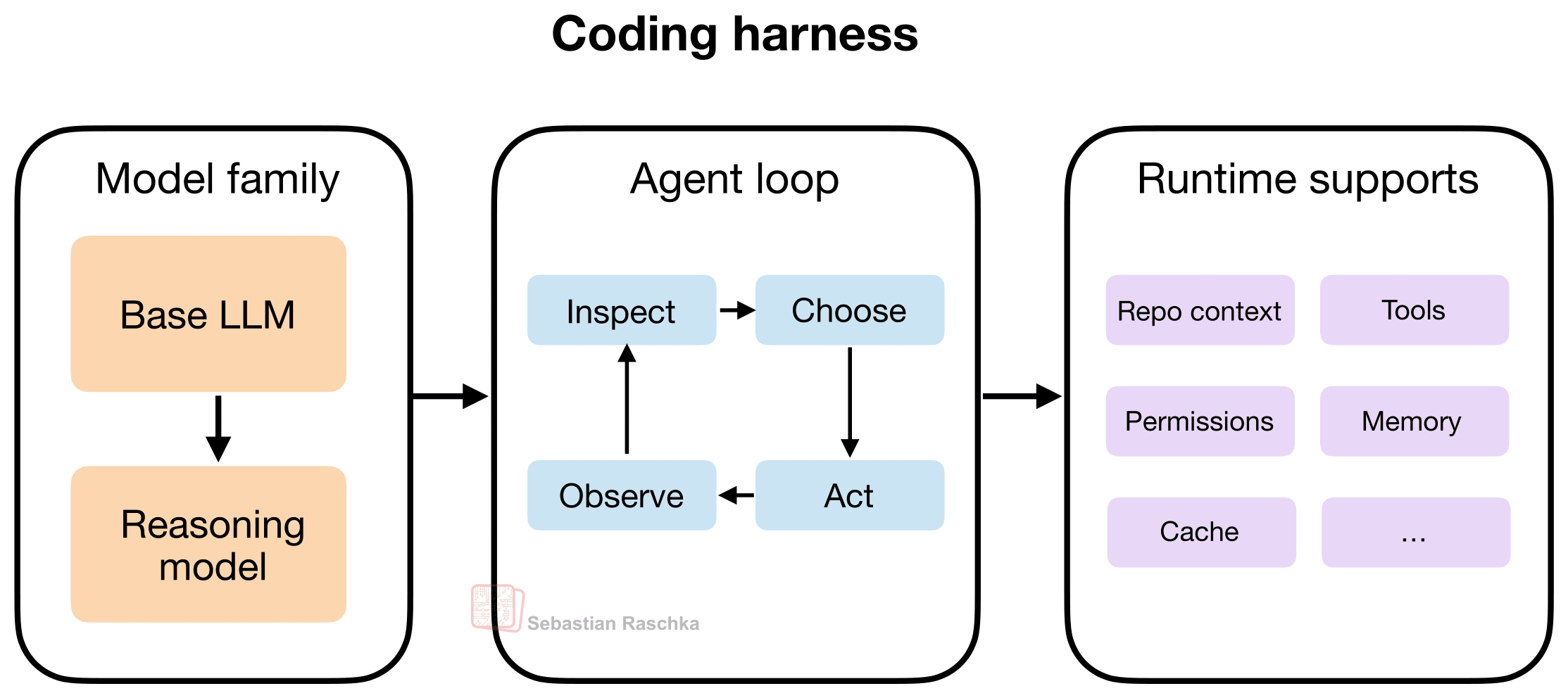
Figure 3. A coding harness combines three layers: the model family, an agent loop, and runtime supports. The model provides the “engine”, the agent loop drives iterative problem solving, and the runtime supports provide the plumbing. Within the loop, “observe” collects information from the environment, “inspect” analyzes that information, “choose” selects the next step, and “act” executes it.

The takeaway here is that a good coding harness can make a reasoning and a non-reasoning model feel much stronger than it does in a plain chat box, because it helps with context management and more.

The Coding Harness

As mentioned in the previous section, when we say harness, we typically mean the software layer around the model that assembles prompts, exposes tools, tracks file state, applies edits, runs commands, manages permissions, caches stable prefixes, stores memory, and many more.

Today, when using LLMs, this layer shapes most of the user experience compared to prompting the model directly or using web chat UI (which is closer to “chat with uploaded files”).

Since, in my view, the vanilla versions of LLMs nowadays have very similar capabilities (e.g., the vanilla versions of GPT-5.4, Opus 4.6, and GLM-5 or so), the harness can often be the distinguishing factor that makes one LLM work better than another.

This is speculative, but I suspect that if we dropped one of the latest, most capable open-weight LLMs, such as GLM-5, into a similar harness, it could likely perform on par with GPT-5.4 in Codex or Claude Opus 4.6 in Claude Code. That said, some harness-specific post-training is usually beneficial. For example, OpenAI historically maintained separate GPT-5.3 and GPT-5.3-Codex variants.

In the next section, I want to go more into the specifics and discuss the core components of a coding harness using my Mini Coding Agent: https://github.com/rasbt/mini-coding-agent.

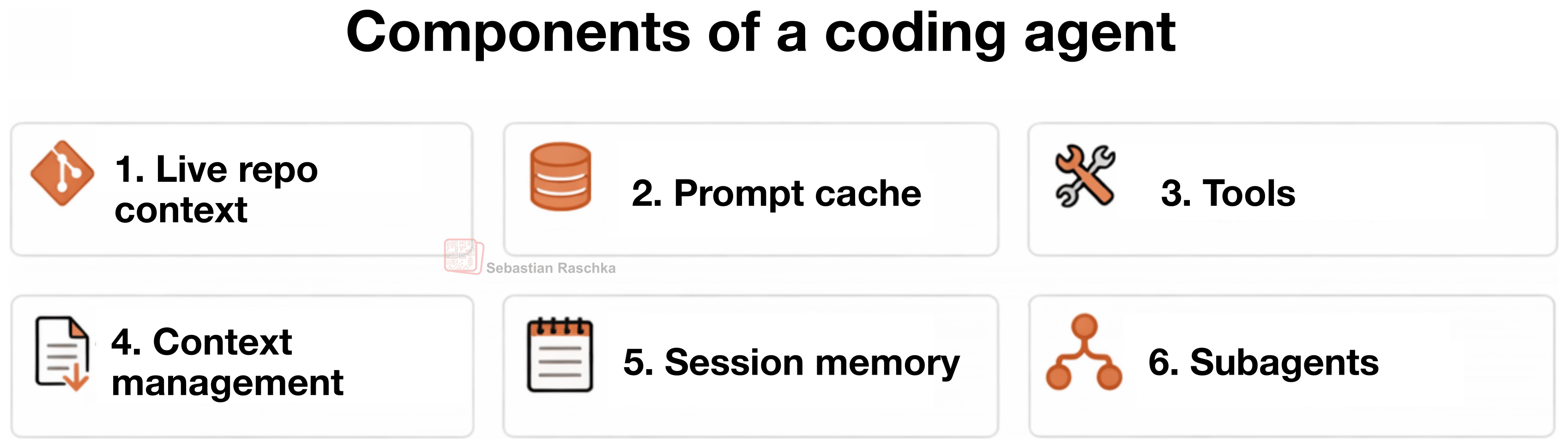
Figure 4: Main harness features of a coding agent / coding harness that will be discussed in the following sections.

By the way, in this article, I use the terms “coding agent” and “coding harness” somewhat interchangeably for simplicity. (Strictly speaking, the agent is the model-driven decision-making loop, while the harness is the surrounding software scaffold that provides context, tools, and execution support.)

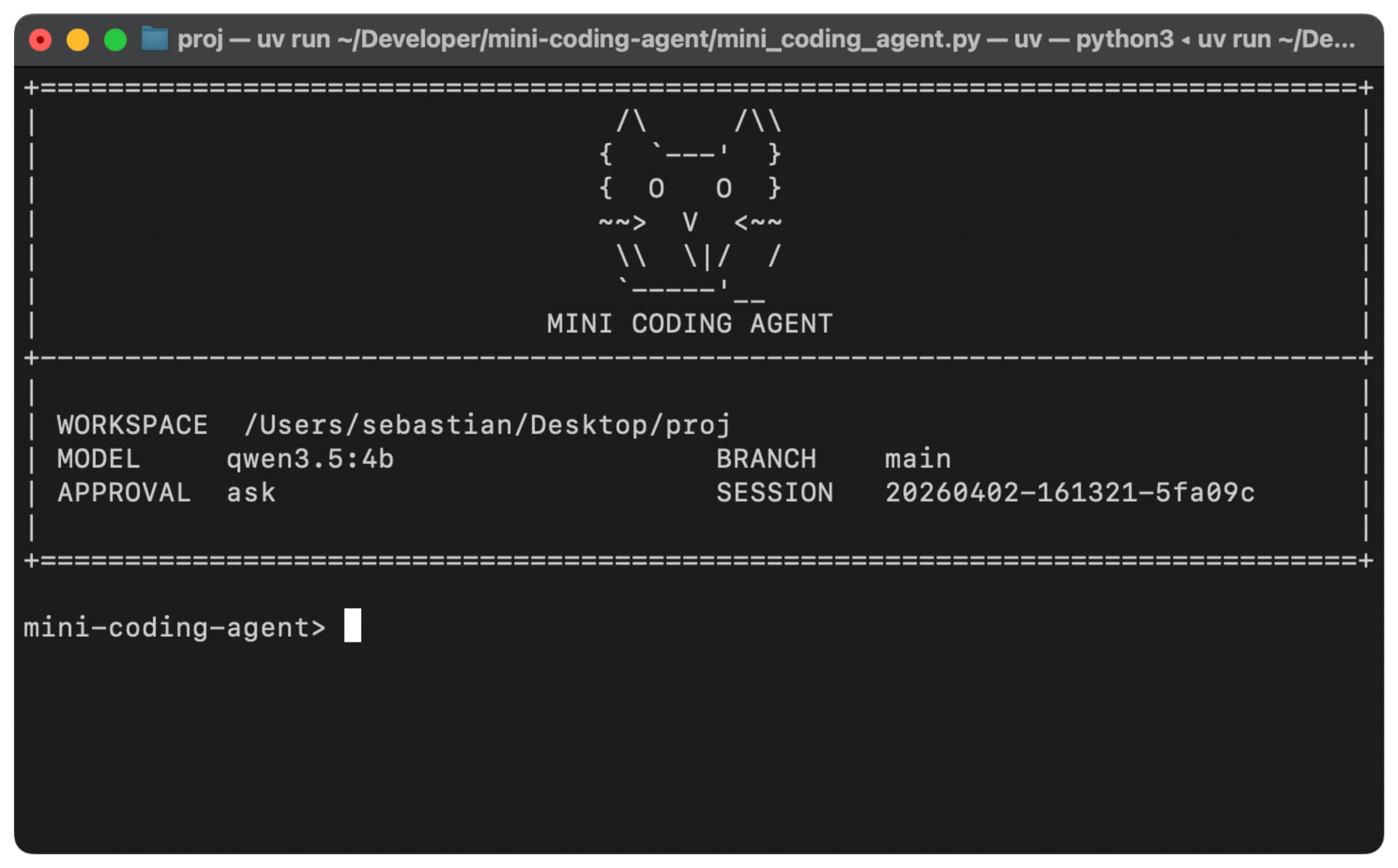
Figure 5: Minimal but fully working, from-scratch Mini Coding Agent (implemented in pure Python)

Anyways, below are six main components of coding agents. You can check out the source code of my minimal but fully working, from-scratch Mini Coding Agent (implemented in pure Python), for more concrete code examples. The code annotates the six components discussed below via code comments:

##############################
#### Six Agent Components ####
##############################
# 1) Live Repo Context -> WorkspaceContext
# 2) Prompt Shape And Cache Reuse -> build_prefix, memory_text, prompt
# 3) Structured Tools, Validation, And Permissions -> build_tools, run_tool, validate_tool, approve, parse, path, tool_*
# 4) Context Reduction And Output Management -> clip, history_text
# 5) Transcripts, Memory, And Resumption -> SessionStore, record, note_tool, ask, reset
# 6) Delegation And Bounded Subagents -> tool_delegate

1. Live Repo Context

This is maybe the most obvious component, but it is also one of the most important ones.

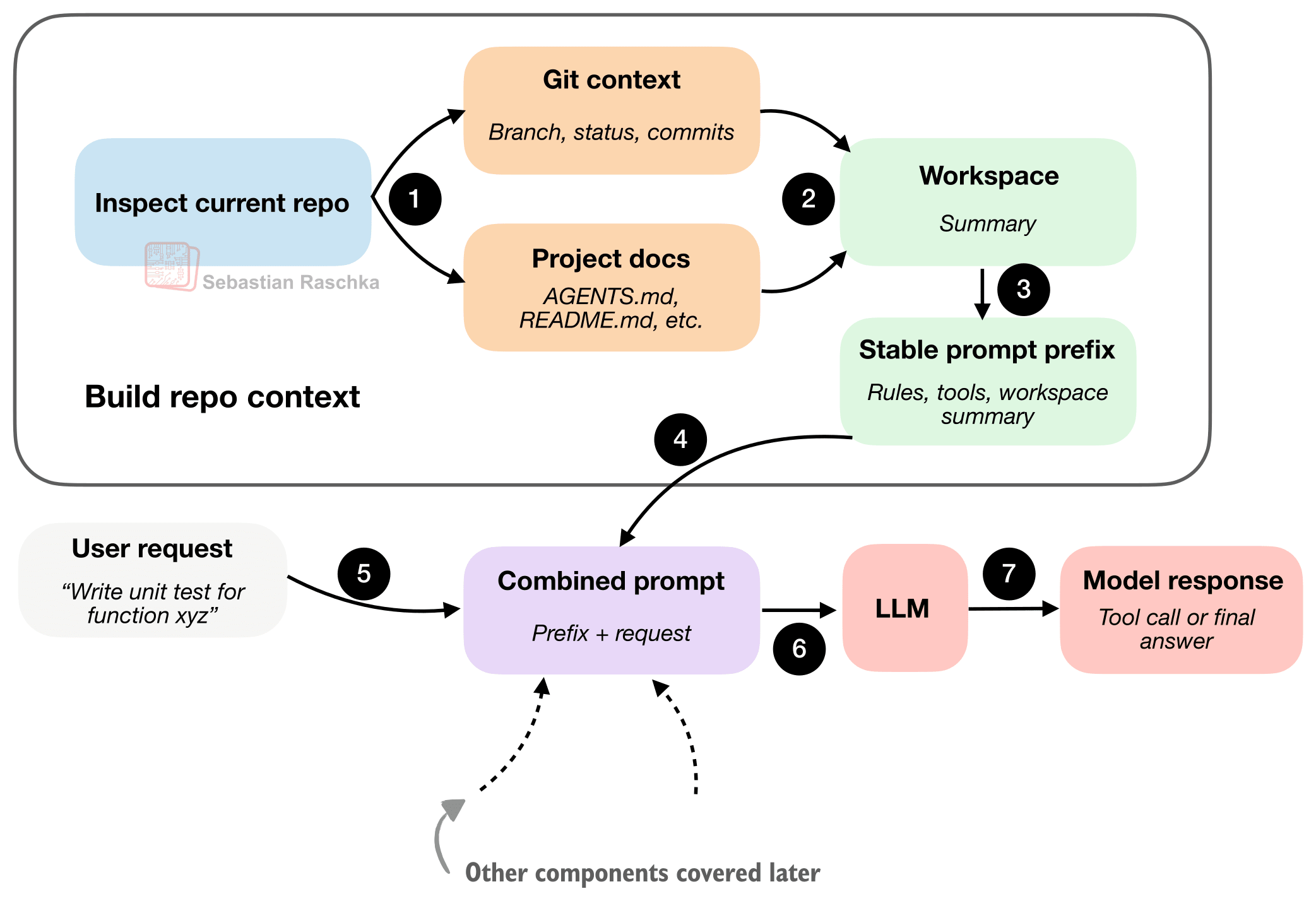
When a user says “fix the tests” or “implement xyz,” the model should know whether it is inside a Git repo, what branch it is on, which project documents might contain instructions, and so on.

That’s because those details often change or affect what the correct action is. For example, “Fix the tests” is not a self-contained instruction. If the agent sees AGENTS.md or a project README, it may learn which test command to run, etc. If it knows the repo root and layout, it can look in the right places instead of guessing.

Also, the git branch, status, and commits can help provide more context about what changes are currently in progress and where to focus.

Figure 6: The agent harness first builds a small workspace summary that gets combined with the user request for additional project context.

The takeaway is that the coding agent collects info (”stable facts” as a workspace summary) upfront before doing any work, so that it’s is not starting from zero, without context, on every prompt.

2. Prompt Shape And Cache Reuse

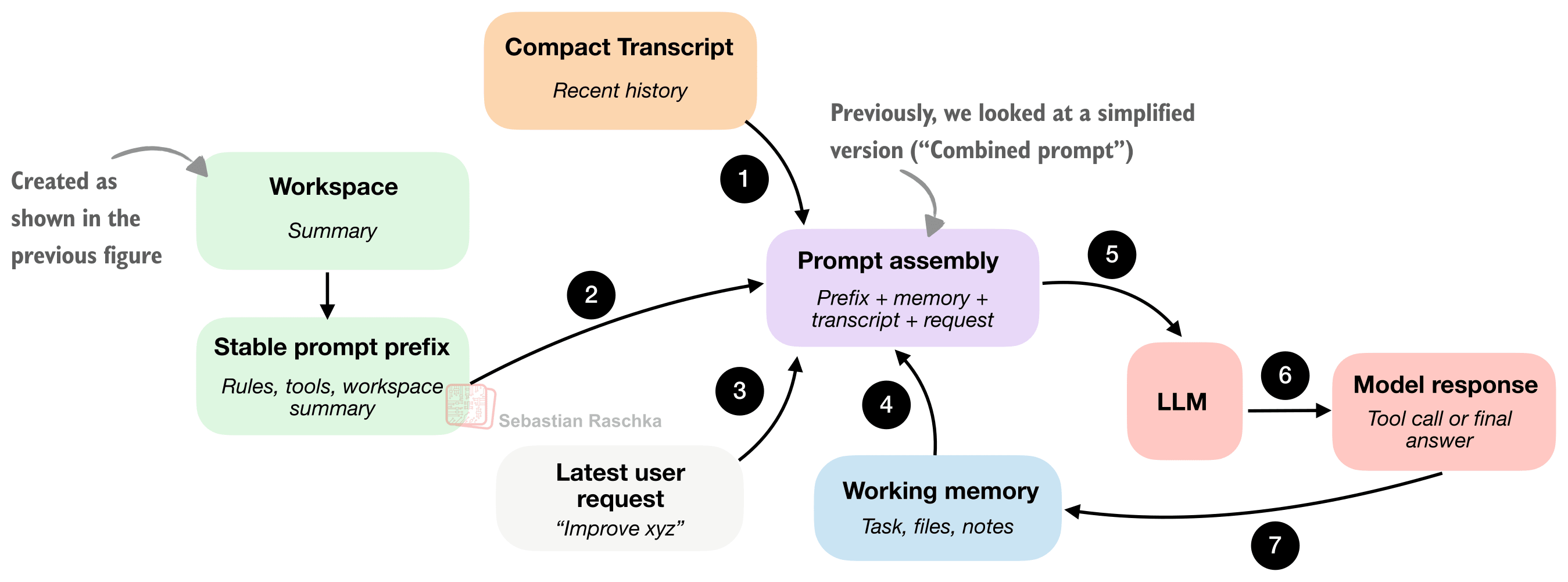
Once the agent has a repo view, the next question is how to feed that information to the model. The previous figure showed a simplified view of this (“Combined prompt: prefix + request”), but in practice, it would be relatively wasteful to combine and re-process the workspace summary on every user query.

I.e., coding sessions are repetitive, and the agent rules usually stay the same. The tool descriptions usually stay the same, too. And even the workspace summary usually stays (mostly) the same. The main changes are usually the latest user request, the recent transcript, and maybe the short-term memory.

“Smart” runtimes don’t rebuild everything as one giant undifferentiated prompt on every turn, as illustrated in the figure below.

Figure 7: The agent harness builds a stable prompt prefix, adds the changing session state, and then feeds that combined prompt to the model.

The main difference from section 1 is that section 1 was about gathering repo facts. Here, we are now interested in packaging and caching those facts efficiently for repeated model calls.

The “stable” “Stable prompt prefix” means that the information contained there doesn’t change too much. It usually contains the general instructions, tool descriptions, and the workspace summary. We don’t want to waste compute on rebuilding it from scratch in each interaction if nothing important has changed.

The other components are updated more frequently (usually each turn). This includes short-term memory, the recent transcript, and the newest user request.

In short, the caching aspect for the “Stable prompt prefix” is simply that a smart runtime tries to reuse that part.

3. Tool Access and Use

Tool access and tool use are where it starts to feel less like chat and more like an agent.

A plain model can suggest commands in prose, but an LLM in a coding harness should do something narrower and more useful and be actually able to execute the command and retrieve the results (versus us calling the command manually and pasting the results back into the chat).

But instead of letting the model improvise arbitrary syntax, the harness usually provides a pre-defined list of allowed and named tools with clear inputs and clear boundaries. (But of course, something like Python subprocess.call can be part of this so that the agent could also execute an arbitrary wide list of shell commands.)

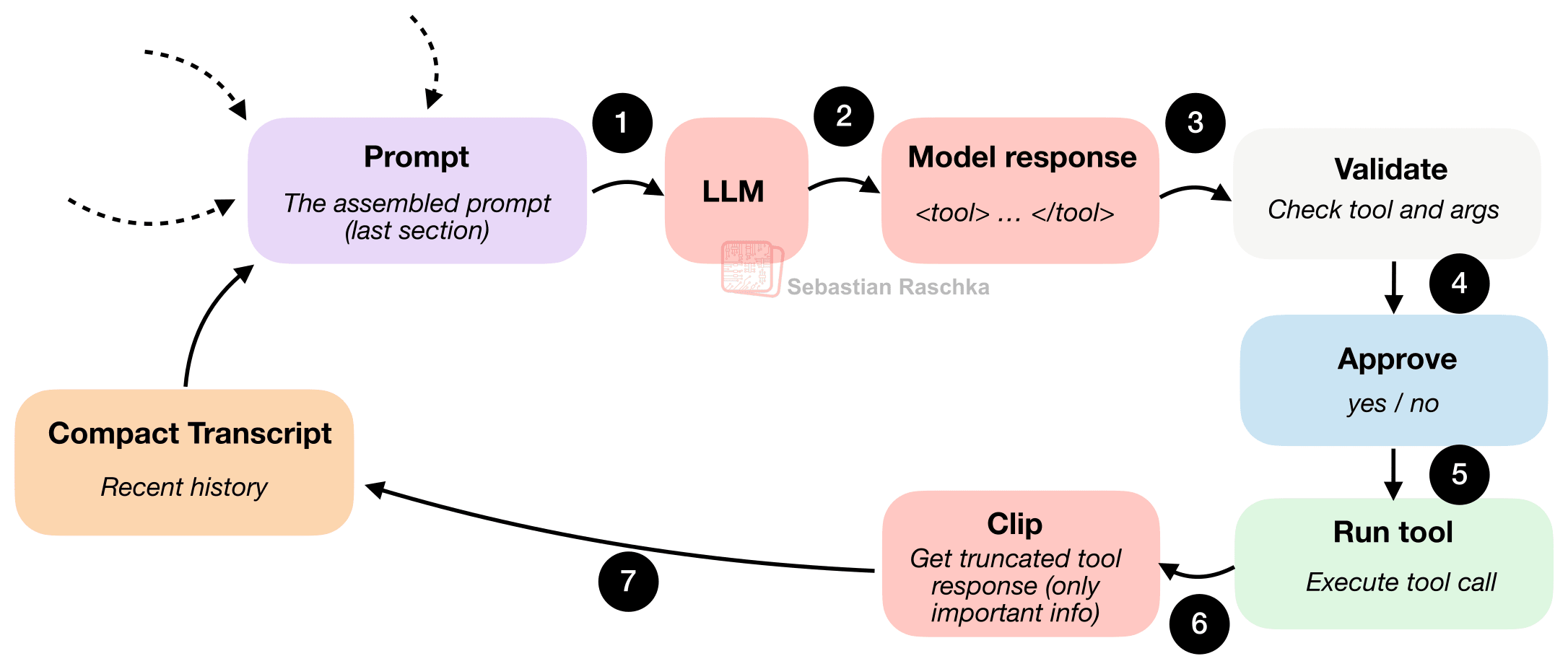
The tool-use flow is illustrated in the figure below.

Figure 8: The model emits a structured action, the harness validates it, optionally asks for approval, executes it, and feeds the bounded result back into the loop.

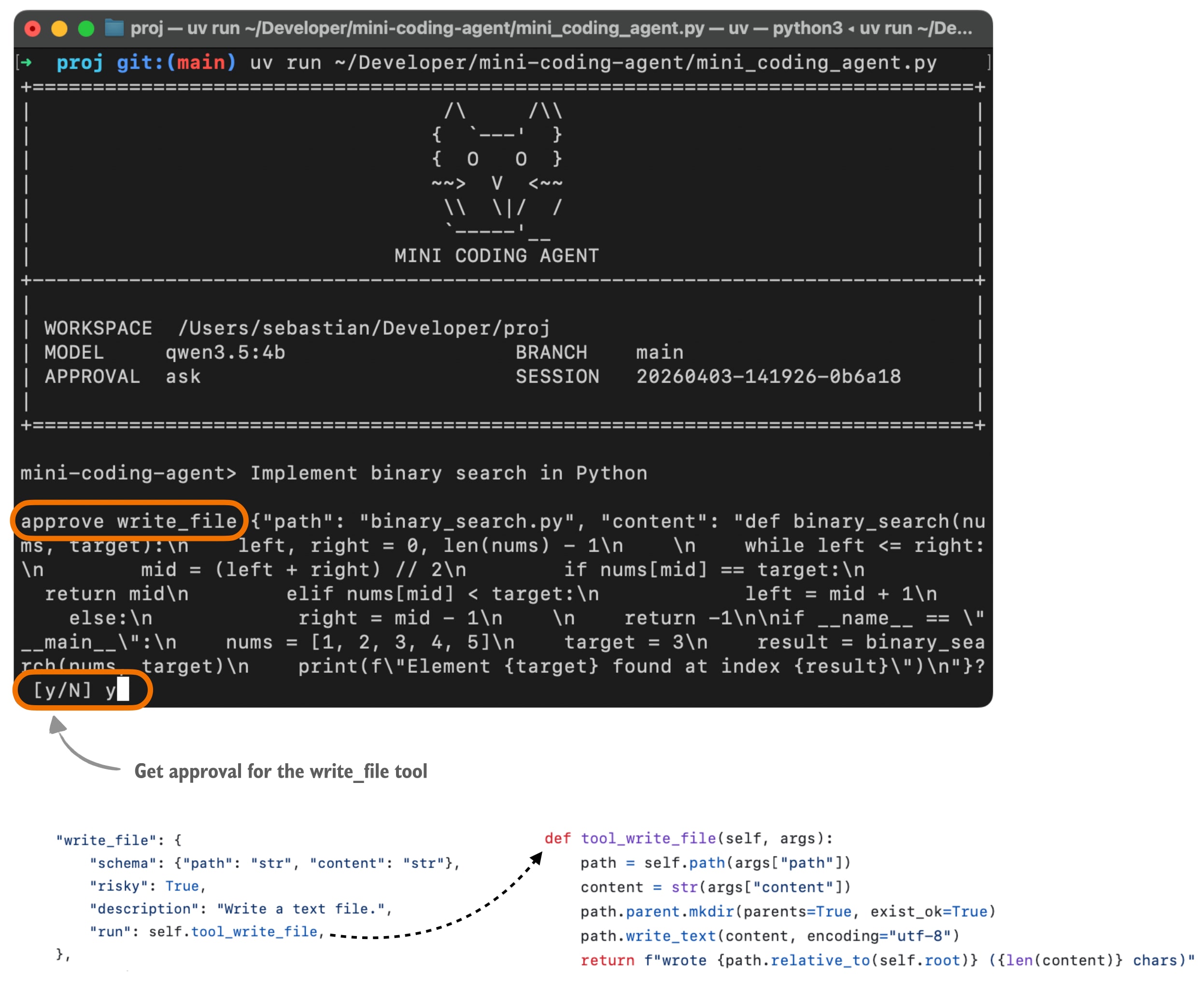
To illustrate this, below is an example of how this usually looks to the user using my Mini Coding Agent. (This is not as pretty as Claude Code or Codex because it is very minimal and uses plain Python without any external dependencies.)

Figure 9: Illustration of a tool call approval request in the Mini Coding Agent.

Here, the model has to choose an action that the harness recognizes, like list files, read a file, search, run a shell command, write a file, etc. It also has to provide arguments in a shape that the harness can check.

So when the model asks to do something, the runtime can stop and run programmatic checks like

  • “Is this a known tool?”,

  • “Are the arguments valid?”,

  • “Does this need user approval?”

  • “Is the requested path even inside the workspace?”

Only after those checks pass does anything actually run.

While running coding agents, of course, carries some risk, the harness checks also improve reliability because the model doesn’t execute totally arbitrary commands.

Also, besides rejecting malformed actions and approval gating, file access can be kept inside the repo by checking file paths.

In a sense, the harness is giving the model less freedom, but it also improves the usability at the same time.

4. Minimizing Context Bloat

Context bloat is not a unique problem of coding agents but an issue for LLMs in general. Sure, LLMs are supporting longer and longer contexts these days (and I recently wrote about the attention variants that make it computationally more feasible), but long contexts are still expensive and can also introduce additional noise (if there is a lot of irrelevant info).

Coding agents are even more susceptible to context bloat than regular LLMs during multi-turn chats, because of repeated file reads, lengthy tool outputs, logs, etc.

If the runtime keeps all of that at full fidelity, it will run out of available context tokens pretty quickly. So, a good coding harness is usually pretty sophisticated about handling context bloat beyond just cutting or summarizing information like regular chat UIs.

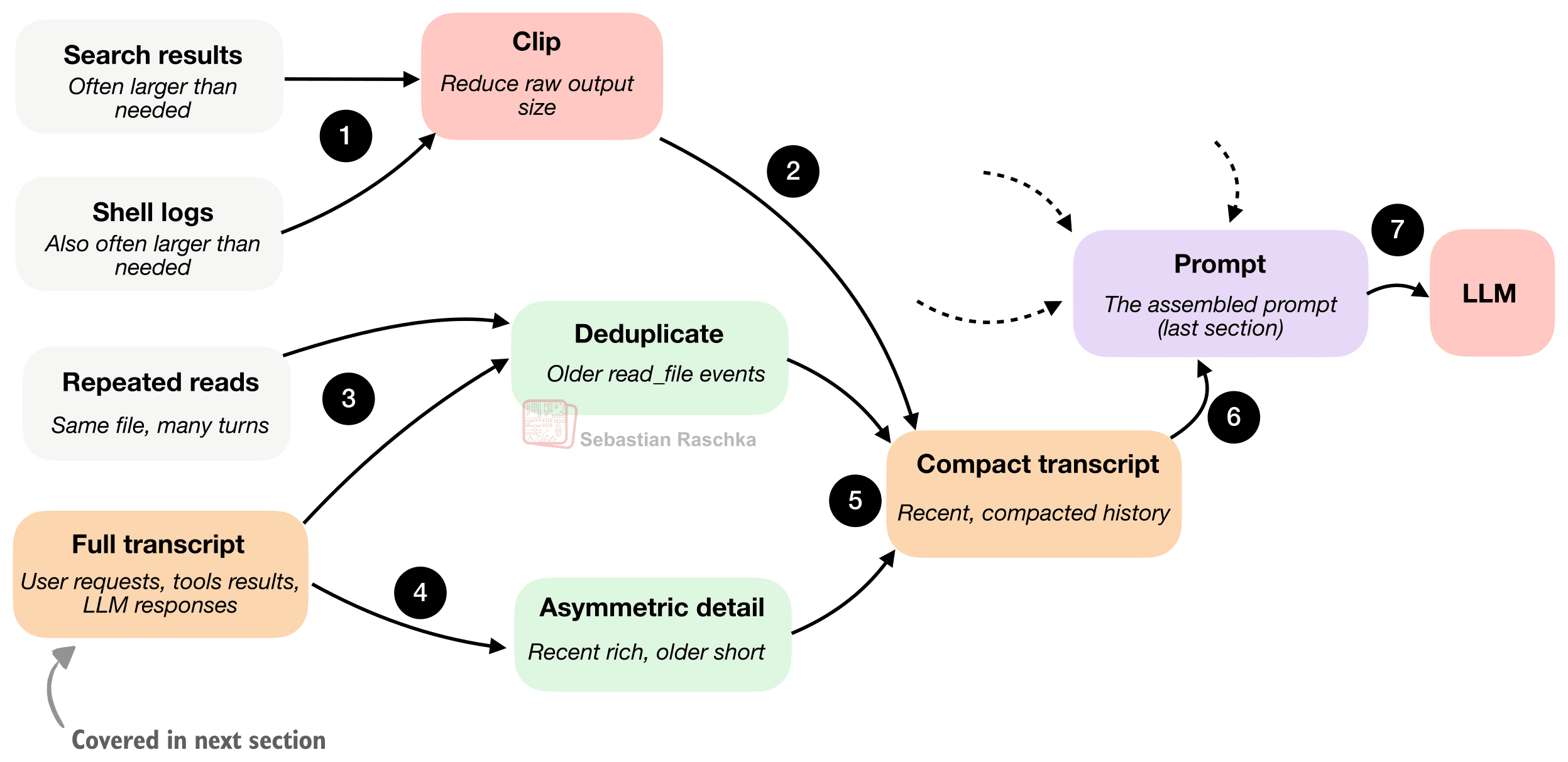
Conceptually, the context compaction in coding agents might work as summarized in the figure below. Specifically, we are zooming a bit further into the clip (step 6) part of Figure 8 in the previous section.

Figure 10: Large outputs are clipped, older reads are deduplicated, and the transcript is compressed before it goes back into the prompt.

A minimal harness uses at least two compaction strategies to manage that problem.

The first is clipping, which shortens long document snippets, large tool outputs, memory notes, and transcript entries. In other words, it prevents any one piece of text from taking over the prompt budget just because it happened to be verbose.

The second strategy is transcript reduction or summarization, which turns the full session history (more on that in the next section) into a smaller promptable summary.

A key trick here is to keep recent events richer because they are more likely to matter for the current step. And we compress older events more aggressively because they are likely less relevant.

Additionally, we also deduplicate older file reads so the model does not keep seeing the same file content over and over again just because it was read multiple times earlier in the session.

Overall, I think this is one of the underrated, boring parts of good coding-agent design. A lot of apparent “model quality” is really context quality.

5. Structured Session Memory

In practice, all these 6 core concepts covered here are highly intertwined, and the different sections and figures cover them with different focuses or zoom levels. In the previous section, we covered prompt-time use of history and how we build a compact transcript. The question there is: how much of the past should go back into the model on the next turn? So the emphasis is compression, clipping, deduplication, and recency.

Now, this section, structured session memory, is about the storage-time structure of history. The question here is: what does the agent keep over time as a permanent record? So the emphasis is that the runtime keeps a fuller transcript as a durable state, alongside a lighter memory layer that is smaller and gets modified and compacted rather than just appended to.

To summarize, a coding agent separates state into (at least) two layers:

  • working memory: the small, distilled state the agent keeps explicitly

  • a full transcript: this covers all the user requests, tool outputs, and LLM responses

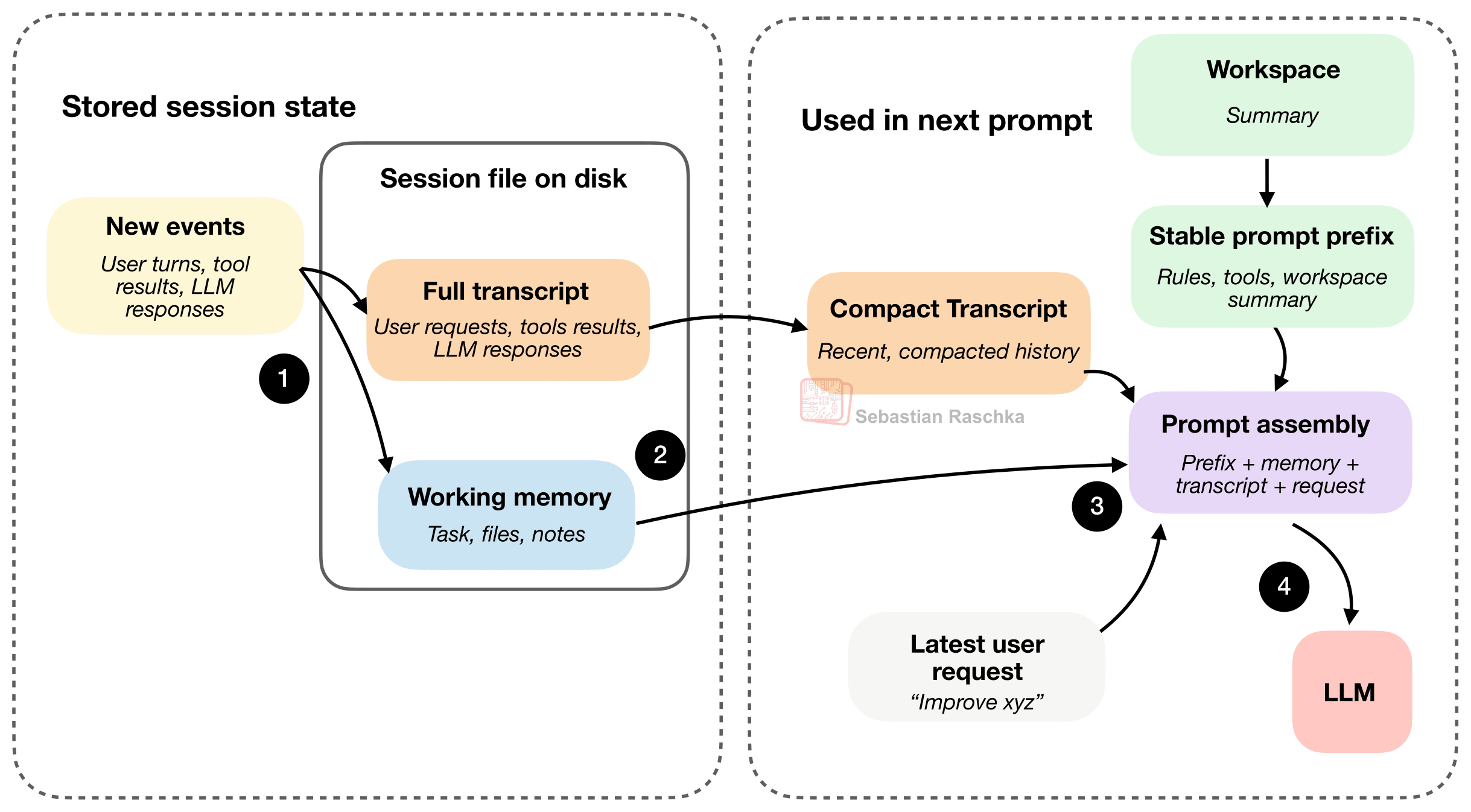
Figure 11: New events get appended to a full transcript and summarized in a working memory. The session files on disk are usually stored as JSON files.

The figure above illustrates the two main session files, the full transcript and the working memory, that usually get stored as JSON files on disk. As mentioned before, the full transcript stores the whole history, and it’s resumable if we close the agent. The working memory is more of a distilled version with the currently most important info, which is somewhat related to the compact transcript.

But the compact transcript and working memory have slightly different jobs. The compact transcript is for prompt reconstruction. Its job is to give the model a compressed view of recent history so it can continue the conversation without seeing the full transcript every turn. The working memory is more meant for task continuity. Its job is to keep a small, explicitly maintained summary of what matters across turns, things like the current task, important files, and recent notes.

Following step 4 in the figure above, the latest user request, together with the LLM response and tool output, would then be recorded as a “new event” in both the full transcript and working memory, in the next round, which is not shown to reduce clutter in the figure above.

6. Delegation With (Bounded) Subagents

Once an agent has tools and state, one of the next useful capabilities is delegation.

The reason is that it allows us to parallelize certain work into subtasks via subagents and speed up the main task. For example, the main agent may be in the middle of one task and still need a side answer, for example, which file defines a symbol, what a config says, or why a test is failing. It is useful to split that off into a bounded subtask instead of forcing one loop to carry every thread of work at once.

(In my mini coding agent, the implementation is simpler, and the child still runs synchronously, but the underlying idea is the same.)

A subagent is only useful if it inherits enough context to do real work. But if we don’t restrict it, we now have multiple agents duplicating work, touching the same files, or spawning more subagents, and so on.

So the tricky design problem is not just how to spawn a subagent but also how to bind one :).

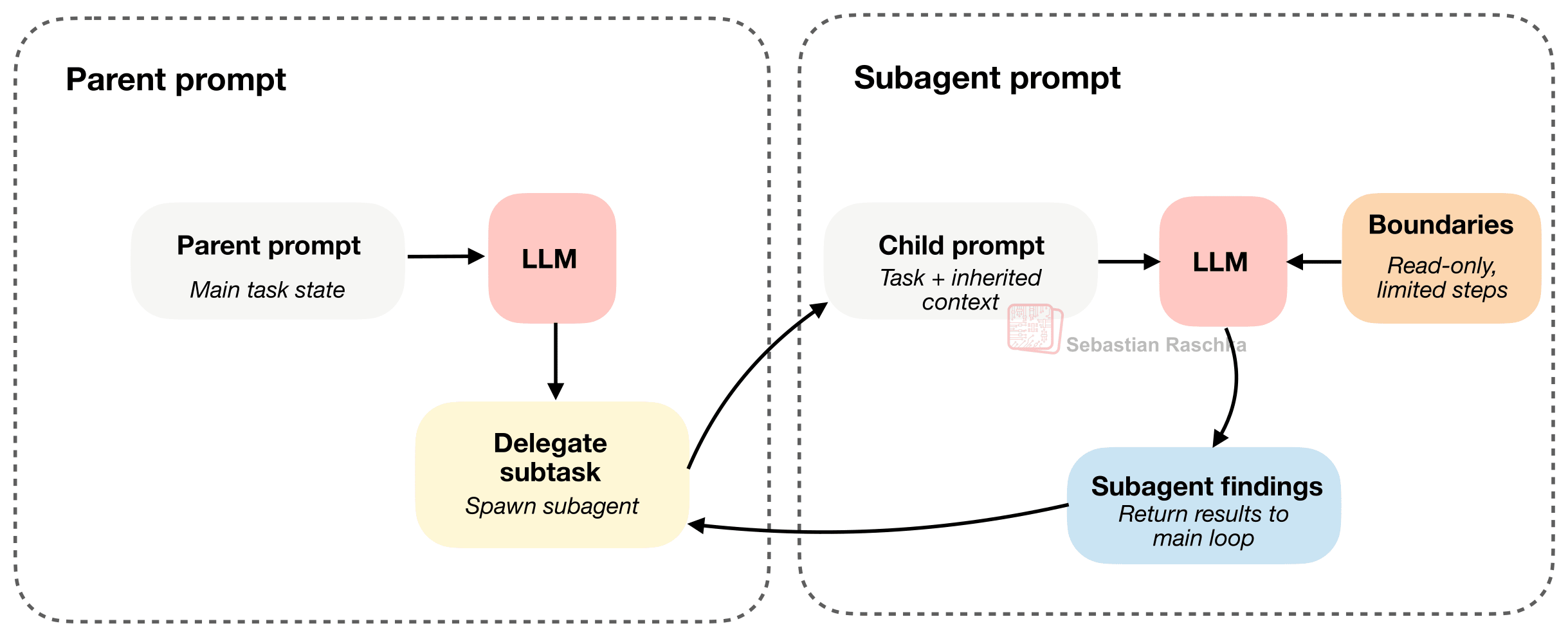
Figure 12: The subagent inherits enough context to be useful, but it runs inside tighter boundaries than the main agent.

The trick here is that the subagent inherits enough context to be useful, but also has it constrained (for example, read-only and restricted in recursion depth)

Claude Code has supported subagents for a long time, and Codex added them more recently. Codex does not generally force subagents into read-only mode. Instead, they usually inherit much of the main agent’s sandbox and approval setup. So, the boundary is more about task scoping, context, and depth.

Components Summary

The section above tried to cover the main components of coding agents. As mentioned before, they are more or less deeply intertwined in their implementation. However, I hope that covering them one by one helps with the overall mental model of how coding harnesses work, and why they can make the LLM more useful compared to simple multi-turn chats.

Figure 13: Six main features of a coding harness discussed in previous sections.

If you are interested in seeing these implemented in clean, minimalist Python code, you may like my Mini Coding Agent.

How Does This Compare To OpenClaw?

OpenClaw may be an interesting comparison, but it is not quite the same kind of system.

OpenClaw is more like a local, general agent platform that can also code, rather than being a specialized (terminal) coding assistant.

There are still several overlaps with a coding harness:

  • it uses prompt and instruction files in the workspace, such as AGENTS.md, SOUL.md, and TOOLS.md

  • it keeps JSONL session files and includes transcript compaction and session management

  • it can spawn helper sessions and subagents

  • etc.

However, as mentioned above, the emphasis is different. Coding agents are optimized for a person working in a repository and asking a coding assistant to inspect files, edit code, and run local tools efficiently. OpenClaw is more optimized for running many long-lived local agents across chats, channels, and workspaces, with coding as one important workload among several others.


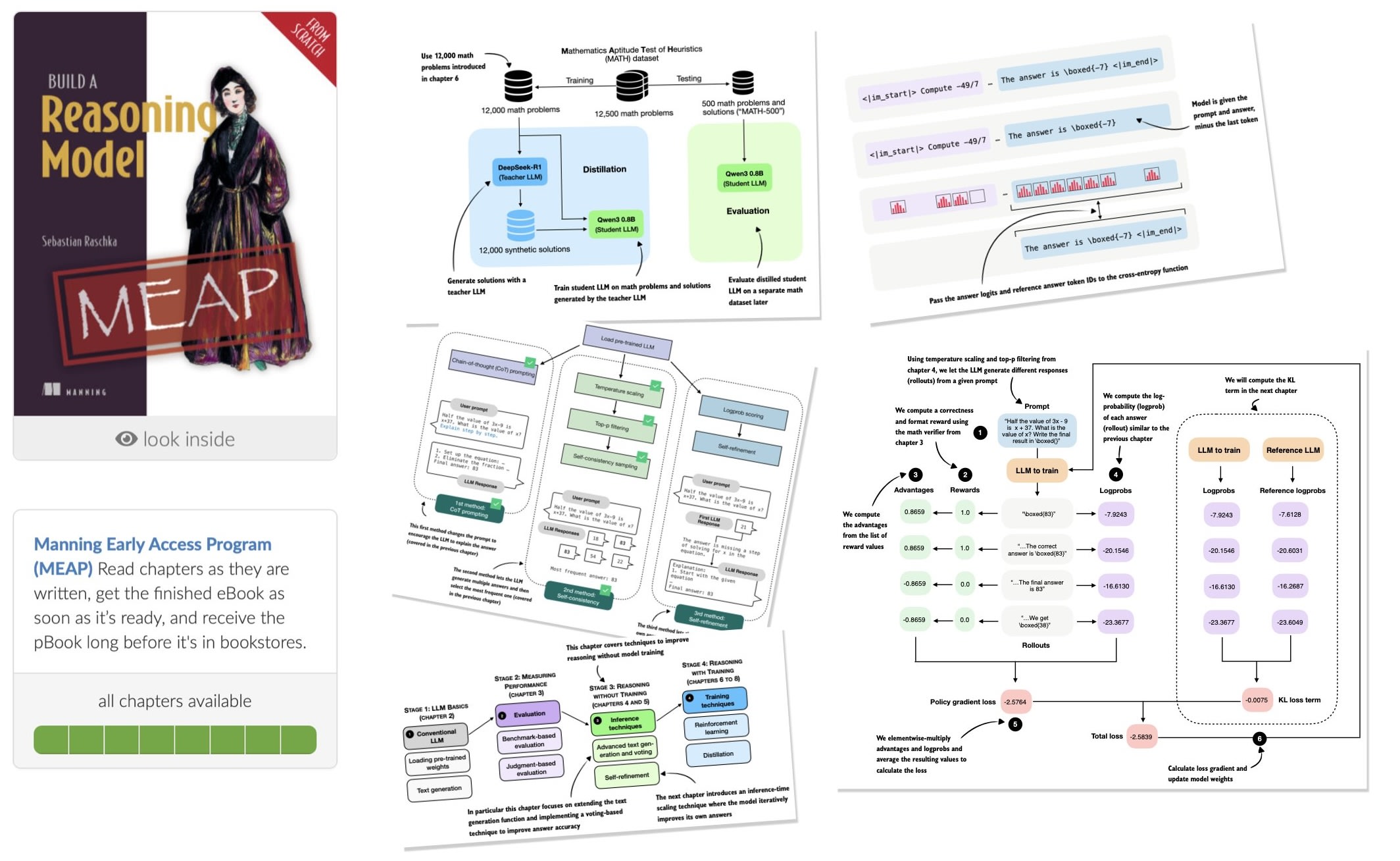
I am excited to share that I finished writing Build A Reasoning Model (From Scratch) and all chapters are in early access yet. The publisher is currently working on the layouts, and it should be available this summer.

This is probably my most ambitious book so far. I spent about 1.5 years writing it, and a large number of experiments went into it. It is also probably the book I worked hardest on in terms of time, effort, and polish, and I hope you’ll enjoy it.

Build a Reasoning Model (From Scratch) on Manning and Amazon.

The main topics are

  • evaluating reasoning models

  • inference-time scaling

  • self-refinement

  • reinforcement learning

  • distillation

There is a lot of discussion around “reasoning” in LLMs, and I think the best way to understand what it really means in the context of LLMs is to implement one from scratch!

Gemma 4 and what makes an open model succeed

3 April 2026 at 16:57

Having written a lot of model release blog posts, there’s something much harder about reviewing open models when they drop relative to closed models, especially in 2026. In recent years, there were so few open models, so when Llama 3 was released most people were still doing research on Llama 2 and super happy to get an update. When Qwen 3 was released, the Llama 4 fiasco had just gone down, and a whole research community was emerging to study RL on Qwen 2.5 — it was a no brainer to upgrade.

Today, when an open model releases, it’s competing with Qwen 3.5, Kimi K2.5, GLM 5, MiniMax M2.5, GPT-OSS, Arcee Large, Nemotron 3, Olmo 3, and others. The space is populated, but still feels full of hidden opportunity. The potential of open models feels like a dark matter, a potential we know is huge, but few clear recipes and examples for how to unlock it are out there. Agentic AI, OpenClaw, and everything brewing in that space is going to spur mass experimentation in open models to complement the likes of Claude and Codex, not replace them.

Especially with open models, the benchmarks at release are an extremely incomplete story. In some ways this is exciting, as new open models have a much higher variance and ability to surprise, but it also points at some structural reasons that make building businesses and great AI experiences around open models harder than the closed alternatives. When a new Claude Opus or GPT drops, spending a few hours with them in my agentic workflows is genuinely a good vibe test. For open models, putting them through this test is a category error.

Something else to be said about open models in the era of agents is that they get out of the debate of integration, harnesses, and tools and let us see close to the ground on what exactly is the ability of just a model. Of course, we can’t test some things like search abilities without some tool, but being able to measure exactly the pace of progress of the model alone is a welcome simplification to a systematically opaque AI space.

Share

The list of factors I’d use to assess a new open-weight model I’m considering investing in includes:

  1. Model performance (and size) — how this model performs on benchmarks I care about and how it compares to other models of a similar size.

  2. Country of origin — some businesses care deeply about provenance, and if a model was built in China or not.

  3. Model license — if a model needs legal approval for use, uptake will be slower at mid-sized and large companies.

  4. Tooling at release — many models release with half-broken, or at least substantially slower, implementations in popular software like vLLM, Transformers, SGLANG, etc due to pushing the envelope of architectures or tools.

  5. Model fine-tunability — how easy or hard it is to modify the given model to your use-case when you actually try and use it.

The core problem is that some of these are immediately available at release, e.g. general performance, license, origin, etc. but others such as tooling take day(s) to week(s) to stabilize, and others are open research questions — with no group systematically monitoring fine-tunability.

In the early era of open models, the days of Llama 2 or 3 and Qwen pre v3.5, the architectures were fairly simple and the models tended to work out of the box. Some of this was due to the extremely hard work of the Llama, Qwen, Mistral, etc. developer teams. Some is due to the new models being genuinely harder to work with. When it comes to something like Qwen 3.5 or Nemotron 3, with hybrid models (either gated delta net or mamba layers), the tooling is very rough at release. Things you would expect to “just work” often don’t.

I’ve been following this area closely since we released Olmo Hybrid with a similar architecture, and Qwen 3.5 is just starting to work well in the various open-source tools that need to all play nice together for RL research. That’s 1.5 months after the release date! This is just to start really investing more into understanding the behavior of the models. Of course, others started working on these models sooner by investing more engineering resources or relying on partially closed software. The fully open and distributed ecosystem takes a long time to get going on some new models.

All of this is lead-in for the most important question for open models — how easy is it to adapt to specific use-cases? This is a different problem for different model sizes. Large MoE open-weight models may be used by entities like Cursor who need complex capabilities in their domain, e.g. Composer 2 trained on Kimi K2.5. Other applications can be built on much smaller models, such as Chroma’s Context-1 model for agentic search, built on GPT-OSS 20B.

The question of “which models are fine-tunable” is largely background knowledge known by engineers across the industry. There should be a thriving research area here to support the open ecosystem model. The first step is to understand characteristics of different base and post-trained models to understand what they look like. The second step is to tune pretraining recipes for open models so they’re more flexible.

Interconnects AI is a reader-supported publication. Consider becoming a subscriber.

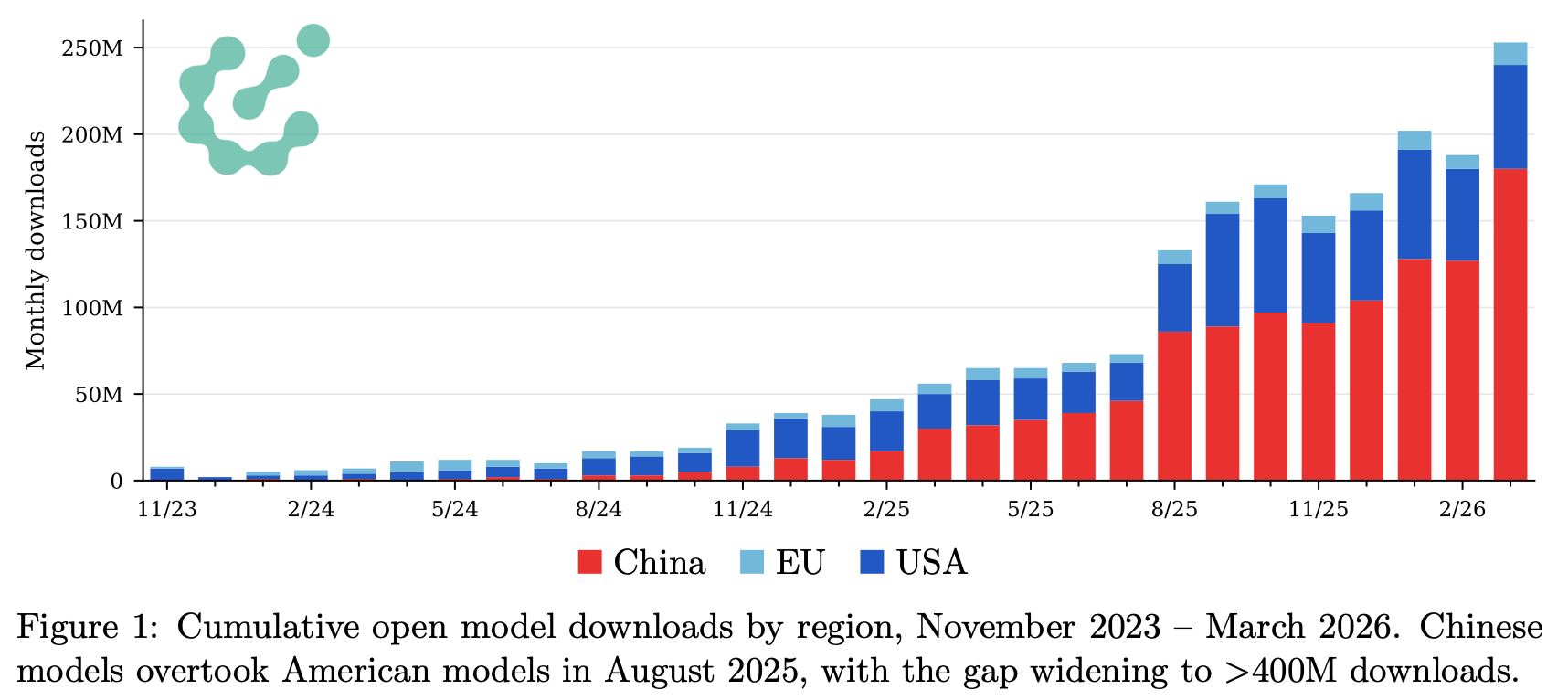
For The ATOM Project and other Interconnects endeavors, we’ve put in substantial effort to measuring adoption trends in the open ecosystem. Everything takes a long time to unfold after a model is first publicly available — and adaptability is why. What we know for sure now, when Qwen has been going from strength to strength with its releases, is that technical staff across the industry has gotten comfortable working with Qwen models. Countless research methods and datasets were made to work with Qwen. It’ll take patience for any other model family to get to this point — a patience I’m not sure many open model builders have.

This takes us to Gemma 4, Google’s latest open models. Gemma 3 was released more than a year ago, in March of 2025, and is a bit underrated. Gemma 4 comes in 4 sizes for now, with a bigger, MoE model of over 100B total parameters rumored but not released yet. The models we have today come in sizes of ~5B dense, 8B dense, 26B total 4B active MoE, and 31B dense.

I’m most excited that they’re finally adopting a standard Apache 2.0 open source license. This’ll massively boost adoption. The standard of better licenses for strong open-weight LLMs was set by mostly Chinese open model labs in the last 1-2 years, and now U.S. companies are following suit. I will personally be so happy if the horrible Llama licenses and Gemma terms of service were an ~18-month transient dynamic of the industry being nervous about releasing strong open models.

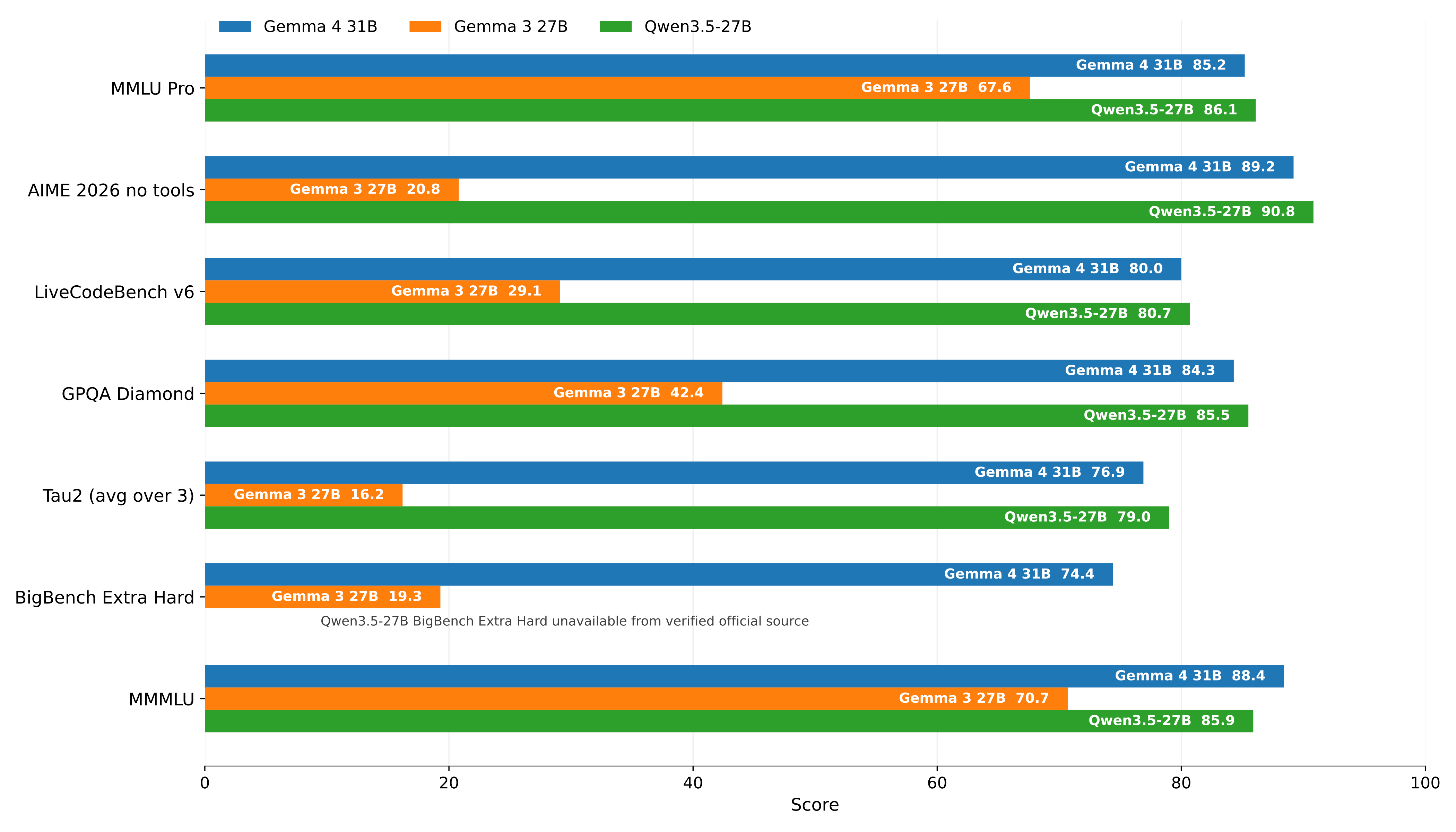
The Gemma 4 scores look very solid, the small models have incredible benchmark scores (especially in general domains like LMArena) and the 31B model rivals the recent Qwen 3.5 27B, which is the leading member of that class. The ~30B size range is an important one, as it’s accessible both to researchers and to enterprises looking to deploy the model in real use-cases. Where the 7B model scale is the default for tinkering and research, a 30B model is the default for seeing if an open model can unlock substantial value in your specific workflow — a good mix of intelligence, low price, tractability for downstream training, etc.

Source: Sebastian Raschka, Ahead of AI

This takes us back to the above adoption criteria I mentioned for open models and the bigger question — do I think Gemma 4 will be an overwhelming success? Previous Gemma models have been plagued by tooling issues and poorer performance when being finetuned.

Gemma 4’s success is going to be entirely determined by ease of use, to a point where a 5-10% swing on benchmarks wouldn’t matter at all. It’s strong enough, small enough, with the right license, and from the U.S., so many companies are going to slot it in.

I’m cautiously optimistic that Gemma 4 is going to work better here. Winds are shifting for open models built in America. We saw GPT-OSS go through a bumpy launch to become an overwhelming success. There’s a collective energy around the likes of Reflection, Arcee, Nemotron, Gemma, Olmo, and peers that show substantial demand for building new stacks around open models. There’s capital to be spent on AI stacks across the economy by those who want more ownership of everything, including the model.

After launching The ATOM Project 240 days ago, the conversation is shifting into the next stage. Summer of 2025 was a crisis moment where the U.S. AI scene realized it can’t wait and figure out open models after building AGI. The two markets will capture different areas and proceed in parallel. Now that more companies in the U.S. are releasing strong models, we need to improve the ecosystem so that these models are easy to use, understand, and build value around. It’s the hard work to build another inflection point in these adoption plots I’ve been updating consistently, but that’s the work to be done. Join me in it.

More data coming soon! Here’s a sneak peek:

❌