Discover how astrophysicist Chi-kwan Chan uses Codex to build black hole simulations, helping scientists study extreme physics and test Einstein’s theory of general relativity.
A new report from OpenAI details PRC-linked influence operations using AI to target U.S. tech debates, data center narratives, tariffs, and false claims about ChatGPT.
DiffusionGemma is an experimental text-generation model built on the Gemma 4 architecture that uses diffusion-based parallel generation instead of token-by-token autoregression, enabling much faster inference, bidirectional context awareness, and real-time self-correction while remaining deployable on consumer GPUs. Its architecture generates and refines 256-token blocks in parallel through iterative denoising, allowing it to handle complex constraint-based tasks such as Sudoku more effectively than traditional language models and demonstrating strong gains from fine-tuning. The model integrates with vLLM and other popular inference frameworks, giving developers access to a new non-autoregressive approach that combines high performance, efficient long-context scaling, and straightforward customization and deployment.
Developers building real-time AI—such as chat assistants, copilots, and agentic workflows—are often constrained by token-by-token generation speed. This...
Developers building real-time AI—such as chat assistants, copilots, and agentic workflows—are often constrained by token-by-token generation speed. This limits responsiveness, increases serving costs, and makes fluid, interactive experiences difficult to achieve. DiffusionGemma, created by Google DeepMind and optimized to run efficiently across NVIDIA platforms, introduces a new approach to…
Today we announced the general availability of the new M9g and M9gd instances of Amazon Web Services’ (AWS’s) Elastic Compute Cloud (EC2), the first instance types powered by Graviton5, the latest generation of our general-purpose CPU. Graviton5 doubles the number of cores from the previous generation, from 96 to 192. They’re also the first instance types to use the new Nitro Isolation Engine, a component of the Nitro Hypervisor whose sole job is isolating virtual machines (VMs) from each other. In this post, we explain how we used the Isabelle/HOL (higher-order logic) proof assistant — software that mechanically checks reasoning steps for adherence to the laws of logic — to prove that the Nitro Isolation Engine behaves correctly and enforces isolation between virtual machines. The Nitro Isolation Engine is the critical component of the first formally verified hypervisor to be deployed in a commercial cloud environment. Our Isabelle/HOL model and proof comprise 330,000 lines of machine-checked mathematics. It’s comparable in scale to seL4, the landmark project that first demonstrated that realistic operating-system verification was feasible and was an inspiration for our own work. However, unlike seL4, the Nitro Isolation Engine is designed for a commercial cloud environment and ships on production hardware as an always-on feature for Graviton5 users. Our talk at Amazon’s 2025 re:Invent conference introduces our formal-verification methodology, and our white paper is a more detailed discussion covering important aspects of the results, such as scope and assumptions. This blog post gives an informal overview of the main aspects of our formal-verification work and how they fit together. What is a separation kernel? John Rushby coined the term “separation kernel” in 1981 to describe a minimal OS component that partitions a system into isolated compartments. The key idea: separate policy from mechanism. A separation kernel does not decide what to isolate, how to allocate resources, or which VMs to schedule: those decisions are made elsewhere. Instead, it focuses solely on enforcing isolation, and this clarity of purpose makes separation kernels much simpler to implement than full OS kernels. Since its introduction in 2017, the Nitro Hypervisor has been responsible for enforcing isolation in EC2, but it also handles business logic, device drivers, and AWS-specific features. That complexity makes proving correctness much more difficult. Moreover, the Nitro Hypervisor was not designed for verification from the start. Distilling the hypervisor’s critical isolation logic into a minimal component, the Nitro Isolation Engine, makes it small enough to verify and audit, giving customers unprecedented visibility into how isolation is enforced. We also wrote the Nitro Isolation Engine in Rust, a language that lends itself more naturally to formal verification. The Nitro Hypervisor still handles policy — VM creation, resource allocation, migration, scheduling — but it is now deprivileged and must ask the Nitro Isolation Engine to perform any operation touching guest state. The Nitro Isolation Engine checks every request before acting. Specifications and proofs The two key parts of our work are specifications and proofs. Formal specifications precisely capture the expected behavior of the system, and proofs establish that the implementation meets those specifications. Our theorems about the Nitro Isolation Engine address four types of properties: Confidentiality and integrity. Only authorized information flows can occur. For example, guest memory allocations are always scrubbed before reuse. Functional correctness. The implementation behaves exactly as specified. Absence of runtime errors. There are no runtime errors such as unwraps of None option values in Rust — an erroneous command invocation that will stop program execution. Memory safety. There are no issues such as buffer overflows and NULL pointer dereferences. In practice, we handle the last three properties collectively, as a functional-verification result, with confidentiality and integrity treated separately, because we use different proof techniques for each. Functional verification For functional verification, the key parts are a formalization of a core subset of the Rust language, called μRust (“micro Rust”); an expressive specification language using Separation Logic for precisely capturing specifications; and a verification technique, weakest-precondition calculus, with custom proof automation for proving a program correct with respect to its specification. Each of these is part of a general-purpose proof infrastructure that we open-sourced in 2025 as the AutoCorrode library. In more detail, μRust is a restricted subset of the Rust programming language that is expressive enough to write the Nitro Isolation Engine but amenable to formal reasoning because we deliberately excluded advanced Rust features, such as traits and dynamic dispatch. The formal semantics of μRust is defined as a shallow embedding in Isabelle/HOL, which means that the meaning of μRust is defined in terms of higher-order logic, the “host language” of Isabelle/HOL. The specification for a μRust program is defined as a contract with pre- and postconditions, which are assertions about the system state before and after executing the program. Our contracts specify “total correctness”, which means that in all states that satisfy the precondition, the program always terminates, and the resulting state satisfies the postcondition. This total-correctness condition also means the program is memory safe and free of runtime errors. Our specifications are written using Separation Logic, a logic designed to reason about low-level pointer-manipulating programs. Despite the relative simplicity of separation kernels, with the verification of the Nitro Isolation Engine we are still operating on the edge of what is possible with formal verification, and both our specifications and proofs grow very large. For example, the following specification captures what happens when an executing guest virtual CPU tries to turn itself on (an erroneous request): While the specification above is complex, what it captures is intuitively straightforward: in this circumstance, the Nitro Isolation Engine sees that, to act as the caller, the virtual CPU must be turned on already, and it therefore returns a defined error code, AlreadyOn. Everything else about the system state remains unchanged. The complexity in the specification is a reflection of the depth of our modeling and the fact that several other error checks must already have been performed for us to have reached this point in the implementation of the Nitro Isolation Engine. To prove a μRust program correct with respect to its specification, we use a standard weakest-precondition calculus. A weakest-precondition calculus is a systematic way to identify the least restrictive constraint that can ensure that the state of a program after a particular operation is not outside some specified range of states. For example, the weakest precondition of the expression "x + y" is the state in which the values of x and y cannot overflow the addition. The proof obligation then is to show that the contract’s precondition entails the computed weakest precondition. Confidentiality and integrity For confidentiality and integrity, the first key part is a high-level specification that captures the behavior of the Nitro Isolation Engine as a transition relation, where each “high-level” step of the system (e.g., hypercall) is an atomic transition. This specification is rigorously connected to the more concrete Separation Logic specification used in our functional-verification results, which uses another proof idea called Refinement. The second key part is the idea of noninterference. Noninterference is the idea of indistinguishability preservation that we use to make confidentiality and integrity mathematically precise. The idea is that if two states are indistinguishable to an observer before a step, they must remain indistinguishable afterward. The intuitive reason why this captures confidentiality is that the observer has learned nothing new because of the step. Understanding why indistinguishability preservation guarantees confidentiality is subtle. Consider two simple machines, A and B, each with one public and one private register. An observer considers them indistinguishable if their public registers match: the private register is hidden. In the following diagram, A and B are indistinguishable: Now consider what happens if we execute a program that branches on the private register to assign 1 to the public register. The resulting machines A' and B' now have different public registers — they're distinguishable! A clever observer could use this to deduce the original private values, and this failure to preserve indistinguishability corresponds to illicit information flow to the observers. And more to come We hope you’ve enjoyed this overview of the main pieces of our verification work. There are many other aspects to our work, such as conformance testing and how we handle reasoning about concurrent code, that we’re excited to share in future posts.
AWS Graviton processors have improved steadily across generations, with each iteration delivering advances in computational performance, price performance, energy efficiency, and memory capacity. Today, Amazon announced the general availability of the new M9g and M9gd instances of its Elastic Compute Cloud (EC2), for general-purpose workloads. These are the first Amazon products powered by Graviton5, the latest generation of Amazon’s CPU. After five generations of custom silicon and eight years of continuous investment, Graviton powers over 350 instance types that are suitable for workloads including web applications, microservices, analytics, databases, machine learning inference, electronic design automation, gaming, video encoding, and agentic AI. Graviton5 doubles the number of cores from Graviton4, from 96 to 192, and it supports DDR5-8800 memory and the latest PCIe gen6 interconnects. We’ve worked closely with leading DRAM manufactures to meet the DDR5-8800 level of performance, and AWS Graviton instances deliver the fastest memory of any processor instances in the cloud. With Graviton5, Amazon also moved to a three-nanometer process, enabling greater circuit density and faster on-chip communication. Not only does Graviton5 pack in more cores than Graviton4, but each of those cores offers 25% better performance. We've talked for a while about how micro benchmarks are very different from big, real-life workloads, and we design for our customers’ actual workloads — not small loops but all the code and complexity of a real application like a database. To execute code quickly, modern processors predict branches that come from control flow in programs and speculatively execute the predicted paths. The Neoverse V3 core used in Graviton5, codefined by Arm and Amazon’s Annapurna Labs, substantially improves the branch prediction capability of the CPU, and that in turn makes it able to execute real applications like databases up to 30% better. The DRAM of a CPU can be about 100 nanoseconds away. That doesn’t sound like a lot, but for a CPU that runs at 3.3 gigahertz, one memory access takes 330 cycles. CPUs use caches to bring data closer to the CPU, and when a request can be fulfilled from one of these caches, the CPU doesn’t have to wait for the full DRAM latency. Graviton5 has 64-kilobyte first-level caches, two-megabyte second-level caches, and 192 megabytes of level-three cache — more than five times as much as the previous generation of Graviton. Graviton3 was the first Graviton CPU to adopt a chiplet architecture, using seven dies across cores, DRAM controllers, and PCIe controllers. Graviton4 followed the same architecture as Graviton3, with a few refinements. However, in Graviton5, we’ve changed it substantially: the 192 cores in Graviton5 are split across four chiplets, with each chiplet containing DRAM controllers, PCIe controllers, and 48 cores, with custom die-to-die connectivity that provides up to 420 gigabytes per second of bandwidth between chiplets, minimizing latencies between cores in the mesh. There is no longer a separate I/O die nor a separate DRAM controller die. This organization allows us to configure two or four nonuniform-memory-access (NUMA) regions per chip and partition the size of the L3 cache to the size of the virtual machines (VMs) running on the CPU while reducing memory latency for VMs that are 48 cores or smaller. With these enhancements, Graviton5 offers up to 25% better computational performance than Graviton4-based instances, with up to 35% faster performance for web applications, up to 35% for machine learning inference, and up to 30% for databases. The M9g and M9gd instances that are powered by Graviton5 are also raising the bar on security even further with the introduction of the Nitro Isolation Engine. The Nitro Isolation Engine is an enhancement to the Nitro System, which enforces isolation of instances and harnesses formal verification to provide assurances of isolation with mathematical precision. The Nitro Isolation Engine is a purpose-built component that is responsible for enforcing isolation between VMs, including mediation of all access to VM memory, CPU register state, and I/O devices through a minimal set of APIs. The Nitro Isolation Engine leverages formal verification, a technique for mathematically demonstrating that hardware or software behaves as intended, and not just in specific test cases. This intensive verification establishes Nitro as the first formally verified cloud hypervisor, pioneering a new standard for mathematically proven cloud security. To learn more about the Nitro Isolation Engine, read the Amazon Science blog post or our technical white paper.
AI factories are changing what data-center infrastructure must do. Unlike traditional data centers, AI factories are built to manufacture intelligence at scale....
AI factories are changing what data-center infrastructure must do. Unlike traditional data centers, AI factories are built to manufacture intelligence at scale. They run power-dense training and inference workloads, increasingly support agentic and reasoning models, and must deliver predictable performance even as compute demand shifts rapidly. In this environment…
See how LSEG uses OpenAI to scale trusted AI across its global business, accelerating insights, shrinking release cycles, and empowering 4,000 employees.
Edit Jun. 11: Anthropic changed their silent model manipulation of AI research queries to also use a classifier like the other safety domains. This addresses a key concern I had in the mistreatment of “safety” in the release, and props to Anthropic for a quick change, but it does not fully address the trust that has been broken. I shared more reflections here.
Today, Anthropic released their Claude Fable 5 model to consumer and enterprise audiences. This is the general-access variant of their Mythos-class models. With it, Anthropic rolled out a series of safety measures — some explicitly called out to users and some modifying the model without telling the user. It should be less surprising than it is that the next major step in AI capabilities came with heavier-handed safety measures indicating Anthropic’s intention to protect, or entrench, their current lead.
The unevenly applied safety policies that Anthropic have rolled out are on track to become a classic cautionary fable in how narrow and self-fulfilling notions of safety and control rarely work out.
Before digging into the nuance of the safety facts, it is important to establish the quality of this model. The quality of the model paints the stakes of today — as these safety features are meaningfully changing the shape of access to frontier AI, something which has never happened with the modern LLMs we know. Second, the capabilities point to this story only accelerating. Recursive self-improvement isn’t quite the right mental model of progress from here, but Claude Fable 5 should make it very clear that there are no immediate walls in training LLMs.
To start — Claude Fable 5 is definitely the smartest model available to the general public — a remarkable leap on pretty much every relevant benchmark of the day — at only 2X the price of current Opus models1 (which is still less than GPT 5.5 Pro’s variant). This alone is a seminal moment for the field. To have a model iteration take such a substantial step in capabilities, a few years into the post-ChatGPT LLM race, is astounding. There’s no clear breakthrough associated with this model, such as inference-time scaling or RL, and public wisdom is that this is achieved by advances across the whole stack (of course, we can’t know for sure — it’s not documented). This is a major technical achievement and the employees who built the model should be very proud of their work.
This model was delayed 2+ months after it was done training before it was publicly available2. Given the competitive dynamics of the AI economy, the smarter version of this model is already well underway.
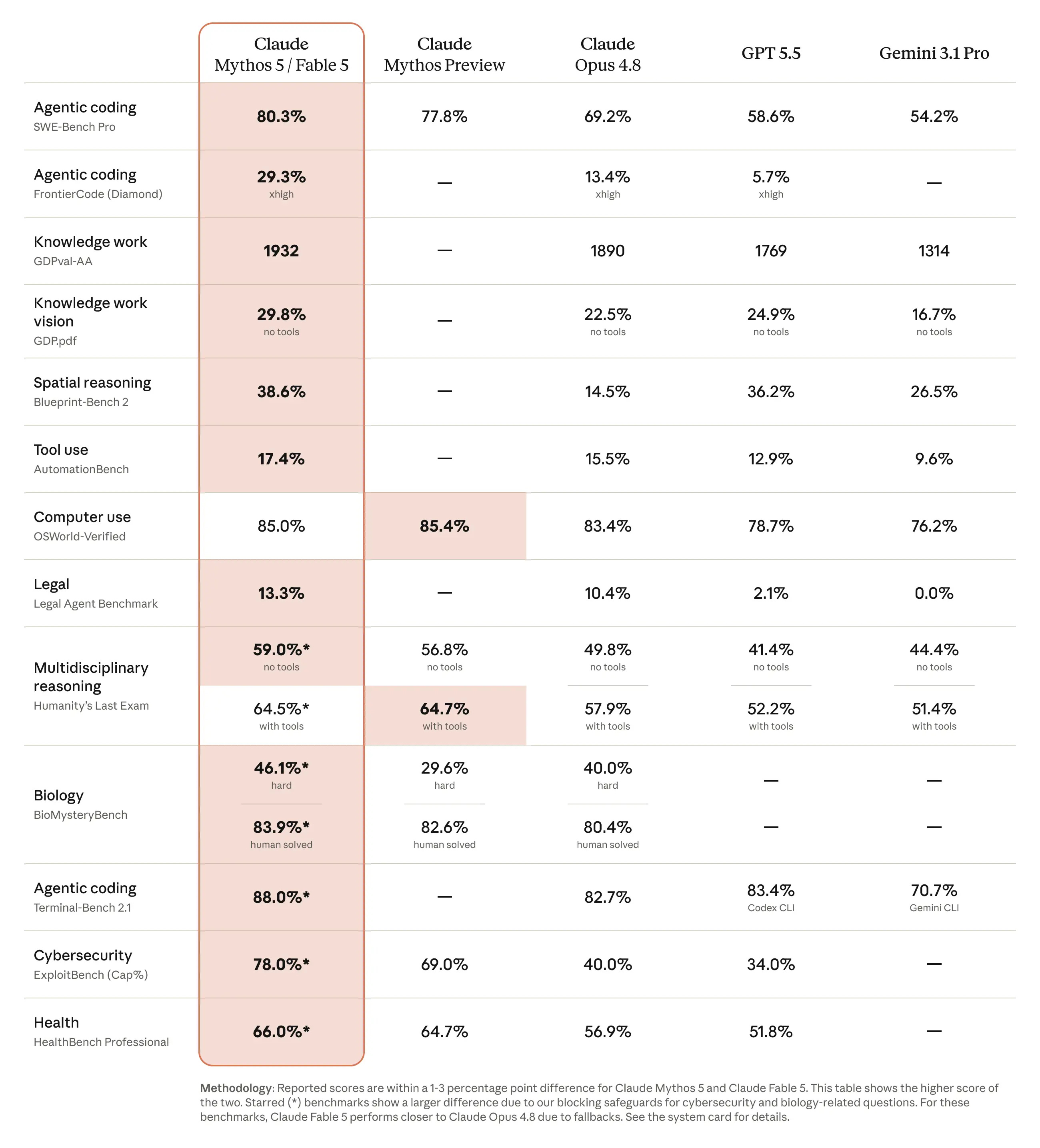
To continue, the benchmarks for the model are below.
An asterisk on these scores is that these aren’t necessarily the scores that the public will get, as some of the prompts will be downgraded to Opus 4.8 with the current safety filters on the model.
This is the type of jump in benchmark scores where I don’t even need to substantially test the model to know it’s an incredible tool. Remember that Anthropic is also the AI lab with the track record of caring the least about benchmarks (in particular, when compared to OpenAI and Gemini). Recall a comment I made in June of 2025:
This is a different path for the industry and will take a different form of messaging than we’re used to. More releases are going to look like Anthropic’s Claude 4, where the benchmark gains are minor and the real world gains are a big step. There are plenty of more implications for policy, evaluation, and transparency that come with this. It is going to take much more nuance to understand if the pace of progress is continuing, especially as critics of AI are going to seize the opportunity of evaluations flatlining to say that AI is no longer working.
Clearly, a few pieces of the progress dynamics have changed, but that’s a post for another day. I’ve written multipleposts about new models this year specifically in how it’s hard to trust benchmarks (and partially because the benchmarks don’t move that much). Altogether, this is a major validation for AI-savvy workers who realized they’re likely never going to write meaningful code again and need to develop new workflows around agents.
Interconnects AI is a reader-supported publication. Consider becoming a subscriber.
Smarter models spawn new safety games
There are multiple pieces of safety tooling associated with this release, including but not limited to required data-retention policies and added prompt filters. Through this analysis it is particularly important to be precise and clear as to which pieces of these are causing harm, and why single elements being out of place in an otherwise comprehensive policy are so damning for the overall safety process.
For their focus areas of cybersecurity, targeted model distillation, and research biology, Anthropic details new safety classifiers in their blog post:
Fable 5 comes with a new set of classifiers: separate AI systems that detect potential misuse, including jailbreak attempts, and prevent the main model (in this case Fable 5) from responding. We’ve been running classifiers on our models for some time, and Fable 5’s classifiers are an extension of this previous work with extra coverage.
When Fable’s classifiers detect a request related to cybersecurity, biology and chemistry, or distillation, the response is automatically handled by Claude Opus 4.8 instead. Users will be informed whenever this occurs. Opus 4.8 is a highly capable model in its own right: a response that falls back to Opus is a far better experience than an outright refusal from Fable. Our early data shows that more than 95% of Fable sessions involve no fallback at all—for those sessions, Fable 5’s performance is effectively the same as that of Mythos 5.
Examples of the primary cybersecurity and biology safety filters — which tell the users explicitly when they’re triggered — are alreadyproliferatingonline and appear quite sensitive. These can be a frustrating experience for users, but Anthropic is definitely within its power to do this and intellectually consistent for doing so.
The damaging part of the safety story falls under the fold in the Claude Fable 5 & Claude Mythos 5 System Card:
We have also added safeguards related to frontier LLM development. As discussed in Section 6.1 of our February 2026 Risk Report, we are concerned about the risks of accelerating the overall pace of AI development, though we remain uncertain about the severity of these risks. In particular, our concern is with—as we wrote then—“accelerating other AI developers in building powerful AI systems that pose similar risks to the ones ours pose - without necessarily having commensurate safeguards.”
In light of the ability of recent models to accelerate their own development, we’ve implemented new interventions that limit Claude’s effectiveness for requests targeting frontier LLM development (for example, on building pretraining pipelines, distributed training infrastructure, or ML accelerator design). Using Claude to develop competing models already violates our Terms of Service, but enforcing this restriction through our safeguards avoids accelerating the actors most willing to violate these terms.
Unlike our interventions for cybersecurity, biology and chemistry, and distillation attempts, these safeguards will not be visible to the user. Fable 5 will not fall back to a different model. Instead, the safeguards will limit effectiveness through methods such as prompt modification, steering vectors, or parameter-efficient fine-tuning (PEFT).
Anthropic documents on how this will impact a small percentage of users, which is true. I focus on the small amount of users supporting AI’s diffusion and understanding outside of the few frontier labs, as a crucial mechanism for the continued safety of the technology.
Anthropic is documenting how the proliferation of AI capabilities is a concern to them, but they are solving it by misleading their users. An AI model that gets less intelligent automatically without notifying me is categorically misaligned AI. The next step on this line — not that Anthropic did it, but they could — is to have a model silently manipulate a workplace when it thinks it is an unsafe use for AI. Second, the implementation here is more complicated than was documented for cybersecurity or biology — modifying the model itself or the data presented to it, all without notifying the user.3
The duality of these policies is extremely confusing and paints a strong inconsistency that casts doubt over their safety policies. This “safety” measure is presented as being far more about maintaining their competitive position. Again, if all of the safety policies took one form, this would be far more cogent and easier to support intellectually.
Anthropic has been very vocal about their concern over distillation attacks from particularly Chinese actors. Their claims are not transparent enough with the facts — or context as to why they can’t prevent the behavior — to be fully believable. Despite the limited information, in the broader AI and DC communities, there have been serious discussions about taking action against the Chinese model builders on the grounds of said distillation.
On the point of distillation, my hypothesis is that API builders don’t have an easy time preventing hacks or jailbreaking because it’s a deeply grounded property of reasoning models to want to output the reasoning traces, and it would make the model far less intelligent to fully patch the behavior. This is based on a few assumptions:
Chinese labs are not just showing up as customers to Anthropic’s API and paying for tokens in the intended input-output form. If the Chinese labs are paying for intended use behaviors, despite being banned by the terms and conditions, I don’t have a lot of sympathy for the frontier labs manifesting policy actions against this.
Reasoning traces are disproportionately effective at seeding behavior in downstream models.
Leading labs work very hard to patch the pipeline of these jailbreaks.
So, my logical conclusion is that the model companies would have to weaken their economic position to fully protect their IP. If this is the case, Anthropic would get a lot more sympathy from the AI research community by being transparent. It would also be far easier to have informed policy discussions, and not rely on me proposing Occam’s razor explanations for what the API jailbreaking looks like.
Building these safeguards is not something that Anthropic should do alone. Safety research should be built on common understanding and information sharing across both labs and public research efforts.
If the exact safety procedures were actually the top line item to the company — a true non-negotiable for the leadership — they wouldn’t permit the model to be released with an unclearly implemented safety filter in one of their areas of focus (frontier AI training). I am asking — why isn’t there a classifier to downgrade AI research requests? This is a mix of transparent and reasonable safety policies with quietly rolled-out market entrenchment tactics.
I personally cannot trust the best AI model in the world to work in my professional domains building models, which I’ve constructed entirely out of a passion for making sure the transition to very powerful AI systems goes well for society. This inevitably will feel like a declaration of superiority by the Anthropic leadership.
The control problem and open-source as the only answer
All of the actions Anthropic is taking, including calling out smaller Chinese companies for distillation, is well within their right. In fact, many people already expected the leading frontier models to be obviated from users so that labs can protect their IP. Today’s actions miss the big picture that AI will always be an ecosystem, and cultivating an us against them dynamic between the leading company and the other players is structurally unstable.
Remember, this is at a time when the AI ecosystem is seeing the first stirrings of violence against AI leaders — and I’ve heard from many people that they don’t expect it to abate. I wish I knew how to engage more to prevent this, and I see myself in the non-profit sector as someone who can hopefully independently represent AI to broader stakeholders.
I believe there was something misread, or at least misunderstood here, by the Anthropic leadership having a narrowly cultivated worldview around AI. An overwhelming sentiment I had today was one of obligation and confusion. I shared how I don’t really want to have to go to bat against Anthropic, but they’ve just been unnecessarily antagonistic to China, then not so subtly to open weight models, and now more broadly to open AI research.
I understand that Anthropic has a specific view of AI, but such a powerful technology will never have its final equilibrium be one of singular control by a private company. Anthropic showcased this earlier this year in the spat between the Department of Defense and themselves — which points to a long-term equilibrium where the government will either want AI to be controlled by them or to be open. This made me believe that an open ecosystem is a far safer outcome.
Many of these events make me feel that Anthropic’s leadership has a culture by which they can’t help but speedrun through these issues — going head to head with existing power structures. This adds substantial uncertainty into an AI ecosystem at a time when it is very much not needed.
Collectively, the last week could be seen as a major rallying point for a new open-source ecosystem in the U.S. Nvidia released their first flagship model last week — Nemotron 3 Ultra — and these actions from Anthropic have galvanized a unanimous motivation and concern among my peers building open models. We need intelligence that we can trust, that we can modify, and that we can control.
The American open-source ecosystem has its feet underneath it and keeps being given more reasons to fight for its leadership, right from the hands of the companies it directly undercuts. That’s the moral of this fable.

 Login
Login