❌

Normal view

🔬Bio-security is an AI Arms Race - Eric Nguyen (CEO, Radical Numerics)

23 September 2026 at 13:27

The OpenAI → Hugging Face attack has people asking “what else do we need to worry about?” and Anthropic’s filters flag two things: cyber-security and biology. The natural question is: what about bio-security, then?

Clem Delangue argues that cyber-warfare defensive capabilities need to be open and to keep pace with frontier models’ attack capabilities

Radical Numerics co-founder Eric Nguyen sat down with us and explained why the same models that increase biological capability can also keep defense from falling behind.

Building a virus from scratch

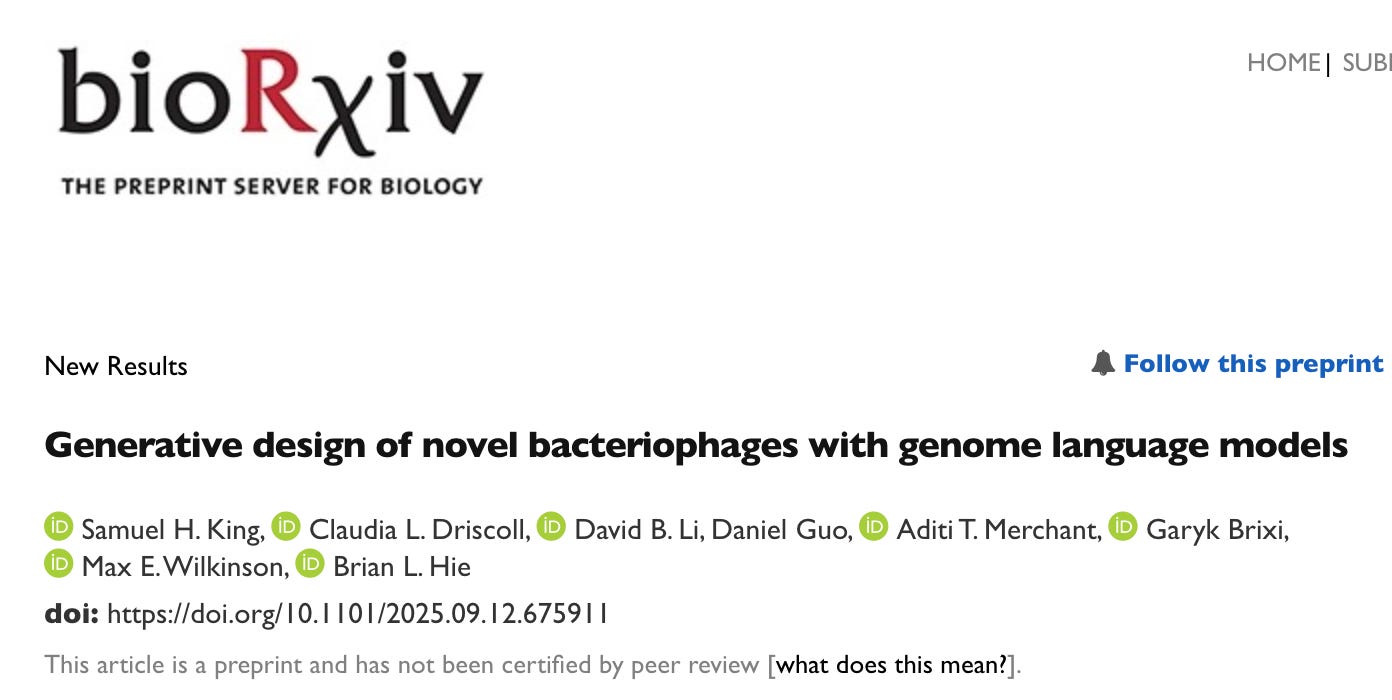
While he was at Stanford, Eric couldn’t get traction on Genomic Language Models (GLMs) for a long time. Biologists didn’t believe it would work, didn’t think they could verify the output, and didn’t see important applications beyond what they could already do. He kept pushing, eventually helping lead the development of Evo and contributing to Evo 2 at Arc Institute. Those models were later used by a separate Arc/Stanford team to generate entire bacteriophage genomes that were synthesized into functional viruses!
Long context unlocks biological intelligence

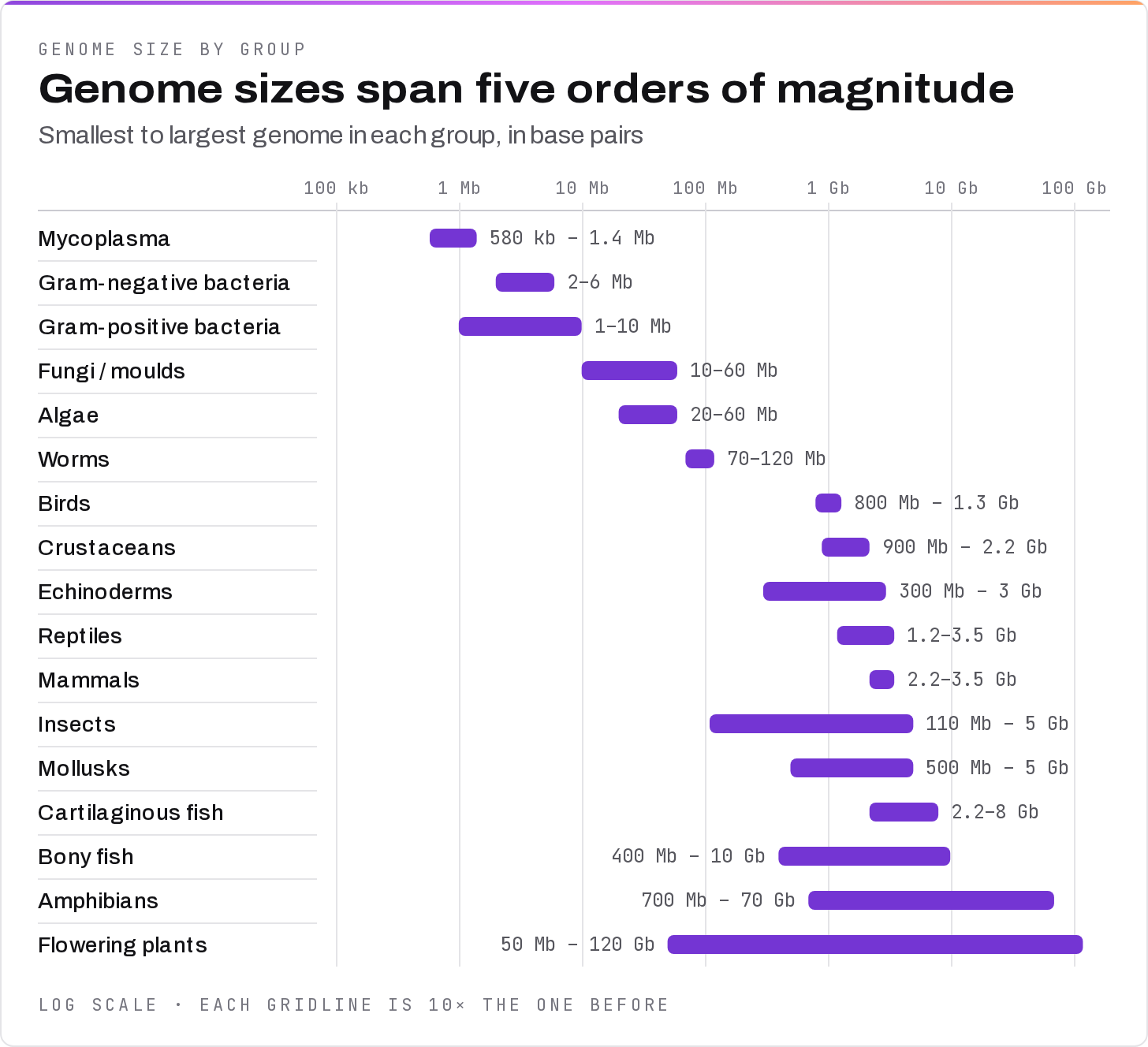
Early ChatGPT spit out poems and email, and early DNA language models like Evo and Evo-2 could build a genome from scratch. DNA is different, however, from natural language in that it has a very small alphabet (4 characters ACTG) and that its sequences are very long:

  • 60K for an average human gene

  • long being up to 2.3M

  • the whole human genome around 3B.

Innovation in long-context models made this possible about 3 years ago (footnote: striped hyena), long before the frontier labs were building 1M+ context models.
Now Eric and other AI x Bio luminaries1 have founded Radical Numerics to build and scale GLMs to tack a wide range of biological problems, extending well beyond generating DNA.

Thinking in DNA

Their GLMs already do pretty well with RNA and protein because there are clear markers in the DNA sequence for genes (RNA sequences the perform many functions) and specific genes that encode proteins. This means that the models already generalize to multiple “languages,” before even attempting to train in other modalities, such as 3d protein structure, epigenetics and natural language.

If a model thinks in the DNA language, maybe it understands the imprint that environment left on different genomes as well? Perhaps the model has learned the functional relationship between different sequences, and could extrapolate to new sequences based on that?

And so what we wanted to showcase was that if we show the model progressively better RNAs in a series of steps with its score, right? So you have like low scores first and then you gradually move up the chain. Can the model continue that trajectory on its own? And then in the final step, does it self optimize to a point where it's like the best score it can get? That was the experiment. Can we do that? And so we took a data set, a large data set of aptamers. We held out a portion of the best performing ones and we showed it only the lower ones, but then we ranked it, right? So we showcase lower scores with the RNA aptamers and then progressively got higher, and then ask the model to just like continue with that pattern. And it turns out it was able to recapitulate some of those higher scores that we had not shown it yet.

So, voila: chain-of-thought, thinking in DNA!

The arms race

But much as long-context inference, chain-of-though and multi-modal perception unlocked sophisticated reasoning in natural language LLMs, these capabilities in GLMs are enabling increasingly sophisticated “biological intelligence,” and along with it, greater danger.

According to Eric, defense is currently losing this battle, but Radical Numerics argues to push the frontier harder!

I won’t spoil the details for you. In the episode we talk in detail about:

  • Biosecurity as an arms race — and how defense can keep up

  • The genome as the imprint of the environment on DNA

  • Going truly multi-modal

  • How chain-of-though works when you “think” in the language of DNA

1

Eric Nguyen: Co-founder and CEO, holding a PhD in Bioengineering & AI from Stanford University. He previously helped develop large-scale genome language models like Evo and Evo 2
Michael Poli: Chief AI Scientist, holding a Stanford PhD and a former founding scientist at Liquid AI.
Stefano Massaroli: President, a former postdoc with Yoshua Bengio and a founding team member at Liquid AI.
Armin W. Thomas: CTO, a former Stanford postdoc who worked with Chris Ré and was previously at Liquid AI.
💾

🔬The BioAI Phase Shift - Matthew McPartlon & Neil Patil, Chai Discovery

11 August 2026 at 21:03

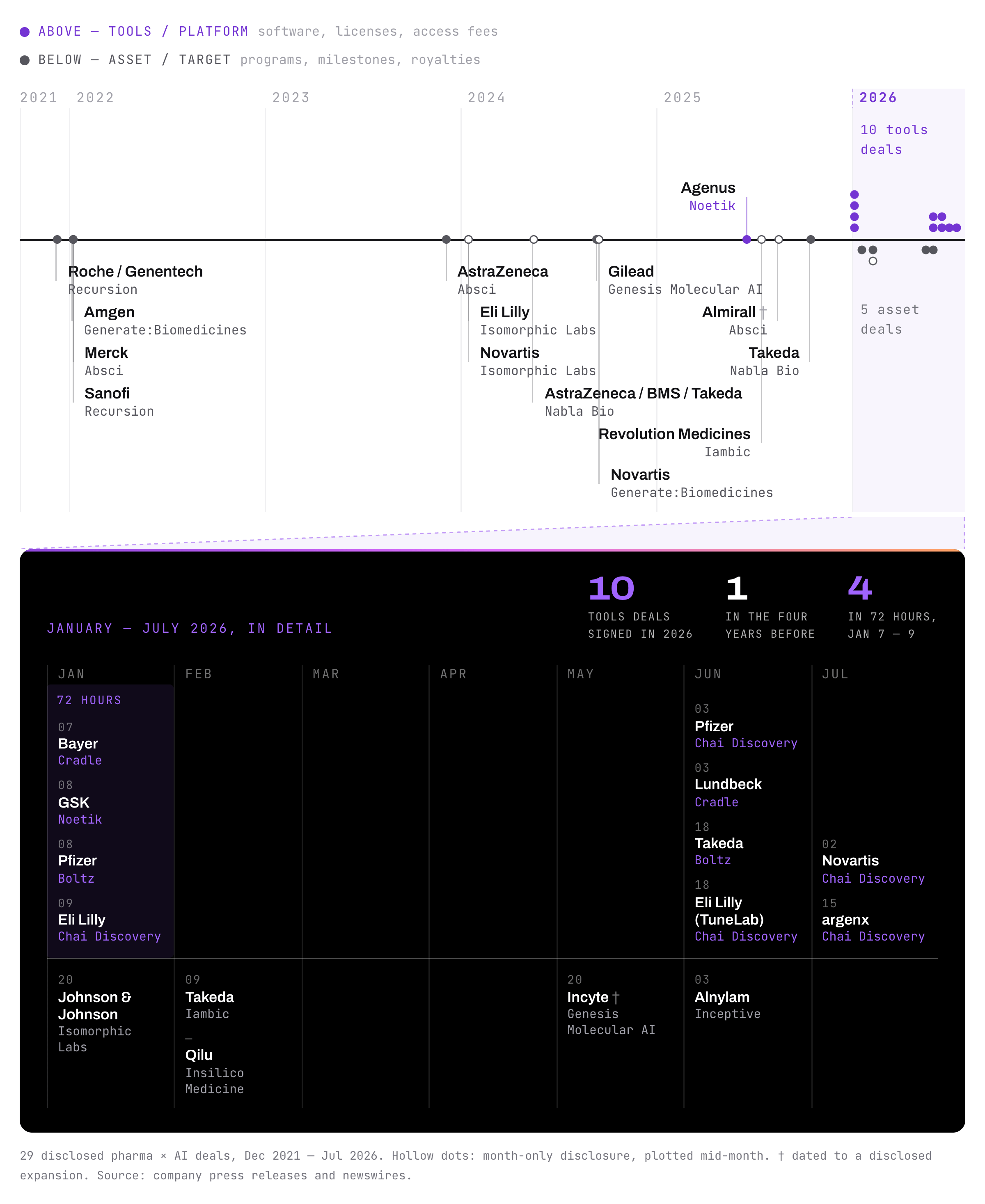
This January, four big AI × Pharma tools deals were announced at the huge JPM Pharma conference that takes over San Francisco every year. OpenAI-backed Chai Discovery (now worth $4B) was somehow at the heart despite being all of 2 years old.

The Science team is proud to bring you the first podcast with cofounder Matt McPartlon and product lead Neil Patil to tell the full story!

Editor’s note: not to be confused with Chai AI, which was another top pod of ours.

Pharma suddenly doing big AI tools deals

For the non-pharma people, JPM is JP Morgan’s annual conference for pharma deal-making that takes over San Francisco for a week in January with hundreds of side events, etc. It’s a big thing.

Tools deals for pharma are also a big (new) thing: companies that start as AI for Pharma usually end up building their own drug pipelines instead, and the reason is something like this: convincing pharma to use your tool requires proof that your tool works. Proof means good targets, maybe with good clinical validation. If you have that, then it’s easier to raise money (with a known, if long path to commercialization) or sell (e.g payment in biobucks1) for a specific target than it is to sell to lots of companies on a promise that it will work across their portfolios.

The “we’ll just partner / build our own drug” optionality proved to be the only good path up until January. What changed? In short, the tools got good enough for drug design teams to trust.

Good-enough-to-trust unlocks the ability to scale discovery: get more, better candidates into the lab and animal trials faster. More screening for toxicity, better delivery, etc. This means that what you push to the clinic is more likely to succeed.

Tools also unlock new capabilities: mechanisms that are very hard or impossible to develop using lab-based discovery. Designing an antibody that precisely triggers a very specific molecular cascade takes many years of trial and error. Designing bi-specific antibodies (that bind to two different proteins) is similarly difficult. Good design tools can unlock this.

RJ: The fact that the quality of the model has jumped means you’re enabling things you just plain couldn’t do. So it’s a step change. It’s not an efficiency argument at all, or not so much.

Matt: Yeah, exactly. It’s kind of interesting, even for us — it took me a while to believe in the thesis, actually. I talked to Josh for months before Chai started... It’s like, can I beat a mouse, and then can I do what mice can’t do? And then how many levels of interaction can you just keep building on top of that?

Everyone playing in the structural / binding space has an angle here, and some will be better than others, but Chai is pointing to a different unlock: getting good molecules right out of the gate (meaning they don’t then need as much lab work) means that the iteration time is faster. This turns science into engineering: you can design your systems to reduce friction and hill climb towards one-shotting molecules all the way to the clinic.

This, per-se, is not a new thesis: a16z articulated a version of this in 2020. What has changed is that structural models became binding models (how well doesn’t this molecule bind to this molecule, aka “binding affinity). Binding models unlock design, which has been steadily improving. Chai’s observation is that for engineering problems the best product tends to win, and good technology is a necessary but not sufficient condition.

Photoshop for molecules2

With that in mind Chai has invested heavily in partnerships that allow them to learn from their Pharma counterparts.

What is kind of cool about working so closely and supporting so many of these partners is we get to really learn about what is the stuff that would be helpful in research. So rather than doing research in a vacuum, based on what would hypothetically be cool, we're able to do informed research based on what our partners have just been organically asking us for help with.

— Neil Patil, (Chai product lead)

This means better UX, such as a molecule editor that is more like a CAD or graphics design program than a chatbot.

Their approach has paid off: since June, Chai has announced three more major deals: Lilly, Novartis, argenx, plus an expansion of their Eli Lily program. This episode is too full of quotable moments for a short blog, so tune in to learn about

  • Why protein tokens have the highest downstream value of any token

  • Climbing levels of abstraction as models improve

  • How Pharma, VC, and research are all just portfolio optimization

  • How better tech changes the whole portfolio

  • How relentless focus on simplicity leads to scale

Plus much more!

1

"Biobucks" is deal-value for milestone-heavy licensing agreements — the headline number (e.g., "$1.7B deal") is almost entirely contingent on hitting targets. Typically only 2–5% of the total is upfront; the rest pays out only if the drug clears each gate, and most drugs don't.

2

I actually think SolidWorks is a better analogy, but PhotoShop has better brand recognition ¯\_(ツ)_/¯

💾

🔬Causal Models Need Causal Data - Xaira’s X-Cell model for Drug Discovery (Bo Wang & Ci Chu, Chief Discovery Officer & Chief AI Scientist)

21 July 2026 at 19:34

Bet on information

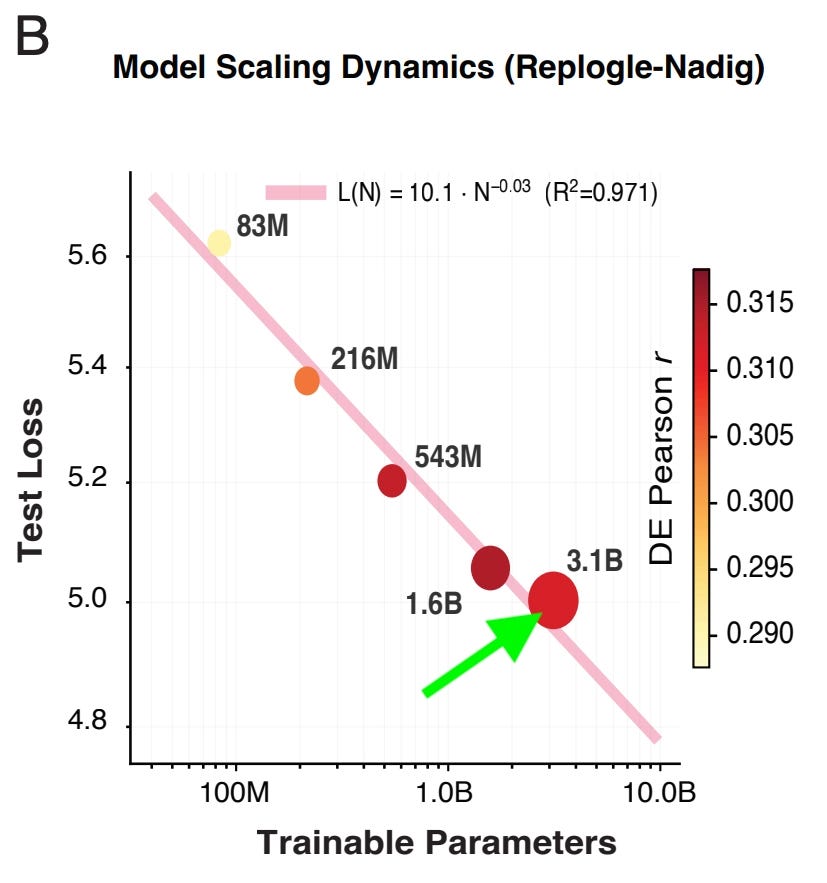
If test loss flatlines after 1.5B parameters while training loss continues to drop as you scale, that tells you that your model is limited by the amount of information in your data.

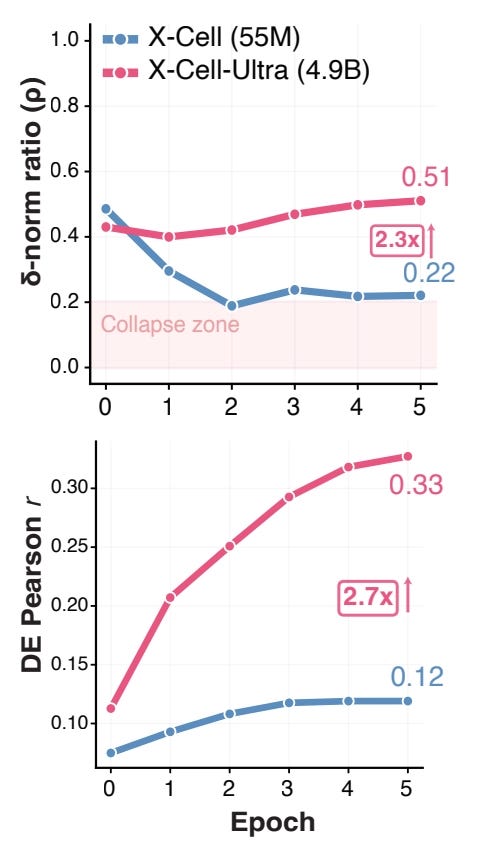
Training on a single, smallish data set exposed an information gap: the 3.1B model falls off the scaling trend. Neither parameters nor compute will improve performance past this wall. For predicting changes to gene expression, you need more information rich data.

This is what Chu and Bo’s teams have done, and here is what ~30x the information buys you:

Now we can scale with parameters and training compute! We don’t know how much this effort costed, but we can guess that data collection experiments and infrastructure was a few tens of millions, and compute + headcount + research was a few million. The budget looks like a RL rollout budget, rather than a data rich pre-training one.

We were lucky enough to have the two central figures in this story on our podcast. Taking the lead from Ci Chu and Bo Wang, Xaira Therapeutics is betting that information rich data is the key to AI-driven drug development. Chu was recently promoted to Chief Discovery Officer and Bo to Chief AI Scientist1, underscoring just how strategic Xaira considers this bet.

Reverse engineering the human cell

If you had to figure out how a human cell works, what would you do? A good place to start might be by documenting what genes are expressed (e.g. what RNA is floating around) in different kinds of cells, in different circumstances.

That is CELLxGENE, a database of 168M cells built by Chan Zuckerberg Institute that maps each cell to a count of how many times 20K-30K genes were detected in that cell, plus detailed metadata about every cell. A ~4 trillion-entry matrix.

If the Protein Data Bank (PDB) unlocked structural biology models (Boltz Episode, ESM/BioHub Episode), CELLxGENE has done the same thing for Virtual Cell models. Like PDB, CELLxGENE has inspired a zoo of AI models of RNA expression; so much so that RNA expression models have become synonymous with Virtual Cell models. Bo Wang built one of the most influential, scGPT, that became the starting point for Xaira’s new model.

RNA expression ≠ Virtual Cell

Models trained on CELLxGENE describe the relationship between cell types and cell states, but they are not good at predicting what will happen if we make changes to RNA expression. Changes in gene expression are highly correlated, and its is difficult (impossible) to figure out what causes what in most cases.

If you could “turn the dial down” on one gene at a time, however, then you would be able to observe what is upstream and downstream of a given gene2. You could tell if A → B & C or B → A & C or B → A, C → B → … If you did this for all of the genes, then maybe you could train a model that could predict what would happen to a cell if you change a gene (e.g. with a drug or a gene edit). Or maybe you could figure out the least invasive way to change a particular gene’s expression.

X-Atlas → X-Cell

This is exactly what Chu and Bo’s teams have done. The data set is called X-Atlas and the model is called X-Cell.

In this episode, we discuss:

  • Why the team abandoned autoregression for diffusion

  • The CRISPR-based experiments that run millions of tests in parallel, and generate the raw data for X-Atlas and X-cell

  • Generalization to real lab experiments in real human cells

  • Beating the linear baseline that has outperformed previous models

  • Justifying a kitchen-sink of priors, and how that stacks up vs. data and architecture

Bo also shared with us some of the (major) advantages he has as an academic vs. industry leader, and how his labs keep up with the breakneck pace of AI innovation.

Check out the full episode on YouTube, or your favorite podcasting platform!

1

These promotions happened after we recorded the episode

2

There can be cycles in the chain reaction, of course, and there can be second, third, etc. order effects (meaning things that only happen when multiple genes change at once), but the first order effects are a great place to start, and might tell us a lot of what we need to know.

💾

❌