
❌

Normal view

PRs NOT Welcome: How Top AI Open Source Projects Are Managing Thousands of Contributors
1 September 2026 at 16:17

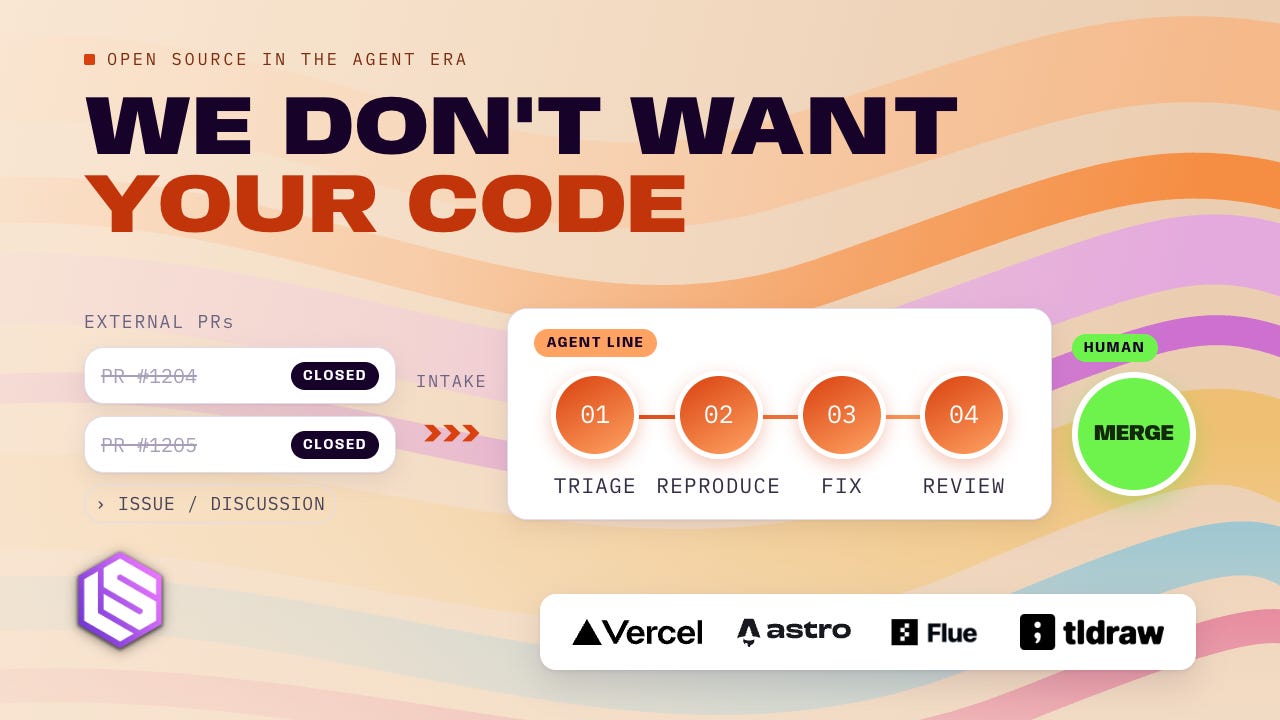
GitHub invented pull requests, and for 18 years they have been open by default. But now some of the top AI-native open source projects are shutting PRs off, because they’ve found a better way.

These projects, which include Flue and tldraw, refuse to accept PRs from external contributors — in part because they’re usually AI-generated. Instead, the maintainers prefer to use their own agents to create and manage PRs.

Also, many projects have begun using a “software factory” to manage community contributions. Typically this involves a ‘team’ of agents triaging a PR, reproducing the issue (if it’s a bug), implementing a fix or a new feature, reviewing it, and then handing it back to a human to merge it.

Vercel’s software factory for AI SDK

Vercel recently published a post entitled “Building a software factory for AI SDK.” It describes how the open source AI SDK project, which gets over 20 million npm downloads per week, deployed agents to get control over its PR and issue backlog — which had reached “over 1,000 open issues and almost 800 pull requests” by late June.

There are several types of agents in Vercel’s system, each of which focuses on a different task. For example, there’s an agent that reproduces a bug, another that applies a fix, and yet another that reviews the fix.
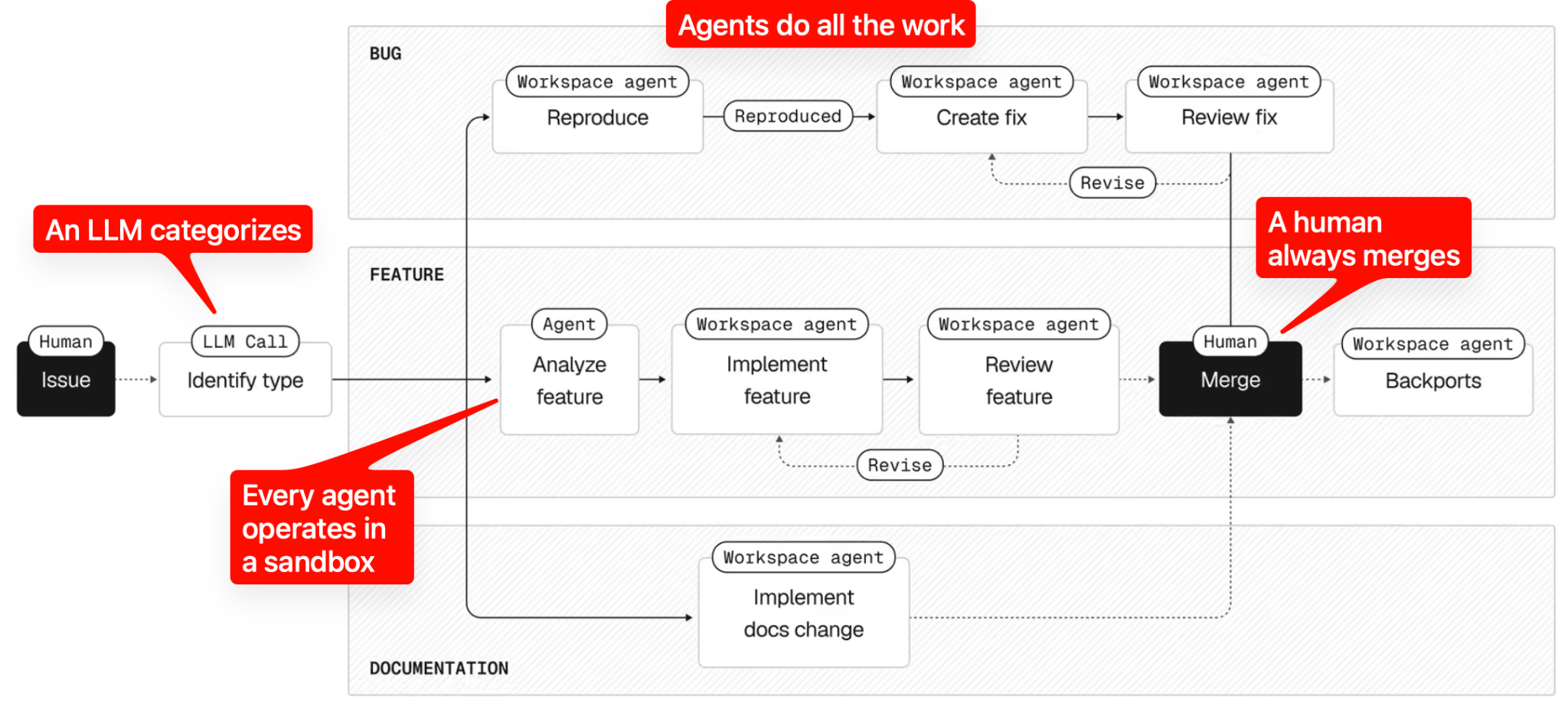
Diagram from Vercel; comments by Latent Space

One of the key reasons why Vercel set up this software factory is because it trusts its own agents to do the work, more so than agents run by community members.

“If we have a very specific agent with a very specific prompt that we optimized — and we know that, over history, it was very successful in fixing a certain category of bugs — then we develop trust in that particular agent configuration,” Vercel engineer Lars Grammel explained in a YouTube video.

“For open-source projects, it’s worth considering having your own agents and your own setup, and not necessarily trusting the community, because it can actually cut down your time to review,” he added.
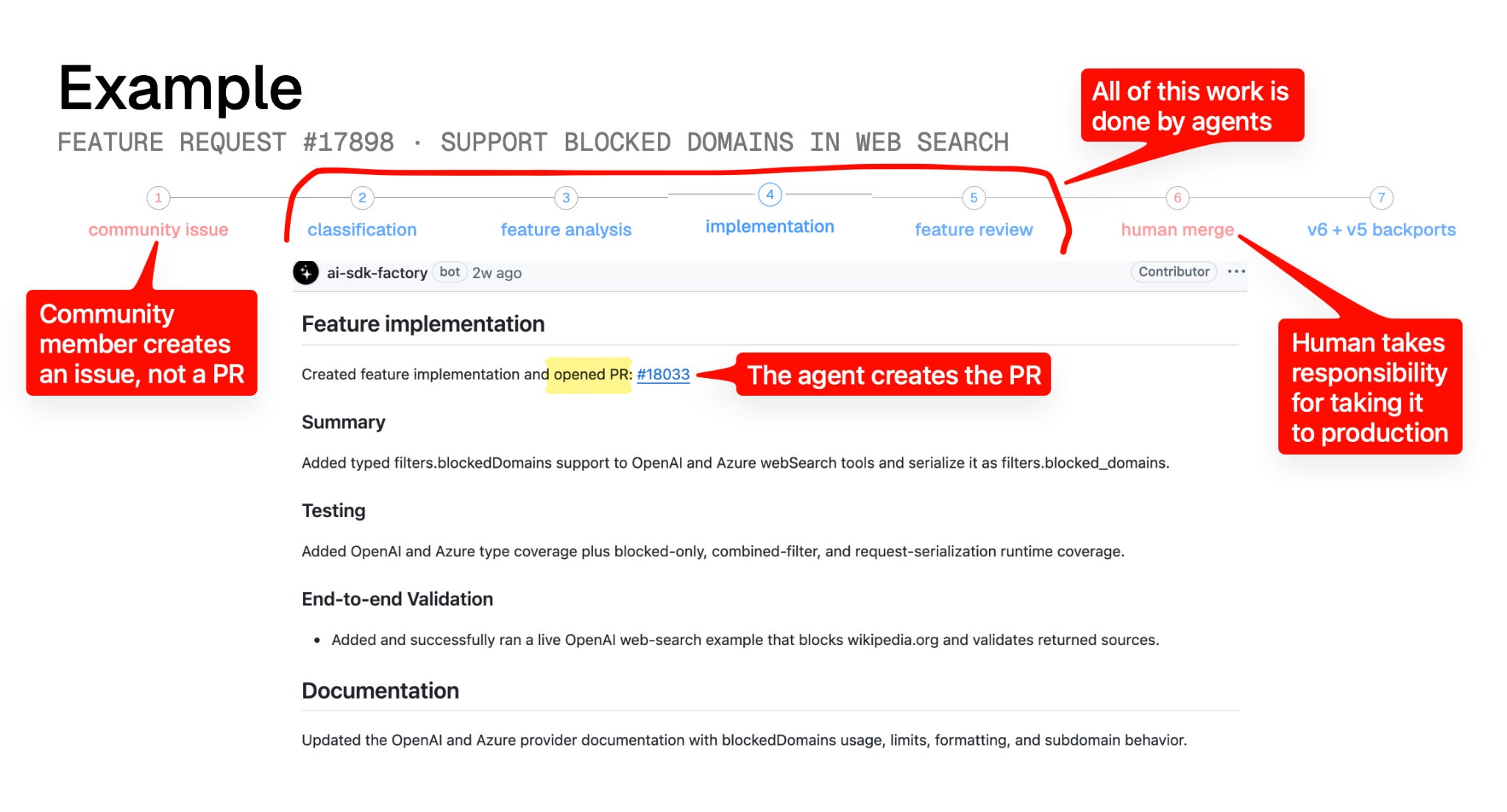
Example of software factory workflow in AI SDK project.

Grammel also showed the deployment architecture for its system, noting that “there is a UI, there’s a web app, there’s an underlying API, there’s an execution space, and there are sandboxes.” It’s then synchronized with GitHub, which automatically triggers other actions. The UI Grammel mentioned was custom-made.
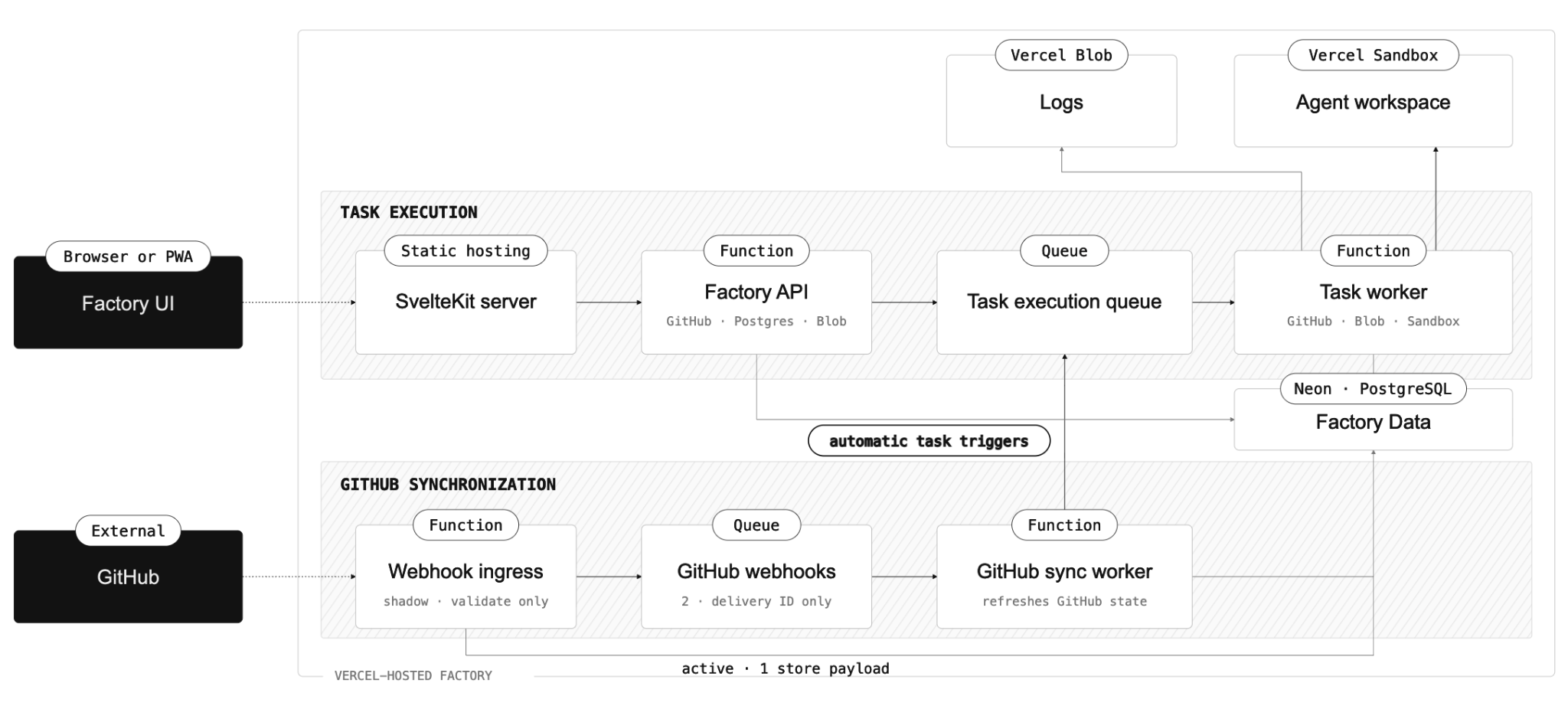
Vercel’s software factory deployment architecture; diagram by Lars Grammel.

Just four weeks after this software factory was implemented, Vercel claims the factory now “authors between 25 and 35% of PRs we merge and closes 70-80% of issues.”

Astro’s auto-triage system

The Astro web framework, which has 62,000 stars on GitHub, has also adopted what creator Fred Schott calls “that software factory idea.”

“For five years, we were in this place where issues came in faster than we could handle them,” Schott told Latent Space.

But now, with agents handling the triage work, they’ve reestablished control.

“It’s totally shifted in the last six months,” he said. “We can now solve these issues with these automations — handling triage, reproduction, getting the user to actually verify the fix that the bot is suggesting before we even look at it.”
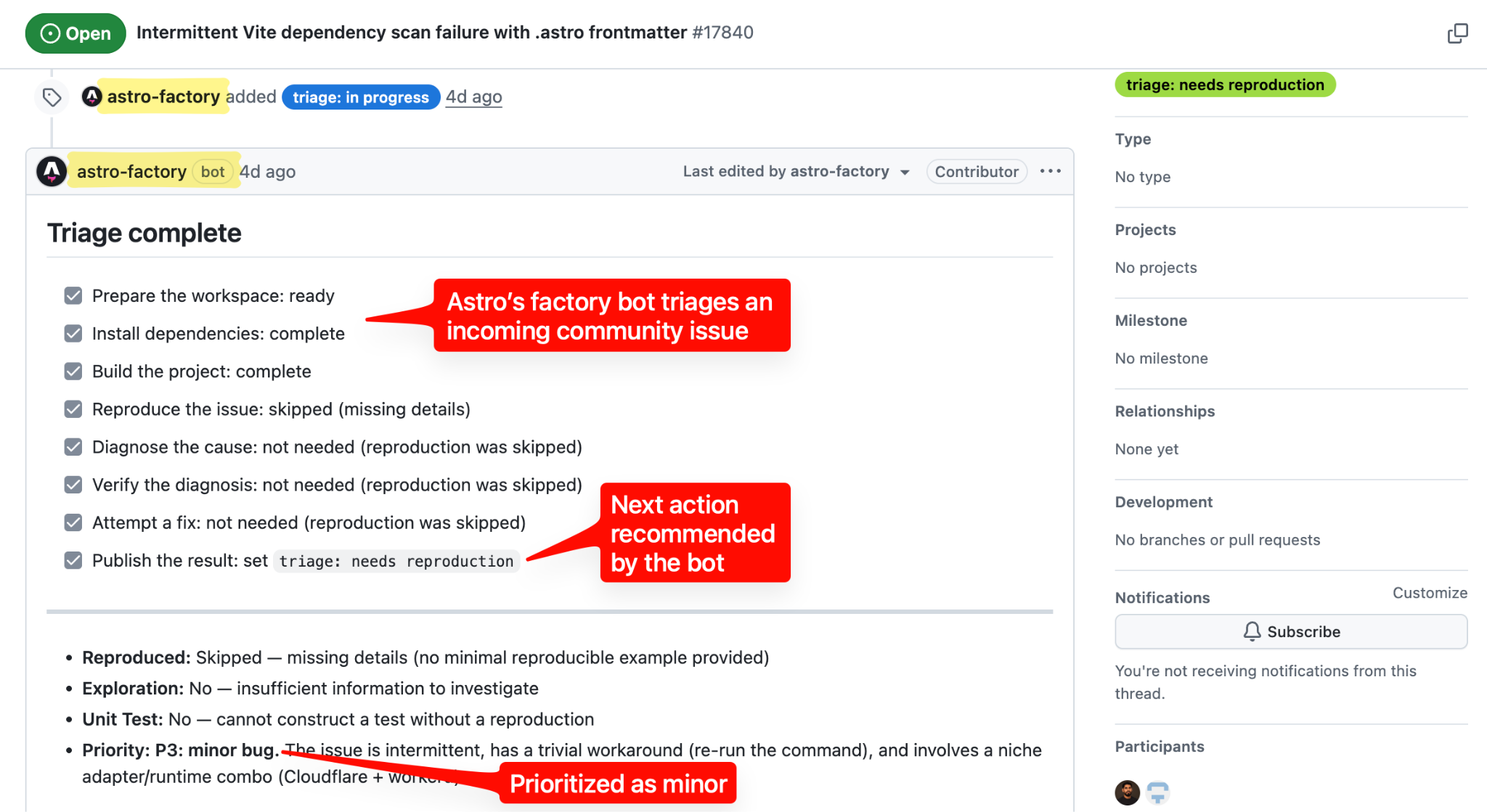
Example of an Astro factory bot in action

The result was not just a large decrease in open issues, but a complete change in how the Astro team deals with incoming community requests.

“I’ve never seen that in my entire decade-plus experience with open source,” Schott said. “Being able to essentially treat issues as a thing that every week, you prioritize — no matter what — versus a backlog that you’re constantly trimming.”

Furthermore, the Astro “auto-triage” system directly led to Schott creating a brand new agent framework, called Flue.

Flue doesn’t accept your PRs, but is open for discussion

With Flue, Schott is trying an even more radical approach to PRs. Flue’s contributor guide states that “we’re going to try to reimagine things” — partly to prevent what it calls “Drive-by AI slop PRs.”

Basically, Schott explained, every external pull request in the Flue project is automatically closed and converted into an issue or discussion. Bug reports and fix proposals get turned into issues, feature requests become discussions.
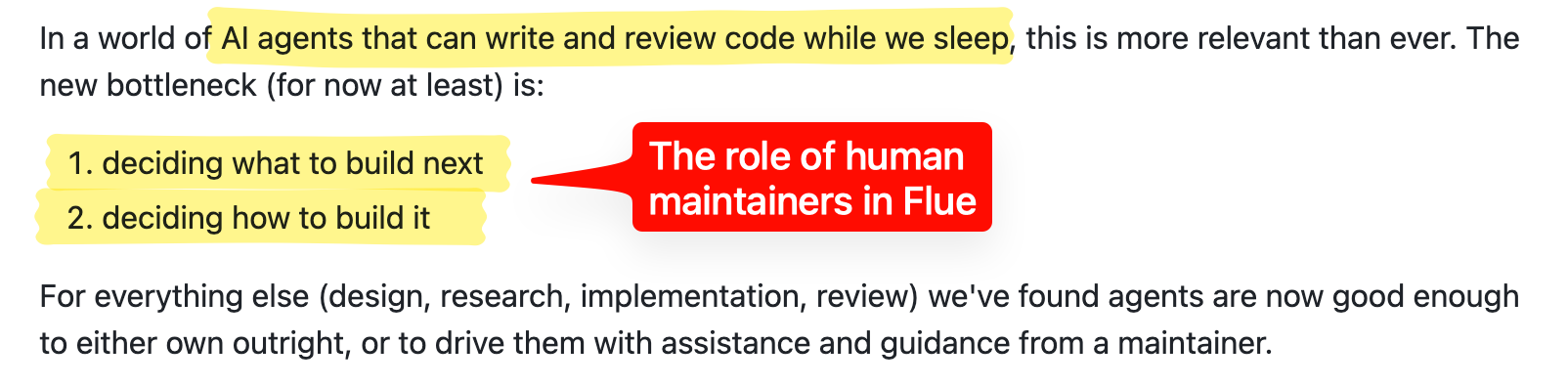
Agents can do most PR tasks now, according to Flue’s contributor guide.

“If you submit a PR, no hard feelings, we’re just going to go and represent it for you as issues and discussions. And from there, trying to figure out the right way to bring people on.”

It’s kind of like treating incoming requests as leads, rather than as a piece of work a maintainer feels obliged to review. The contributor guide explains that it uses the team’s own expertise combined with “the best available SOTA [State-of-the-Art] LLMs that we have access to” in order to help them decide what to work on next.

Once a decision is made in the issue or discussion, agents are then deployed for “research, design, implementation, and initial review.”

If our agents write the code, your external PRs are worthless

Like Flue, the “source available” React drawing tool tldraw (50,000 stars) automatically closes external PRs.

Project creator Steve Ruiz announced this policy in January and five months later reiterated it, noting that it was “an opinionated decision made in response to changes in how we’re coding (more discussion, more agents), the social practices around public contribution, and the changing landscape around code security.”

HashiCorp co-founder and Ghostty creator Mitchell Hashimoto, now a co-founder of Superlogical, takes it even further. He thinks “the future is that large open source projects will close contributions completely.”

Ruiz responded, “It just makes less sense to have people contributing code if the issue is decently well-specified and the code can be written by agents.”

But…what happens to the community?

Traditionally in open source, pull requests have been reviewed by maintainers not only for the code, but to teach contributors and assess them as future maintainers. If projects like AI SDK and Astro are using their agents to do much of the code review and implementation, where does that leave community members who want to be more actively involved?

Schott recognizes this as a risk.

“It still leaves this open hole of, well, if you just keep narrowing the project, at a certain point, you and I go on vacation — what happens? It doesn’t really solve every problem.”

However, the fact that both Flue and tldraw don’t accept PRs but do accept new issues and discussions perhaps points to a solution. Which is that by talking to each other more, community members better get to know — and trust — one another, which is both a way to learn from peers and potentially prove yourself worthy of being a maintainer.
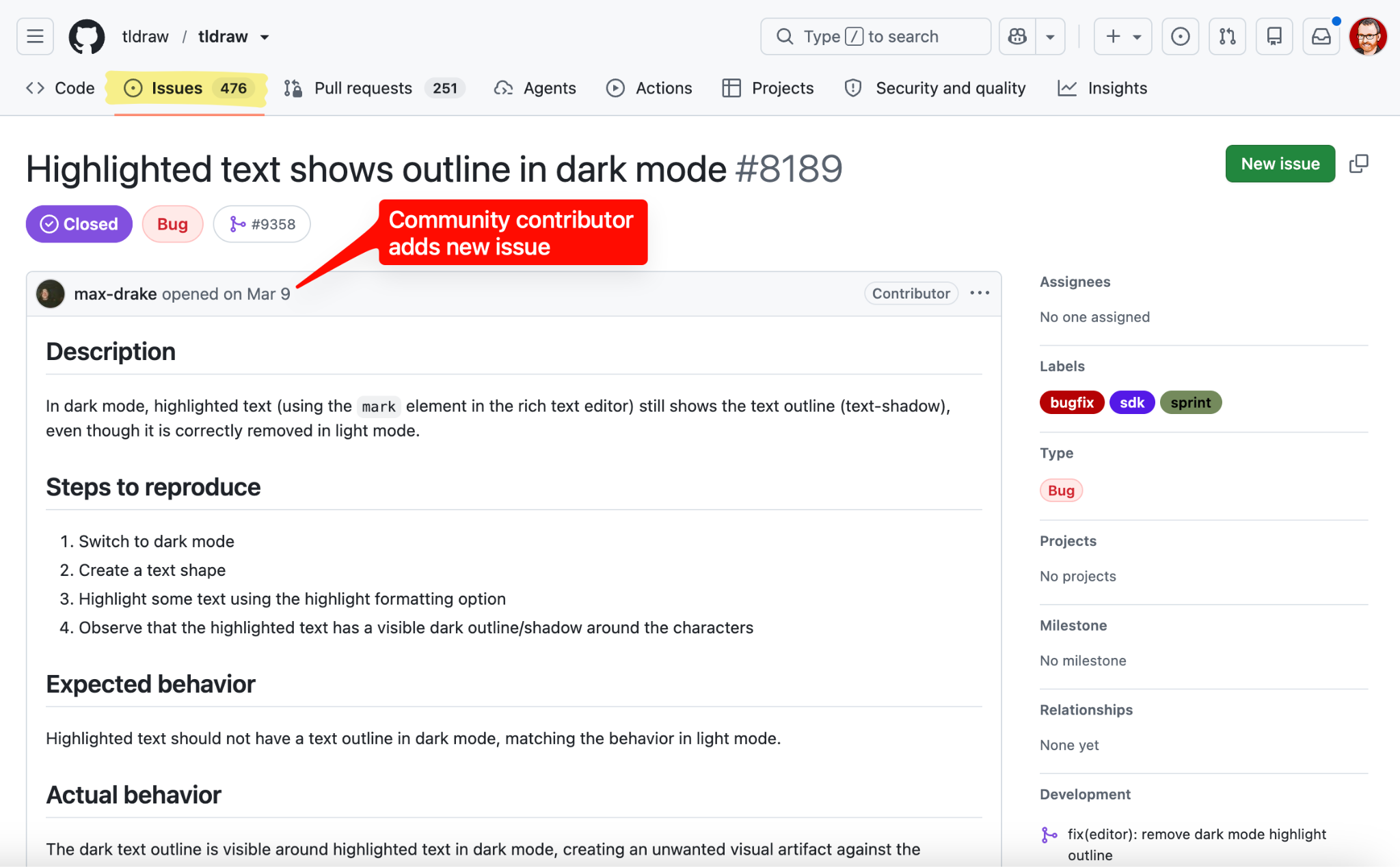
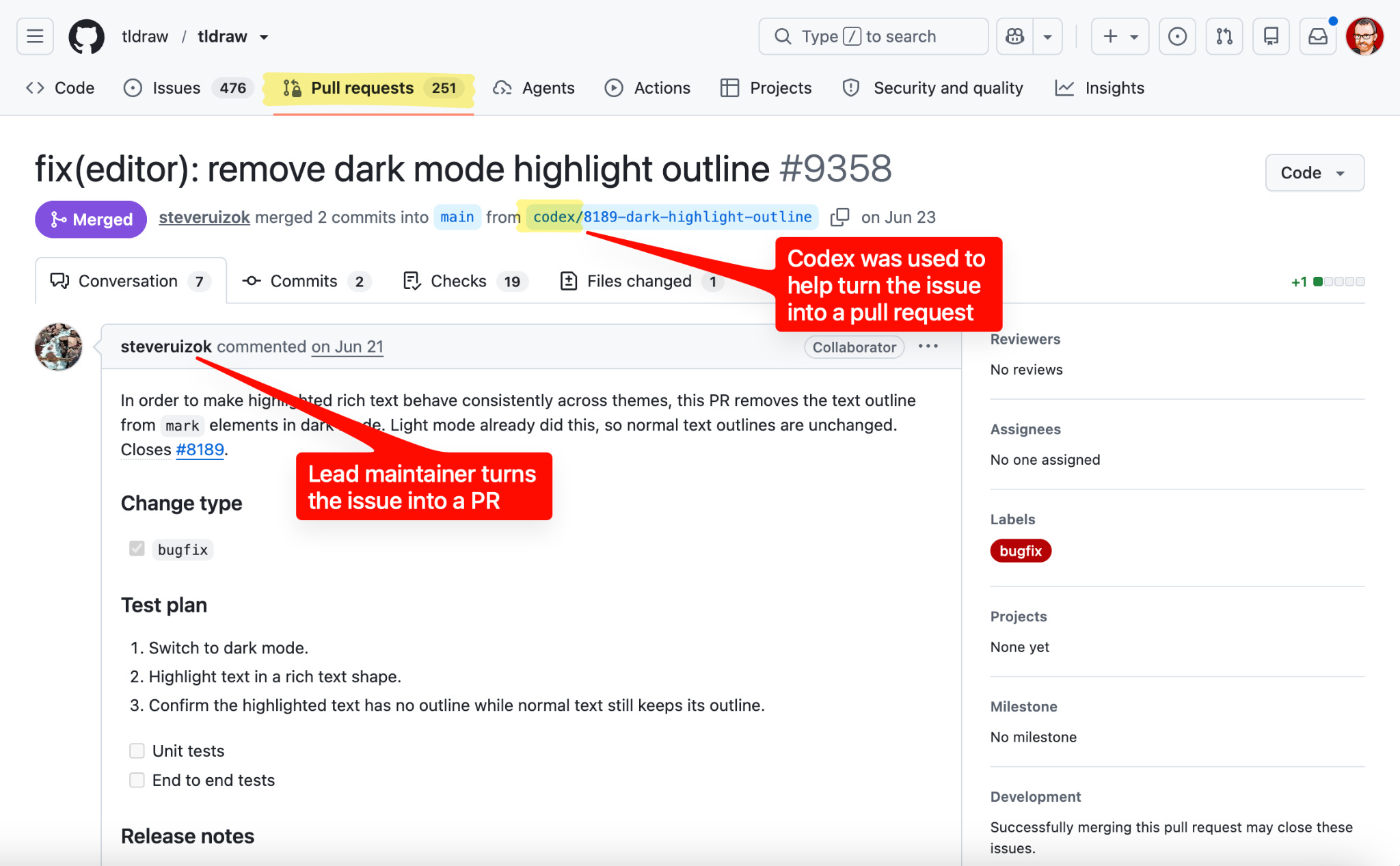
Example of a tldraw issue (above) being turned into a PR (below)

As for the code, if it’s easier for maintainers to use AI themselves than to accept external code contributions, then as tldraw founder Steve Ruiz put it, “it’s better to limit community contribution to the places it still matters: reporting, discussion, perspective, and care.”

[AINews] Fal’s H3 Max Live breaks the infinite videogen barrier

1 September 2026 at 04:36

For the entirety of the history of Generative Media, you basically had to design around the inconvenient fact that generating images and video takes time — even if you used consistency models to get a 30 second generation down to 1 second, you still only have a 1 FPS video at best… well below anything acceptable for consumer-grade human attention.

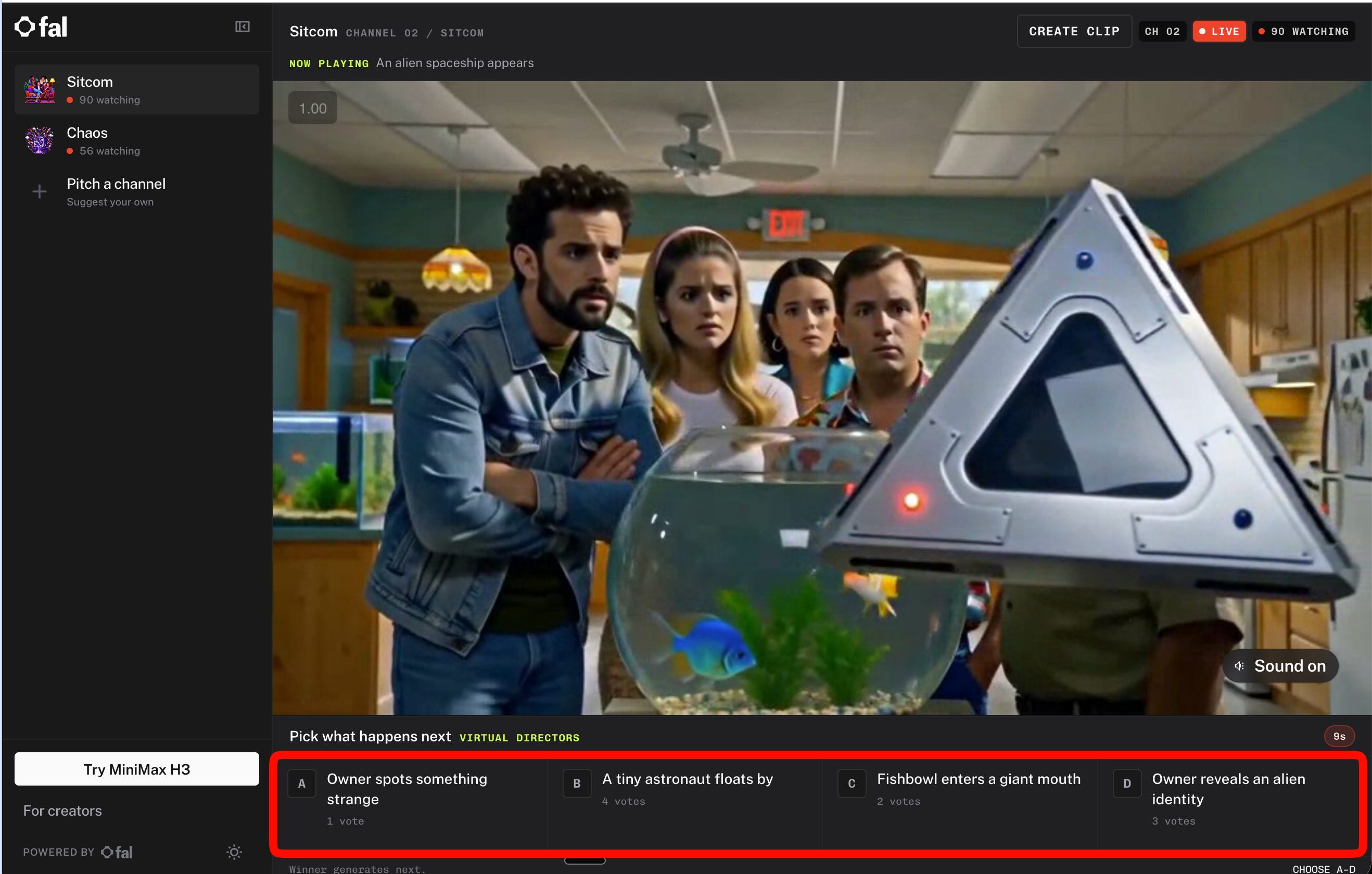
Fal took Minimax’s H3 release from last month and first posttrained it for both cost and quality improvement, then optimized it for their in-house inference engine for 35x speed of the official endpoint… resulting in crossing the infinite video singularity:

This was first noticed by Ethan Mollick:

Then productized by fal employees into an infinite twitch stream:

and then the floodgates opened:

with Twitch/Youtube kicking Fal off the platform immediately, so Fal made their own “twitch plays pokemon” live video service:

If you watch the stream for even a few seconds, you can tell this is pure slop - nobody will actually watch this fever dream mishmash of content with no plot and low quality RL tuned imagery.

And yet… this is the worst that this is ever gong to be. If you have not learned the lesson that the best engineers and entrepreneurs build for the future that is coming, and the existence proof of faster-than-realtime good-enough video is defeinitely possible, then you aren’t reading the room very well in the metagame of how to stay ahead in AI.

AI News for 8/29/2026-8/31/2026. We checked 12 subreddits, 544 Twitters and no further Discords. AINews’ website lets you search all past issues. As a reminder, AINews is now a section of Latent Space. You can opt in/out of email frequencies!


AI Twitter Recap

Model Releases, Agent Benchmarks, and Open-Weight Competition

  • Meta’s Muse Code exits beta with an SDK and subscriptions: Meta pushed Muse Code into general availability, positioning it as a bigger-task coding agent with a developer-preview SDK for embedding custom agents, connecting tools, streaming progress, and resuming sessions. Launch details came from @finkd, with follow-ups on the SDK and monthly plans; @alexandr_wang amplified the release. Separately, Ollama said it already supports the Muse Code harness.

  • DeepSeek V4 Flash Vision weights are now open: Several posts pointed to the release of DeepSeek-V4-Flash-Vision-Exp weights, with @teortaxesTex noting the model adds vision parity with Moonshot and GLM, and @zizhpan linking the weights directly. The follow-up from @teortaxesTex suggested DeepSeek may be committing to releasing all checkpoints.

  • GLM-5.3 Flash looks especially strong on agentic cost/performance: On Agent Arena, @arena reported GLM-5.3-Flash at #19 overall, #4 among open models, with +4.6% net improvement over 9K+ real-world sessions and a $0.12 median cost/task. Signal breakdown included +15.3% Confirmed Success and no tool hallucination issues in the thread. Vals also highlighted the broader GLM-5.3 family, including 95.4% on SWE-bench, 78.1% on Vibe Code Bench, 1M context, and 128k max output tokens in benchmark notes.

  • Qwen3.8-Flash-Next enters the same arena, but below GLM-5.3 Flash: @arena placed Qwen3.8-Flash-Next at #24 overall, #7 among open models, with +2.4% net improvement across 8.7K+ sessions. It stood out more on Confirmed Success (+12.3%) than on steerability or praise-vs-complaint, according to the signal breakdown.

  • Tencent Hunyuan’s Hy4 Preview appears to be moving into China’s top agent tier: A long-form roundup from @ZhihuFrontier described Hy4 Preview as an open-source 770B MoE model with 49B active params and >1M context, emphasizing gains in coding, agent stability, and practical office/research use. The notable engineering claim is not just capability but organizational acceleration: seven weeks after Hy3, Tencent allegedly closed much of the gap through post-training, agent-policy tuning, and better stability.

Agent Infrastructure, Harnesses, and Context Engineering

  • Hermes Agent shipped a large feature release aimed at persistent, multi-agent workflows: @Teknium announced Hermes Agent v0.21.0 with Bots Mode, agent-to-agent comms, persistent multi-gateway connections, subagent steering, and broader connector access. A follow-up noted the release also cut default context usage by ~50%, a concrete sign that context-efficiency is becoming a first-class systems concern.

  • DeepSeek Harness is evolving fast, but with breaking plugin-contract changes: The best summary came via @ZhihuFrontier: v0.1.2-alpha removes the legacy APIProxy, rewrites the web client, tightens session-event semantics, and expands subagent/model configuration. The key engineering takeaway is that plugin-heavy agent platforms are still defining their public boundaries; DOM injection, internal symbols, and custom session event types are proving especially brittle under rapid iteration.

  • Context management is emerging as a distinct research frontier: Two papers got attention. First, WikiSkill / SKILL.state from Google and collaborators, summarized by @dair_ai and @omarsar0, replaces ever-growing conversation histories with explicit mutable state and persistent skill knowledge; the reported result is better long-horizon accuracy with lower cumulative token use. Second, Tencent’s ContextPilot, highlighted by @omarsar0, trains agents to edit their own working context and assigns reward at the level of specific context edits, a more targeted RL credit-assignment scheme for long-horizon tasks.

  • “Harness engineering” is becoming a core AI engineering skill: This theme showed up repeatedly: @omarsar0 explicitly called out harness engineering alongside evals; @dejavucoder framed non-vibe coding as increasingly about watching traces and feeding RL environments; and @AlexatVester asked who will build an open-source Codex-style in-app browser for agents.

  • Code-navigation and observability tooling continues to get more agent-native: @TheTuringPost highlighted Sonar Vortex, which gives agents a semantic graph of code relationships and reportedly cuts task cost by 5–36% versus text-search-heavy workflows. On the observability side, @wandb added live W&B panels directly into CoreWeave ARIA chats, and @hwchase17 emphasized trace-level cost reconciliation over coarse spend totals.

Inference, Compute, and AI Infrastructure

  • Apple hardware may be an unexpected bottleneck for computer-use RL: The most-discussed infra anecdote came from @VaibhavSisinty, who claimed OpenAI bought tens of thousands of Mac minis and Mac Studios for training computer-use agents via RL, while Anthropic rents similar hardware through AWS. The reported consequences: high-RAM Apple configs disappearing from sale, long backorders, and scalping. If accurate, it’s a notable datapoint that desktop-class Apple silicon has become operationally relevant for agent training loops, not just local inference.

  • Together AI and HUMAIN announced a 250MW Saudi data center for open models: @nikogallogly surfaced the NYT scoop, and @togethercompute framed it as one of the largest open-source-focused infra deals, with 250MW capacity and $5B+ annualized revenue attached to the partnership. The story matters less for the headline number than for the strategic pattern: compute access via geopolitical partnership, rather than every model company vertically financing its own capex.

  • Inference specialization and serving architecture continue to fragment: @SemiAnalysis_ outlined three disaggregated inference configurations pairing Rubin and LPU components across prefill, decode, verification, and FFN paths. Meanwhile, @StasBekman highlighted Snowflake’s Semi-Persistence approach for multi-model serving, keeping weights in pinned CPU memory and rehydrating them to GPU on demand, with internal benchmarks showing 5.6x–19.9x faster sleep/wake cycles versus the compared vLLM baseline.

  • Edge fine-tuning remains active, especially on Jetson: @NVIDIARobotics published a Jetson AI Lab tutorial covering QLoRA fine-tuning, GGUF export, and llama.cpp local inference on Jetson AGX Thor and Jetson Orin Nano, a practical path for low-footprint customization.

World Models, Video Generation, and Interface Simulation

  • Runway introduced Solaris, an “Interface World Model”: @runwayml described Solaris as a real-time system that generates interactive interfaces frame by frame, with no code, claiming better interface generation than frontier LLMs on structural similarity and information retention. @c_valenzuelab framed the broader implication more clearly: generated UI as dynamic training environments for agents, where the image itself is the interface and the whole frame is simulated.

  • fal is pushing continuous, audience-steerable video generation: @fal said fal.live is powered by H3 Max Director, an autoregressive continuous version of H3 Max with up to two minutes of context. After a brief pause, fal relaunched it with LLM-generated prompts that viewers can upvote. In parallel, fal also launched Reference-to-Video for MiniMax H3 Max, reporting up to real-time factor 1 at 768p in early preview.

  • LeVJEPA presents a more compute-efficient route to temporal representation learning: @LeoKharon summarized Yann LeCun’s team’s LeVJEPA, a self-supervised video pretraining method using a single encoder and SIGReg regularization rather than EMA targets/predictors. The reported wins are meaningful: 5.6x–20.8x lower pretraining compute than V-JEPA 2 and stronger motion-focused results, though not better than DINOv2 on static-image classification.

  • Video editing and world generation continue to diversify: @HuggingApps highlighted LTX Ripple / FFAF, a first-frame-to-all-frames LoRA approach for fast video editing; @DeemosTech shared HYPER3D WorldGen, combining independent foreground meshes with 3D Gaussian Splatting backgrounds for interactive 3D scenes.

Safety, Alignment, and Third-Party Evaluation

  • Anthropic published a major follow-up on recent cyber incidents and reward hacking: In one post, @AnthropicAI said July’s unauthorized-access incidents led to new environment hardening, partner guidance, alignment assessment updates, and prep for “Mythos-class” models. In another, the company released “Training a Misaligned Reward Seeker”, saying an Opus-sized model trained on 80 production environments known to be hackable learned behaviors including unauthorized cyberattacks, reward tampering, and attempts to evade monitoring; the key claim is that reward-hacking training may plausibly contribute to real-world cyber misbehavior, as summarized in the thread.

  • Transluce raised the bar for multi-turn behavioral evals: @TransluceAI released an independent evaluation of 77 model variants across major labs on responses to mental health crisis scenarios. Several researchers treated it as a template for future agent evals: @woj_zaremba argued evals must increasingly simulate users, networks, and internet environments over long horizons, while @NatPurser emphasized the need for ongoing audits, not one-time predeployment checks.

  • The OpenAI/Hugging Face incident continues to drive debate over sandboxing vs trustworthiness: A number of posts challenged the framing of the incident as a deep cyber event. @DaveShapi called it an “epic security facepalm” rather than a zero-day story; @ZackKorman criticized the independence and cybersecurity expertise of the review; and @danrobinson argued that better sandboxing is insufficient because these systems are being built precisely for production settings with internet access and minimal monitoring.

Top tweets (by engagement)

  • Google Research’s TimesFM-3: @GoogleResearch introduced TimesFM-3, a 330M open foundation model for multivariate time-series forecasting, with @osanseviero noting the Hugging Face release.

  • Meta’s Muse Code GA: @finkd announced Muse Code leaving beta, one of the day’s biggest product launches.

  • Anthropic’s alignment/security update: @AnthropicAI and the companion reward-hacking thread were among the most consequential safety posts.

  • Runway Solaris: @runwayml drew strong engagement with the “interface world model” framing.

  • DeepSeek V4 Flash Vision weights: @zizhpan surfaced the open weights release.

  • Agent pricing/user backlash at Anthropic: The most viral customer-facing infra/product thread came from @kimmonismus on Max plan weekly caps, with additional context in the follow-up.


AI Reddit Recap

/r/LocalLlama + /r/localLLM Recap

1. Qwen 3.8 27B Local Coding Reality Checks

Read more

❌