❌

Reading view

🔬 An Oscar, Two Asteroids, and the Algorithm in Your sklearn: John Platt on AI for Science

How often do you get to talk to a guest who has both an Academy Award and who invented textbook machine learning algorithms? John Platt has an Oscar, two textbook algorithms, two named asteroids, and an Erdos-Bacon number of 6. This was easily the most fun bio of all the guests we’ve read to date. And the result was an epic and fun chat covering Google’s Empirical Research Assistance (ERA), how AI can help battle climate change, and tons of great stories about the co-evolution of science and AI.

John’s colleague Dave Bacon likes to tease John that his career has been defined by being twenty years early to the next big thing. This may be convolutional neural networks (some credit him with coining the term), fusion research, quantum computing. John and Google have been working on solving some of humanity’s hardest problems with AI and computation for well over a decade now. Recently John and his team set their sights on using AI to solve any scientific problem that can be written down as a score.

Google’s Empirical Research Assistance (ERA)

John’s team has taken on many hard scientific problems over the years. In solving these, they noticed a pattern, many scientific problems can be reduced to what John calls a “scoreable task”. Once you have the score function, the goal is to find some code that maximizes the score. The hard part is in formulating the score, but once you have the score finding the maximizer can still be quite a lot of effort.

John’s team set out to automate solutions to this general problem. This came out of the idea of an “auto-Kaggle” AI, which can solve any Kaggle problem you can throw at it. Kaggle is owned by Google, so all the data was ready and easily available to them!

The result is Google’s Empirical Research Assistance or ERA (paper, github, blog).1 ERA is surprisingly simple conceptually. Gemini (or your LLM of choice) keeps a running tree of past experiments (notebooks) and where they’re going. It’s a close cousin of Monte Carlo Tree Search: at each iteration the Upper Confidence Bound rule picks which notebooks are most promising to mutate. This is optimistic, not greedy, so sometimes even the fifth-best notebook gets chosen. Gemini then proposes mutations for each one, about ten at a time. The history of each branch is shared, so different leaves can learn from each other.

“It’s almost like having a hyper-eager grad student who doesn’t sleep.”

Evolutionary algorithms have been around since the 70s, but this works because Gemini actually knows where to look! What’s even more interesting is that there was a step change between Gemini 2.0 and 2.5, and this went from just not working to working great.

ERA is so powerful that John and his team solved many outstanding problems with it, resulting in at least ten papers. Some of these were climate change related, which we talk about in the next section.

So, we had to ask: if you have an optimization god how do you avoid fooling yourself? John’s answer is that ERA provides predictive models. It’s up to the scientist to make sure they’re truly descriptive. Some of this just involves good old-fashioned careful machine learning science. “It’s a power tool. It can slice your fingers off.” This led to some fun discussion about Kaggle competitions, and the fun ways people can overfit to datasets without meaningfully solving the problem you actually care about: Google’s contrail-detection competition was won by entrants who noticed a half-pixel error in the labels (is the origin at the corner of the pixel or the center?) and this turned out to be a part of the winning special sauce. Great for winning $15,000, not so helpful if you actually want to solve contrails.

“People themselves will act like these LLMs and try to reward hack. It goes back to Goodhart’s law: any metric that becomes a target is no longer good as a metric.”

His advice for where to start instead?

“Always just fit linear regression. Just do it. Just do it. Just do it. Or SVM.”

Tackling Climate Change with AI

John and his team have worked extensively to mitigate the effects of climate change. We talked about several of their initiatives.

Perhaps the most interesting result we talked about was reducing the effects of condensation trails (contrails) from airplanes. Those little streaks you see running behind planes somehow account for 1% of all human-induced global warming?!? Some of these trails of ice crystals can hang out for days. These crystals are black in the infrared, acting like a thermal blanket that traps heat day and night.

It’s easy to understand what’s happening here, a region of atmosphere becomes “ice supersaturated”,2 and a tiny bit of exhaust seeds water vapor that instantly crystallizes. The scale here is astounding, with a single gram of exhaust resulting in ten kilograms of ice crystals.

The solution to all of this is quite simple, in principle! We know what parts of the atmosphere are most likely for the trails to form. Just have the planes drop a flight level or two. Problem solved, right? Well, the hard part is accounting for how much warming was prevented. This is a counterfactual problem, parts of which stumped John’s team for over two years. They had a working model for the heat-trapping half, but not for the reflected sunlight. ERA was able to find a simple model with some confounders they hadn’t considered. Cracked it!

Modeling climate generally is a hard problem. Climate is best thought of an attractor of many different possible weather outcomes.3 This makes it much harder to model.

“Weather is where you are on the attractor, and climate is the statistics of the attractor. The problem with climate is that we’re altering it. The attractor itself is changing, it’s moving.”

John and his team have worked on treating both the symptoms and the disease of climate change, with several other works in the area. Another fun example we briefly cover is FireSat, a way of using a constellation of satellites to rapidly identify fires before they grow too big to put out. For anyone living in California, you understand the problem. In dry years a small fire can result in hundreds of thousands of acres. If you could find this fire when it’s the size of a room, it could be put out. By the time it hits an acre we have a much harder problem.

Where is this all going? Looking forward by looking back

By now it should be clear John has an incredible and unique view over the intersection of science, computation, and AI. John talked about a class on physics of computation4 he took with Richard Feynman back in 1982. This was when quantum computing was an ill-defined concept with no theory or experimental backing. John recalls every Tuesday was a guest lecture, and every Thursday was Feynman explaining why the Tuesday guest was wrong. John also recalls doing science back when there was essentially no compute, a million operations per second was cutting edge.

What is John’s recommendation: the most important skill is developing deep domain expertise. There’s no other way to develop taste than to tackle hard problems. One surprising part of this is that John recommends spending time doing things the old fashioned way. Play with tools, and just implement things yourself.

“You could drive up the mountain, or you could hike up the mountain, and maybe it’s okay, even fun, to occasionally hike.”

Summing it up, John’s message to the audience is that there will still be a place for scientists, and that if anything it will just open up more opportunities for “the creative stuff, the rigorous stuff, the philosophy stuff.” But don’t forget to spend time doing the grunt work.

“There just seems to be this strong impetus in the world to optimize and squeeze everything out. But you do lose something when you hyper-optimize. It’s overfit.”

And whatever tools you end up using, John’s advice is the same one Feynman gave him forty years ago: you must not fool yourself, and you are the easiest person to fool.

We had a great time talking with John. We hope you enjoy!

Also in this episode

  • Fusion is three years away, not thirty, if you ask John. And why the Lawson criterion means every fusion approach has an Achilles heel.

  • Why superconducting qubits are still finicky.

  • The asteroid he named after his mom, which turned out to have a moon.

  • The looming helium shortage nobody talks about.

  • How NeurIPS started as people crashing a private workshop at Snowbird, and why Hopfield networks are all you need.

  • Being Carver Mead’s sysadmin on a VAX with an 80 MB disk the size of a dishwasher.

  • Finding asteroids in 1985 with film, a stereoscope, and a letter to Brian Marsden. The Vera Rubin Observatory found 11,000 in six weeks.

  • The Feynman effect: total clarity in the room, none once you leave.

  • Quantum echoes, the NISQ era, and why he thinks quantum is neither thirty years away nor tomorrow.

  • A startup that wants to inject mercury into a fusion reactor and sell the transmuted gold. “It might not work.”

  • John’s 20% time rule for his own group: do stuff for learning, and you don’t even have to tell him what.

1

The ERA GitHub repo features an open source implementation that ran Gemini but can be used with any LLM. ERA is not currently available as a Google product.

2

“Ice-supersaturated” is about water vapor, not liquid water. Cold air can hold a given amount of vapor, and there are two different limits: the amount in equilibrium with liquid water, and the smaller amount in equilibrium with ice. Below freezing, a pocket of air can sit between those two limits. It has more vapor than ice can tolerate, but not enough to condense into droplets, and ice won’t form directly from vapor without a seed. So the vapor just hangs there, metastable, sometimes for days, until something seeds it.

3

We recently covered the weather-climate crossover in our episode with Anima Anandkumar, and we plan on covering both weather and climate more in future episodes.

4

This was really about quantum computing, but in the early days before anyone really knew what this meant and it was just a vague idea Feynman and a few others were kicking around.
💾

  •  

[AINews] Xiaomi MiMo-V2.6-Pro 1T-A42B: the new top Open Weights model, trained for $3M

Meet Xiaomi and other top Chinese frontier labs at AIE Shanghai!


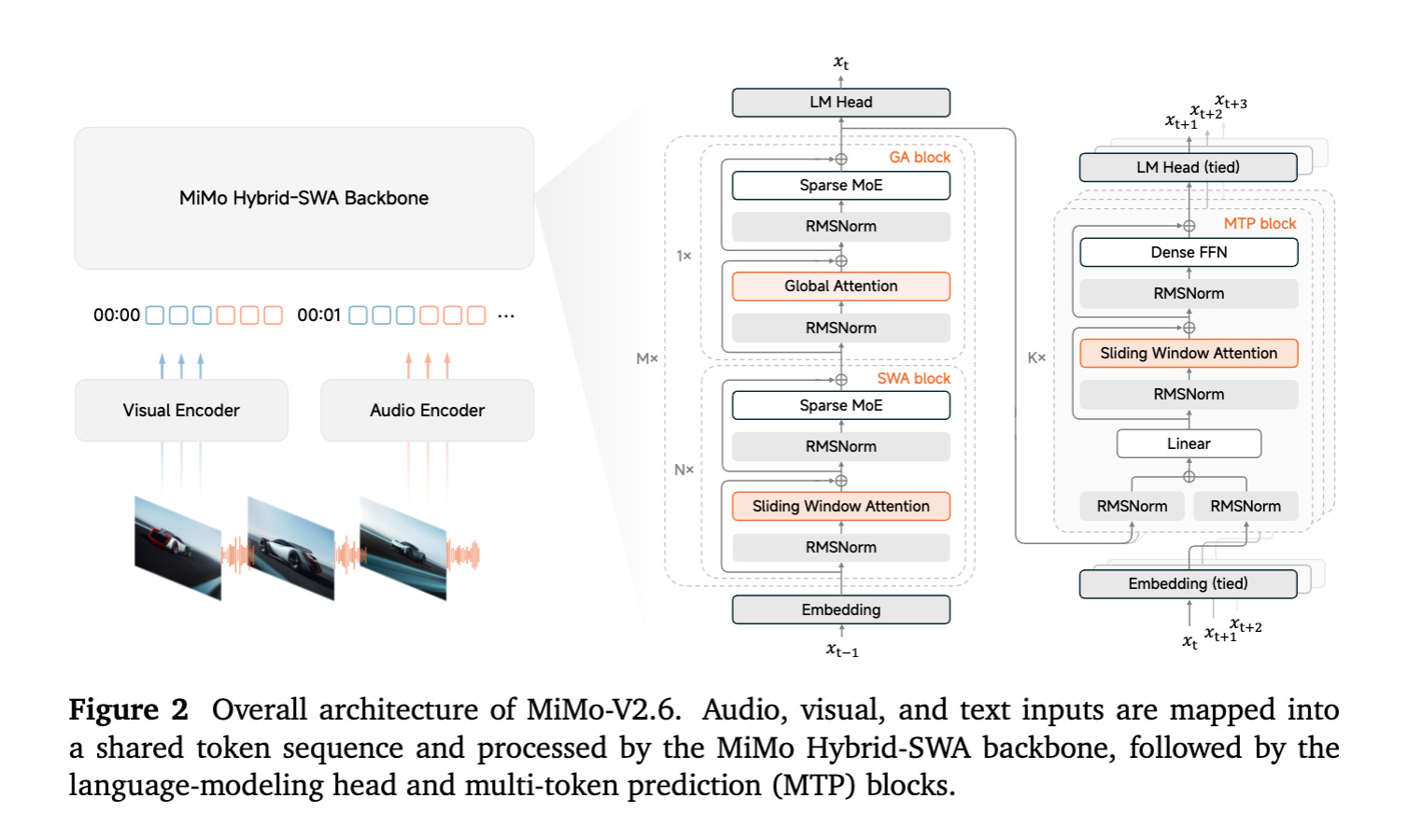
This is a first for the “Apple of China” phone maker-turned-frontier lab: “The MiMo-V2.6 series includes two natively omnimodal models: MiMo-V2.6-Pro is our most capable model to date, while MiMo-V2.6-Flash strikes the best balance between intelligence, efficiency, and cost. We are also rolling-out MiMo-V2.6-Pro-UltraSpeed, delivering up to 20x faster output speed at the same quality, for users who require extreme generation speed.”

Xiaomi is not traditionally considered one of the six Chinese AI Tigers, so it is very surprising to the established order of names you have come to know and love. And… it is natively omnimodal!

Xiaomi made news a few days ago when Fuli Luo, a former DeepSeek star engineer now at Xiaomi, started publishing their final RL training runs live, which showed an abnormal amount of transparency in their internal metrics.

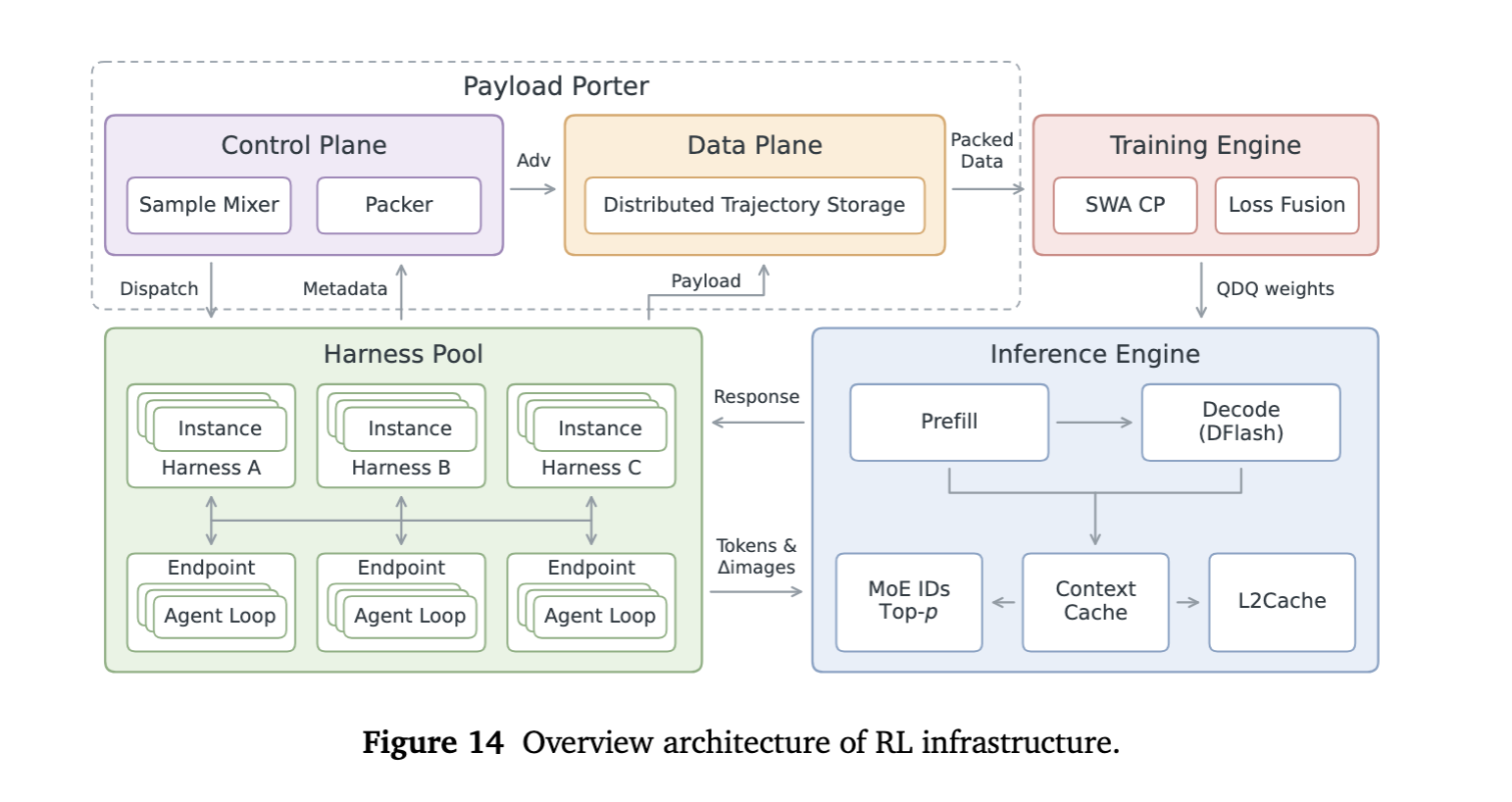
As they note in their technical report, they scaled RL compute along three axes:

  1. Larger batches and higher throughput: large batches on a fully asynchronous architecture, with 1,568 samples per update, training at up to 1M context length, and 3.5 to 3.7B tokens per step.

  2. More tasks and richer environments: a multi-task training suite spanning coding, general agents, visual and cyber, mixed across several harnesses so that gains in one capability reinforce the others.

  3. More grader compute: relative comparison within each group gives long-horizon RL tasks more precise and more diverse reward signals, closes a self-improvement loop, and steers the model toward shorter paths and fewer tokens per task.

ALL of this tooling, including the environments, will be open sourced.- the environment code and training recipes, but the complete 7k+ task datasets have not yet been released.

AI News for 9/19/2026-9/21/2026. We checked 12 subreddits, 544 Twitters and no further Discords. AINews’ website lets you search all past issues. As a reminder, AINews is now a section of Latent Space. You can opt in/out of email frequencies!


AI Twitter Recap

Open Models, Competition, and the China Gap

  • Open models remain the central policy and market story: Nathan Lambert shared a congressional briefing on open-model performance, adoption, and U.S.-China competition, followed by a public summary. The broader argument resurfaced elsewhere: @Yuchenj_UW claims frontier coding capability has plateaued since Opus 4.8, while open-source models keep closing the gap at 10–50x lower cost; @ClementDelangue similarly argues APIs are overkill for many real-world use cases and that specialized models will take share. Counterpoint: @teortaxesTex argues frontier has actually split into new higher tiers, with internal models and top closed models still well ahead.

  • The release cadence from Chinese labs is now difficult to dismiss: @Thom_Wolf compiled an unusually dense ~10-week run of open releases including Kimi K3, Qwen3.8-Max, DeepSeek V4-Pro, GLM-5.3, Hy4 Preview, Atria Dawn, and more. This is reinforced by a Bloomberg-sourced note via @Polymarket that startups are increasingly building custom models on open weights to cut cost and reduce dependence on OpenAI/Anthropic. The subtext across several tweets: open-weight capability is no longer confined to midsized models; multiple teams are shipping frontier-scale MoEs with credible cost-performance stories.

Xiaomi MiMo-V2.6 and RL as the New Scaling Lever

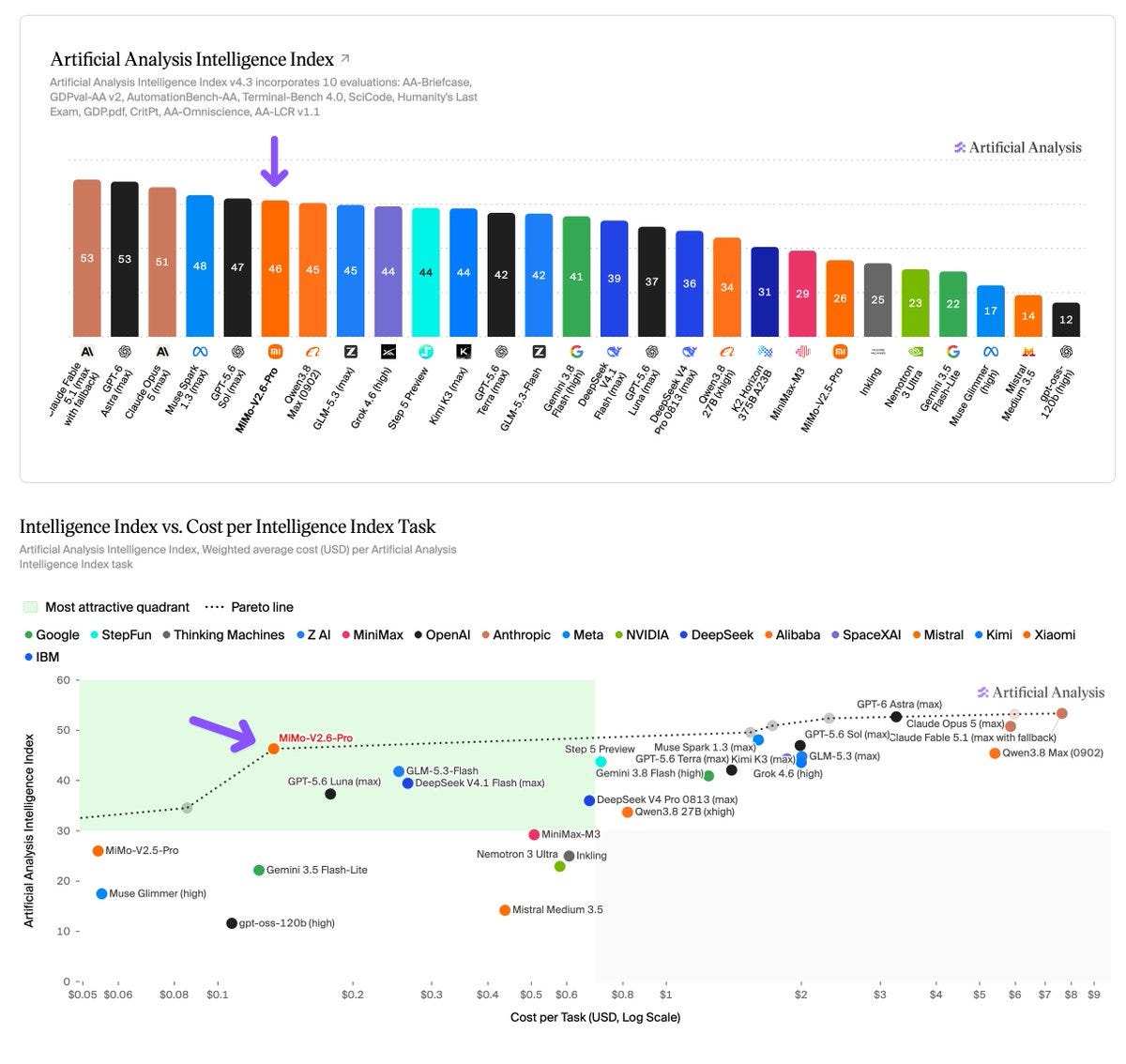
  • MiMo-V2.6 is the biggest open-model release in the set: @XiaomiMiMo launched MiMo-V2.6 Pro and Flash, described as open omnimodal models with weights, technical report, RL environments, and training code. Artificial Analysis says MiMo-V2.6-Pro debuts as the top open-weights model on its Intelligence Index (46), with 1.02T total / 42B active parameters and strong cost efficiency at $0.435/M input and $0.87/M output tokens. @victormustar notes the models are under MIT license.

  • What stood out technically was not just the model, but the RL stack: @eliebakouch highlighted Xiaomi’s environment/data-factory paper for generating RL tasks from open repositories with “agents in the loop” for robustness and anti-cheating. Later commentary points to a second paper and unusually high transparency: @xeophon notes Xiaomi wants to release ~7K RL environments, and @eliebakouch emphasizes the team shipped model + tech report less than a week after the final RL run. A recurring interpretation, from @bertgodel and @Thom_Wolf, is that high-quality open RL environments may now be as strategically important as pretraining corpora were in the last cycle.

  • RL cost/throughput details drew attention because they compress timelines: @zephyr_z9 cites 130 hours, 75B tokens, and $2.6M for the RL run behind the result; @tianjun_zhang says the MiMo family scales RL on JAX + TPU, where scaling is “mostly a config change, not a code rewrite.” If these numbers hold up, the implication is that post-training/RL is becoming a far cheaper route to frontier-adjacent gains than many assumed.

Decision Models, Jev, and the Return of Specialized Inference

  • Jev was the dominant product/theme discussion: Multiple posts converged on the same framing: this is “just” classification/routing, but with modern model intelligence and much better latency/cost. @karpathy calls it a point on the Pareto frontier for “no thinking, single token, low latency acceptable intelligence”. @willdepue describes it as a zero-shot classifier with frontier-ish intelligence, while @ClementDelangue argues the excitement shows there is large latent demand for specialized models rather than ever-larger generalists.

  • The ecosystem around Jev expanded quickly: @sarah_edo built a Chrome extension that uses Jev to select and fill relevant WebMCP tools per keystroke. LangChain added Jev-as-a-judge to LangSmith; @hwchase17 and @Hacubu pushed SemIf, an open-source decision model, through the LangSmith Gateway. @omarsar0 reports using Jev to retag ~2.3K papers in 83 seconds for $0.14, with 579 high-confidence changes and manual validation of disagreements.

  • The more durable takeaway is architectural: DSPyOSS argues that asking frontier agents is like managing people, while hand-writing decision-model programs is analogous to writing assembly; both extremes are useful, but brittle if overused. Several posts emphasized where these models fit best: routing, approval gates, trace scoring, tool selection, discrete document decisions, and low-cost supervision inside larger agent loops rather than as standalone “smart agents.”

Inference, Tooling, and Systems Optimizations

  • Tokenizer and post-training infra both got substantive upgrades: Hugging Face’s tokenizers v1 RC claims up to 30x faster tokenization, improved multithread scaling, lower memory use, and much smaller package size; @art_zucker framed it as a new SOTA tokenization library. Separately, Halo launched as a post-training framework claiming up to 2.8x throughput over stock TRL while keeping models in native Hugging Face format.

  • Inference-side engineering remains a major lever: @RisingSayak showed how KV caching is incorporated into QwenImage 2.1, separating fixed context from changing image positions and yielding a 2.55x speedup; the thread cites 50.57s → 19.86s DiT time on a warmed A100 with moderate memory overhead. vLLM published tuned serving configs for Qwen3.8-2.4T on GB300 NVL72, showing a Pareto frontier from 5K total tok/s/GPU at high throughput to 180 output tok/s/user at low latency. In video workloads, vLLM also integrated PyNvVideoCodec/NVDEC, removing CPU decode bottlenecks and reporting 2x+ throughput at 8×H100.

  • Compression/quantization is still moving fast: @ZhihuFrontier summarized Tencent Hunyuan’s engineering behind packing Hy4 Preview (770B) into 214 GiB via mixed-precision quantization averaging ~2.38 bits/weight, including custom CUDA kernels in patched llama.cpp. On the edge/local side, @vikhyatk released Parakeet Redux, compressing NVIDIA’s speech model from 1.2GB to 178MB, running at 113x realtime on CPU, while beating the base model on 25-language FLEURS and staying within 0.3 WER on English.

Agents, Security, and Human-in-the-Loop Control

  • Computer-use systems are becoming more productionized, but security is now central: Patrick Wardle reported a serious local-hijack flaw in Muse, arguing broad OS access makes such assistants a high-value attack surface. In contrast, DeepLearningAI highlighted Meta’s design philosophy for Muse-like agents: assume prompt injection will happen, keep real credentials away from the model, isolate tools in containers, and use an independent outbound-call gatekeeper.

  • Commercial agents are also being pushed deeper into workflows: Cognition introduced Devin Cloud in Terminal and devin ssh, making the model’s VM directly accessible from the CLI and allowing handoff between Devin and the user’s machine. GitHub Copilot teased editable diffs in the desktop app, while @pierceboggan showed a Sentry-integrated canvas for moving from crash report to fix.

  • A recurring systems point: inference and agent infra are shifting toward test-time compute: @sarahookr predicts compute moving from pretraining—where marginal FLOPs yield less—to test-time compute, requiring “very different infrastructure.” That theme also showed up in persistent-cache discussions for local serving, e.g. @TheZachMueller on SGLang’s multi-level hiCache (GPU/RAM/disk) for preserving KV cache across model swaps and restarts.

Top tweets (by engagement)

  • Grok 4.7 release: SpaceXAI announced Grok 4.7, described as a notable improvement over 4.6 at the same price/speed. Follow-on evals were mixed: Artificial Analysis reported 56 on its Coding Agent Index with gains on DeepSWE/Terminal-Bench/SWE-Atlas-QnA, while Vals saw it rank #24 on its Vals Index, down 5 points from Grok 4.6 despite gains in legal/medical.

  • OpenAI’s automated model-training workflow: A widely shared summary from @wallstengine reports that OpenAI has largely automated parts of training experimental models, including GPU kernel writing and code optimization, with internal agents collaborating and compressing some experiments from years to about a week.

  • OpenAI mathematics advisory group and claims of solved open problems: OpenAI announced an independent advisory group of mathematicians to guide assessment and communication of AI advances in mathematics. Attention then shifted to the stronger claim, amplified by @AndrewCurran_ and others, that an internal OpenAI model has resolved 100+ long-standing open problems across mathematics. This was among the most consequential but least independently evaluated items in the set.

  • Open-sourcing of valuable data assets: @ClementDelangue highlighted Eidon AI open-sourcing 1,274 hours of egocentric robotics data (13,451 recordings) as a rare case of a startup preserving impact for the community after shutdown.


AI Reddit Recap

/r/LocalLlama + /r/localLLM Recap

1. Qwen-Image 2.1 and Tiny Open Image Models

  • Qwen-Image-2.1 released! (Activity: 2485): Qwen-Image-2.1 was released with open weights as a unified 7B image generation/editing model, positioned as a faster, lower-cost member of the Qwen-Image series (blog, GitHub, Hugging Face). Key technical additions include native RGBA/transparent image generation and editing, support for up to 10 reference images, multi-image inference acceleration, and localized edit control for tasks like object removal, attribute changes, product/portrait-preserving edits, panoramas, infographics, typography, and virtual try-ons. Comments primarily highlight the native transparency pipeline and local-edit interface; one example uses colored circles to target three regions simultaneously for removal, hair recoloring, and clothing replacement, suggesting interest in more controllable multi-region editing workflows.

    • Qwen-Image-2.1 is reported to add native transparent image generation and transparent-image editing support, which is technically notable because alpha-channel workflows are often handled as post-processing or masking rather than directly by the image model. The linked example shows transparent-output capability: https://preview.redd.it/59fu834idoqh1.png?width=767&format=png&auto=webp&s=5fb81b135b35dac70f9d38a9995d7c1a7a2877dd

    • The model appears to support multi-region local editing via visual annotations, where circled regions can be referenced in the prompt and edited simultaneously. One example asks it to “remove the metal watch in the blue circle, change the hair in the red circle to black, and replace the area in the green circle with gray short-sleeved linen pajamas,” demonstrating combined object removal, attribute modification, and region replacement in a single edit pass: https://preview.redd.it/cvh09tyvdoqh1.jpeg?width=1242&format=pjpg&auto=webp&s=32077f7420def5bec85160e2e982d6aef5efce54

    • Several commenters highlight the model size: Qwen-Image-2.1 is described as 7B parameters, which is significantly smaller than prior Qwen image models that commenters say were over 20B. This size reduction is viewed as important for local inference feasibility, with one user specifically noting interest from the perspective of a 16GB VRAM GPU such as the RTX 5060 Ti 16GB.

  • Clarification on the Qwen-image-2.1 license (Activity: 948): The image is a non-meme screenshot of a Qwen Developers X post clarifying that Qwen-Image-2.1 outputs are not considered licensed “Materials”, so users retain rights to generated images/content. This matters because the model license reportedly still contains a non-commercial restriction on use of the Materials, creating ambiguity over whether commercial image generation is allowed even if generated outputs are user-owned. Commenters welcomed the clarification, with one user saying Qwen-Image-2.1 “easily beats all current Flux models.” Another noted they can run it locally via ComfyUI int8 on a 16 GB RTX 5060 Ti peaking around 15.2 GB VRAM, but warned the Hugging Face LICENSE file may not yet reflect the clarified intent.

    • A commenter reports running Qwen-Image-2.1 locally in ComfyUI using int8 quantization on a 16 GB RTX 5060 Ti, with VRAM peaking around 15.2 GB. They describe the model as suitable for local testing but note that licensing uncertainty around generated outputs was the main blocker for broader/client use.

    • Several commenters highlight a legal/implementation mismatch: the Hugging Face README was apparently clarified, but the actual LICENSE file still contains Section 2(b) language prohibiting commercial “use” of the Materials. One user emailed model-business@notice.qwencloud.com asking whether the license text will be updated, because the tweet/README intent may not be sufficient for client or commercial work.

    • The key technical/legal distinction being debated is whether “commercial use not allowed” applies only to serving, redistributing, or monetizing the model/materials, versus also restricting outputs generated by the model. Commenters argue that until the canonical license file is updated, downstream users comparing it with permissive Apache-2.0/MIT-style model licenses may reasonably avoid commercial workflows despite the clarification.

Read more

  •  
❌