❌

Reading view

The Case Against Building Your Own Agent Platform

You know the meeting. The board wants an AI agent strategy by end of quarter. Someone on the leadership team has read a McKinsey report. You’ve been voluntold to build the platform. The slide deck says “AI-native.” The acceptance criteria are vague. Somebody mentions LangGraph, and somebody else says, “We’ll just wrap it ourselves.”

You ask what “done” looks like. Nobody in the room can answer.

The cost of building this is almost always estimated before anyone has a clear picture of what “this” actually is. And that’s the problem I want to work through here, because the scope of the work being casually assigned to internal platform teams right now is genuinely larger than the people assigning it understand.

Build versus buy, flipped in a year

This particular pendulum has swung before. App servers in the late 1990s. Content management systems in the 2000s. Container orchestration in the 2010s. The pattern rhymes every time: When a category is new, the components look deceptively simple. Early adopters build their own. The market catches up. Within 18 months, building becomes the expensive path. Within 36 months, the teams that built internally are rewriting on top of the category winner that emerged while they weren’t looking.

What’s different about the current moment is the speed. Menlo Ventures’ 2025 State of Generative AI in the Enterprise report shows the build-versus-buy split inverted in a single year. In 2024, 47% of enterprise AI solutions were built internally. By late 2025, that number had collapsed to 24%. The market made the decision in 12 months, which is unusual.

I’ve lived through enough of these transitions to recognize the shape. What I want to do in this piece is explain why I think the scope of “agent platform” is systematically underestimated right now, and what platform engineers should be asking before they commit to building one.

Most “agent platforms” aren’t

A lot of the projects labeled “agent platform” right now are actually workflow systems with an LLM in the loop. That’s a meaningful distinction. As Anthropic pointed out in its “Building Effective Agents” guidance, workflows are systems where LLMs and tools are orchestrated through predefined code paths. Agents are systems where LLMs dynamically direct their own processes and tool usage.

Most of what enterprises are shipping today sits on the workflow side. That’s fine. Workflows have bounded requirements, tractable testing, and predictable failure modes. If your team is building a workflow system, you might reasonably build it yourselves.

The trap is that teams start building for workflows, then get asked to support agents, and discover the jump isn’t incremental. Agents need memory that survives across sessions. They need evaluation that handles nondeterminism. They need governance that tracks actions, not just outputs. They need orchestration that recovers from failure modes a workflow engine never sees.

Here’s the thesis I want to put on the table: The decision to build an agent platform almost always underestimates the long tail. Memory, governance, eval, and orchestration aren’t features you add to a workflow engine. They’re separate product bets, each with its own maturity curve, its own vendor landscape, and its own team of specialists who’ve been working on it full-time for 18 months while you’ve been doing something else.

Let me walk through them.

Memory

The assumption inside most build proposals is that memory is a database problem. You’ll pick a vector store, shove conversation history into it, and retrieve relevant chunks when the agent needs context. Done.

Production memory is three separate systems: episodic, semantic, and procedural, each with different retention and retrieval policies. It’s temporal reasoning that tracks when facts were valid, not just what they were. It’s deduplication, multitenant isolation, and explicit source-of-truth governance.

The signal that this is a separate product category, not a feature: Mem0 raised $24 million across seed and Series A. Letta (formerly MemGPT) raised $10M from Felicis. Zep exists as an independent company with a temporal knowledge graph engine. Mem0’s State of AI Agent Memory 2026 report maps 21 frameworks across three hosting models with measurable benchmark gaps between them. On LongMemEval, Zep scores 15 points higher than Mem0 on temporal queries, which tells you these aren’t interchangeable tools that happen to serve the same market.

This is the component that platform teams underestimate hardest. Memory sounds like a database problem. It isn’t.

Governance

The assumption is that governance is RBAC plus audit logging. Your agents are services. Services get role-based access controls. You log the tool calls. Compliance is happy.

Agent governance is something different. It spans action authorization, not just data authorization. It requires decision-chain auditability, where you can reconstruct why the agent did what it did, not just what it did. It needs behavioral drift detection, tiered autonomy, and compliance mapped to agent actions rather than data accesses.

Grant Thornton’s 2026 AI Impact Survey of 950 business executives found that 78% lack strong confidence they could pass an independent AI governance audit within 90 days. Meanwhile, enterprises are moving to increase agent autonomy faster than their governance frameworks can keep up. Traditional AI governance wasn’t designed for action-level authorization, which is where most agent-specific risk accumulates.

And there’s a hard deadline attached to this. The EU AI Act becomes fully enforceable for high-risk systems in August 2026. Credit scoring, hiring decisions, healthcare support, and critical infrastructure all fall in scope. If your internal platform doesn’t handle conformity assessments, human oversight mechanisms, complete audit trails, and ongoing monitoring, that’s not a v2 feature. That’s a legal exposure.

OWASP now documents “excessive agency” as a top vulnerability class for LLM applications. Cornell researchers have demonstrated indirect prompt injection attacks that manipulate agents through content they ingest. These are agent-specific attack surfaces, and traditional security tooling doesn’t see them.

RBAC was designed for humans with predictable intent. Agents don’t have predictable intent.

Eval

The assumption is that evaluation means writing test cases and measuring accuracy. You built software before. You know how to test things.

Agent evaluation is qualitatively different from traditional software testing or even LLM evaluation, McKinsey’s QuantumBlack team noted: For LLMs, you evaluate the response to a prompt. For a single agent, you evaluate the full trajectory, including tool calls, state transitions, and intermediate decisions. For multi-agent systems, you evaluate system dynamics, including coordination patterns and collective invariants.

This matters because agent behavior is nondeterministic by design. The same input produces different valid execution paths. “Did the agent succeed?” is no longer a yes-or-no question, because the agent might reach the right answer through a trajectory you didn’t anticipate, or reach the wrong answer through a trajectory that looks reasonable until the last step.

The tooling ecosystem reflects this. Google Vertex AI has standardized trajectory_exact_match, trajectory_precision, and trajectory_recall as production metrics. These didn’t exist 18 months ago. LangSmith, Braintrust, Arize, Galileo, Maxim, and others are building full evaluation platforms around trajectory-based analysis, LLM-as-judge scoring with statistical validation, and regression testing against production failures.

Here’s the signal that the category is real: LangChain’s 2026 State of AI Agents report found that 57% of organizations now have agents in production, and 32% cite quality as the top deployment barrier. Gartner projects that 60% of software engineering teams will adopt AI evaluation and observability platforms by 2028, up from 18% in 2025. When a category jumps from 18% to 60% adoption in three years, that’s not a “we can build this in a sprint” situation.

You can’t tell whether your evaluation is working without another evaluation. Judge drift, calibration against human experts, internal consistency across independent runs. . .your eval system needs its own eval system, which is exactly the kind of recursion that eats platform teams alive.

Orchestration

The orchestration layer hasn’t converged. LangGraph uses directed graphs with conditional edges. CrewAI uses role-based crews. OpenAI’s Agents SDK uses explicit handoffs. AutoGen uses conversational GroupChat. Google ADK uses hierarchical agent trees. Claude’s Agent SDK uses tool-use chains with subagents. Microsoft’s Agent Framework is its own thing. Each represents a different bet on state management, communication pattern, and coordination model. None of them are interchangeable. Migration between them isn’t a config change—it’s rewriting most of your agent logic.

Underneath them, the protocol layer is still being invented. The Model Context Protocol is becoming the standard for tool integration, and agent-to-agent (A2A) protocols are emerging for cross-framework coordination. Both are moving targets, and building on a moving protocol is a cost that internal platform teams rarely price in.

If you built your own orchestration layer in 2024, you’re rewriting it in 2026. The teams that picked a framework spent those two years shipping.

The honest case for building

I want to engage the strongest version of the build argument, because there are real reasons to build, and pretending otherwise makes this piece less useful than it should be.

Proprietary data genuinely is a durable competitive moat. Mastercard built a foundation model on its transaction network. Plaid built one on its financial institution coverage. As Morgan Stanley’s analysis from last year made clear, decades of verified historical data with consistent identifiers is both technically challenging and prohibitively expensive for outside players to recreate. If your organization has data like that, you should absolutely build on it.

Regulated industries have legitimate reasons to want control over the full stack. Off-the-shelf AI tools don’t always cleanly map to frameworks like HIPAA, GxP, 21 CFR Part 11, SOX, FFIEC, and PCI DSS, and the cost of a failed audit is measured in business units shut down, not in sprints.

Vendor lock-in at the AI layer is subtler and more dangerous than in traditional software. If your agentic workflows are built on a vendor’s proprietary orchestration layer, switching costs compound rapidly across memory, eval, and integrations simultaneously.

But here’s the distinction that matters: Those are arguments for building agents on top of platform components, not arguments for building the platform components themselves. You can own the data, the domain logic, the evaluation criteria, the governance policies, and the specific behaviors your business needs without owning the memory layer, the orchestration engine, or the trace collection infrastructure underneath them.

Build the things that are specific to your business. Buy the things that are specific to the technology category. That’s the heuristic.

Five questions before you commit

If you’re the platform engineer being pulled into this decision, here are the questions worth asking before anyone signs up for the scope.

Are you building an agent platform or a workflow system? They’re not the same scope, and conflating them is where most of the cost overruns originate. A workflow system is a reasonable thing to build. An agent platform is four product categories you haven’t staffed for.

Can you articulate what “done” looks like for each of the four components? Memory, governance, eval, orchestration. In under three sentences each. If you can’t, you don’t have requirements. You have a vibe. And vibes don’t ship.

What happens to your platform when you need to swap the underlying model? Menlo’s December 2025 data shows Anthropic went from 12% of enterprise LLM spend in 2023 to 40% in 2025, while OpenAI fell from 50% to 27%. Enterprises didn’t plan those switches. The capability gaps forced them. If your internal platform hardcoded assumptions about context windows, tool-calling formats, or reasoning styles from one vendor, swapping models isn’t an API key change. It’s simultaneous rewrites across memory, eval, and orchestration.

What happens when the techniques themselves change? Eighteen months ago the default pattern was RAG with flat vector retrieval. Now it’s just-in-time context strategies, agent-managed memory tiers, and trajectory-based evaluation. Anthropic’s own follow-up to “Building Effective Agents” explicitly acknowledges the field has moved since they wrote the original. If your platform baked in the 2024 patterns, the 2026 patterns are a refactor, not a config change. Vendor platforms absorb those shifts as releases. Internal platforms absorb them as sprints.

What happens when the platform team leaves? This is the tale as old as COBOL, custom ESBs in 2008, or hand-rolled container orchestration in 2015. A small team builds something clever, it works, they move on, and five years later you’re paying premium rates to contractors who can still read the code. Agent platforms are a particularly bad candidate for this pattern because the talent pool is both small and mobile. Here’s the uncomfortable version of the question: Who on your team, today, could rebuild the memory layer if the person who wrote it left tomorrow?

What this looks like in 2 years

Gartner’s prediction that over 40% of agentic AI projects will be canceled by 2027 isn’t really about the AI. It’s about projects that got scoped before anyone understood the shape of the work. Most of the canceled projects will be internal builds, because internal builds are where the scope estimation error accumulates. Deloitte’s data on two- to four-year AI ROI horizons is the warning shot. If your timeline to value is already long, every month you spend rebuilding a component that exists as a product is a month you don’t have.

The teams that built their platforms around OpenAI in 2023 weren’t wrong. They made a reasonable bet on the market leader at the time. But they spent 2025 porting to a landscape where Anthropic had tripled share and Google had gone from 7% to 21%. The teams that picked model-agnostic platforms spent 2025 shipping. The only durable bet in this space is the one that assumes the bet will change.

The best platform engineering decision you can make this quarter might be to not build the platform.

Sources

Primary sources

Secondary Sources

  •  

Linear Thinking, Nonlinear Costs

Many AI agent systems become economically unsustainable long before they become technically impressive. Teams usually focus on model choice, prompt design, tool calling, and orchestration. Those things matter, but they are only part of the system setup. The deeper issue is that coding agents, such as Claude Code, Codex, and Jules, make agent workflows easier to generate. But when implementation is abstracted away, the underlying mechanics become harder to see. Bad engineering used to produce slow code. Now it produces expensive systems that also happen to be slow.

When we design agent systems, we still need to remember that the costs scale nonlinearly. A single user request rarely triggers a single model call. It expands into routing, retrieval, reasoning, reflection, guardrail checks, tool calls, and synthesis. Each step may repeat shared context, reload state, recompute a planner decision, or retry a failed path. What looks like an intelligent workflow can therefore behave like a recursive, stateful computation with overlapping subproblems. If that sounds like backtracking, dynamic programming, and memoization to you, you’re right.

We already know how to optimize systems like this. The problem is that coding agents make agent systems easier to generate, but not necessarily easier to optimize. Unless we recognize the underlying mechanics, we may never ask our coding agents to apply the optimization patterns that keep our systems viable.

Old problems wearing new clothes

When we use coding agents to generate agent architectures, it’s tempting to stop at “the trace looks reasonable.” The tool can generate routers, retrievers, planners, evaluators, guardrails, tool interfaces, and synthesis steps. It may also know about caching, pruning, memoization, and state modeling. But it won’t necessarily implement those patterns unless you ask for these optimization layers explicitly.

Even if you work with agent instructions, unless your SKILL.md, AGENTS.md, or project instructions include constraints around repeated context, memoization, cache invalidation, pruning, and cost per request, your resulting agent system may be functionally correct and economically wasteful at the same time. That’s the tricky part: The code can pass review, the unit tests can pass, and the architecture can look reasonable. The invoice is where the hidden computation finally shows up.

It’s easy to give too much agency to tools like Claude Code. When a coding agent reasons in language, calls tools, reflects, and produces fluent text or code, it can feel like a knowledgeable coworker. At the interface level, that impression is understandable. These tools help teams generate more code, move faster, and become more productive. Still, this doesn’t remove the need for engineering craft underneath. Someone still has to recognize repeated context, recomputed planner decisions, correlated retries, unpruned branches, and state that can’t be reused. The coding agent can implement the system, but the engineer still has to understand what kind of system should be implemented. This is where old computer science returns, not as theory but as the optimization layer our agent systems need in production.

The cost multiplier, repeated-work problems, and backtracking

The cost multiplier often shows up first as latency. The user doesn’t see the router, the retries, the reflection loop, or the tool calls. They only see that the agent is taking too long. From the outside, the system looks stuck or broken. From the inside, it may simply be repeating work.

This is one of the uncomfortable differences between traditional software and agent systems. In a conventional application, a failed operation often throws an error, times out, or leaves a trace that is easy to inspect. In an agent workflow, failure can look like effort to improve reliability. Take the weakest step in your agent workflow. If it succeeds 60% of the time, and you try to push it close to 99% reliability through retries, you need 5 retries:

1 − (1 − 0.60)5 = 0.98976

This math assumes each retry is a roll of fair dice. LLMs aren’t dice. Whether you’re using greedy decoding or probabilistic sampling, the model is still drawing from the same underlying distribution shaped by your prompt. If the first “thought” is a hallucination or logic error, bumping the temperature won’t fix the underlying state. You aren’t buying independent trials; you’re just sampling different paths through the same flawed map and state.

This is where the old algorithmic framing matters. In a backtracking problem, you don’t keep walking down the same failed branch and call it progress. You return to the last valid state, mark the failed path, and use the failure as information for the next choice. The point isn’t just to try again. The point is to try again under a changed state.

Agent workflows need the same discipline. A retry shouldn’t mean “run it again and hope.” It should give the model structured feedback about why the previous attempt failed: which constraint failed, which tool result was invalid, which schema didn’t validate, which assumption was unsupported, or which branch added nothing. The next attempt should then change something meaningful: the prompt, the tool choice, the retrieved evidence, the validation constraint, or the planner state.

Memoization, pruning, and dynamic programming

Prompt caching is usually the first optimization. If every step repeats the same system prompt, tool definitions, schema constraints, examples, and policy rules, then caching the shared prefix is an obvious win. It reduces the cost of repeated context. But prompt caching only recognizes that text repeats. It doesn’t notice that decisions repeat.

In many agent systems, the expensive unit isn’t only text. It’s the repeated decision. If the same or equivalent state appears again, paying the model to rediscover the same action is unnecessary. That is what memoization does: It turns repeated computation into lookup. In classical algorithms, the repeated computation might be a recursive subproblem. In an agent system, it might be a planner decision over the same task, facts, tools, and constraints. The planner can be treated as a function over state:

^πLLM(S_t) \rightarrow a_{t+1} πLLM(St)→at+1

where S_t St is the current state of the workflow and a_{t+1}at+1 is the next action. Without memoization, this function is evaluated again and again through an LLM call. With memoization, the system first checks whether it has seen the same or equivalent state before. If you want a deeper walkthrough of how to use memoization, I cover it in AI Agents: The Definitive Guide.

But memoization only helps once the system knows which states are worth revisiting. Pruning handles the other side of the problem: branches that shouldn’t be explored further. However, don’t limit pruning to KV cache pruning or speculative decoding. Use it also when a tool repeatedly returns no new information. Your next LLM call shouldn’t be a slightly reworded version of the same query. If a reflection loop keeps producing stylistic changes without improving correctness, the loop should stop. If a search path violates a constraint or depends on an unsupported assumption, it should be marked as unproductive and removed from the active search space.

Dynamic programming becomes relevant when different branches of the workflow solve overlapping subproblems. A research agent may ask similar questions across several documents. A coding agent may inspect the same dependency chain from different entry points. A business analysis agent may compute the same metric for several report sections. If every branch solves these subproblems from scratch, the system pays repeatedly for work it has already done. Table 1 shows examples of how these patterns map to AI agent systems.

Table 1. Classical optimization patterns applied to AI agent systems 

OptimizationThe “old” CS wayThe “agent” way 
MemoizationStore results of expensive function calls.Cache decisions. If the agent saw this state before, don’t ask it to reason again. 
PruningCut off search paths in a tree that won’t lead to a solution.Kill a reflection loop when the critique stops yielding structural improvements.
Dynamic programmingBreak problems into overlapping subproblems. Share codebase analysis across multiple specialized agents instead of rereading files.


This isn’t nostalgia. These patterns mitigate the cost structure of agent systems. Memoization reduces repeated decisions. Pruning reduces repeated failure. Dynamic programming reduces repeated subproblem solving. Together, they form the optimization layer many agent architectures are missing in production.

Where to start: Optimization follows topology

The patterns above aren’t a checklist you apply uniformly. Each multi-agent topology, whether centralized, decentralized, independent, or hybrid, distributes communication and coordination differently, which directly affects overhead, latency, and failure propagation. The optimization layer has to follow.

Centralized
A single orchestrator decides, delegates, and aggregates. The expensive unit is the orchestrator’s decision, repeated across similar inputs. Memoize the planner first.

Decentralized
Agents coordinate peer-to-peer, exchanging messages without a central authority. The cost moves into the communication itself: redundant exchanges, restated context, agents reasoning over the same shared state from different angles. Prompt caching on the shared context is the first win, followed by pruning exchanges that no longer add information.

Independent/swarms
Lightweight agents fan out without coordinating. Cheap individually, expensive in aggregate. If three of your ten agents ask semantically equivalent questions, you pay three times for the same answer. Memoization and pruning aren’t optimizations here; they’re load-bearing.

Hybrid
The repeated work shows up at two scales: within a cluster (overlapping subproblems among peers) and across clusters (the coordinator rediscovering the same routing decision). Use dynamic programming on shared subproblems inside the cluster, memoization on the coordinator’s decisions across them.

The optimization layer isn’t a generic discipline you bolt on. It’s a function of the shape of the implementation. Coding agents made it easy to generate the shape without seeing it. The craft is in seeing it anyway.

  •  

Who Owns the Code Claude Wrote?

The following article originally appeared on Sena Evren’s Legal Layer newsletter and is being reposted here with the author’s permission.

TL; DR

Agentic coding tools like Claude Code, Cursor, and Codex generate code that may be uncopyrightable, owned by your employer, or contaminated by open source licenses you cannot see. Some of this is settled law, some is actively contested, and this piece is clear about which is which. If you are shipping AI-assisted code and have not thought about any of this, this piece is for you.

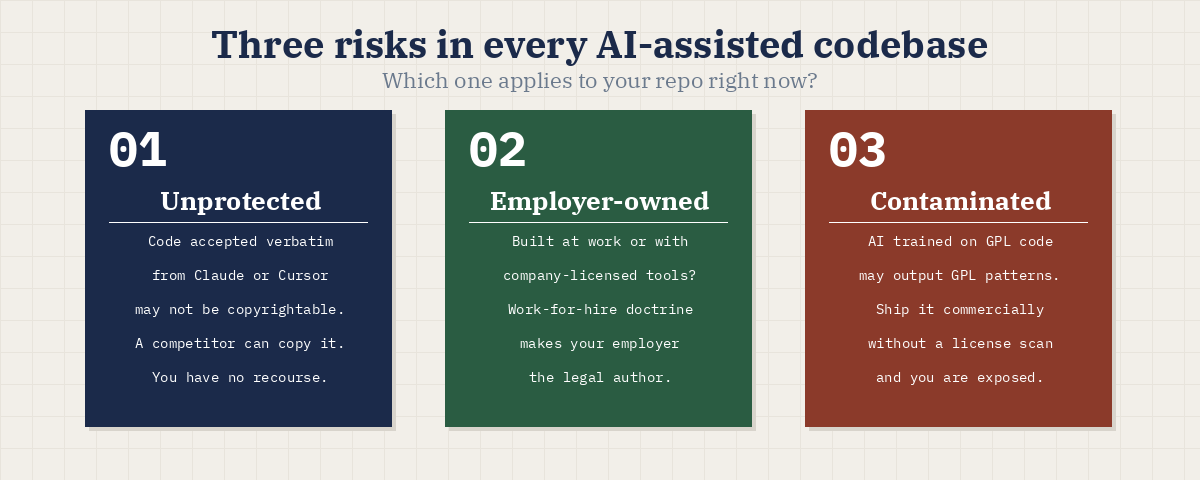
If you shipped code this week, some of it was probably written by an AI. The question of who legally owns that code is less settled than most developers assume, and the answer depends on three things that have nothing to do with how good the code is:

  1. Whether a human made enough creative decisions to establish copyright
  2. Whether your employment contract already assigned it to your employer
  3. Whether the model pulled from GPL-licensed training data and quietly contaminated your codebase

On March 31, 2026, Anthropic accidentally published 512,000 lines of Claude Code’s source code in a routine software update through a missing configuration file. Before sunrise, the codebase was mirrored across GitHub. Before breakfast, a developer had used an AI tool to rewrite the entire thing in Python, and the “claw-code” repository hit 100,000 GitHub stars in a single day, the fastest in history. Then came the DMCA takedowns, and then came the question nobody had a clean answer to:

If Claude Code was, by Anthropic’s own lead engineer’s admission, predominantly written by Claude itself, does Anthropic even own it? Can you issue a DMCA takedown for code that copyright law may not protect?

That incident compressed every open question about AI-generated code ownership into a single news cycle. The same questions apply to your codebase.

Three risks in every AI-assisted codebase

The copyright rule nobody told you

Here is the legal baseline, in plain terms: Copyright only protects work created by a human.

The US Copyright Office has confirmed this consistently, and the DC Circuit upheld it in the Thaler case. When the Supreme Court declined to hear the Thaler appeal in March 2026, it did not endorse the lower court’s reasoning or settle the question nationally. Cert denial means the court chose not to hear the case, nothing more. What it does mean is that the DC Circuit’s ruling stands, the Copyright Office’s position is intact, and no court has yet gone the other way. Works predominantly generated by AI without meaningful human authorship are not eligible for copyright protection under current doctrine, and that position is stable even if it is not finally settled.

Two important limits on what Thaler actually decided.

  1. The case involved a painting created with zero human involvement at all. Thaler listed the AI system as sole author and made no claim of any human creative contribution. The ruling does not directly address the harder question of AI-assisted work where a human was involved but the degree of that involvement is disputed.
  2. Thaler involved visual art. No court has yet applied the human authorship doctrine specifically to code output from an AI coding tool. The logic applies, but the direct precedent does not exist yet.

What it means for you: Code that Claude Code or Cursor generated and you accepted without meaningful modification may not be copyrightable by anyone. If a competitor copies it, you may have no legal recourse, because the code sits in the public domain in everything but name.

What counts as meaningful human authorship?

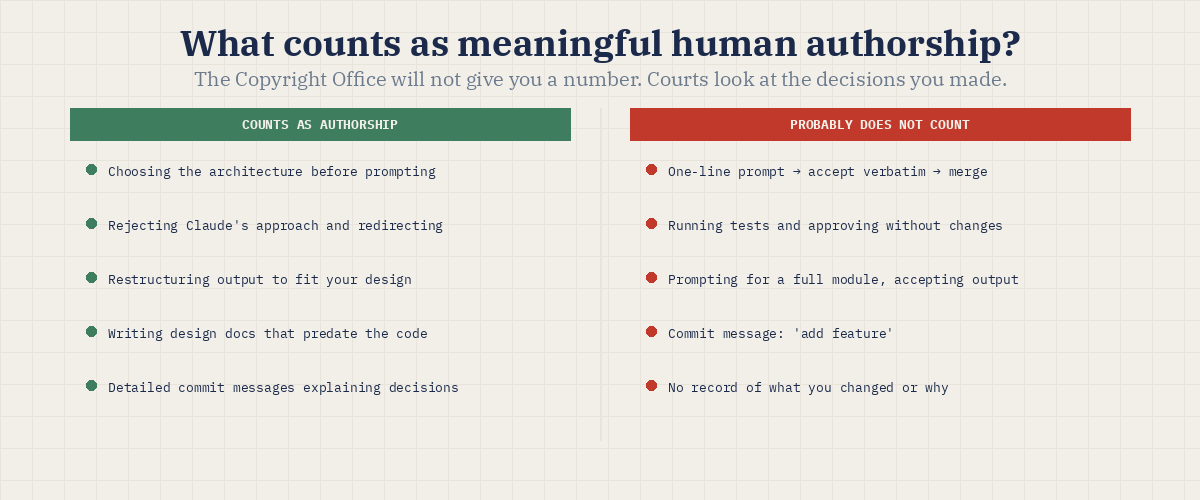
The phrase that determines whether your code is protected is “meaningful human authorship,” and the Copyright Office has deliberately refused to quantify it with a percentage or a number of edits, because what courts look for is evidence that a human made genuine creative decisions:

  • Choosing the architecture
  • Deciding what to reject
  • Restructuring the output to fit a specific design

Specifying an objective to the model is not enough. Directing how the work is constructed is what counts.

In an agentic workflow, this distinction is harder to establish than it sounds. Consider a typical Claude Code session:

  • You write a one-line prompt: “build a rate limiting module for the API.”
  • Claude Code plans the approach, generates five files, and iterates through three versions.
  • You review the output, run the tests, and merge.

Your contribution in that sequence is your architectural intent and your final approval. Whether that constitutes meaningful human authorship in a courtroom is an unresolved question with no definitive court ruling yet.

The honest answer is: probably yes for modules you substantially redirected, probably no for code you accepted verbatim, and unclear for everything in between.

The middle ground is actively being litigated right now. In Allen v. Perlmutter, artist Jason Allen is challenging the Copyright Office’s denial of registration for a work he created using more than 600 detailed prompts and subsequent editing in Photoshop. The Copyright Office acknowledged the Photoshop edits as human-authored but still denied registration for the AI-generated underlying elements. That case has not been decided yet, and whatever it decides will be the closest thing to a ruling on how much human involvement is enough.

The closest existing precedent on partial protection is Zarya of the Dawn, a graphic novel where the Copyright Office granted registration for the human-authored text but denied it for the Midjourney-generated images. That decision establishes a practical principle developers can use right now: The human-authored elements of an AI-assisted codebase may be separately protectable even if the generated code itself is not. Your architecture documents, your design decisions recorded in commit messages, your ADRs, your prompt logs showing deliberate redirection, these may be protectable as human-authored expression even if the code they produced is not. Protecting what you can starts with documenting what you actually did.

What your employer probably already owns

Before you think about whether your code is copyrightable, there is a more immediate question: Even if it is, is it actually yours?

Your employment contract almost certainly says that anything you build at work belongs to your employer. That principle has a name in copyright law: the work-for-hire doctrine. Under it, any code created by an employee within the scope of their employment is owned by the employer, who is treated as the legal author, regardless of whether the code was written by hand, generated by Claude Code, or some combination. Using an AI coding tool during work hours, on a work project, on a work machine, does not change who owns the result.

Most employment contracts go further than the doctrine’s defaults. Look for a section in yours called “Intellectual Property,” “IP Assignment,” or “Work Product.” Open the contract, search for those terms, and read that section. A clause that says any of the following almost certainly covers your AI-assisted code:

  • “Any work product created using company equipment or resources”
  • “Any invention or development made during the term of employment”
  • “Any software created with the assistance of company-licensed tools”

The third one is the one to watch. If your employer licenses Claude Code, Cursor, or Copilot for the team, and you use those same tools to build a side project, a broad IP assignment clause may give the employer a claim over that project, even if you built it on your own time.

A senior developer in San Francisco described exactly this situation earlier this year. He had used Claude Code for work projects and for a personal fitness tracking app built on evenings and weekends. His company updated its IP policy and claimed everything he had built with AI assistance, including the personal app, arguing that because Claude had access to open work files in the IDE, any AI output was a derivative work of company IP.

This is the clearest example of how far this can stretch. His company’s claim rested on one phrase: The AI tools were “context-aware” of his company’s codebase. The argument does not hold up legally, because context visibility in an IDE does not make AI output a derivative work of files that were open nearby, and the connection between what Claude can see and what it generates is probabilistic pattern completion, not copying. But the argument illustrates what employers are starting to claim. If the clause is broad enough, it has surface validity regardless of what the AI actually did.

The practical rule: If you are building something on the side, use a personal account, a personal machine, and tools you pay for yourself. Keep your employer’s licensed tools out of that workflow entirely.

The open source contamination problem

Even if you own your AI-generated code, you may have already contaminated it with an open source license you cannot see.

AI coding tools are trained on massive amounts of public code, including code licensed under the GPL, LGPL, and other copyleft licenses. Copyleft licenses carry a specific obligation that travels with the code:

  • If you distribute software that is a derivative of GPL-licensed code, you must release your own source code under the same license.
  • This applies even if you did not know the code you incorporated was GPL-licensed.
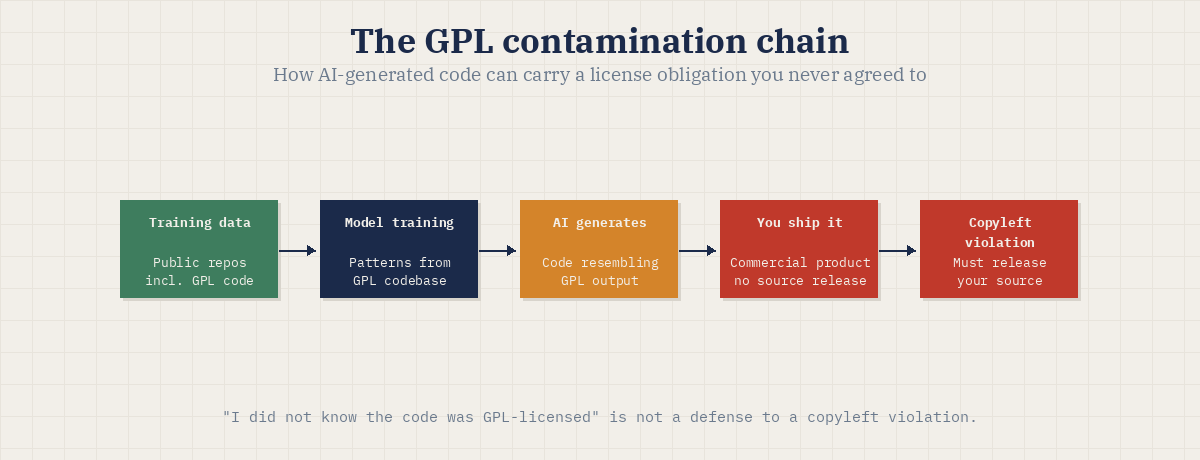
  • “I did not know” is not a defense to a copyleft violation.
The GPL contamination chain

When an AI tool reproduces a substantial verbatim portion of GPL-licensed code from its training data, and you ship that code in a commercial product without releasing source, you may have created a copyleft violation without ever touching the original repository. The legal standard for infringement is substantial verbatim reproduction, not functional similarity or resemblance, and this distinction matters: an AI tool generating code that works like GPL code is different from an AI tool that reproduces GPL code word for word. The risk sits at the verbatim end of that spectrum, and the problem is that you have no way to know which side of the line your codebase is on without running a scan.

The chardet community dispute made this concrete in early 2026. This was not a filed lawsuit but a public dispute within the open source community that raised the question without resolving it legally. A developer used Claude to rewrite chardet, a Python character encoding library, and rereleased it under an MIT license, arguing that the AI rewrite was a “clean room” implementation free of the original LGPL license.

The legal question the community fought over: If Claude was trained on the LGPL-licensed codebase and its output reproduces substantial verbatim portions of that code, can the output be treated as license-free? The chardet dispute did not resolve cleanly and no court has issued a definitive ruling on this specific question. What is settled is that verbatim copying of GPL code violates the license regardless of how it was produced. What is unsettled is whether AI-generated output that reproduces training data patterns counts as verbatim copying. The working assumption among lawyers advising companies through M&A is that it probably does, and that assumption is now showing up as a standard condition in acquisition due diligence.

The Doe v GitHub litigation, still working through the Ninth Circuit as of April 2026, is asking whether GitHub Copilot reproduces licensed code without attribution in violation of copyright law and DMCA Section 1202. The district court dismissed most claims but the appeal is live. Whatever the outcome, the litigation has already changed industry behavior: GitHub Copilot added duplicate detection filters, and acquisition due diligence now routinely includes an AI codebase license scan.

What to do about all of this

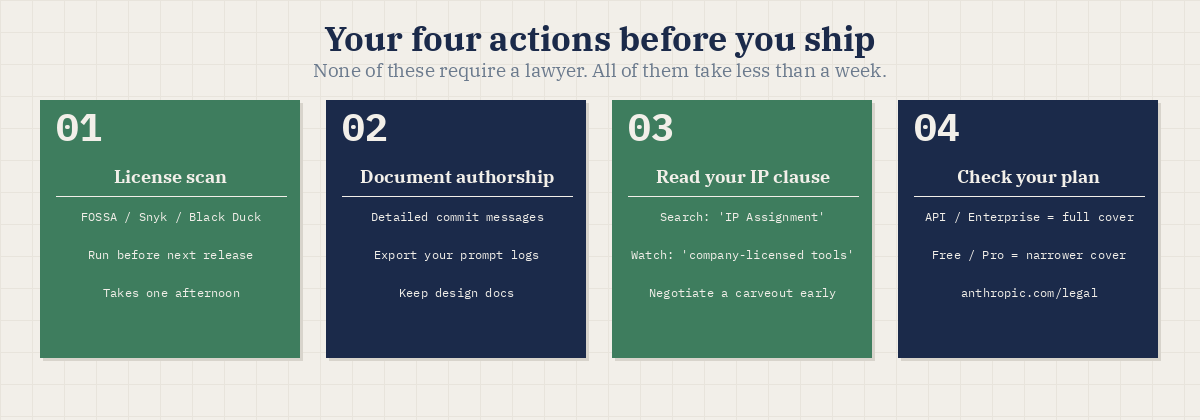
Your four actions before you ship

Four concrete actions, none of which require a lawyer.

1. Run a license scan on your AI-assisted codebase

Tools that do this well:

  • FOSSA—most comprehensive, widely used in enterprise
  • Snyk Open Source—good for dev-team workflows, integrates with GitHub
  • Black Duck—standard in M&A due diligence

Each will scan your codebase, flag code that matches known open source libraries, and identify the licenses attached. If you are shipping a commercial product and have never run one of these, you are operating on assumption. The scan takes an afternoon and costs less than the first hour of a copyright dispute.

2. Document your human creative contributions as you go

The evidence that establishes meaningful human authorship is the same evidence you already produce in a normal engineering workflow. You just have to keep it deliberately rather than letting it disappear.

What to preserve:

  • Commit messages that describe what you changed and why, not just what the AI generated. “Restructured Claude’s module architecture, rejected initial state management approach, rewrote error handling from scratch” is evidence. “Add rate limiting module” is not.
  • Prompt logs. Claude Code and Cursor both retain interaction history. Export or screenshot the sessions where you made significant architectural decisions.
  • Design documents, ADRs, or any notes that predate the generated code and show you specified the structure before the AI built it.

The second commit message versus the first is the difference between a defensible authorship claim and a clean “Claude wrote this” record.

3. Read the IP clause in your employment contract before you build anything on the side

Open your contract, search for “intellectual property,” “IP assignment,” or “work product,” and read that section carefully. The specific language determines your exposure:

  • “Work product created during employment hours” is narrower than “work product created using company resources.”
  • “Relating to the company’s business” is narrower than “any software development.”
  • “Company-licensed tools” is the phrase that captures AI coding tools even on personal projects.

If the clause is broad and you want to build something independently, you have three realistic options: negotiate a written carveout before you start (easier at the start of a new role than mid-employment), use entirely personal tools on entirely personal time on a personal machine, or accept that the claim exists and decide whether the risk is worth it.

4. Check which Anthropic plan you are on before shipping for commercial use

Go to anthropic.com/legal and compare the consumer terms against the commercial terms. The difference that matters:

  • Consumer terms (free and Pro plans): Anthropic assigns outputs to you, but the IP indemnification is narrower and covers fewer scenarios.
  • Commercial terms (API and enterprise): Anthropic assigns outputs to you and will defend you against copyright infringement claims arising from your authorized use of the service and its outputs.

If you are shipping AI-assisted code in a commercial product using the free or Pro plan, the indemnification gap is real. The API or enterprise agreement is the appropriate tier. Note that neither indemnification covers a downstream GPL violation from license contamination in your codebase. That is your governance problem to solve with the license scan in action 1.

The thing worth sitting with

Anthropic’s own lead engineer publicly stated that his recent contributions to Claude Code were written entirely by the AI, and the leaked codebase that Anthropic issued 8,000 DMCA takedowns to suppress may be predominantly AI-authored. Whether Anthropic’s copyright claims over that codebase are legally valid remains an open question no court has yet resolved.

If the company that built the tool cannot cleanly assert copyright over its own AI-assisted code, the question of whether you can is worth taking seriously before it becomes relevant in a transaction, a dispute, or an acquisition conversation. The developer who documents their creative contributions from the start is in a meaningfully different legal position than the one who accepted three thousand lines of Claude output and merged without review, even if both shipped the same product.

A note on what this piece covers and what it does not

Three things in it are settled law:

  • Works lacking human authorship are uncopyrightable,
  • The work-for-hire doctrine applies regardless of how code was generated.
  • Verbatim copying of GPL-licensed code violates the license.

Two things are emerging consensus without definitive court rulings yet:

  • How much human direction is enough to establish meaningful authorship in an agentic workflow
  • Whether AI output that reproduces training data patterns counts as verbatim copying

One thing is genuine speculation:

  • Whether any of this will be litigated at scale in the near term

Most code copyright claims never reach court. The place where the unsettled questions become concrete today is M&A due diligence and institutional fundraising, where acquirers and investors are already asking these questions as a condition of closing.

If neither of those applies to your situation right now, the four actions above are still worth doing, but the urgency is lower than the piece might imply.

Further reading

1. US Copyright Office—Copyright and Artificial Intelligence (Part 2: Copyrightability)
The primary regulatory source on what qualifies as meaningful human authorship in AI-assisted works. Part 2 covers the specific tests the Office applies when reviewing AI-generated content registrations. Essential if you want to understand exactly where the legal line sits.

2. Andersen v. Stability AI, Midjourney, DeviantArt—Ninth Circuit docket
The foundational case on AI training data and copyright infringement, currently shaping how courts think about what AI models learn and reproduce. Relevant to the GPL contamination question in a way most developers have not connected yet.

3. Doe v. GitHub, Inc.—Ninth Circuit appeal
The live litigation on whether Copilot reproduces licensed code without attribution. Track this one: The Ninth Circuit decision will set the standard that determines whether AI-generated code carrying open source patterns constitutes copyright infringement.

4. GitHub—Copilot and copyright: What you need to know
GitHub’s own legal position on why Copilot outputs are not infringing. Worth reading as a counterpoint: Understanding the argument they make helps you understand where it is strong and where it has limits, particularly on the GPL training data question.

5. FOSSA—Understanding open source license obligations
A developer-friendly reference to how copyleft obligations actually work in practice: what triggers the source disclosure requirement, what constitutes a derivative work, and how the GPL, LGPL, and AGPL differ in their reach. The clearest plain-language guide available on this topic.

6. Anthropic—Usage Policy and Terms of Service
The actual document that determines your IP rights and indemnification scope when you use Claude commercially. Read sections 7 and 8 specifically: output ownership and IP indemnification. The difference between the consumer and commercial terms is stated plainly and takes 10 minutes to understand.

I write about legal architecture for AI products at Legal Layer. This piece is informational and does not constitute legal advice.

  •  

This Week in AI: The Next-Gen Recommendation Experience

This week Miguel Fierro, a former Microsoft principal researcher who recently founded his own company, RecoMind, joined data and AI evangelist Christina Stathopoulos to talk about the state of recommendation systems. Christina also ran through the latest AI news she’s been watching, from Anthropic’s continued rise to responsible AI, announcements from Google’s I/O 2026 conference, and (continuing the discussion from last week) the growing backlash against tokenmaxxing as a productivity metric. Here are three takeaways from the conversation.

Recommendation systems are a bigger deal than most companies realize

Miguel has spent the better part of a decade building recommendation systems for enterprise customers at Microsoft, and he thinks most companies are leaving a lot on the table by not paying closer attention to recommendations. Amazon generates roughly 35% of its revenue through recommendations. Netflix attributes 75% of content consumption to them. Best Buy credits recommendations with 24% of revenue. TikTok’s entire user experience is a recommendation engine. And yet many large retailers he worked with at Microsoft weren’t investing seriously in the area, often because they weren’t tracking the value it was generating.

The gap between the top tier and everyone else is wide and getting wider. The most advanced systems today treat user behavior as a sequence prediction problem, similar to how large language models predict the next token. Rather than just encoding clicks, they encode all user actions into embeddings, run sequences through those representations, and use huge 1.5 trillion-parameter models to predict what a user will want next. That’s not something a mid-tier retailer can replicate today, but it signals where the field is heading.

Even if you don’t work in a top well-resourced company, you should still pay attention to the convergence of search and recommendations into a single personalized retrieval layer and the early application of foundation models to recommendation problems. Netflix has built what Miquel described as the only published foundation model in this space; Meta is rumored to be developing one as well. The barrier is data, particularly for smaller organizations. Unlike text, behavioral interaction data isn’t publicly available, so building at that scale requires both proprietary datasets and serious compute.

If you want to get your hands on state-of-the-art implementations, including knowledge graph-based approaches, without starting from scratch, Miguel suggested the open source Recommenders library, originally developed at Microsoft and now housed under the Linux Foundation, as a practical entry point.

The agent hype has a recommender-shaped hole in it

Miguel drew a distinction between true sales agents and what most companies offer today, which are usually just conversational agents. A conversational agent responds to what you say. An agentic sales system understands a customer, anticipates what they want, and surfaces the right product or offer at the right moment—and that requires a recommendation system baked in.

If your “agent” is a chatbot with access to a knowledge base, it’s not doing recommendation. Recommendation systems need training data, a retrieval layer, and a personalization model, none of which you get for free from a foundation model API. A language model can answer questions about a product catalog, but it can’t offer up personalized recommendations unless it also has a model of the customer’s preferences, history, and likely next action. Most companies don’t have the infrastructure in place to make that possible. . .yet.

The responsible AI conversation has left the research community

What’s notable about the responsible AI conversation right now is the range of institutions offering their perspective. Anthropic, alongside announcing a funding round pushing its valuation toward $1 trillion, urged a global pause on AI development tied to the risk of recursive self-improvement: systems that can design and develop their own successors. The Future of Life Institute published The Better Path for AI, a framework arguing for capability development oriented toward human benefit rather than human replacement. And the pope issued a formal encyclical focused on AI and the common good.

None of these institutions is making the same argument, but the convergence of their attention matters. Responsible AI used to be a specialized conversation happening largely within research labs and a small set of policy organizations. It’s now a topic where major AI companies, religious institutions, and civil society groups are all staking out public positions in the same news cycle.

For the technical community, this creates both pressure and opportunity. “We’re thinking about safety” is no longer a sufficient posture; external scrutiny is intensifying from directions that don’t share the field’s assumptions or vocabulary. But the broader conversation creates real demand for practitioners who can translate between what responsible AI actually requires in practice and what policymakers, executives, and institutions are trying to figure out. That translation work is increasingly where the field needs people.

What’s next

Join us Monday morning for the next episode of This Week in AI, where YK Sugi and John Lindquist will break down the massive structural and financial shifts reshaping the technology industry. (They’ll also chat about the recent release of Claude Fable 5.) And on July 23, Christina will be hosting the AI Superstream on AI harnesses, a four-hour event focused on agentic AI and the frameworks practitioners need to move from models to agents. Both are free to attend. Register now to save your seat.

For deeper reading on topics covered this week, Christina recommended three titles available on the O’Reilly learning platform: Hands-On LLM Serving and Optimization, Hands-On RAG for Production, and Large Language Models: The Hard Parts. Not a member? Sign up for a free 10-day trial to check them out.

We’ll continue to publish our takeaways here on Radar each Friday and share full episodes on YouTube, Spotify, Apple, or wherever you get your podcasts.

  •  
❌