❌

Normal view

Reading today's open-closed performance gap

20 April 2026 at 18:25

It’s a clear, current equilibrium that open models will be in perpetual catch-up of closed models, but this gap being viewed as a single number, a “distance”, covers up a nuanced and crucial dynamic at what capabilities the models are covering. The most popular benchmark to comment on this gap is the Artificial Analysis Intelligence Index — a composite benchmark of ~10 sub-evals that they maintain over time to capture the “frontier” of current language model capabilities.

Particularly, I spend a lot of time understanding how dynamics that feed into that index are misunderstood by the natural tendency to reduce performance and trends to one number. Examples include:

  • How benchmarks evolve over time, becoming more or less correlated with how people actually use models,

  • How different models’ real-world performance relates to their benchmark rankings, and

  • How training regimes evolve over time to move said benchmarks.

Agentic benchmarks are in a decent place, but benchmarks are no longer as trusted as a correlate to real-world performance. A key example to this gray area is Gemini 3’s incredible benchmarks and remarkable irrelevance in where AI tools currently are being tested and deployed (agents). These trends point to obvious and lasting flaws in our measurements.

Share

At the root of this dynamic — the dance of correlating model real-world performance and benchmark scores — is the constant shift of the industry. As all the models, i.e. both open and closed, evolve over time, the topics of focus for benchmarking shifts about every 12 to 18 months. All of the domains of interest have very different training domains associated with them, especially in post-training. The longer a single paradigm goes on, the better the industry gets at measuring performance. In a new era of rapid post-training improvements, I’m at a relative minimum in my personal confidence in benchmarks.

Task evolution and LLM paradigms

Right after ChatGPT the focus was a mix of chat, math, and simple code. Instruction tuning and RLHF dominated. Chat capabilities saturated and faded quickly, then mathematics became less focal. Through 2025 and to today, especially once reasoning models became the default, the focus shifted to more complex coding and other simpler agentic tasks. We’re at the tail end of this first era. Recent training recipes are all dominated by reinforcement learning with verifiable rewards (RLVR), but the domains it is applied in have shifted dramatically from basic question-answer checking to complex environments.

What we’re seeing is that the closed, frontier labs are investing astounding sums of money in mastering these current foci — i.e. code, terminal tasks, etc. — while starting to push into more diverse knowledge work tasks. These newer tasks encompass specialized domains, such as accounting, law, healthcare, etc. They are still agentic, but require more expertise and often integrations with existing software or domain-specific tools.

We have very limited evidence on the true balance of capabilities of these newer domains, but these are the areas I’m focusing on when I say open models will struggle to keep up. The problem is that evaluating complex language model workflows is also a challenging research problem in itself.

The tasks are getting harder and the data needed to hillclimb on them is getting more private (relative to code, which has swaths of code on GitHub). Leading open model labs are helped by dynamics happening in the data industry that are economically similar to building chip fabs. The few, leading labs in the U.S. pay astronomical sums to buy new environments and datasets, then the fast-following labs (often in China), buy these later at a steep discount.

This is a key missed point — that the levers non-frontier labs pull to keep up constantly shift over time. A focus on distillation as the key lever to Chinese models’ progress reflects a blind-spot to the importance of RL environments to current training regimes. If an environment can be built either as a single evaluation in the Artificial Analysis Index, or to mirror it, currently the Chinese labs will be able to keep up.

Interconnects AI is a reader-supported publication. Consider becoming a subscriber.

Economic pressure to reinvent “the frontier”

The question worth dwelling on is: How crucial is the current set of tasks (again, coding and terminal tasks), where the likes of OpenAI and Anthropic have a massive business-adoption advantage over leading open weight models (and even Google alike), is crucial to maintaining revenue numbers? In order to maintain these record growth numbers and trajectories, there needs to keep being a meaningful edge in performance. Many companies would love to reduce their token expenditure cost if they can swap in a far cheaper, open model equivalent.

If agentic coding abilities saturate and the “frontier” of AI performance moves elsewhere, a large amount of the enterprise revenue could be reliant on well-formed customer relationships, inertia, and better product development, rather than the models being leaps and bounds better.

This precarious position is what I describe as the frontier labs needing to constantly reinvent themselves, and the field’s prospects, for monetizing the vast buildout of AI infrastructure. I still tend to fall on the side that the buildout will be worth it, and Anthropic and OpenAI will be astronomically profitable businesses, so I take this as a faith of a mix of them continuing to unlock compelling, new, valuable use-cases for the models, and that the benchmarks the open models are closing in on as not being a complete signal.

I operate with a sort of presumption where the leading open models from China are focused slightly more on benchmarks than the leading closed labs in the U.S. They’re incentivized to do so — they want to present the image as constantly being on the heels of the best closed models. Saying the Chinese labs are only in this narrative because they’re overfitting to benchmarks would be incredibly naive and incorrect. They’re genuinely strong models, and these dynamics of overselling and real innovation are a fine balance.

There are a few out-of-distribution benchmarks where open-weight models are very far behind, such as WeirdML or ARC AGI 2, but there are countless random benchmarks that show these open models as being unexpectedly strong. When you use the models, you can pick up on this lack of robustness (e.g. in long-context capabilities, and needing to reset your agent context more often than Claude/Codex), but they’re not a category error in the sense that they’re fundamentally different classes of models. They’re far closer than many would’ve expected.

How long can open models keep up?

Read more

My Workflow for Understanding LLM Architectures

18 April 2026 at 11:24

Many people asked me over the past months to share my workflow for how I come up with the LLM architecture sketches and drawings in my articles, talks, and the LLM-Gallery. So I thought it would be useful to document the process I usually follow.

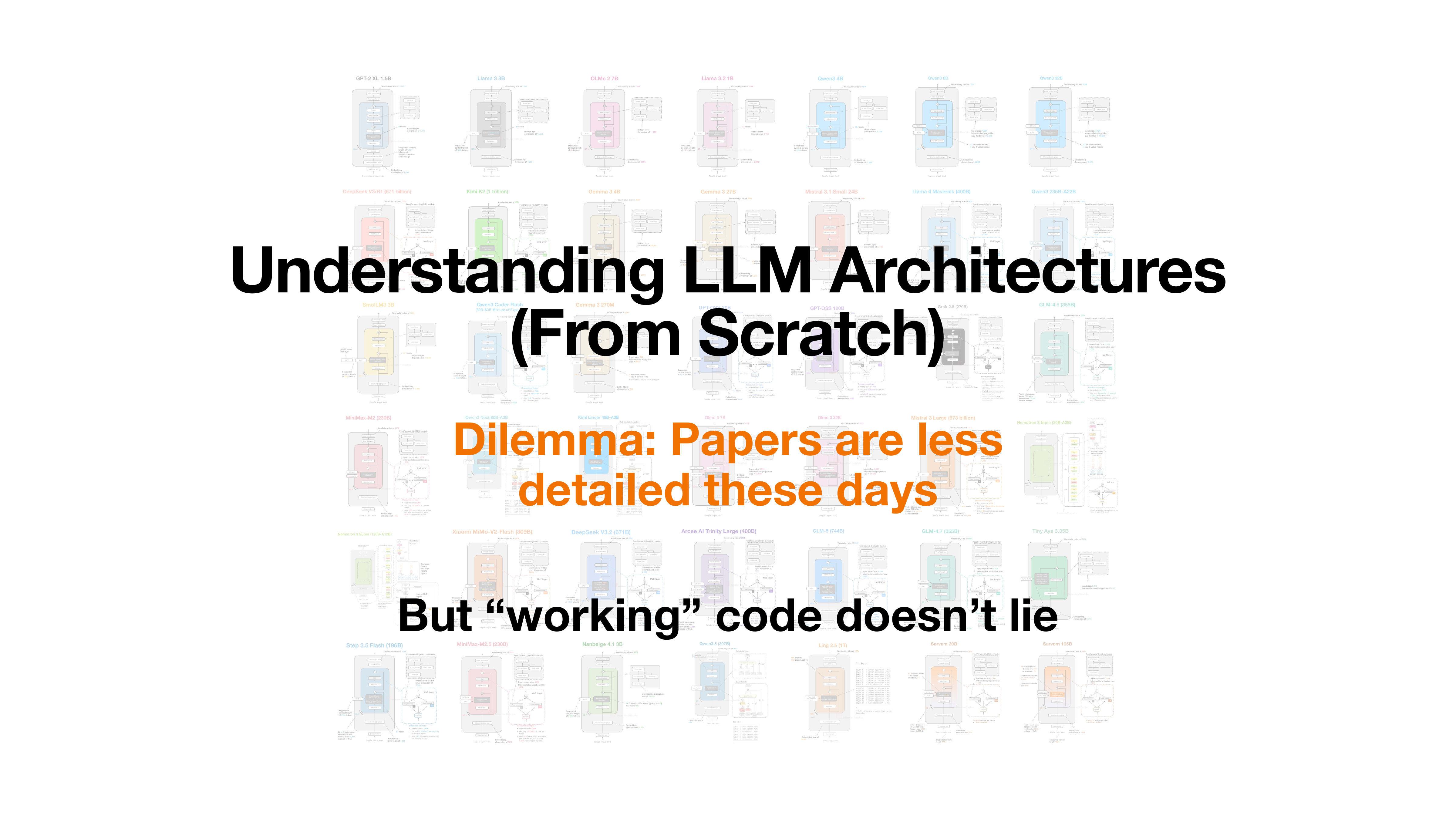
The short version is that I usually start with the official technical reports, but these days, papers are often less detailed than they used to be, especially for most open-weight models from industry labs.

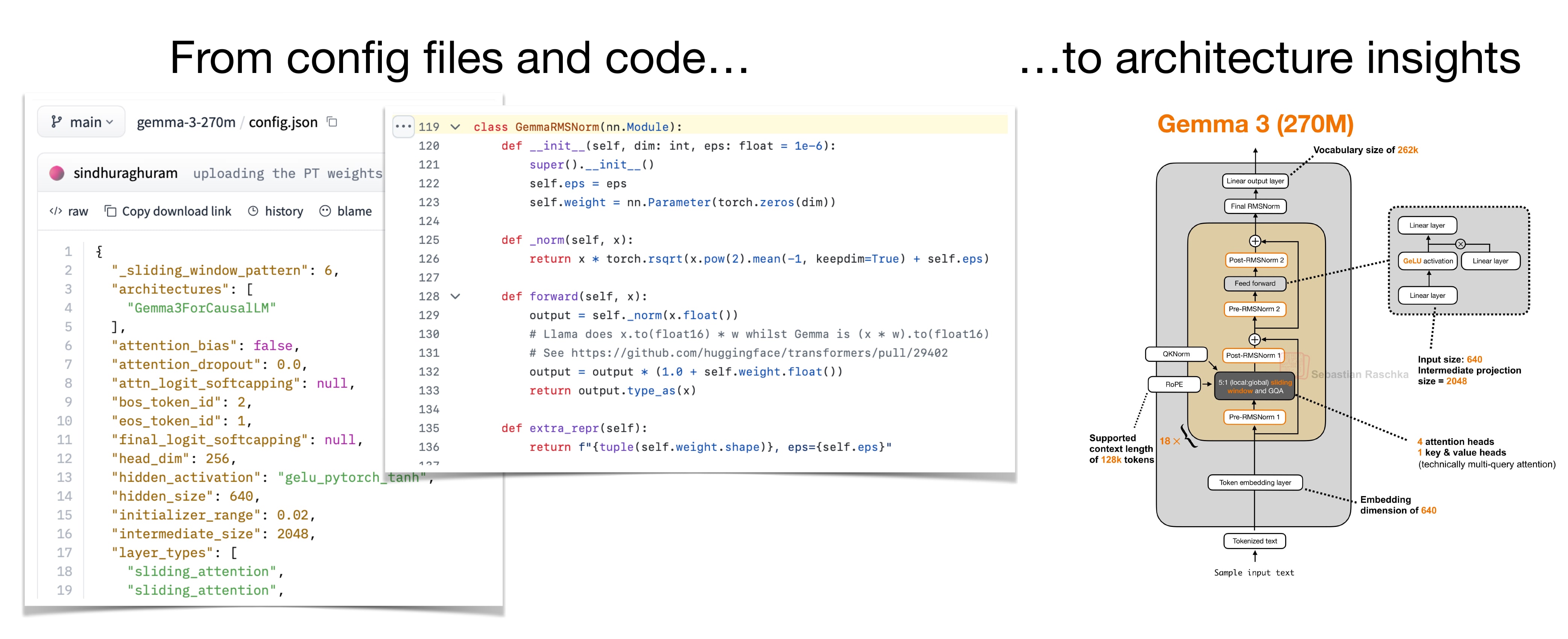
The good part is that if the weights are shared on the Hugging Face Model Hub and the model is supported in the Python transformers library, we can usually inspect the config file and the reference implementation directly to get more information about the architecture details. And “working” code doesn’t lie.

Figure 1: The basic motivation for this workflow is that papers are often less detailed these days, but a working reference implementation gives us something concrete to inspect.

I should also say that this is mainly a workflow for open-weight models. It doesn’t really apply to models like ChatGPT, Claude, or Gemini, where the weights and details are proprietary.

Also, this is intentionally a fairly manual process. You could automate parts of it. But if the goal is to learn how these architectures work, then doing a few of these by hand is, in my opinion, still one of the best exercises.

Figure 2: At a high level, the workflow goes from config files and code to architecture insights.

Read more

Isabelle/HOL: The proof assistant behind the Nitro Isolation Engine

17 April 2026 at 13:00
At Amazon’s 2025 re:Invent conference, Amazon Web Services (AWS) announced the Nitro Isolation Engine (NIE), a software module tasked with providing resources to AWS clients while ensuring the security of customer data. AWS also announced the formal verification of the isolation engine’s correctness and security guarantees, using a proof assistant called Isabelle/HOL. As the first formally verified cloud hypervisor, NIE sets a new standard for cloud security. A proof assistant is an automated tool that can help human users develop formal proofs — of mathematical theorems, the validity of hardware or software systems, or anything in-between. Several proof assistants are in common use, and we chose Isabelle/HOL because it struck the right balance among expressiveness, automation, proof readability, and scalability. So what do I mean by that? Logical reasoning by computer There is no fixed language of mathematics, but we can create languages for expressing mathematical reasoning, just as programming languages express computational tasks. And just as programming languages involve trade-offs between expressiveness and performance, mathematical languages involve trade-offs between expressiveness and ease of automation. Automation is vital because the construction of a formal proof is both time consuming and extremely tedious, analogous to constructing a ship in a bottle. The most elementary mathematical language is Boolean logic, the world of the binary operators AND, OR, and NOT. Because this language is so simple, powerful automatic solvers exist for it. In 2016, Carnegie Mellon professor Marijn Heule — now an Amazon Scholar — and his colleagues encoded into Boolean logic an unsolved mathematical question, the Boolean Pythagorean Triples Problem, and used automatic solvers to help create the largest proof ever, 200 terabytes long. A richer mathematical language called first-order logic allows us to talk about some domain of interest — the integers, say — and to define functions over that domain. And we can go beyond Boolean logic by including the quantifiers "for all" and "there exists" in assertions. In this sort of language, we can express statements such as "every prime number greater than two is odd". We can also prove the following theorem, due to Lewis Carroll: No ducks waltz; no officers ever decline to waltz; all my poultry are ducks. Hence, none of my poultry are officers. However, most people prefer a still stronger mathematical language, where they can define types, as they do in programming. In higher-order logic, there are even function types, as found in functional programming languages such as Haskell. Higher-order logic is much richer than first-order logic, able to express statements such as Every set containing the number 1 and closed under addition contains all the positive integers. It appears to be rich enough to express most of mathematics. The richest mathematical languages — called dependent-type theories — even allow types to take arbitrary values as parameters, e.g., T(i), where i is an integer. The best-known such languages are Lean and Rocq. Powerful automatic theorem provers exist for first-order logic, but for higher-order logic and beyond, full automation is not available. This is the price of expressiveness. A proof assistant allows users to build proofs interactively, supported by partial automation and the possibility of coding their own proof searches. A proof assistant enforces strict compliance with the laws of logic, typically through a kernel architecture that gives only a limited portion of the code the right to create a theorem. A proof assistant also supports the interactive development of a possibly huge formal-specification hierarchy. For example, verification of the Nitro Isolation Engine (NIE) rests on specifications of the architecture of the Graviton-5 processor, the Rust code of the hypercalls and their functional correctness, and the security properties that are to be proved. These take up much of the quarter of a million lines constituting the formal proof. Higher-order logic is supported by HOL and HOL Light, two closely related proof assistants, and has been used to verify hardware designs, floating-point algorithms, and pure mathematics since the 1990s. AWS senior principal applied scientist John Harrison developed HOL Light, and he has used it to improve the performance of digital signatures on Amazon’s Graviton2 chip by up to 94%, by verifying an optimized version of the cryptographic algorithms. The code was delicate, and exhaustive testing is not feasible; only a formal verification of full functional correctness would do before the deployment of such critical software. But today we are interested in Isabelle/HOL. Overview of Isabelle/HOL The most visible difference between Isabelle/HOL and the other HOL systems — which are all based on higher-order logic — is its specification and proof language. With most proof assistants, users state what they want to prove, followed by lists of commands that replace the original goals with series of subgoals in a kind of whack-a-mole game. In Isabelle and to some extent Lean, the proof language allows desired intermediate goals to be written out explicitly, allowing a better controlled proof process and a more legible proof document. There are plenty of examples online. Other notable features are as follows: a user-configurable parser, which allowed us to embed a significant fragment of the Rust language into our specifications; type classes for principled overloading, so that say + can be given its natural meaning, not just for a variety of numeric types but for machine words and in other appropriate contexts; locales, a lightweight module system allowing a hierarchy of specifications to be defined and interpreted in various ways, even within a proof; powerful built-in automation through simplification and backchaining proof search; sledgehammer: one-click access to even more powerful external automation; counterexample-finding tools, for identifying claims that are actually false; code generation from executable higher-order specifications, which we used to test conformance. For the verification of NIE, we began by implementing a specialized language called separation logic on top of Isabelle/HOL. Separation logic is designed for verifying program code operating on shared resources. We coded our own proof automation and also used what was built in. We therefore could use separation logic but also plain higher-order logic when we wanted to. Isabelle turned out to be resilient enough and efficient enough to cope with the truly gigantic subgoals. It could run that quarter-million-line proof in half an hour using an off-the-shelf laptop. Some applications of Isabelle/HOL The single most impressive application of Isabelle prior to NIE is probably the verification of seL4, a widely used microkernel. This proof was also about a quarter of a million lines when first announced, although it is now much longer. The seL4 developers proved that the microkernel’s C implementation refined the abstract specification, yielding full functional correctness of the core operations. And they have observed no bugs in the verified parts of the code, although testing still plays a role in covering unverified parts and certain assumptions that cannot be formalized. Isabelle was also used in the following projects: to formalize the semantics of the WebAssembly language, to identify errors and, in particular, to prove the soundness of its type system; to create a verification framework for the Cogent programming language; to prove the correctness of algorithms for conflict-free replicated data types, which are used for distributed editing; to formalize numerous results in pure mathematics; to verify cryptographic protocols at an abstract level. Isabelle is free, open source, and available to download. It runs on all the main operating systems on any machine that has enough memory.

My bets on open models, mid-2026

15 April 2026 at 18:20

We’re living through the period of time when we’ll learn if open models can keep up with closed labs. The obvious answer is that no, they won’t. This answer is a form of saying they won’t keep up in every area. This framing closes off a popular prediction where the open models completely catch up, as in all models saturate and open and closed models only become increasingly similar. In living through this, it’s evidently very unclear when the longer-term stable balance of capabilities will solidify.

This is a very complex dynamic, where the core point we monitor is a capability gap between models. At the same time, this gap is intertwined with evolving dynamics in the funding of open models, who builds open models, how techniques like distillation that enable fast-following translate through new application domains, potential regulation hampering the open-source AI ecosystem, and of course who actually uses open models.

The capabilities gap is one signal in a complex sea of forces, pushing supply and demand into different shapes. In many cases the demand — where obviously tons of individuals, organizations, and sovereigns want, or need, open models — is largely separated from supply. Supply is fully dictated by economics. The question of “which business strategies support releasing open models” is still at stake.

Interconnects AI is a reader-supported publication. To receive new posts and support my work, consider becoming a subscriber.

With this complexity, I wanted to distill my key beliefs down into a clear list. These are downstream of 10+ pieces I’ve written or recorded on open models this spring (which are linked throughout).

  1. It’s surprising that the top closed models did not show a growing capability margin over open models, based on compute differences for training and research, especially in the second half of 2025 and through today.

  2. Open model labs are technically very strong at keeping pace on well-established benchmarks. This will continue and reflects a balance of abundant talent and sufficient computing power.

  3. Chinese open-weight labs focus slightly more on benchmark scores than comparable closed labs in the U.S. Distillation helps the Chinese LLM companies do so, but it’s not a panacea. Changes in the distillation dynamic (e.g. regulation) will not be a determining factor on the balance of capabilities. This increase in focus is a natural evolution of their incentives in keeping the narrative on keeping up with the frontier alive, which is crucial to fundraising and adoption.

  4. To date, closed models tend to be more robust and generally useful than similarly scoring open models. Closed models have certain hard-to-measure qualities that are not well captured in current or past benchmarks. This will be key to enabling closed models to dominate in markets where an individual user constantly presents new challenges, i.e. supporting knowledge workers as a direct assistant.

  5. The open vs. closed model race, as monitored through benchmarks, will largely be a game of economic staying power and fast-following, until the market structure constricts. I expect Chinese open-weight labs to face funding difficulties first, as soon as later this year. Funding difficulties will be seen in different capability trajectories 3-9 months later.

  6. The RL dominated training era has increased the relevance of distribution to real-world use-cases as a key factor in continued capabilities improvements. These are tasks where users directly use tools like Claude Code or Codex to solve problems in their job with agents. This is the first clear technical area that closed labs can dominate open-weight models on capabilities, potentially leveraging online RL directly based on user feedback.

  7. Open models will be increasingly adopted in repetitive automation tasks, as measured in the relative share of the API market, for repetitive tasks across the ecosystem. This takes the form of many new AI-native applications, business backend automation, etc. The success of this will drive more investment in domain-specific, efficient open models.

This is a complex picture, where the long-term trajectory is more of an economics question rather than an ability one. Many other outlets can paint a far more simplistic narrative that “China will assuredly catch us in AI” and get more distribution because it is a simple story. The reality is complex. Only real AI revenue begets more investment, eventually that’ll be linked to the ability to keep improving models at a rapid rate. Economic realities have not yet impacted scaling open models, as a general category.

Share

This economic-focused angle relates to my positions on the open model ecosystem more broadly.

  1. Recurring calls to ban certain types of open models will continue to come but are in practice impossible to implement. Training strong AI models (i.e. near but not at the frontier) is a relatively small cost compared to large-scale deployments. E.g. if the U.S. bans open models over a certain compute threshold, another sovereign entity will eventually train them and release them publicly, with the models entering the U.S. market with less oversight.

  2. The second derivative of influence on open models has shifted, and the U.S. will slowly regain ground in adoption metrics of open models starting in early 2027 (it takes a long time for China’s velocity to slow, then flip). Examples include Google’s Gemma 4 (a wild success), Nvidia’s Nemotron, and Arcee AI.

  3. As ever-stronger closed models are built, previewed, and released, there will be more safety-shocks saying that open-weight versions of the strongest AI models never can be allowed to exist, similar to reactions to Claude Mythos. These can spur burdensome regulation on open models.

  4. With the above, there will also be increased long-term interest in open models, as sovereign entities and existing power structures realize the coming, super powerful AI tools cannot land in the hands of only one or a few companies. These entities will see open models as a different governance paradigm.

  5. New funding structures for open models will emerge, as many stakeholders realize dependencies on single, for-profit companies for access to intelligence are unreliable.

  6. Local agents, OpenClaw, and other personal agents represent a large, to date, mostly ignored market for open model usage. It is a sort of dark matter, with pervasive, massive potential for influence on the balance of open-to-closed models.

A single word governs this post and is intentionally repeated — complex.

This complex reality has been driving me to think more deeply about how to clearly describe the open model gap, and why I can hold it in my head that I expect American closed labs to clearly draw ahead, despite the fairly unequivocal evidence in support of the capabilities of recent open-weight models. More on the nuance in the open-closed gap in another piece coming soon, so please subscribe!

Let me know any positions that I missed.

Customized Amazon Nova models improve molecular-property prediction in drug discovery

15 April 2026 at 16:10
In recent years, large language models (LLMs) have become indispensable assistants for software engineers and knowledge workers. Nimbus Therapeutics enlisted us at Amazon’s Generative AI Innovation Center and Artificial General Intelligence (AGI) organization to investigate whether it’s possible to make equally capable assistants for medicinal chemists discovering new drugs. Such an agent could significantly speed up drug discovery, potentially saving lives. AI in drug discovery has traditionally involved models called graph neural networks, or GNNs. GNNs are the workhorses of molecular-property prediction across pharmaceutical R&D, and for good reason: they deliver strong accuracy on well-defined tasks. Typically, multiple GNNs, specialized for different molecular properties, have to be built and maintained in-house — an expensive, operationally complex process. In recent years, the success of LLMs in a variety of research domains has caught the eye of biotech firms, but for drug discovery, general, off-the-shelf LLMs have proven to be less accurate than GNNs or other computational methods. We have adopted a new approach that combines the accuracy of GNNs with the generalizability and reasoning ability of LLMs. Using supervised fine tuning (SFT) and reinforcement fine tuning (RFT) to customize a general-purpose LLM, we were able to achieve results comparable to those of using multiple GNNs, at a fraction of the time and labor. Fine-tuned LLMs offer a significantly simplified workflow. In the traditional setting, each GNN has a separate interface, with its own quirks, data formats, and failure modes. Results come back as disconnected numbers that the chemist must manually integrate. When a new property needs to be predicted, someone must construct a multitask dataset and train and validate an entirely new model, a process that can take weeks. In contrast, a single, fine-tuned LLM allows a chemist to submit one query and receive predictions on all molecular properties of interest. Adding a new property requires incremental fine tuning rather than building a new model from scratch. Moreover, a language model opens the door to a qualitatively different capability: conversation. With a fine-tuned LLM, it’s now possible to ask for the reasoning behind the model outputs or to suggest molecular modifications that might yield the desired properties. This points toward an assistant that unifies molecular-property prediction and generation in one interactive experience, which we see as the ideal next step for AI-assisted drug design. Customized LLMs unlock domain-specific scientific assistants, giving lean biotech teams a practical way to collaborate with AI systems that speak their scientific language. Today, bringing a single drug to market takes 10 to 15 years and costs on average over $2 billion, with only about 8 percent of drug candidates that enter clinical trials receiving FDA approval. We believe that AI assistants could particularly improve productivity in the early stages of this pipeline, where chemists design molecules with druglike properties. Increasing the speed of development and the number of viable candidates would maximize the chances of delivering a safe and efficacious drug to the clinic. What we looked at Our work with Nimbus Therapeutics focused on properties spanning three categories critical to drug development: Lipophilicity (which has one associated property) determines whether a molecule can cross biological membranes. It is fundamental to drug absorption and distribution and affects all other characteristics of a drug. Permeability (four associated properties) measures how easily a drug enters the body via the bloodstream. Clearance (six properties) determines how quickly the body eliminates a drug. A drug that takes too long to be cleared could become toxic; one that is cleared too quickly won’t be effective. These properties span different value ranges and exhibit complex interdependencies — in practice requiring separate multitask GNN models . We tested the general-purpose LLMs Claude Sonnet 4 and Nova 2 Lite on the task of predicting all three sets of properties for particular molecules. Despite their impressive capabilities elsewhere, the models significantly underperformed specialized GNNs, with an accuracy gap that ranged from 40% to over 200% error, as measured by the root mean squared error (RMSE), depending on the property. However, we discovered that Nova 2 Lite with supervised fine tuning (SFT), followed by reinforcement fine tuning (RFT), could close that gap. Our single, fine-tuned LLM predicted 11 different molecular properties with accuracy similar to that of multiple separately trained multitask GNN models. How we did it Our approach to fine-tuning the LLM follows a principle common to both human-expertise development and machine learning: foundational knowledge must precede performance optimization. During SFT, the model learned core concepts such as molecular structure and property relationships. Then, during RFT, training shifted to the development of predictive judgment through practice and feedback. During SFT, we exposed Nova 2 Lite to more than 55,000 molecules labeled with experimental measurements across 11 properties. SFT was essential because the domain-specific tasks we asked the model to perform fall far outside Nova 2 Lite’s generalized pretraining data. For example, we use a notation called SMILES (simplified molecular-input line entry system) to represent chemical structures. Without SFT, the LLM wouldn’t have been able to perform a task like “predict chemical property from SMILES strings in structured JSON format”. The second training stage, reinforcement fine tuning (RFT), is especially critical for properties with limited experimental data, where SFT alone struggles to generalize. RFT also enables the intramodel transfer of learning across properties. For instance, lipophilicity affects permeability, and both can inform metabolism predictions. Further, RFT shifts the learning objective from pattern matching ("given molecule X, output value Y based on similar examples") to quality optimization ("minimize prediction error across all properties"). We tested the SFT and RFT models on 15,000 molecules unseen during training. We also built a system prompt that encompassed a knowledge of both core chemistry and our 11 chemical properties of interest, including their definitions and expected value ranges. During the RFT stage, we experimented with three strategies for generated rewards, which guided the learning process. Molecular-property prediction is particularly amenable to reward engineering for RFT since the output is a single number, which allows us to measure exactly how far off each prediction is. Our first strategy was to use an exponential decay function, so predictions closer to the true value received exponentially higher rewards. But at high error, improving from “terrible” to merely “bad” yielded almost no reward difference, keeping the model from learning from its worst predictions, while at low error, small changes resulted in large reward differences, which made the reward signal noisy and ultimately unhelpful. Our second strategy, binary pass/fail rewards, created the opposite problem. The model received zero reinforcement for gradual improvement: it either crossed an arbitrary threshold (in our case, correct within 10 percent) or learned nothing. Rewards based on the Huber loss — a metric proposed in 1964 by the Swiss statistician Peter Huber, which limits the influence of outliers — solved both issues. Unlike exponential decay, Huber rewards don't become negligible on large errors — the model always receives a meaningful signal to improve — yet they remain stable near the correct answer, refining predictions without overreacting to small fluctuations. This yielded our best result, a 4.9% R² improvement over baseline, and we used the Huber reward as the default for training the model on multiple molecular properties simultaneously. Carrying this forward into multiproperty training, we fine-tuned a single model to predict all 11 properties simultaneously. Our best-performing model was Nova 2 Lite with RFT on top of full-rank SFT, meaning that all the model parameters were updated. It outperforms Claude Sonnet 4 by 39% and base Nova 2 Lite by 37% on average RMSE. While averaging 5% behind the baseline GNN, it matches or outperforms the GNN on 7 of 11 properties — a striking result given that a single LLM is going toe-to-toe with multiple independently trained multitask GNN models, reducing not just model count but the entire infrastructure footprint around training, deployment, and maintenance. It’s important to note that Nova Forge — a service that allows Amazon Web Services customers to use proprietary data during both pretraining and SFT — supports both SFT and RFT on SageMaker, enabling extensive model customization. Since SageMaker handles the training framework and infrastructure maintenance internally, organizations avoid the cost of building and maintaining custom training pipelines from scratch. What’s next? Based on these initial experiments and results, Nimbus Therapeutics recently deployed its Novus model on Amazon Bedrock. Novus is the company’s custom-built LLM, created through Nova Forge. In its current form, Novus handles molecular-property prediction with an accuracy that is competitive with purpose-built GNNs. The next milestone is extending those capabilities toward molecular design, enabling the model to propose structural modifications, predict their downstream properties, and explain its reasoning, all in a single conversation. Acknowledgements Leela Dodda (Nimbus), Aarush Garg (Nimbus), Matthew Medina (Nimbus), Md Tamzeed Islam , Elyse Zhang, Clement Perrot, Rohit Thekkanal, Shiv Vitaladevuni

Partnering with Auctor

By: sbarry
15 April 2026 at 16:00

Partnering with Auctor: AI Autopilot for Software Implementation

Matt, Will and Sky.

For every dollar spent on software, six are spent on services. Why? Because buying enterprise software is easy. Implementing it is hard, and still leans heavily on labour. Across the top 10 software ecosystems (ServiceNow, Salesforce, SAP, AWS, and others), 9 million implementation consultants represent more than $500 billion in annual labour spend, still growing 10%+ a year. It’s one of the largest markets in technology, and one of the least disrupted.

Enterprise platforms have thousands of components that change daily. A single deployment can span hundreds of requirements, dozens of stakeholders, and months of back-and-forth between what a business needs and what the system can actually do. Today, consultants hold all of this together through experience and pattern recognition. But they forget context between meetings. They miss dependencies across systems. They can’t track thousands of platform updates simultaneously. Unlike LLMs, their context windows are limited by biology. 

Auctor is the autopilot for software implementation, from the moment a customer requirement is captured all the way through to delivery. It brings together the requirements, decisions, and context that typically live across meetings, documents, and dozens of disconnected systems, and translates them directly into the outputs needed to move a project forward. What used to take teams weeks of scoping now gets done in a single sitting.

We first partnered with Auctor at the Seed, shortly after the team graduated from YC. At Sequoia, each year we select a handful of portfolio companies and take their founders to meet executives at some of the most important technology companies in Silicon Valley. For an hour, these leaders effectively join the team, helping us and the founders think through strategy, positioning, and go-to-market. In our very first meeting with the C-suite of a major enterprise platform, the executives asked for a pilot halfway through the conversation, before we’d even demoed the product. 

What gave us conviction beyond the market was the team. This is a category where speed of execution determines the winner given the first mover advantage. Will, Sky, and Matt are the hardest-charging, fastest-moving team we’ve met in this space. They shipped their platform and landed their first major enterprise contract within months of graduating YC. They’ve set up shop in New York and are pulling in talent the way only a team with this much momentum can.

We’re leading Auctor’s Series A and couldn’t be more excited to partner with Will and the team to bring software implementation into the age of AI.

Share

Share this via email
JOIN OUR MAILING LIST

Get the best stories from the Sequoia community.

The post Partnering with Auctor appeared first on Sequoia Capital.

What I’ve been building: ATOM Report, post-training course, finishing my book, and ongoing research

14 April 2026 at 20:41

This post is a roundup of my recent efforts that did not warrant a standalone Interconnects post, why I’m spending time on them, and what they accomplished.

  1. The ATOM Report: Measuring the Open Language Model Ecosystem

  2. RLHF Book is done & ready for pre-order!

  3. A post-training course I’m making

  4. Recent technical research

Share

1. The ATOM Report: Measuring the Open Language Model Ecosystem

https://arxiv.org/abs/2604.07190

To accompany The ATOM Project memo, arguably a manifesto, making the case for investment in open models in the U.S. – originally launched in August 2025 – we’ve released an updated technical report with our latest data, analysis, and storytelling within the open language model ecosystem. The ATOM Report is dense with the methods Florian and I use to keep track of the open ecosystem. It covers GPT-OSS’s rise, inference market share, the influence of China’s mid-tier players like Moonshot, Z.ai, & MiniMax, signs of the U.S.’s progress on open models, and much more.

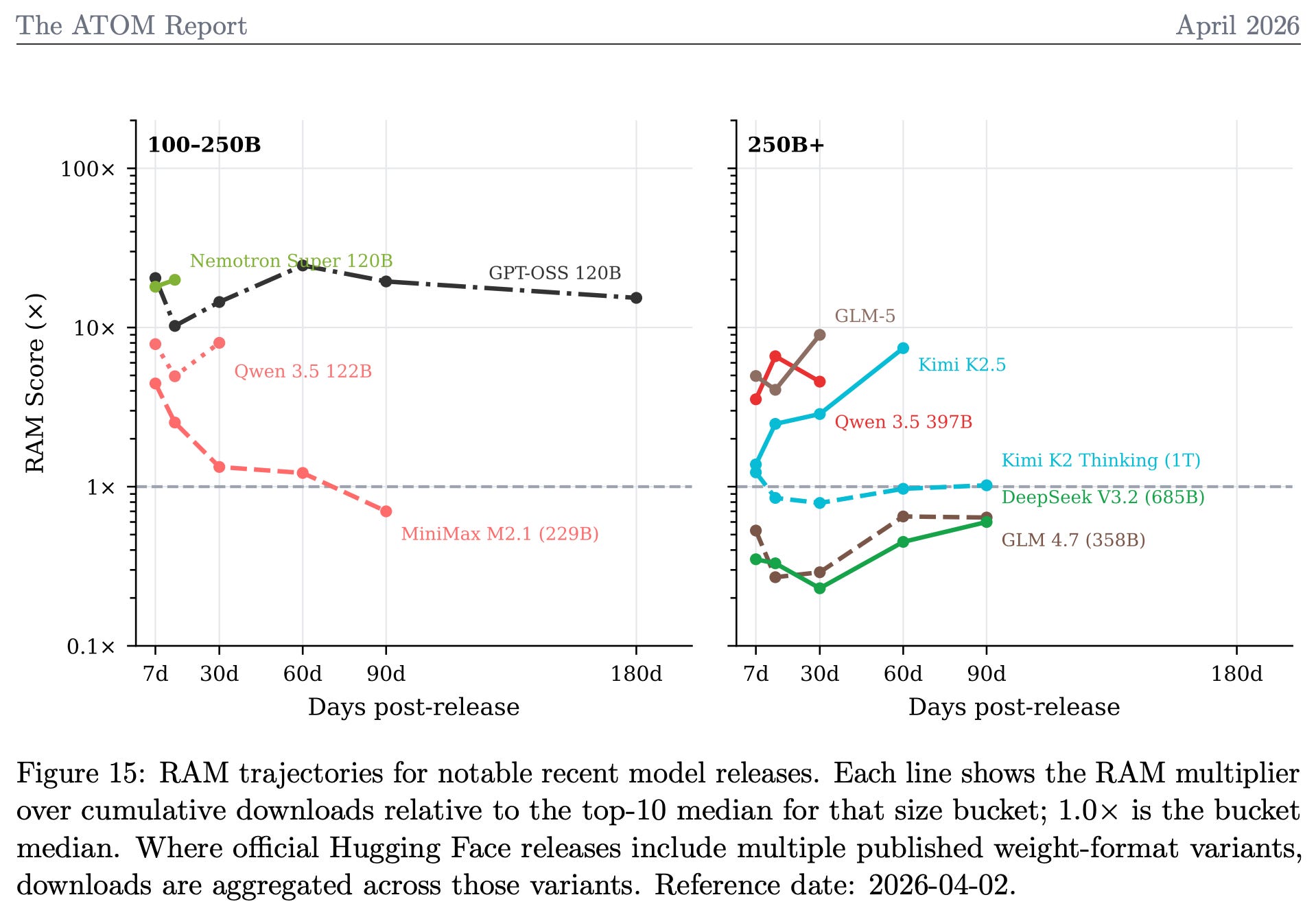
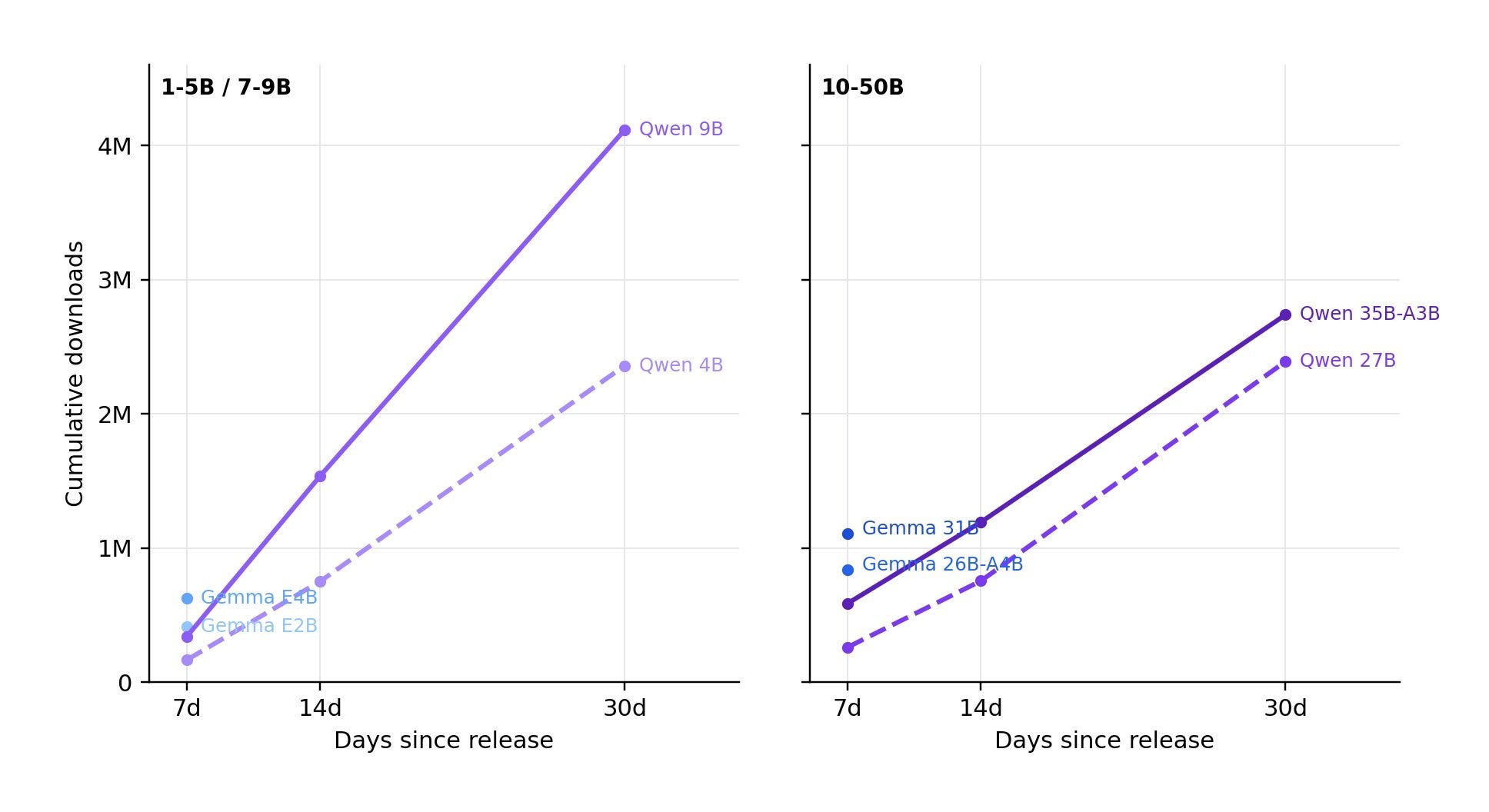
In particular, the paper details our updates to the Relative Adoption Metric (RAM), which we use to evaluate the adoption of recent models in a time-varying and size-normalized manner. Here’s a sampling of recent, primarily Chinese, models on the RAM score. The RAM score is designed so that a score >1 indicates a model is, at that point in time, on track to be a top 10 most downloaded model of its size category, ever. It reduces a messy landscape to one, easily interpretable number!

We used the data to also analyze the recent Gemma 4 release, which is showing incredible early adoption numbers. We’ll stay tuned on it!

Image

Subscribe to the (infrequent) ATOM Project Substack for more updates like this!

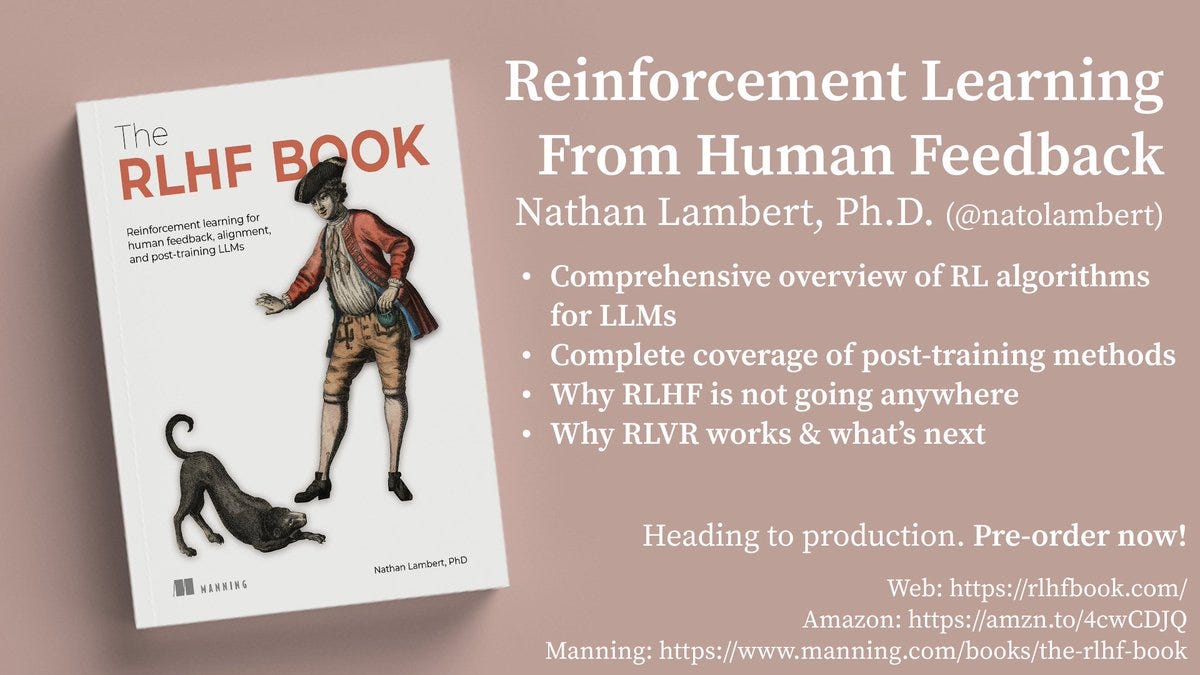
2. RLHF Book is done & ready for pre-order!

http://rlhfbook.com/

The goal of this book was to write the book I wished I had when I was getting started in post-training language models. This project has been on my mind for a long time. I bought the domain rlhfbook.com and started to take it more seriously on May 20th, 2024. Here we are!

Last week, it was sent to production with the Manning team. This means content edits are done, and it’ll be sent to print in ~2 months. In the meantime, I’m spending my time developing the accompanying code and course (more on that below).

You can preorder on Amazon or Manning (currently cheaper).

Image

3. A post-training course I’m making

https://rlhfbook.com/course

The goal of my book is for it to be the central resource for people looking to transition from beginner to expert in post-training. It’s not necessarily an entry-level book, but as AI models become stronger, it needs to be a community-building effort as well. The first step I’ve made to expand the scope from just a book to a complete learning experience is building a lecture series. The lectures will be freely available on YouTube and incorporate community questions & answers (as standalone videos in between lectures).

You can watch the first batch of videos below, and subscribe on YouTube for future ones. I’m going to build on the book platform more this summer, as I develop the book codebases and host in-person events.

4. Recent technical research

Long-time followers of Interconnects know that this blog has its roots in explaining fundamental research in the field. This has immense value in two ways. First, as AI moves incredibly fast, far more people need to be able to parse research to make the right bets on the technology. Research is the only early warning of some big changes coming. Second, it helps uplift the careers of my collaborators – the people I spend my life with! On that note, check out two papers I had the privilege of being part of below.

https://arxiv.org/abs/2603.16759 - TurnWise: The Gap between Single- and Multi-turn Language Model Capabilities, Graf et al. 2026

This work explores the strengths of various models in multi-turn dialogue settings, how to create training data to improve it, and other quirks in post-training. My interests here have fully shifted to agents, where I see multi-turn interactions as a very important user interface problem — what information do I show to the user to solve the task as soon as possible without cutting corners?

https://arxiv.org/abs/2603.11327 - Meta-Reinforcement Learning with Self-Reflection for Agentic Search, Xiao et al. 2026

This paper frames solving hard problems with RLVR as a meta-learning problem, where context from previous attempts should be used to inform future rollouts. It’s a very obvious idea in some ways, where most of RL for LLMs is still very on-policy, but naive. The models learn from recent trials in parameters, but not in context. This research feeds into a ton of other recent work on ways that RL can be formulated to solve different forms of continual learning. Another great related paper is Learning to Discover at Test Time.


Leave a comment

I’m off to China (and then hopefully DC) in the next couple of months to learn even more about how the world sees progress in AI. I’m excited to talk to a broader range of people than I tend to in my focused technical job. Thanks for reading, as always!

AWS and Hopkins Engineering announce groundbreaking database for AI/ML antibody design

14 April 2026 at 14:00
In 1986 the US Food and Drug Administration issued its first approval for human use of a therapeutic antibody. Despite steady advances in methodology, genetic sequencing, and biomedical science, 40 years later the process of discovering and optimizing therapeutic antibodies often remains prohibitively expensive, in terms of both cost and time. Recent experiences with pandemic-style infectious-disease outbreaks lend an even greater urgency to the need to more quickly and efficiently identify and develop these antibodies. Artificial-intelligence- and machine-learning-guided approaches to antibody design, in the form of biological foundation models (BioFM), represent a significant opportunity to address these challenges. Models built using protein language models (pLMs) and structure-based deep-learning frameworks have significant potential to predict antibody developability properties — the characteristics that determine whether a molecule is manufacturable, stable, and safe as a therapeutic. The development of those tools could drastically shorten discovery timelines while also reducing experimental costs. That potential, however, has been hindered by the lack of a public dataset that would allow researchers to benchmark those tools, a crucial step in the development of trustworthy in-silico tools for drug discovery. While there are existing public antibody datasets, they are too frequently limited by a focus on a single antibody format or target. Others are composed of naturally occurring or clinically advanced antibodies, a bias that severely limits their utility for training or evaluating predictive models. “Trust in the predictions made by these models must be grounded in evaluations against experimental data that is sufficiently large and diverse,” explained Luca Giancardo, an applied scientist with Amazon Web Services (AWS) who works on the Amazon Bio Discovery team. “That data must be representative of the real sequence space encountered during antibody engineering and balanced in terms of developability outcomes.” Jeffrey Gray is a professor in the Chemical and Biomolecular Engineering Department at the Johns Hopkins Whiting School of Engineering, where he leads the Gray Lab, which focuses on the computational prediction and design of protein structures. He is also the original developer of RosettaDock, a tool for the prediction of the structure of protein complexes from their constituent proteins. Gray noted that while AI has made tremendous progress in the prediction and design of antibody properties, his own lab’s benchmarks have shown that current models do not yet reliably predict critical developability features, such as solubility and specificity, needed for efficient design of therapeutics. He cited the lack of diverse data in standardized conditions as a primary limitation for training models. That, coupled with the absence of a comprehensive, heterogenous, large-scale database, has acted as a significant drag on the potential of developing AI tools for antibody development. Antibody developability benchmark To that end, AWS, in collaboration with the Gray Lab and Johns Hopkins Engineering are announcing the launch of the Antibody Developability Benchmark, powered by the largest and most diverse antibody dataset in public literature. This is the first large-scale benchmark of antibody biophysical and biochemical properties designed to support the development and rigorous evaluation of in-silico antibody property predictors. The Antibody Developability Benchmark is 20 times as diverse — in terms of antibody formats, targets, and developability profiles — as benchmarks currently available in the scientific literature. While other datasets may contain more individual antibody designs, they typically explore a single target or antibody framework with limited property coverage. The Antibody Developability Benchmark is unique in its combination of scale and heterogeneity, encompassing 50 seed antibodies, four structural formats, and 42 antigens. It also includes both favorable and unfavorable developability outcomes. Gray lauded the opportunity to work with AWS experts, noting that the collaboration has enabled the creation of a dataset larger and more diverse than any of the publicly available datasets. He called the project an important next step toward fulfilling the promise of AI to improve human health. The Antibody Developability Benchmark includes the first heterogeneous antibody-property dataset explicitly designed to capture favorable and unfavorable developability profiles across multiple antigens and mutation strategies. Crucially, all data was affirmed via wet-lab experiments, providing ground truth validation that existing public benchmarks lack. “This dataset will allow researchers to confidently be able to answer ‘Which model is better suited for our purposes?’,” noted Giancardo, whose Bio Discovery team led the development of the dataset. “Today there are many computational models coming out that are mostly evaluated on either proprietary data or public datasets, which are not representative of antibody heterogeneity. That means deciding what is better or worse is very, very hard — if not impossible.” The unmatched diversity and deliberate heterogeneity of the Antibody Developability Benchmark will help make those determinations possible. Michael Chungyoun, a PhD researcher at JHU who worked on the project, observed that the benchmark covers a wide space of antibodies, particularly in terms of their properties. He noted that allowing researchers to check against a very diverse benchmark can save time and labor by helping them compare models and choose the best approach. The antibody dataset The dataset consists of 50 clinically and scientifically relevant seed antibodies spanning four structural formats — IgG, VHH, NearGermline-IgG, and scFv — targeting 42 distinct antigens. It measures expression, purity, thermostability, aggregation, polyreactivity, and hydrophobicity — six traits that are essential in the development of viable therapeutic antibodies. “The composition is a deliberate design choice,” Giancardo noted. “We strove to find a balance between heterogeneity of antibody classes, therapeutic targets, and mutation types, with the aim of creating benchmarks that would be generalizable across the structural diversity of the modern therapeutic-antibody landscape.” Researchers at the Gray Lab, assisted by a sponsored research grant from AWS, helped select the seed antibodies for inclusion in the dataset. They were intentional about the seeds they chose, Chungyoun noted, opting in some cases for existing clinical-stage antibodies or FDA-approved antibodies. The team also selected antibodies more akin to those that circulate in the human body but aren't approved therapeutics. Those are called germline antibodies. Chungyoun explained that germline antibodies are those found in the human body, and they have important biophysical characteristics. While some of those characteristics are shared with therapeutic antibodies, there are also differences between the two. The extent of those differences, and how to bridge that gap, is a vital and unanswered question. Traditional antibody-based drug discovery begins with antibodies that come from animals or humans. Chungyoun explained that germline antibodies occasionally need to be modified to look more like therapeutics. That process is one researchers are still exploring. Mutation strategy The dataset also includes engineered variants of each seed antibody, generated by applying systematic mutation strategies to each seed. “Initially, the hardest thing was essentially coming up with example sequences that would cover the broad spectrum of properties and the ways of mutating these sequences,” Giancardo explained. “It's challenging because you have to do it a priori until you do it, and then you don't know what will come out.” Working with Johns Hopkins Engineering, Giancardo and his team systematically engineered variants employing a variety of approaches, including protein-language-model-guided (pLM-guided) versus non-pLM-guided mutation selection and amino acid substitutions versus insertions/deletions. “Protein language models are essentially the equivalent of large language models [LLMs] for the protein world,” Giancardo said. “There are multiple ways of looking at proteins. A common way is expressing them as a string of amino acids, which are essentially letters.” When some of the letters in the amino acid chains are masked, the models can be trained to fill in the gaps — the same "self-supervised" approach used to train LLMs. The models can also be trained to predict what changes inserting a different letter or letters — i.e., mutation — will yield. That approach resulted in a wide variety of mutations — up to 99 engineered variants per seed. The breadth and depth of those mutations contribute to another distinguishing feature of the Antibody Developability Benchmark: its deliberate heterogeneity. The inclusion of both favorable, or developable, and unfavorable, or poorly developable, examples sets it apart from existing datasets. “This range is essential for training and evaluating machine learning models, which require balanced label distributions and exposure to the failure modes they are intended to predict and avoid,” Giancardo explained. He also clarified that those failures still fall within a range of viability. “These are not examples that are obviously wrong but rather bad examples that have a fighting chance," he added. "These all still meet some baseline quality assessment, meaning researchers could reasonably send them to a wet-lab partner to test.” Zero-shot learning Gray and his team at Hopkins Engineering also collaborated with their AWS counterparts by selecting and running existing open-source antibody design and prediction models on their own. They then shared their findings with the Bio Discovery team, who compared the results those models generated against the benchmarking dataset without exposing those models to the information in that dataset. “This is essentially zero-shot inference,” Giancardo said. That siloed approach allowed both sides to have greater confidence in the results the Antibody Developability Benchmark generated. “The fact that we operated separately gave us confidence that we were not introducing errors. There is no data leakage of any sort, even from an external perspective.” The teams compared their data and used those results to further fine-tune the Antibody Developability Benchmark. That iterative process means researchers who utilize the benchmark can have greater confidence about the viability of their models before the necessary, and costly, step of working with a wet lab partner. That can also shorten the overall timeline in terms of experimentation. “When you are confident enough to do a screen, then you can turn to the wet lab, get new metrics, and further train on those results, which will be much, much, much more meaningful,” Giancardo explained. The future Researchers at both AWS and Hopkins Engineering emphasized the importance of sharing model benchmarks based on the Antibody Developability Benchmark Dataset with the larger scientific community. The benchmark results are now available as part of Amazon Bio Discovery; additional benchmarks will be added over time and released in a paper later this year. The sharp uptick in proposed protein AI models has researchers excited, but the expense and time commitment of wet labs has meant researchers have thus far been unable to compare those models head to head, Chungyoun observed. He noted that the launch of this dataset means those researchers now have an opportunity to learn which model properties improve performance. That can serve to illuminate the connection between what models learn and how those models can be improved to better predict those properties. The dataset won’t remain static either: more models and properties will be added in the future. "The database has the potential to surface models and tools that may have previously gone unrecognized — research published in lesser-known venues or work that simply didn't receive the attention it deserved," said Nina Cheng, a senior science manager in the AWS Life Sciences organization. "This database can play a key role in bringing that kind of overlooked work to light." Acknowledgements Amazon Bio Discovery Science and product team: Luca Giancardo, Yue Zhao, Melih Yilmaz, Kemal Sonmez, Lan Guo, Gordon Trang, Edward Lee, Chuanyui Teh, Fangda Xu, Nina Cheng, Jiwon Kim.
❌