 Login
LoginDevelop High-Performance GPU Kernels in C++ with NVIDIA CUDA Tile
26 May 2026 at 21:40
 Developers can now use NVIDIA CUDA Tile programming within large existing C++ GPU codebases to develop highly optimized GPU kernels using tile-based...
 Developers can now use NVIDIA CUDA Tile programming within large existing C++ GPU codebases to develop highly optimized GPU kernels using tile-based...
 NVIDIA CUDA 13.3 brings new capabilities and performance optimizations to developers across the CUDA ecosystem. The launch of NVIDIA CUDA Tile programming in...
NVIDIA CUDA 13.3 brings new capabilities and performance optimizations to developers across the CUDA ecosystem. The launch of NVIDIA CUDA Tile programming in C++, enables high-level, tile-based kernel development that automatically manages complex low-level GPU details for optimal performance and portability. Additionally, CUDA Tile programming is now supported on Compute Capability 9.0…
NVIDIA CompileIQ tackles one of the hardest problems in performance engineering: finding the compiler options that unlock the best performance for a specific...NVIDIA CompileIQ tackles one of the hardest problems in performance engineering: finding the compiler options that unlock the best performance for a specific workload. Consider a team that has spent weeks optimizing an LLM inference pipeline on GPUs, tuning batch sizes, quantizing to FP8, adopting flash attention, fusing every kernel they can. The profiler says there’s nothing left to squeeze.
Precision medicine depends on two fundamental capabilities: understanding disease at the genomic level and identifying treatments at the molecular level. ...Precision medicine depends on two fundamental capabilities: understanding disease at the genomic level and identifying treatments at the molecular level. NVIDIA’s contributions to precision medicine extend far beyond accelerated computing, delivering a full-stack platform that translates hardware and software advancements directly into healthcare outcomes. Sequencing the human genome…
As the years of AI progress go by, it’s been accompanied by a slowly rising tide of consequence. Models are getting more capable, how we work is changing quickly, economics of AI are becoming real, just as real-world risks come to the forefront. 2026 is the first year where I don’t think there’ll be any breaks from this. The hard part to prepare for is that there’s a good chance things just continue to ratchet up from here – more disruption, more surprises, more stakes.
On my end, there’s been a growing list of topics that are very fateful to how I see the current state of AI, but I haven’t even gotten to write about them (at least not from all the angles I want to)! All of these are closely related to the implications of different models reaching new capability levels and how I use that to infer what may come next.
The time gap between open and closed models is very often discussed, but the reality is that we have a nice time-gating that’s independent of debatable benchmarks – if open-weight models do or do not become super useful in agentic harnesses. The Opus 4.5 in Claude Code moment of December 2025 was so loud and obvious, that if open models hit this performance level for price points as low as $5/month, there will be an explosion in usage.
Right now we are about 5-6 months in with no equivalent open model. I suspect the robustness of the best closed frontier models that I write about could make this moment take a good amount longer, say closer to 12+ months. In this time, Claude Code and Codex may seem like different categories of products. In the standard flurry of new, state-of-the-art open models from a variety of labs, benchmarks will definitely keep climbing, but the open-closed gap should become more interpretable as real-world use becomes the real litmus test.
The best exclamation point I can offer to reinforce my prediction that open models are further behind than the benchmarks claim is that even the mighty Google doesn’t have a clear competitor for Claude Code and Codex. I’m sure the Gemini team is pushing very hard on this.
I still need to do a lot more testing on Gemini 3.5 Flash, but reading reviews makes it clear that it’s not a substitute for how I’m working today. It’s maybe not the Gemini team explicitly specializing for Google’s existing products (search, YouTube, etc.), but the model seems to suit them. If Google doesn’t have a powerful tool here soon, I don’t expect the open model labs to either. The open models are going to be used more for automated, enterprise agents and low-cost domains, rather than being the driving tool of modern knowledge work. This will feed directly into the economic engine of funding future models, where the agents like Claude Code and Codex are the current best path to massive AI revenue growth.
I discussed how the current environment is quietly driving labs in China to specialize on AI Proem with Grace Shao and this is central to my expectations of open models specializing over the next few years instead of competing with OpenAI, Anthropic, and Google.
Interconnects AI is a reader-supported publication. Consider becoming a subscriber.
While I don’t think Mythos is a general “god model” that will crush the competition in every domain, I do think it’s a remarkable technical achievement in software engineering and cybersecurity. Mythos is obviously a watershed moment for those fields. Having spoken to most of the Chinese labs – particularly those with the most prominent, large, open MoE models like Kimi, Z.ai, DeepSeek, and Qwen – I think they’re heavily resource limited and don’t have an immediate path to scaling up training processes like the big labs in the U.S. For the labs which are more corporate, which comes with more resources, such as Alibaba and Bytedance, they also have more conservative stances on safety and security.
Mythos is a bellwether of the massive acceleration in training and research compute available to the largest American companies.
Epoch AI recently had a nice piece on the compute available to various labs (~Google 25%, Meta 11%, OpenAI 11%, Anthropic 6%). All of these numbers are vastly higher than any Chinese lab.
Nvidia with Nemotron, Google with Gemma, Arcee AI and others are slowly stabilizing the open model ecosystem in the U.S. There’s a lot that’s hard to measure here, especially in the rise of local agents like OpenClaw and Hermes, but there are adoption numbers of American models that we haven’t seen since Llama 3.
Gemma 4’s models are all tying or outperforming the equivalently sized Qwen 3.5/3.6 models — where Qwen has for years now been the default open model at these sizes. These Qwen 3.5/3.6 models have been tricky to get working in a lot of post-training research, partially due to architecture/tooling and partially likely due to modeling (i.e. the model is not easy to finetune for some training decision). I’ve heard few complaints about Gemma, but it also could be because Gemma is not yet the researcher default.
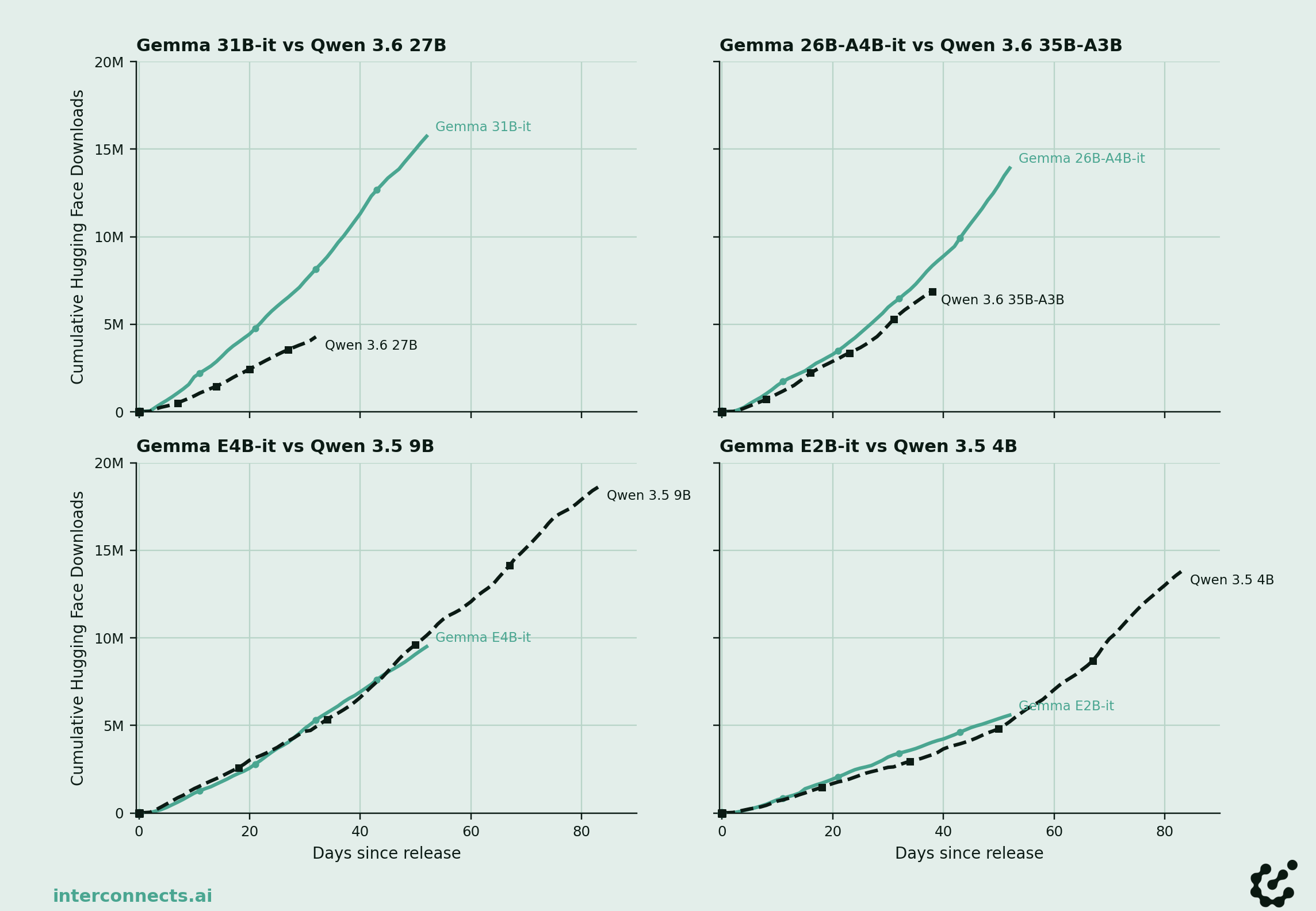
There's a simple reality that we've seen recently with models like GPT-OSS, Nemotron 3, and now Gemma 4, that if a model is in the right range of benchmarks and released by an American lab with a truly permissive license, it'll get a large amount of adoption (in this cycle, recall that Gemma 4 adopted the Apache 2.0 License, changing from one with use-case restrictions on earlier Gemmas). This early phase of American growth in open models is establishing key brands directly with developers. The consensus is that more neolabs like Reflection and Thinking Machines are likely to participate in this space, but being too patient will lose the time when new agentic workflows and enterprise relationships are built.
I expect the rest of this year to be a ruthless competition between these two flagship companies. I’m at an interesting balance where I think GPT 5.5 is a bit smarter of a model and I love the Codex App, so I’m structuring much of my work to be possible there. At the same time, for a lot of writing-related and broader surface area tasks I really still love Claude. These models are rapidly changing how we work, I run Codex from my phone while doing other things, am setting up automated open model analysis jobs on the back of agents, and expect to be able to scale the research side of Interconnects widely.
AI is beginning to drive companies to the two extremes in the scaling era. The biggest companies will be way bigger than ever, using resources and mass talent to have sustained progress at the frontier of raw AI capabilities. On the other side, tiny businesses like Interconnects thrive by using agents to refine, present, and sell niche expertise. The mass social job displacement that’ll come is going to reduce employability for various knowledge workers that don’t fit into either of these extremes for the raw technical side (big or small companies), while sustaining and maybe even amplifying careers that interface directly with humans (e.g. doctors) or other power structures with means to sustain themselves (law/government).
Just in the last few days while writing this, we had the Pope release an over 40,000 word document on where AI is going and China expand personnel movement restrictions on top AI researchers across industry. At the same time, the U.S. has designated Anthropic a supply chain risk and continues to use its models for national security. The list of news like this is only going to grow. Existing power structures are realizing there’s a finite time window for them to exert themselves in the AI dynamic — an intuition that could be mapped to influence going down as AI models get more powerful. This intuition is potentially dangerous, as it sets up meaningful conflict in who controls the technology (as I discussed with Dean Ball after the Anthropic-DoW spat).
These largely technical and power trends accelerating are going to put more pressure on the social and political anti-AI sentiments within the U.S. This is currently the most obvious barrier to continued AI development and beneficial diffusion. Reflecting on this, many people in the tech discourse get too focused on the details, where yes a lot of data-center-detractors are making genuinely wrong factual claims in defense of their position.
The real position that a large swath of Americans has is that they have a voice in saying no to the current trend — by not granting permission to build data centers. This is a voice that they haven’t been granted by the tech industry that changed the face of the global economy and power structures in the last few decades.
This is setting us up for a challenging year ahead for the industry. The labs are aggregating and concentrating talent to peak levels. There are few neutral messengers to communicate the reality of AI to the public. The frontier labs leadership is largely gearing up to IPO and stay ahead in the capabilities race. With the status quo, there are few actions to unwind this path toward social conflict.
It takes individuals in the AI ecosystem to zag and go against the groupthink of needing to make your wealth today, of needing to be at a lab to do impactful work, and so on. I’m personally continuing to bet on this, by trying to make a vibrant and diverse open model ecosystem supported by clear, unbiased information. If you agree with this and have been watching from the sidelines, it’s a good time to get involved, before the situation spirals into something uncontrollable.
High‑quality 3D medical imaging data is the foundation of modern radiology AI, but access to it is often constrained by data scarcity, privacy restrictions,...High‑quality 3D medical imaging data is the foundation of modern radiology AI, but access to it is often constrained by data scarcity, privacy restrictions, and the high cost of expert annotation. As a result, training reliable 3D medical imaging models is frequently bottlenecked by small, narrow, and hard‑to‑share datasets, limiting model robustness and generalization. To help teams overcome…
Video Friday is your weekly selection of awesome robotics videos, collected by your friends at IEEE Spectrum robotics. We also post a weekly calendar of upcoming robotics events for the next few months. Please send us your events for inclusion.
Enjoy today’s videos!
Just months after its debut, Atlas is proving why it is the world’s most capable and dynamic humanoid robot, ready for real work. Lifting a mini-fridge is a feat of strength, but the true breakthrough is in the underlying reinforcement learning and controls systems. The robot is learning to navigate real world adaptability: handling heavy objects by bracing and accounting for the mass and inertia; using whole-body control, not just hands to maneuver; and demonstrating superhuman range of motion and balance. This marks a critical shift in robotics where humanoids move beyond the lab and into dynamic industrial settings.
Watching Atlas move a fridge may be less impressive than whatever the heck it does at 4:10.
[ Boston Dynamics ]
SpikerBot is a robot you teach by wiring neurons, not writing code. Drag spiking neurons in the app, connect them to sensors and motors, then press play. It moves, reacts, and changes behavior based on the brain you built.
Already funded on Kickstarter with a robot kit starting at US $219.
[ Kickstarter ] via [ Backyard Brains ]
Thanks, Greg!
Wheeled-legged robots, which have wheels at their feet and achieve high mobility by coordinating wheel drive and leg drive, have been developed. In this paper, we address the problem of how to draw out the potential task-execution capability of the legs by freeing them from the roles of locomotion through external body support.
[ WiXus ] from [ JSK Robotics Laboratory ] via [ ICRA 2026 ]
A very clever idea for electronics-free, multi-dimensional touch sensing.
Using external voice commands, G1 is directly controlled to generate a wide range of actions in real time. This video was recorded in a single take, with on‑site audio recording.
[ Unitree ]
Hummingbirds are impressive flyers, and advancements in high-speed photography, instrumentation, and measurement techniques have revealed much about their aerodynamics, flight behaviors, and wing and body kinematics. However, comparatively less is known about their natural flight dynamics, which is the relationship among a bird’s flight velocities, the control actions of its wings, and the acceleration of the bird in flight. To investigate this, at the Advanced Vertical Flight Laboratory we have designed, built, and flight tested a biomimetic robotic hummingbird on which is implemented the same techniques for flight control as observed in hummingbirds.
[ Advanced Vertical Flight Laboratory ]
I guess if you’re going to make a robot dog, it’s only fair to give it the ability to frolic in the water.
[ MagicLab ]
The original automated layout robot—the one that showed up when the construction industry was pretty sure robots were lame and then proved otherwise. It has printed millions of square feet of layout across thousands of projects. It built an entire category of construction technology. The category of: Stuff That Actually Does Helpful Work on Real Jobsites. But FieldPrinter 2 is here. It’s faster, tougher, smaller, and smarter. So for FieldPrinter 1, it’s time. Time for a quiet retirement. A mug. Maybe a plaque... But nay, good knight! Thou shalt expire in a blaze of thunderous glory!!
[ Dusty Robotics ]
Here’s an interesting idea for an inflatable monocopter drone.
[ AIRLAB ]
Meet the Lynx S10—a compact all-terrain robot built to deliver industry-grade performance in a lightweight form factor under 20kg.
[ DE Robotics ]
Noble Machines builds general-purpose robots for heavy industry, supporting people with the most hazardous and physically demanding tasks. Attendees at NVIDIA GTC 2026 witnessed the power of autonomous industrial work with Noble Machines Moby.
[ Noble Machines ]
I’m sorry, but Lego bricks should be for humans only.
[ LimX Dynamics ]
Need a robot that can go places? Huskies were around way before legged humanoids, and I bet they’ll be around way after, too.
I know this little dude is just a research platform at Disney, but I still want one to be my friend.
[ Paper ]
In March 1982, General Motors announced a rapid and aggressive conversion to robotics. By 1990, GM wanted 14,000 robots in their factories doing everything from painting to welding to assembly. Nowadays, we dream of robots in the factories, doing everything end to end. In the dark. Lights out. Guess what? GM dreamed the same 40 years ago, and they spent an estimated US $60 billion to try to make it reality. In today’s video, we look at General Motors and their dreams of the automated, all-robot factory.
[ Asianometry ]
Although Cameron McCord wasn’t himself present at Edwards Air Force Base, what was about to transpire that May 2025 day in the Mojave Desert would still make it one he would never forget. AJ Piplica, CEO of Hermeus, was huddled with his team on the tarmac. No matter the outcome of the day’s flight test, he too was going to have a company-defining day. After years of labor, Piplica and his team would be testing their new hypersonic airplane engine, first taxiing down the runway, and assuming that went well, actual liftoff.
Even more nerve-wracking than the prospect of fundraising if the test failed was that of the dual taxi and liftoff test in a single day, a feat that would have been unthinkable even a few years ago. “Our data from the taxi needed to give us confidence that we’re not taking a dumb risk by attempting takeoff and landing. And that’s a huge amount of data to review, that historically took weeks, if not months, to parse between high-speed taxi and first flight,” Piplica says. The time they’d been allotted on the runway for both tests: two hours.
But his team had a new secret weapon. After years of employing a messy patchwork of data review tools that were not designed for hardware testing, Piplica had recently signed a contract with McCord’s Nominal, a company whose sole focus was testing hardware for real-world deployment. Hermeus had seen success with the platform for preliminary Hardware-In-the-Loop (HITL) tests in their Atlanta warehouse, but never in the field with the Air Force breathing down their necks, and certainly never with such high stakes and so little time.
As Hermeus’s plane started taxiing smoothly down the runway just under liftoff speed, data began to stream in through Nominal’s platform: the health of the brakes, actuators, avionics, electronics, control surfaces and more—terabytes of data giving a real-time window into the system’s health. As the plane slowed its taxi on the end of the tarmac, Piplica checked in with his engineers, hoping for good news. “Data review was done by the time we’d towed the airplane back to the other end of the runway,” he remembers, “everybody was thumbs up, so we concluded that, and we were at a safe level of risk to attempt a flight.” Minutes later, their Quarterhorse Mark One was in the air for the first time. When it landed, Piplica snapped a picture and texted it to McCord, Nominal’s CEO. Under the photo it read simply, “Hey, we got it back.”
McCord’s Mojave flight test assist was far from his first brush with the Armed Forces. He was raised on stories about his grandfather, a greatest generation archetype, who had been rushed through the Naval Academy in three years to join the war in the Pacific, witnessed the Japanese foreign minister sign the instruments of surrender, had seen nuclear weapons detonations, and flown the longest flight in history over the South Pole. McCord’s father was a federal attorney in the Department of Justice, and his mother was a special needs teacher. In their home, being of service was a mantra, and an action; most days, McCord and his siblings were explicitly urged by their parents to question how they were being a force for good in the world. For McCord, inspired by his grandfather (and uncle and cousins in the Navy), “Good,” meant joining the Armed Forces.
He paid his way through MIT by doing ROTC, which is where McCord “got bitten by the entrepreneurial bug,” he remembers, but more via osmosis than in practice. In addition to ROTC, he played varsity soccer, double majored in Nuclear Engineering and Physics and minored in Political Science, for practical reasons (“All of this engineering, how do I transition that into something that impacts the world?”). Between training and practice and problem sets and lectures and more lectures, McCord observed his classmates tinkering and creating. In particular, he remembers not infrequently passing by his fraternity brother, Jason Hoch at 4 a.m.. Hoch would still be awake, finishing a CS problem set or hacking away at a new idea as McCord, just up and in uniform on his way to ROTC training, urged Hoch to get some sleep. He admired his classmates’ will to build and create, knowing it was an exercise he couldn’t yet fully embrace, but one that he filed away to explore in some eventual, less time-constrained future.
Within days of graduation, McCord was onboard the USS Helena, SSN-725, the newest officer on the submarine. Any notion that respect would be granted by virtue of his positional authority or pedigree was quickly disabused. “You just start from scratch with first principles—how do you build trust, rapport, and respect with these people where everything you were is stripped away to zero?” says McCord. He did manage to win over his crew after they observed that what he lacked in revolutions around the sun, he made up for in thoughtful leadership, attention to detail, and commitment to understanding the nuances of the underwater behemoth they called their home. “It was my duty to understand that complexity,” says McCord. “Especially for those around me that were relying on me.” Before his service was finished, he’d have a chance to prove just how well he could navigate that complexity.
“We think it’s his appendix,” one of McCord’s crewmates informed him, as a fellow sailor nearby doubled over in pain. “It seems bad.” A few years had passed since McCord was the ‘new guy,’ during which he had experienced a midnight fire, a change in presidential administrations, and hundreds of nights underwater—but this was new. “Appendicitis on a deployed submarine on a mission is not a good thing. So the time was ticking,” says McCord. The ship’s only medically trained officer was not equipped to perform emergency surgery, and since the sub was mid-clandestine mission in North Atlantic waters, reaching a hospital before rupture meant navigating the vessel through Nordic fjords. McCord was tapped to ‘drive.’
Assuming the Conn (naval parlance for, “control of the ship”), he checked above water conditions: temperatures hovered around zero, and a blizzard made visibility nonexistent and conditions turbulent. But despite inclement conditions, this time, McCord wasn’t at a loss. Anxious, certainly, but his years of training, and his dedication to ensuring that he could be of service to his crew, paid off. “Because of my familiarity by then with all of the complexities of the submarine, I was able to gut into how to do this,” says McCord.
By then, McCord was accustomed to managing machinery designed during the Cold War, but that didn’t mean he relished the challenge. “We had to do a lot of very unnatural things with the submarine to get through this fjord and open that rear hatch.” When they neared the shore, a particularly burly soldier “essentially threw the sailor over to the Norwegian coast guard, who picked him up and rushed him to a hospital,” says McCord. Twelve hours later, a WhatsApp message from their new Nordic friend gave them the all clear health-wise.
For two more years, McCord lived many of his days underwater. In his free time, eager to stay apace with the outside world, McCord Coursera’d. “I would watch pre-downloaded Andrew Ng Stanford AI classes. This was in 2015, 2016, and I would be teaching myself and actually building out early models.” His autodidactic afternoons keeping up only reinforced how far his surroundings had fallen behind. “Learning AI, and then going into the control room where you have 1970s software, old hardware—it was a crazy cognitive dissonance.”
As he neared his five-year mark on the sub, it began dawning on McCord that the model of service and impact that had worked so well for his grandfather and uncle, both with decades-long careers in the military, might not be the right fit for him. “The military allowed them to make a huge impact on the world over 30 or so years,” says McCord. “But in today’s world, technology seemed like the way to make that impact. I wanted to use service-aligned technology, but I was not cool with the idea of having to wait 30 years.”
McCord had put in his time, “but then this incredible opportunity came by,” he says. He was selected to be one of the Navy’s liaisons to the House of Representatives. Between 2017 and 2019, McCord got a front-row seat to another deeply complex system. “You get to understand how a bill becomes a law,” says McCord. “But you also get to understand the personalities, the relationships, the executive branch, how budgets get passed, the back doors on The Hill—how it actually happens. I lived that viscerally for two years.”While his job description was to “sort of be a good steward of the Navy, tell war stories, build support,” he also made time for an extracurricular: “I was someone that members of Congress and staffers could go to to understand cutting-edge technology,” says McCord. “I think it’s hard for them to find, frankly, a low-threat way to do this. I developed this reputation of, ‘Hey, you can actually just go down to the Navy liaison shop and there’s this MIT guy Cameron who can just explain LLMs or cybersecurity or why technical stuff in this bill is relevant.” In 2020, capping off his career in public service, McCord’s technical acumen earned him an invite to help develop the House Armed Services Committee’s report on how technology was going to change the nature of warfare (and world). “It’s a little bit crazy to say now, but it was really some of the first governmental writing about AI,” says McCord, whose name is listed in the footnotes among four-star admirals and heads of agencies.
From his years on the sub, McCord was no stranger to waking up at the crack of dawn, but now he found himself doing so in a decidedly more terrestrial context. It was 2020, and he and his first private sector team, Anduril’s drone defense system engineers, were cruising through California’s Central Valley towards the desert to test their system. When they found a suitably remote, dusty patch, they unpacked their hardware—a tower covered with cameras and infrared sensors and miniature drones—and set up their Wi-Fi ‘pucks’ to run flight tests. These sessions would often last days, with team members camping in their trucks to avoid the sunrise commute. Each morning, they would begin tests anew, generating telemetry and sensor data and logs and video and images. “And it was so difficult with the tools we had to capture that data, intuitively organize it, and just answer the question: Did the test work?” As the Product Manager of the system, he led his team in long whiteboard computational sessions, hours in MATLAB, or dated academic graphing software. “None of this was production scale. And none of this was modern in any sense,” says McCord.
The process itself he enjoyed—the rolling up of sleeves, the camaraderie—all of that was pleasantly, arduously familiar. But day after dusty day, McCord remembers feeling renewed shock at the state of hardware testing. Here he was, working in a startup ecosystem where software innovation thrived on cycles of rapid iteration, but hardware testing was stalled in a different century. And it wasn’t lost on him that if Anduril, a company with “all of the venture dollars in the world and incredibly smart people had challenges getting this right, what is like at old organization X or massive company Y? In the back of my head this was just so clearly an area where better software could improve quality of life, and improve outcomes,” says McCord. “To be clear, I didn’t have the answers, but I just was obsessed with the problem.”
McCord first attempted to solve that problem with emerging data technologies: tools built for business intelligence, data marketing, SQL-based tools. In short, nothing “built for the types of telemetry and high-frequency sensor data that robotic hardware systems generate,” says McCord. “So they don’t work.” After fifteen months at Anduril, McCord couldn’t ignore his obsession any longer. Eager to get his bearings in a new complex system—the world of entrepreneurship and VC funding—McCord pitched his rough idea, improving hardware testing, and himself as a part-time entrepreneur-in-residence, to Josh Wolf at the VC firm, Lux Capital. In return for an opportunity to speak with dozens of hardware CTOs to pressure test his thesis, McCord offered to help Lux develop a dual-use, government-private sector business strategy.
For a year, co-enrolled at Harvard for his MBA, McCord effectively moonlit for Lux. “This was only possible because COVID was happening,” says McCord. “I would do Zoom classes and I would shut my Harvard Business School laptop and open my Lux laptop and basically alternate between the two.” HBS is where McCord first encountered Bryce Strauss, a kindred spirit with an aerospace background. McCord asked him to coffee, expecting a 30-minute conversation, and the pair ended up venting for nearly three hours. “It was this winding back-and-forth where we both obsessed about post-test analysis and data review, and how it’s essential to quickly get insight into performance data —whether you’re building an airplane, a car, a nuclear reactor, a drone, or a robot. Every person that builds hardware does this thing,” says McCord. “And we’re like, if we could just make that process 10 times better, we think we can build something valuable here.”
Strauss concluded they needed to turn this idea into a company together, and he wouldn’t take no for an answer. “I’m always doing a lot of things, and Bryce was this incredible unifying north star that was like, ‘Cameron, when we graduate, we’re doing this,’” says McCord. The duo decided to enlist a third, software co-founder. For McCord, there was really only one choice: “I was like, ‘Hey, I know this guy, Jason Hoch from MIT. He’s the smartest software engineer I’ve ever met. I think he’s the person to be the third leg of the stool.’” Strauss, the aerospace expert, came up with a name, a play on “All systems nominal,” common parlance for “all good” during rocket launches. 30 days before graduation, Lux Capital wrote Nominal their first check.
“There’s a bug,” Hoch said from the backseat of their rental car. Six months into their tenure as co-founders, the trio had flown to Los Angeles to demo an early prototype of Nominal’s hardware-in-the-loop (HITL) testing system for a major satellite company, who they hoped would be their first paying customer. “Something’s off with time synchronization of different data sources,” added Hoch. With 20 minutes to go before their pitch, he’d have to do some en route hacking.
When they arrived, the trio walked into a boardroom to find roughly a dozen company leaders waiting. Strauss demoed their product, demonstrating the speed with which it would allow engineers to manage and interpret satellite test data. The last minute hack held, and the time sync across different data sources—telemetry, engine health, computation speeds and more—worked. The trio was ecstatic, even when the satellite company only signed on for an unpaid pilot of their software. “They took a bet on us and they let us learn with them, frankly, which is more valuable than anything,” says McCord.
With some assurance their product worked and had utility for customers, McCord, Hoch, and Strauss decided to hire four more full-time engineers. Still the latter days of COVID in fall 2021, everyone worked remotely half of the time, and would converge in Austin every other week, rent an Airbnb, and build from wakeup to well into Wendy’s-fueled late nights. As the company grew, their Austin reunions became every third week, then once a month. “Finally, we reached a point when we had around 40 people where we declared, we’re not going to have regularly scheduled Austin weeks anymore.”
When he wasn’t sleep deprived in Austin, McCord lived in Washington, D.C., a home that allowed him to leverage his public sector connections while growing his private sector customer base. That’s where he first met AJ Piplica for coffee at Commonwealth Joe’s. Before witnessing the pain of hardware testing as CEO of Hermeus, Piplica had experienced it in the public sector working for NASA. “Within the Department of Defense, which is a very vast test infrastructure—all the data is siloed,” he says. “You were literally moving CSVs around by hand and opening things in Excel.” After witnessing Nominal’s utility during his first Mojave flight test, Piplica recognized the step change it could represent for all hardware development. “Any organization that’s taking data out of the real world, which is, like, every major company in the world could benefit from this,” says Piplica. “Yeah, robotics and AI are cool, but what’s actually cool is when you put them together. That nexus between the digital and the physical world is what really unlocks a huge amount of growth for humanity.”
Ten days before his wedding in January 2025, McCord got a call from Alfred Lin, partner at Sequoia. Nominal was eyeing another round of fundraising to support the expansion of their team and their product. Lin, who had met McCord during Nominal’s Series A process but ultimately deferred investing (“We wanted more evidence in support of his hypothesis before investing”), understood the tailwinds accelerating Nominal’s growth, and wasn’t about to let another round pass him by. “We are living through a hardware renaissance, and we were looking for a new platform that supports modern hardware engineers on this journey”, says Sequoia partner, Anas Biad.
McCord wanted to work with Sequoia, but he wanted to get married first even more. “I told Alfred, look, I’m getting married. But can we schedule time for me to come to SF right when I get back? I will walk you through everything in the business.” Lin agreed, and as promised, McCord flew straight from honeymooning in New Zealand to meet with Lin and Biad. The partners were impressed by McCord, but told him they needed to do their due diligence on the product before any decisions were made. “For days, Anas basically didn’t sleep. He called every single one of their customers,” says Lin. In the end, McCord was reassured by the seriousness with which Sequoia took the whole process. He found it grueling, but ultimately affirming. “There was something pretty powerful in having Sequoia come back and be like, we spoke to 20 customers. People really did love the product.” Ten days after their SF meeting, McCord had a term sheet from Sequoia in hand.
At the time of the final interview for this piece in late March 2026, the war with Iran had started just days earlier. News had just come out about the first casualties on both sides of the conflict, among them, three US soldiers. That reality was weighing on McCord for many reasons, but resonated particularly in the context of his chosen means of service and field of impact. “I’m obviously reading about those casualties and I’m thinking, could it have been prevented? Could Nominal’s technology in some way, shape, or form, have improved the hardware they were using and helped prevent their deaths? I have no idea,” says McCord.
He’s acutely aware that the state of the world has changed the way people think about hardware manufacturing, and he’s ambivalent about what it took for that shift to occur. “I don’t like that there’s a global land conflict in Ukraine and a war in Iran, but the reality is that it’s happening,” says McCord. “And I think it is pushing everyone to rethink and say, ‘Hey, building physical things is critical.”
McCord sees a silver lining to this macro shift in attention to hardware development. He’s hopeful it will enable innovations outside the realm of defense and war, and is actively expanding Nominal’s capabilities for teams building rockets and medical devices, tools for water desalination and electric vehicles. The shift is also apparent in Nominal’s rapid growth: as of May 2026, Nominal has achieved unicorn status, with 75 global customers across aerospace, defense, energy, and transportation, a rapidly growing team, and a constantly expanding product surface area with an eye towards enabling anyone to build hardware efficiently and intelligently. His team is integrating AI to further speed up data collection and analysis, and enable edge computing for systems operating beyond connectivity range—particularly essential in aeronautics and astronautics. McCord understands that service is an ongoing act, and the urgency his parents instilled in him to do something has only grown more acute with time. With each innovation, McCord returns to a mantra, one influenced by his upbringing surrounded by people inspiring him to be of service. “I call it the grandpa test. I basically ask myself all the time, ‘how will I feel when I’m old and sitting in my chair and the grandkids are around?’” says McCord. “I think I will look back very fondly if Nominal played a part in moving the physical ambitions of humanity forward. We talk about flying cars, but yes, there’s also defense, and advanced energy, and compute to power this next generation of AI. There’s advanced transportation, mobility, and water purification. There’s so much we want to do.”
The post All Systems Nominal – Nominal Spotlight appeared first on Sequoia Capital.
When a group of academics started making open-source robotics hardware, a generation of roboticists got years of their lives back. Now, the bigger challenge is getting robots to think—and that’s starting to be open sourced too.
The shift is still early, but companies including Hugging Face, Nvidia, and Alibaba have all made significant bets on open-source robotics in the last two years, releasing tools and models aimed at the higher-level work of getting robots to reason, decide, and act.
The open source movement that accelerated other AI applications is now being applied to the problem of making robots smarter. If these attempts to bring AI to robotics with open-source platforms succeed, the barrier to building a capable robot could fall as fast as the barrier to building an AI application did.
Open-source robotics software has been around since the mid-1990s, with early projects like Carnegie Mellon University’s Inter-Process Communication package and the Player Project in the early 2000s laying the groundwork. But these were often tied to specific research groups, and the field remained fragmented.
The Robot Operating System, ROS, changed that when it made its debut in 2007. By bundling tools and attracting more users, it became the de facto standard. The story of open-source robotics, in many ways, starts there.
Despite its name, ROS is not actually an operating system. Rather, it is a software framework that sits on top of Linux and handles robotic fundamentals like moving data between components, talking to hardware, building maps, planning paths, and supporting developer tools, such as data logging and visualization. Before ROS, every robotics team wrote that infrastructure themselves. It often took a year or two before a lab could get to the research it actually cared about.
Brian Gerkey, who helped build ROS in the mid-2000s, says he was drawn to the project because of how much open source had already changed the world, pointing out that nearly the entire internet is built on it.
“I’m a tool builder, and I like to share everything as openly as I possibly can, because I think that’s where we get the most impact out of what we build,” says Gerkey, board chair of Open Robotics and now CTO at Intrinsic, a robotics and AI unit of Google.
As it was developing, the AI community largely took the same approach, sharing research, models, and data openly, and the field accelerated faster than almost anyone predicted. Now some of those same advancements are arriving in robotics.
Computer vision, once a hard problem, has advanced dramatically in just a few years, says Spencer Huang, Nvidia’s director of product for robotics. What once required significant expertise can now be done in a few lines of code. Simulation tools have become accurate enough to be useful for training, and access to the tooling that once required a specialized lab is now widely available, much of it open source.
“To get into robotics, you no longer need a Ph.D.,” he says. The result is a much larger pool of people who can contribute, and the field is starting to look less like a specialized discipline and more like a platform that anyone can build on.
Nvidia has built out an open-source robotics stack that covers the full development pipeline. Its Cosmos world models generate synthetic training data and simulate physical environments. Its GR00T models give robots the ability to reason through and execute complex tasks. And its Isaac frameworks handle the orchestration that ties training, simulation, and deployment together. Not everyone needs to train the robots from scratch, Huang says, and most people probably shouldn’t.
“If you gate pre-training, the field just never grows,” he says. “We should be able to provide a high-quality, state-of-the-art pre-trained model that anyone can go and take and fine tune for their own purposes.”
All of Nvidia’s open-source models live on Hugging Face, the open-source AI platform that has become the default place to share models and datasets. Hugging Face launched LeRobot, a community platform for robotics AI, in May 2024. Since its launch, the number of robotics datasets on the platform grew from 1,145 at the end of 2024 to more than 58,000 today, making it the single largest dataset category on the hub.
Hugging Face has also moved into hardware, acquiring robotics company Pollen Robotics. The acquisition came from a realization that software alone was not enough, according to Clement Delangue, Hugging Face’s CEO. The goal, as with the software, was to bring more people in.
The contributors to LeRobot include the biggest names in the industry, academic labs, and hobbyists building robots in their spare time. For instance, earlier this year, Alibaba released RynnBrain, an open-source foundation model for physical AI that the company claims outperforms comparable offerings from Google and Nvidia on benchmarks. That diversity of projects, Delangue says, is important.
“It is not just one model or one dataset or one hardware,” he says. “It is a lot of small contributions that everyone can be part of.”
The stakes, Delangue says, go beyond convenience. A world where only a few proprietary systems control the robots in people’s homes is a concerning one. “Having robots at home that you don’t really understand, that you don’t really control, that a few people in Silicon Valley control is a scary thought,” he says. “Open source gives an alternative path.”
But getting there is not straightforward. The open sourcing happening now looks different from what produced ROS, which emerged largely from academics pooling their work with no commercial stake in the outcome. The biggest contributors today are companies with clear business reasons to want more people building on their platforms. That’s not necessarily a bad thing, says Bill Smart, a professor at Oregon State University, in Corvallis, who was part of the early open-source robotics community. But the incentives are worth being aware of.
He also worries that the lowered barrier to entry has a downside. Researchers coming from AI without a robotics background are sometimes solving problems the field already solved. A newcomer might spend a week training a neural network to move a robot’s hand from one point to another, unaware that the same task can be accomplished with a few lines of code using decades-old techniques. The incentives are not always pointing in the same direction as the progress.
Smart is not without hope though. Whatever the motives behind the open sourcing, he says, the effect is real. More people are in the field than ever before, the tools are genuinely easier to use, and the community is bigger and more diverse than anything that existed when ROS was getting started.
“Anyone can make a robot move now,” he says. “As an old tech guy, that makes me happy and sad, because I’m no longer special.”
This sponsored article is brought to you by Wetour Robotics.
A field technician on a wind turbine, harness clipped, both hands on a wrench, needs to send a command to the diagnostic device hanging at her belt. A logistics worker on a loading dock, gloves on, eyes on the pallet, needs to redirect a connected lift. A person using an assistive mobility device on a crowded street wants to nudge it forward without taking out a phone or speaking aloud. None of these moments call for a smarter robot. They call for a smarter way to be heard by the machines that already exist.
The past three years of Physical AI have been a story of remarkable progress on the robot side of the loop. Companies like Boston Dynamics, Figure, and Unitree have advanced actuators, locomotion, and dexterity to a level that would have seemed implausible a decade ago. Google DeepMind’s Gemini Robotics has redefined what vision-language-action models can do in unstructured settings. The trajectory of the hardware and the foundation models is real, and it is accelerating.
But there is another side to this loop, and it has been treated as a solved problem for too long. The interface between humans and machines has defaulted, for 40 years, to three input modalities: screens, buttons, and voice. Each of those assumes the user can stop, look down, and translate intent into structured commands. That assumption breaks the moment the work moves into a real environment. On a turbine. On a dock. On a sidewalk. In any setting where hands are occupied, eyes are committed, or speaking is impractical, the conventional interface stack quietly fails.
Spatial Intent Fusion is the simultaneous processing of three streams of human-centered information, namely spatial position, visual context, and gestural intent: Your body is the interface.
The bottleneck on the human side of the loop is becoming as important as the one on the machine side. And solving it requires a different question. Not how do we make the robot more capable, but how do we let the human participate in the computing system as naturally as the robot already does.
Wetour Robotics is betting that the next architectural leap in Physical AI is not about making the robot more capable. It is about making the human a first-class node in the computing network, with the same kind of low-latency, high-fidelity participation that connected devices already enjoy.
Wetour Robotics’ engineers frame the problem this way: a wristband that recognizes a gesture is not enough. A camera that recognizes a scene is not enough. The information a human carries about what they are about to do is distributed across multiple channels, including where their body is in space, what their eyes are attending to, and what their muscles are preparing to do, and any single channel observed in isolation is ambiguous. Reconstructing intent reliably means fusing those channels at the operating system level, with latency low enough that the loop feels closed rather than mediated.
This approach has a name. Wetour Robotics calls it Spatial Intent Fusion: the simultaneous processing of three streams of human-centered information, namely spatial position, visual context, and gestural intent, fused into a single real-time command for any connected physical device. It is the technical implementation behind a simpler positioning statement the company uses externally: your body is the interface.
Orchestra is a portable intelligent hub running the operating system that handles sensor fusion, intent inference, command translation, and safety arbitration. The reference compute platform is NVIDIA Jetson Orin Nano Super, which provides enough on-device inference capacity to keep the entire control loop at the edge, with no cloud dependency on the critical path. Wetour Robotics
Orchestra is not a single device but a layered platform, designed from the start to be sensor-flexible and actuator-agnostic. The architecture decomposes into three perception layers and four coordination engines.
Orchestra itself is the local compute and orchestration core: a portable intelligent hub running the operating system that handles sensor fusion, intent inference, command translation, and safety arbitration. The reference compute platform is NVIDIA Jetson Orin Nano Super, which provides enough on-device inference capacity to keep the entire control loop at the edge, with no cloud dependency on the critical path. Edge inference is non-negotiable for this application. Full-chain latency from biosignal acquisition to actuator command is held under 100 milliseconds, the envelope inside which closed-loop control feels natural rather than laggy.
VisionLink handles visual and spatial perception. Cameras feed into vision models that identify objects, estimate distances, and track environmental context. VisionLink is designed not as a passive recognition layer but as a real-time command generator: its outputs feed directly into Orchestra OS to be fused with biosignal data.
Conductor is the biosignal pipeline. It ingests raw surface electromyographic (sEMG) data from a wrist-worn device, classifies temporal patterns into discrete gestures or continuous control signals, and outputs actuator commands. The technically interesting property of sEMG for this use case is that the signal precedes visible motion. Motor unit action potentials appear at the skin surface roughly 50 to 80 milliseconds before a finger completes the corresponding gesture. Wetour Robotics calls this property pre-motion intent sensing, and it is what allows Orchestra to anticipate user intent rather than react to it.
On top of the three perception layers, Orchestra OS runs four coordination engines. The Perception Engine ingests and normalizes raw sensor streams. The Intent Engine performs Spatial Intent Fusion across modalities, resolving what the user is trying to do given where they are, what they are looking at, and what their hand is signaling. The Orchestration Engine translates intent into device-specific command sequences for any connected actuator. The Safety Engine arbitrates conflicting commands, enforces operational envelopes, and gates execution against runtime safety conditions.
No system that bridges the human body and the digital world is finished. Three engineering challenges remain open, and the company addresses each with a deliberate trade-off rather than a claim of having fully solved it.
Baseline stability of sEMG under motion. In a stationary user, continuous gesture recognition from sEMG is reliable. Once the user is walking, climbing, or otherwise moving, motion artifacts and electrode drift degrade the signal in ways that are difficult to fully compensate for. Rather than overpromise on continuous control in dynamic settings, Orchestra defaults to a smaller set of robust discrete gestures in complex operating environments, and reserves continuous control modes for contexts where the signal-to-noise ratio supports them.
Miniaturization of edge AI compute. Running the Orchestra control loop entirely at the edge requires real on-device inference, which has historically meant trading off between compute capacity, battery life, and form factor. Wetour Robotics’ approach has been a compact carrier board paired with a thermal design and a battery module sized for all-day wearability. The result is a hub that travels with the user rather than tethering them to a desk, and that performs the full perception-to-actuation loop without offloading to the cloud.
Heterogeneity of third-party device protocols. The actuator side of the loop is a fragmented landscape. Different manufacturers expose different command interfaces, different communication stacks, and different safety conventions, and a Physical AI operating system has to integrate with all of them. Wetour Robotics uses an AI-agent layer to negotiate connection and protocol translation adaptively, so that Orchestra OS can ingest data from a wide range of devices, run them through neural network models that infer human intent, and emit the right command on the right protocol for the device on the other end.
The history of computing is a history of interface revolutions. Command lines gave way to graphical user interfaces, which gave way to touch, which gave way to voice. Each transition expanded who could participate in the system and what they could do with it. The next transition is not about a new screen or a new microphone. It is about treating the human body itself as a participant in the computing network, capable of contributing intent at the same speed and fidelity that any other connected node can.
The history of computing is a history of interface revolutions. The next transition is not about a new screen or a new microphone — it is about treating the human body itself as a participant in the computing network.
This path is not a competitor to the work being done on humanoid robots, foundation models for embodied AI, and dexterous manipulation. It is the missing complement to that work. The hardest open problem for humanoid systems is the data: every natural interaction between a human and the physical world is a potential training signal, and most of those interactions are currently invisible to any computing system. As more humans become first-class nodes in the loop, those interactions become observable, structured, and ultimately useful for training the next generation of embodied AI, including the humanoid robots being developed today.
In other words: putting the human back into the computing loop is not just about better interfaces for individual users. It is about generating the kind of grounded, in-the-wild human-machine interaction data that the broader Physical AI ecosystem will need to keep advancing. The robot side and the human side of the loop are not two competing futures. They are two halves of the same one.
That is what Wetour Robotics means when it says: Your body is the interface.
Learn more at wetourrobotics.com.
Emerging AI capabilities in coding, tool utilisation, and multi-step reasoning, which is core to agentic AI, are shaping a more complex digital security environment. AI-based applications and services are becoming increasingly integrated into software, public services, vital sectors, and the broader economy, offering new opportunities for productivity and innovation. However, they also introduce new types of security exposure – misconfigurations and weaknesses that can lead to unauthorised access.
AI security builds on traditional cybersecurity and goes beyond it. Today’s AI applications are trained on vast, diverse data and increasingly embedded in workflows that retrieve information, use tools, store memory, and perform multi-step tasks. Distinct AI security risks arise because models learn from data, behave probabilistically, and, in agentic systems, act more autonomously.
Many of the most important AI security risk patterns are only beginning to emerge. The evidence base remains uneven across issues such as prompt injection, agentic misuse, model poisoning, and the security of connected tools. AI technologies are by nature cross-border and cross-sectoral, meaning that no single country, company, or institution can adequately address the security challenges they create alone. This is especially true as AI agents become more capable and more embedded in real-world contexts.
Because AI models and applications operate across borders, security measures require international cooperation on shared methods, common tools and information-sharing channels. The same foundational research can also support adjacent safeguards, from content provenance against deepfakes to safer AI chatbot design.
To meet new security requirements, AI developers and governments across jurisdictions and sectors will need to drive additional joint research, more comparable evaluation methods and robust best practices. These should cover the full AI security lifecycle, from protecting models and pre-deployment assets such as model weights and datasets to the security and resilience of AI applications and services during deployment, especially in critical sectors.
A first approach to strengthening AI security requirements would be to pool resources across three areas: resilience against scalable, reusable attacks, such as prompt injection, particularly at the interaction layer; ensuring the secure connection of AI agents to tools and services; and strengthening safeguards for models, model weights, and training data integrity.
Direct and indirect prompt-injection attacks are becoming more reusable, scalable, and security relevant. That is why security researchers at the Open Worldwide Application Security Project (OWASP) rank prompt injections among the most prevalent AI security risks. While evidence on transferability is still developing, recent research suggests that some attacks can be adapted across harmful tasks and, in some cases, across different models.
For example, an AI assistant used in a workplace might be asked to summarise a document or webpage. If that content contains hidden malicious instructions, the system could be manipulated into ignoring the user’s request, revealing sensitive information, or taking an unintended action. That raises practical questions for enterprise deployment, testing, and incident response.
This matters because reusable or automated prompt-injection methods reduce attacker costs and make attacks easier to repeat. For policymakers, this shifts the question from whether a model can be bypassed in a lab setting to whether it remains resilient to attacks that are reused, adapted and improved over time.
The frontier security community should prioritise understanding why some prompt-injection attacks transfer more readily than others and develop evaluations that reflect adaptive, automated attack strategies. Rather than simply blocking known prompt patterns, they should also identify techniques that improve robustness. Recent benchmark work from MLCommons, a technical safety organisation, suggests that classifying attacks by model-manipulation techniques would help evaluators get closer to the underlying mechanisms of vulnerability.
Automated prompt-injection techniques are becoming more transferable and scalable, making it easier to discover, reproduce and act on vulnerabilities across systems. Evaluation capacity will therefore need to support ongoing assessment of how advances in frontier AI may accelerate vulnerability discovery and exploitation. This will be critical both for ensuring defensive testing keeps pace with evolving attack methods and for helping countries use AI more effectively to strengthen cyber resilience.
International collaboration could improve prompt injection evaluations and universal jailbreaks by making it easier to identify reusable and transferable vulnerabilities. International collaboration could improve evaluations of prompt injection and universal jailbreaks by identifying reusable and transferable vulnerabilities. It could also help to direct research investments from governments and frontier labs toward more robust evaluations and more durable defences.
AI agents create a new set of security challenges. Attacks can manipulate content before an agent application retrieves it, misuse connected tools, or hide malicious instructions in documents processed by the agentic system.
Consider an AI agent connected to email, calendars or payment tools. With broad permissions and malicious instructions, failures can become concrete: the agent may share sensitive information, trigger unwanted actions, or move the user’s money in unintended ways.
Because agents can plan tasks, use tools, retain memory and interact with other systems, each capability creates new opportunities for misuse and failure. Three examples illustrate this challenge:
These patterns go beyond traditional threat models. Recent work, including OWASP’s Top 10 for Agentic Applications, reflects a broader recognition that memory, connected tools, identity, permissions and multi-step autonomy create a distinct security profile for agentic systems.
Developments in the financial sector illustrate how quickly these questions are becoming pressing. On 2 March 2026, Banco Santander and Mastercard announced what they described as Europe’s first live, end-to-end payment executed by an AI agent within a regulated banking framework. As agentic AI systems move into higher-stakes domains, coordination on security baselines and implementation practices will become increasingly important.
AI agents will need to be made secure by design, and the external tools and services they connect to will need to be made secure. Design improvements could include stronger memory safeguards, better permission design and more effective sandboxing. Measures to make services reliant on agentic AI more robust could include research into deterministic controls that constrain how an agent can transfer information among untrusted content, memory and tool actions.
Cybersecurity institutions need to be involved from the beginning because issues related to AI agents—such as permissions, connected tools, and secure deployment in sensitive settings—build on well-understood challenges faced by cyber agencies. International collaboration among AI Institutes could help adapt existing security practices to agentic systems, identify shared vulnerabilities, and promote more uniform methods for testing, incident management, and secure deployment.
Model poisoning happens when attackers introduce vulnerabilities or alter a model’s behaviour by manipulating training or fine-tuning data. Until recently, it was often assumed that this would require control over a significant share of a model’s training data, implying that larger models trained on broader datasets would be harder to compromise.
Recent research challenges this assumption. Work published in 2025 by Anthropic, the UK AI Security Institute and the Alan Turing Institute found that a relatively small number of malicious documents (as few as 250) could be enough to introduce a backdoor into models of very different sizes. Researchers at Carnegie Mellon’s CyLab have similarly demonstrated that manipulating as little as 0.1 per cent of a model’s pre-training dataset is sufficient to launch effective data poisoning attacks.
In practice, this means that poisoned content can propagate through the AI supply chain, shaping the behaviour of downstream models even when the original model developer has not been directly compromised.
That can have serious consequences for the security of open-weight models. An attacker could seed a small number of poisoned public documents that would propagate into multiple downstream training runs and forks without access to the original developer’s pipeline.
Promising research by Microsoft’s AI Red Team has explored ways to detect backdoored models at scale after they have been trained and shared. Early techniques identify poisoned models by analysing behavioural signatures and links between backdoors and memorisation, pointing to a promising solution in a previously difficult-to-detect risk area.
However, simply demonstrating that poisoning is possible is not enough. Research to improve the detection of compromised models and to strengthen safeguards during training and fine-tuning would help. So would developing more practical methods for recovery when poisoning is suspected. Promising research techniques are emerging, but they are not yet reliable across all models and deployment settings. This is where coordinated action and international collaboration among universities, frontier labs and AI institutes would be particularly valuable.
These three security priorities show that no country is likely to build the necessary evidence base, testing capacity and operational practices on its own. The more effective objective is therefore to strengthen the foundations of shared AI security: maturing best practices, advancing targeted research, building clearer expectations around deployment conditions and improving cross-country coordination in ways that support more secure adoption over time.
Practical progress can start by establishing building blocks that enhance interoperability and gradually boost the effectiveness of national efforts.
International efforts led through the G7 and the OECD – GPAI are well placed to advance this agenda through a few practical building blocks :
AI institutes, including members of the AI Network for Advanced AI Measurement, Evaluation and Science, can help align evaluation priorities and testing methods. Universities and independent researchers can deepen the knowledge base in fast-moving domains where attack and defence techniques evolve rapidly. Cybersecurity authorities can help turn emerging lessons into operational practices for secure deployment, especially in higher-stakes environments.
These communities should invest in resources, tools, policies, and operational capabilities to assess how frontier AI might. speed up vulnerability discovery. Beginning with France’s G7 Presidency, the next immediate steps could facilitate closer alignment on key research and evaluation priorities and improve information-sharing channels to manage these risks effectively.
For nations aiming to expand AI throughout their economies, integrating security into AI development and deployment processes will be crucial to promoting AI diffusion and adoption. As new models develop stronger reasoning and coding capabilities, governments, researchers, and companies will need better ways to measure their capabilities and define limitations. That makes shared research roadmaps, stronger testing methods and practical security practices more urgent for trusted deployment.
The post Establishing the shared foundations for collective AI security appeared first on OECD.AI.
Over the next few decades, billions of autonomous, AI-powered robots will work alongside people in factories, perform tedious tasks in warehouses, care for the elderly, assist in unsafe disaster areas, deliver packages and food to our doorsteps, and eventually help out in our homes. Some will look like us, and many won’t. What is certain is that regardless of form factor, robots will all rely heavily on AI in order to deliver real-world value.
In 2025, total investments in robotics companies reached a record US $40.7 billion, accounting for 9 percent of all venture funding. The multibillion dollar question therefore is this: What will it take for AI-powered robots to begin to have a serious economic impact? Many of today’s robotics and AI companies are making bold claims, such as that humanoid robots will soon be coming into our homes, but there’s still a big gap between promise and reality.
The promise of robots that live and work alongside us has been the stuff of science fiction for a very long time. And while many programmers have tried to make that promise a reality, the physical world is just too complicated for traditional computer programs to handle the endless complexity it presents. Thanks to AI, robots are no longer being programmed—instead, they learn to operate in the real world. With enough practice, they can learn to perceive and understand the world around them, reason about that world, and use that reason and understanding to perform tasks that are useful, reliable, and safe.
The two of us have worked at the forefront of AI and robotics for the last decade, as a Professor in Robotics at Oregon State University and Co-Founder of Agility Robotics, and as former CEO of the Everyday Robots moonshot at Google X. Our experience deploying AI-powered robots in real-world settings has given us a perspective on where AI can be used to great benefit in complex robotic systems in the near term and where we are still on the frontier of science fiction. We believe AI will enable an inflection point in robotics advances, but that it will be through the well-engineered application of coordinated systems of different AI tools rather than a single ChatGPT-style breakthrough.
As the excitement around AI is matched only by the uncertainty of what will be possible, here are five hard truths that will define AI in robotics.
For years, we have been seeing videos on YouTube with humanoid robots performing amazing moves on everything from a dance floor to an obstacle course. The inside knowledge in robotics is to “never trust a YouTube robot video.” The gap between real robots that can perform real work in unstructured human environments and carefully scripted and edited robot performances remains significant. The latest performance to get a lot of attention was a martial arts show featuring Unitree humanoid robots performing with children at the Chinese 2026 Spring Festival Gala. While impressive, this falls into a long lineage of tightly scripted robotic performances, where everything has been carefully choreographed and planned in advance. The low-level controls, synchronization, and choreography were stunning, yet the Spring Gala robot performance showed a level of autonomy and intelligence much closer to industrial robots building cars in a factory than something that will show up in your living room any time soon.
Seeing these kinds of demos nevertheless raises questions about where robotics really is. If robots can perform kung fu moves and do backflips and dance, why aren’t they also showing up on factory floors yet? And why can’t they do the dishes in my home after dinner? The simple answer is this: Making AI-powered robots capable of performing general tasks in varied human environments is still really hard. While impressive technological feats like those at the Spring Festival may make it look like we could be very close, the use of AI in these demos is only for low-level motor control (to keep the robots from falling over) and therefore is only a small part of the solution for robots to be general purpose in the real, unstructured spaces where we humans live and work.
Large Language Models (LLMs) like OpenAI’s ChatGPT and Anthropic’s Claude were initially trained on an internet-scale database of text. The world woke up one day in late 2022 to ChatGPT demonstrating that AI computers could suddenly “speak” to us in prose or verse and about seemingly any topic. LLMs have turned out to generalize well and are now able to take multimodal input (text, images, video) and produce multimodal output. Importantly, the corpus of training data was both enormous and human-generated, which are characteristics that form the gold standard for AI training.
The fastest path to robots as part of everyday life may emerge through a range of robot forms performing increasingly sophisticated applications and employing a range of AI tools.Agility Robotics
Giving AI a body (in the form of a robot), so that it can engage with people in the physical world, continues to be a very difficult and broadly unsolved problem. AI models for general-purpose robotics must simultaneously satisfy multiple, often conflicting, physical, geometric, and temporal limitations while operating in unstructured, dynamic environments. In order to generalize, robot models need to be trained on data gathered in a high-dimensional configuration space, where “dimensions” represent text, lighting conditions, degrees of freedom, joint limits, velocities, force, and safety boundaries, just to mention a few. Importantly, this must be good data—it must contain many examples from what amounts to an infinite number of possible configurations in the physical world.
Since there are very few existing sources of data like this, approaches like teleoperation, video analysis, motion capture of humans, and self-exploration in simulation and in the real world are all seen as important ways to collect data. It’s a herculean task. For example, at Everyday Robots at Google X, we ran 240 million robot instances in our simulator over the course of 2022 to collect training data, mostly to train a trash-sorting model. Similar amounts of data will be needed for every skill to get to a similar level of capability, which is not yet human level.
We are far away from a moment where a single AI model might allow general-purpose robots to live and work alongside us.
General-purpose robots can have wheels or legs. They can have one, two, three, or more arms. Some have propellers and can fly, while others may be designed to operate under water. Some will drive on busy roads. The physical world is infinitely varied and complex. And then there are all the people and other animals that will be surrounding the robots. How do you train a model to operate a robot safely and reliably in all of these settings? The simple answer is: You don’t. At least not for quite some time.
We believe the winning AI architecture leading to the next big breakthroughs in general-purpose robotics will be “agentic AI” for robots, which are high-level coordinating models that can reason, plan, use tools, and learn from outcomes to execute complex tasks with limited supervision. Agentic, high-level models running on robots will invoke a system of specialized ones for different types of tasks. We will likely soon see multiple robots collaborating and coordinating with each other through their onboard agentic AI models.
AI tools are unlocking new and powerful capabilities in robotics, which in turn will enable new solutions and new markets. It’s encouraging to see these new models being made broadly available, some even as open-source solutions. This availability is akin to what happened with the internet: Real progress occurred when it became ubiquitous. We anticipate an inevitable democratization of complex behaviors in robotics with wide access to these AI tools and technologies.
Robots are complex systems with many parts that all need to work together with great precision. For a robot to be useful and safe, every part of it must be coordinated, from its perception systems to the computer controlling it, all the way down to its individual actuators.
Actuators—that is, the motors and gears—are a good example of an important part of the robot where what got us here won’t get us there. The actuators used at scale by most industrial robots will not work for robots that will operate in human environments. If these robots accidentally collide with an obstacle, the resulting impacts are harsh, forces are high, and things break. Humans don’t move in this way. We are far more compliant in how we interact with the world, and we’re constantly making contact with our environment and using that contact to help us accomplish things.
Consider the challenge of inserting a key in a lock: Humans typically don’t do this by aligning the key perfectly with the keyhole. Instead, we just feel for the edge of the keyhole and jiggle the key in. Robots need to be able to operate in novel ways to achieve comparable capabilities by using a new class of actuators that are sensitive to force and able to have a compliant interaction with the environment. While these kinds of actuators do exist, they are not yet generally available at scale for robot systems designed to operate around people.
There’s a big difference between tasks that look impressive and real-world tasks that provide value. Robotics is a perfect example of Moravec’s paradox, which states that tasks that are hard for humans are easy for computers (like multiplying two big numbers), and tasks easy for humans (like a toddler’s movements) are extremely difficult for computers and robots.
Serving customers is an unforgiving reality check, because customers only care about solving the real problems they have. If we are to deploy AI-based robot solutions, they must outperform the way things are currently done while demonstrating reliable performance metrics and safety. Agility Robotics’ early work to deploy our humanoid robot Digit in customer locations led to the realization that our first obstacle was safety: Robots that balance and manipulate objects in human spaces bring new types of risk to the workplace. In the first humanoid deployments, physical barriers were necessary, and Agility kicked off a multi-year engineering effort to solve the safety challenge, touching nearly every aspect of robot design and relying heavily on new AI-based approaches to human detection and behavior control.
Everyday Robots at Google deployed robots in 2019 that worked autonomously in office buildings doing chores like cleaning cafe tables and sorting trash. We quickly learned how “messy” and difficult the real world is for a robot. This experience informed the architecture and deployment of our AI systems while also gathering real-world data that could be combined with simulation data for training and improving models.
This focus on creating a product to meet specific customer needs and deploying robots in real-world settings is the only way to inform the structure of the AI tools and infrastructure for near-term utility on a path towards long-term broader capability and generality. There will be no “aha” moment, no silver bullet algorithm, and no volume of data sufficient to produce a general-purpose robot without extensive real-world experience.
