Slopsquatting represents an emerging supply chain threat made possible by AI hallucinations. As developers increasingly rely on AI coding assistants, they unknowingly grant cybercriminals access to their software from day one.
Understanding what slopsquatting is
Slopsquatting is a new type of supply chain attack that uses large language model (LLM) hallucinations to inject malicious code into development workflows. The term combines "AI slop" and "typosquatting," a deceptive practice where attackers register misspelled or lookalike versions of popular domains to prey on users who enter URLs incorrectly.
This novel attack vector exploits LLMs' tendency to generate fictitious software package names, which threat actors can then register and populate with malicious code.
During AI-assisted coding, the model may generate fake open-source packages — bundled collections of files, programs and installation tools. This alone is not necessarily harmful. However, if an attacker registers that fake package name, they can inject malware that gets incorporated directly into a developer's codebase.
How AI creates a supply chain risk
Traditionally, AI safety risks stem from hallucinations, which can adversely affect users who treat misinformation as valid. However, those same hallucinations have evolved into exploitable security vulnerabilities.
Typosquatting is a deceptive practice where a cybercriminal registers a mispelled version of a popular package to trick developers. It has existed for decades, so registries have built protections against it.
However, AI has changed the threat model. It recommends fictitious packages that sound plausible rather than making simple misspellings. Once attackers learn which hallucinated packages models tend to invent, they can register malware-filled packages under those names.
Since the hallucinated packages are not simply typoed versions of popular libraries, there are no protections against this practice at scale. For example, the registry protects against an attacker publishing "crossenv," a squat of the popular "cross-env" package. However, it would not identify "mpn install cross-env file" or "cross-env-extended" as threats.
Hallucinations are persistent and severe
Even if many LLMs recommend the same hallucinated package, widespread compromise is still possible. Malicious packages could remain undetected in production for months or even years, allowing threat actors to passively inject malware across countless environments.
One research team analyzed 31,267 vulnerabilities belonging to 14,675 packages across 10 programming languages. They discovered that reported vulnerabilities are increasing at an annual rate of 98%, faster growth than the 25% annual increase in the number of open-source software packages. The team also observed an 85% increase in the average lifespan of vulnerabilities, indicating a decline in security.
Real-world dangers of AI hallucinations
Malicious actors can create open-access packages under the same name as commonly hallucinated libraries. Instead of standard code, they are filled with malware. The models believe they are referring to existing packages, so they often repeat the same hallucinated names. Since the hallucinations are not random, attackers could theoretically register packages that trick tens of thousands of developers.
These packages appear legitimate. String similarity to real libraries makes them recognizable. One-character typos suggest simple mistakes rather than malicious intent. Even fully fabricated names remain believable when the AI presents them in proper context. Detection is challenging, as developers trust their coding assistants to recommend valid dependencies.
Why are LLMs hallucinating packages?
LLMs generate the statistically most likely answer rather than prioritizing accuracy. Hallucinations are relatively common as a result. One study found hallucination rates range from 50% to 82%, depending on the model and prompting method. Even GPT-4o, the best-performing model, goes no lower than 23%, even with prompt-based mitigation.
Adversarial hallucination attacks could worsen this problem. Threat actors can leverage token-level manipulation or retrieval poisoning to force models to hallucinate in ways they want, increasing the likelihood that models recommend their malicious packages.
Which LLMs are prone to slopsquatting?
While all LLMs are prone to slopsquatting, some are more vulnerable than others. The likelihood of producing hallucinated packages during code generation depends on the model. Proprietary models are four times less likely to generate hallucinated packages than open-source models.
One research group proved this by conducting 30 tests across 30 different systems. Out of the 576,000 code samples and 2.23 million packages it produced, 19.7% were hallucinations. GPT-4.0 Turbo had a hallucination rate of 3.59%, while DeepSeek 1B, the best-performing open-source model, reached 13.63%.
This research suggests that organizations relying on open-source AI tools for code generation are roughly four times more exposed to slopsquatting attacks. That doesn’t necessarily mean proprietary tools will always remain safer, though. Once attackers realize this disparity, they may manipulate proprietary LLMs to take advantage of perceived safety.
Vibe coding contributes to the problem
Software developers who use AI tools estimate that over 40 percent of the code they commit includes AI assistance. They expect that percentage will increase considerably within the next few years. Already, 72% of those who have tried AI use it daily.
The uptick in vibe coding and AI-assisted coding amplifies the threat surface. As more developers integrate AI tools into their workflows without implementing proper verification processes, the attack surface for slopsquatting continues to expand.
For those using AI to assist with coding, double-checking output is essential. Verifying that recommended packages actually exist in official repositories before incorporating them into projects reduces risk.
Navigating AI-assisted development
Implementing automated checks that validate package names against known registries can help catch hallucinated packages before they enter production code. Security teams should also monitor for unusual package installations and maintain up-to-date threat intelligence on known slopsquatting campaigns.
Most engineering teams I talk to can ship an AI demo. The prototype works, stakeholders are impressed, and everyone agrees the use case has potential. Then the project hits a wall.
The reasons for this can vary, but new research shows that difficulties in collecting and parsing real-time data from multiple sources are often the problem. And it’s compounded by a growing skills shortage.
“Only 32% of organizations report having agentic AI running in production.”
According to Confluent’s 2026 Data Streaming Report, only 32% of organizations report having agentic AI running in production. At the same time, two-thirds of respondents cited data infrastructure and data quality as barriers to the success of agentic AI. The models work in controlled conditions, but production is a different story.
Why the demo-to-production gap is so wide
Demos tend to work because everything around them is controlled. The data is static and curated carefully to support exactly what the model will be asked to do. Production environments don’t always offer those luxuries.
In production, AI systems have to query data that lives across dozens of sources, including databases, event streams, application logs, and third-party feeds. Much of that data is poorly governed, and little of it is designed to be consumed by an AI agent in real time. Models that looked impressive in pilots return unreliable results because they’re working with stale, incomplete, or uncontextualized data.
The instinct is to tune the model, but the problem is more likely to be the data feeding it.
In the report, 72% of IT leaders cited insufficient infrastructure for real-time data processing as a barrier to scaling AI, up from 61% the year before. That increase suggests the problem isn’t going away; it’s getting more visible as teams move projects into production.
“The instinct is to tune the model, but the problem is more likely to be the data feeding it.”
AI systems need data that’s trustworthy, contextualized, and current, and those properties are hard to guarantee when data is sitting in siloes that weren’t built for continuous consumption. Batch pipelines almost always introduce latency, lack formal data contracts, and obfuscate lineage. The AI system ends up working with an inconsistent, partial snapshot of the business instead of what’s actually happening now.
The skills problem makes this harder
The report reveals another challenge: 71% of IT leaders cited a shortage of relevant expertise and skills as a barrier to AI adoption.
The work of application development has shifted from encoding business logic to creating an information environment where automated systems can learn and generalize. Building reliable AI applications requires developers to be stronger data engineers. They need to understand distributed systems, streaming architectures, data quality controls, and how to build pipelines that hold up under real-world conditions. They need to reason about data lineage, schema evolution, and what happens when an upstream source changes. And the QA patterns that work for deterministic software — where the same input yields the same output — don’t transfer to probabilistic systems.
Most developers haven’t had to think this way before. The discipline of getting the right data to the right system at the right time, in a governed and reusable way, has gone from a specialist concern to a requirement for anyone building production AI.
This affects how organizations should think about closing the demo-to-production gap. The investment in data engineering skills needs to keep pace with the investment in AI itself.
What production-ready AI actually requires
Organizations that make it out of the pilot stage treat data infrastructure as a first-class concern from the start. That means building real-time pipelines rather than batch processes. It means applying schema definitions, ownership metadata, and quality checks at the point of data production rather than in the data lake. And it means structuring data as reusable products that different teams and applications can build on, so the engineering work supporting one AI application can accelerate the next one, rather than starting from scratch.
The 2026 report found that 88% of IT leaders said data streaming platforms help address data infrastructure and quality issues for agentic AI. That’s because they address the specific reasons AI projects stall — real-time data delivery, upstream governance, and making data trustworthy enough to use at inference time.
The shift is already happening
For the first time, the report found that investments in data streaming outranked those in AI and machine learning, by 88% to 82%. Organizations that have tried to ship production AI are increasingly recognizing that the model isn’t the hardest part.
“For the first time, the report found that investments in data streaming outranked those in AI and machine learning, by 88% to 82%.”
So if you’re stuck at the pilot stage, resist the urge to keep optimizing the model. A better question is whether the data feeding the model is fresh, accurate, and well-governed, and whether your pipelines were actually built for production AI or a demo that only had to work once.
“The largest AI models, which can measure in the trillions of parameters, are still far too big to run on mobile devices. But the model PrismML has working on an iPhone is capable of tasks like complex chat, reasoning, fully autonomous agents and software coding, the startup said.”
“Humanoid robots have surgically removed the gallbladders from living animals in an unprecedented medical experiment—but not as autonomous machines capable of replacing human doctors. Instead, skilled human surgeons remotely controlled the robots’ movements in a new example of human-robot teamups.”
“An international team…reviewed data from laboratory studies, clinical trials, and real-world statistics to fully investigate this relatively novel class of vaccine, from design and manufacturing to its long-term performance. ‘After billions of doses, we now have an extraordinary amount of scientific evidence,’ says lead author Dr. Anna Blakney, assistant professor at UBC’s Michael Smith Laboratories and School of Biomedical Engineering.”
“SpaceX has already gone public at a $1.77 trillion valuation, and with both Anthropic and OpenAI pushing into the trillions it’s likely the trio together will land somewhere north of $4 trillion. By comparison, the US Securities and Exchange Commission counted just $70 billion in US-based IPO proceeds last year.”
“Gallup notes that obesity reached a record high in the US in 2022 at 39.9% but has ticked down to 36.4%, according to the latest data based on self-reported height and weight. That dip has been credited to the large number of Americans now using GLP-1 drugs.”
“Forward-deployed engineers, dispatched by AI labs to help customers implement their models, will come back to the mother ship with a deep understanding of how banks, consulting firms, retailers, manufacturers, and consultants operate. That customer support, to a suspicious eye, looks a lot like reconnaissance.”
“Microsoft says this was ‘driven primarily by the expansion of our datacenter infrastructure,’ as well as the company’s decision last February to stop purchasing ‘non-additional, unbundled renewable energy certificates.'”
“Having successfully persuaded corporate America to give their products a try, OpenAI, Anthropic, and Google are now struggling to prove that their tools are worth the money. …While it’s too soon to know whether GLM-5.2 is really capable of replacing America’s top-tier AI agents, any firm or developer who is balking at the costs now might have an alternative.”
“The J-space contains individual words that are related to the words and phrases that the model is most likely to spit out in a response in the near future. If Claude were a person (which it is not), you might say that these hidden words can reveal what’s on its mind before it actually speaks.”
“A new attack the researchers have named HalluSquatting has the potential to assemble massive botnets, perform large-scale DDoSes, and infect devices at scale, a first for prompt-injection attacks. The attack works against AI coding assistants and agents, including Cursor, Cursor CLI, Gemini CLI, Windsurf, GitHub Copilot, Cline, OpenClaw, ZeroClaw, and NanoClaw, which are all susceptible.”
“The UN Secretary-General António Guterres called for a ban on ‘killer robots,’ saying the decision to take life ‘must remain forever human.’ …Guterres called AI-controlled weapons ‘morally repugnant,’ although not all ethicists agree: One roboticist argues they are more discriminate in their killing than scared human soldiers, while a philosopher said in 2022 that using robots will prevent young men and women bearing ‘the moral burden’ of wars.”
The OCC, Board, FDIC, NCUA, CFPB, FHFA, CFTC, SEC, and Treasury are publishing a final joint rule to establish data standards to promote interoperability of financial regulatory data across these agencies. The standards established pursuant to this joint rule will later be considered for potential incorporation (to the extent feasible) into data standards to be adopted for certain collections of information in separate rulemakings by the agencies or through other actions taken by the agencies. At the effective date, the joint rule will not change any reporting requirements without further action by the agencies. The agencies are publishing this joint rule as required by the Financial Data Transparency Act of 2022.
OFPP, DoD, GSA, and NASA (collectively referred to as the Federal Acquisition Regulatory Council or FAR Council) are proposing to amend the Federal Acquisition Regulation (FAR) to implement Executive Order (E.O.) 14275, Restoring Common Sense to Federal Procurement. The E.O. directs the elimination of excessive acquisition regulations to stop the inefficient use of American taxpayer dollars. The FAR Council is issuing twelve proposed rules that collectively will streamline the FAR in its entirety. This rule proposes revisions to FAR parts 6, 7, 10, 18, 26, 37, 41, and 52.
This week data and AI evangelist Christina Stathopoulos returned for a solo news briefing. Instead of exploring one or two topics in depth, Christina sorted the week’s headlines into a handful of threads: advances in physical hardware to keep up with AI demand, the widening reach of government oversight into frontier model companies, and a […]
The incident that should worry you makes no destructive call. Nothing is deleted, nothing crashes, no alert fires. An employee asks an agent to summarise a customer ticket; the agent does exactly that, the user gets a useful answer, and somewhere, in the same second, a customer record leaves the cluster over an ordinary HTTPS […]
The following article originally appeared on Charity Majors’s Substack and is being republished here with the author’s permission. I recently attended a talk where one of the presenters made some pretty…astonishing claims about what they had achieved by the pure, uncut power of vibe coding. Difficult engineering problems solved, backlogs cleared. Rewrites that would have […]
The U.S. Department of Commerce (Commerce) preliminarily determines that countervailable subsidies were provided to producers and exporters of crystalline silicon photovoltaic cells, whether or not assembled into modules, (solar cells) from the People's Republic of China (China) during the period of review (POR), January 1, 2023, through December 31, 2023. In addition, we intend to rescind this review with respect to the companies listed in Appendix III. Interested parties are invited to comment on these preliminary results and Commerce's intent to rescind the review in part.
After buying Statsig and making a big deal out of GPT5’s routing/getting rid of the model picker, the main issue now is that GPT 5.6’s extra options are confusing people a bit. Most people just have a single slider:
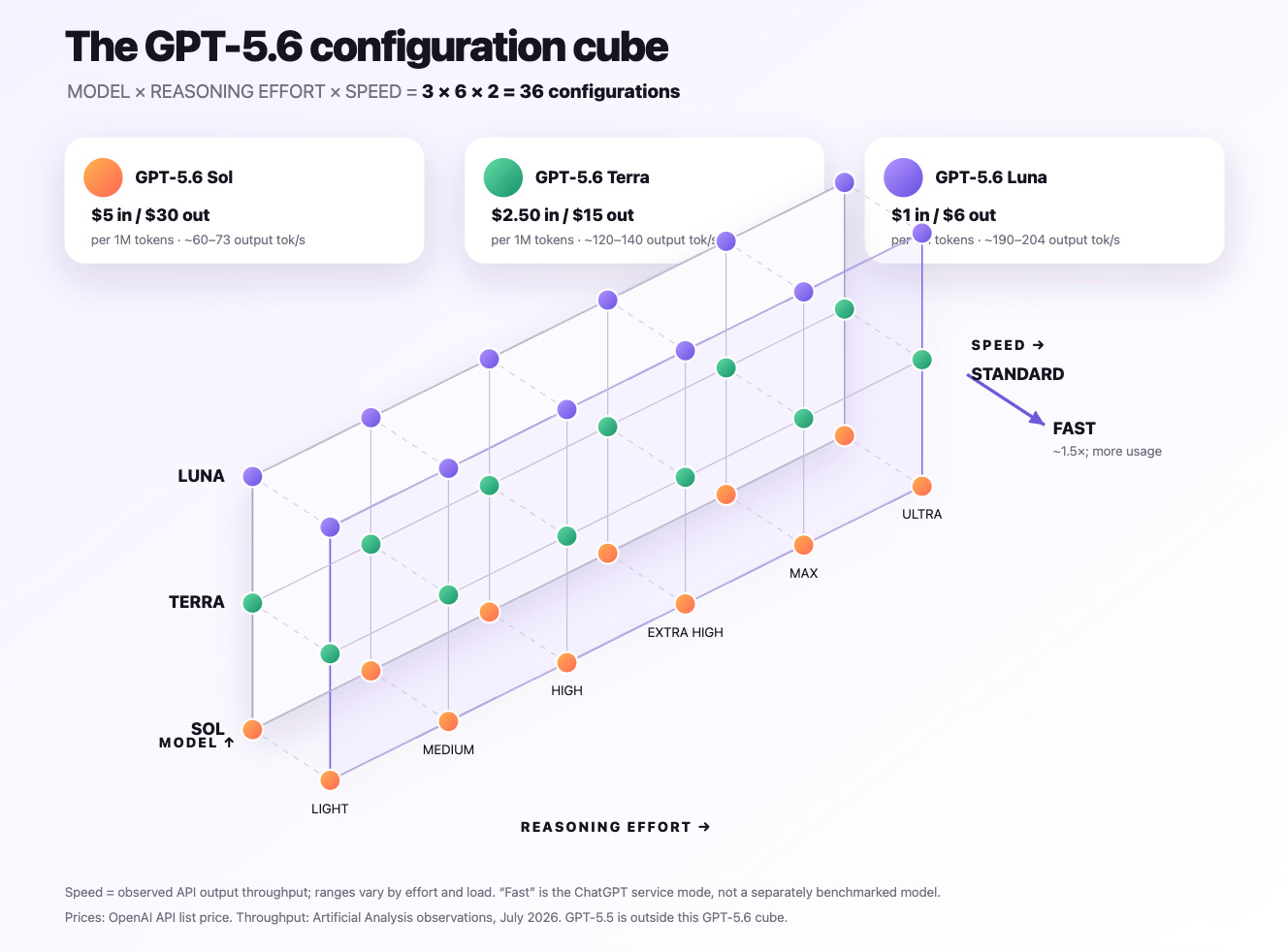
But API users have literally 36 variants of GPT 5.6 now:
Most people can get by with just 3 rough clusters
And many guides are coming up:
The top AIE talk so far this week has been Theo’s closing keynote, and the last of the online track will be released this weekend.
OpenAI’s GPT-5.6 rollout: model stratification, agent UX, and early benchmark signals
GPT-5.6 introduced a more explicit model/compute ladder: users are now navigating Luna / Terra / Sol plus multiple effort levels, with community guidance converging around “start lower than you did on 5.5.” OpenAI staff explained that Max means one model spending longer on a hard problem, while Ultra parallelizes work across subagents; they also noted that 5.5→5.6 effort settings are not directly comparable (guidance from @reach_vb, follow-up, practical default suggestion). The community reaction was mixed: many praised the added control, while others criticized the 30+ configuration combinatorics and missing “Auto” routing (@rasbt, @Yuchenj_UW).
The product launch landed with real UX regressions, and OpenAI publicly course-corrected fast: users complained that the new ChatGPT Work / Codex split was confusing, chats/projects became harder to find, and usage burned down faster than expected (@scaling01, @simonw, @kimmonismus). OpenAI responded unusually directly: multiple usage-limit resets, acknowledgements that defaults nudged users toward overly expensive settings, and a commitment to restore familiar sidebar/navigation patterns and clarify positioning between Work and Codex (@thsottiaux reset announcement, second reset, full corrective roadmap).
Initial eval picture: GPT-5.6 appears strongest in agentic coding / presentation / some science tasks, but not unambiguously dominant everywhere. Examples: #1 tie in Code Arena: Frontend with Claude Fable 5 while being ~2× cheaper on listed IO pricing (Arena); best recorded Presentation Elo on AA-Briefcase with a ~500-point jump over GPT-5.5 (Artificial Analysis); CritPt gains over GPT-5.5 and beats Fable 5 by ~4 points (Artificial Analysis); and strong results on WeirdML at lower cost (@htihle). At the same time, users reported instruction-following issues, uneven token efficiency in practice, and some concern about jailbreakability / reward hacking (@teortaxesTex, @Mononofu, @kimmonismus).
Parallel-agent workflows, computer use, and the “harness is the product” theme
GPT-5.6’s biggest perceived leap may be orchestration and computer use rather than pure chat quality. Multiple users highlighted that Sol is unusually strong as a planner / verifier / orchestrator, often using subagents automatically and reacting more quickly to steering (@omarsar0, @Hangsiin). OpenAI also showcased computer use with Sol Ultra and promoted ChatGPT Work as bringing agents to consumer/mobile scale (OpenAI demo via @gdb, Work positioning). Community reports described very high-throughput GUI automation and Blender workflows (@mckbrando, @kimmonismus).
A recurring operational issue is hidden subagent cost explosion: users found that spawned agents may inherit premium settings, draining quotas much faster than expected. One concrete claim was that spawn_agent doesn’t let users choose model/effort, so Sol Ultra spawns more Sol Ultra by default (@evi77ain). This fits the broader pattern of people liking the capability jump but finding the cost model opaque.
The broader systems trend is toward harness-centric competition. This came through in product commentary from Perplexity’s Arav Srinivas (“the real product is now the harness around it”), in LangChain’s launch framing around Deep Agents + Nemotron + OpenShell, and in a growing set of memory / orchestration tools like OpenWiki and OpenSWE (@dee_bosa quoting Arav, @hwchase17, OpenWiki proactive memory, OpenSWE adoption). The meta-point: frontier model parity is tightening, so value is increasingly shifting to routing, memory, tool use, safety rails, and enterprise context.
Meta’s Muse Spark 1.1 and the widening frontier of “good enough, fast, cheap” models
Muse Spark 1.1 was the other major model story of the day, with many practitioners calling it the most surprising release of the week. Reports consistently emphasized strong UI/frontend generation, fast responses, and unusually aggressive pricing, often framing it as near-frontier quality for a large subset of coding/product tasks (@alexandr_wang, @rowancheung, @kimmonismus).
Benchmarking suggests a real step up, but not outright frontier leadership. Artificial Analysis scored Muse Spark 1.1 at 51 on its Intelligence Index, up 8 points from 1.0, roughly tied with GLM-5.2 / GPT-5.4 / GPT-5.6 Luna and behind Grok 4.5 / GPT-5.6 Sol / Claude Fable 5. Notable details: 1M context, median speed ~114 tok/s, pricing $1.25 / $4.25 per 1M input/output tokens, and strong token efficiency (Artificial Analysis). Arena also placed it #9 on Code Arena: Frontend with strong gains in instruction-following and longer-query categories (Arena).
The strategic implication many drew: Meta’s compute-heavy bet is starting to show up as cost-effective inference products, not just talent headlines. Several commentators argued this materially raises competitive pressure on OpenAI/Anthropic, especially if Meta improves distribution and API ergonomics (@scaling01 asking for OpenRouter, @alexandr_wang, @mweinbach).
Open models, infra, and efficiency work
Open-model tooling kept shipping despite the closed-model attention vacuum. Unsloth released Qwen3.6 NVFP4 quants with claims of 2.5× faster inference, including 27B on 24GB VRAM and a 35B-A3B variant hitting 17,561 tok/s on B200 (Unsloth, technical details from @danielhanchen). QuixiAI reported Qwen3.6-35B-A3B-NVFP4 on dual B60 at 65 tok/s and 128k context (QuixiAI).
Inference optimization remains a major live research area. Cohere open-sourced Hardware-aware Dynamic Speculative Decoding in vLLM, addressing the familiar issue where speculative decoding helps at low batch sizes but hurts at high ones (Cohere/vLLM, vLLM commentary). Google/Hugging Face’s Gemma challenge reported up to 5× faster single-A10G inference, with 315 TPS lossless and 491.8 TPS fastest overall (Gemma).
Agent evaluation / self-improvement work is getting more concrete: “LLM-as-a-Verifier” reported SOTA on Terminal-Bench V2, SWE-Bench Verified, RoboRewardBench, and MedAgentBench using repeated sampling plus score-logprob ranking (paper thread); Meta researchers proposed an explicit memory agent to combat behavioral state decay in long-horizon agents (summary).
Science, math, health, and modality-specific systems
Math/science capability claims escalated sharply. OpenAI staff and community members circulated examples of GPT-5.6 Sol Ultra producing a claimed proof of the Cycle Double Cover Conjecture using 64 subagents in under an hour (claim from @eknight, amplified by @gdb). Separately, Bubeck noted a single-person 1M-line Lean formalization effort with GPT-5.6 (@SebastienBubeck). These are still claims pending external scrutiny, but they indicate where labs want the narrative to go: parallelized research agents as a scientific compute primitive.
Health is becoming a first-class benchmark and product vertical. OpenAI said GPT-5.6 is a major step forward for health intelligence, highlighting that Luna at lowest effort beats GPT-5.5 at highest effort while costing 25× less (OpenAI). Karan Singhal added that, in blinded physician comparisons over 20,000 axis ratings, physicians found fewer flaws in GPT-5.6 responses than physician-written responses across a hard task set (details).
Audio/music and creative tooling also moved: Kyutai + Mirelo released MuScriptor, an open model for multi-instrument audio-to-MIDI transcription from full mixes, not stems (MireloAI, Kyutai). Sakana’s new Picbreeder-style work explored open-ended creativity with VLM agents, concluding that diverse agent populations help but still fall short of human open-ended exploration (Sakana).
Security, safety, and policy frictions
Security concerns rose alongside capability gains. OpenAI moved its Bio Bug Bounty into a private ongoing program and doubled rewards to $50K, specifically seeking universal jailbreaks against predefined biosafety challenges (OpenAI). Separately, OpenAI tightened access requirements for its most cyber-capable models, requiring hardware security keys for Trusted Access for Cyber members starting Sept. 1 (@cryps1s).
Evidence of misuse remains salient: a new study reported Boko Haram members using frontier chatbots for bomb-making and related tactical queries (@AntoniaJuelich). That thread sat uncomfortably next to ongoing online discussion that GPT-5.6 may be relatively easy to jailbreak or reward-hack in some settings (@Mononofu).
Policy discourse remains polarized and speculative. The “AI 2040 / Plan A” transparency-and-governance scenario drew both support and ridicule, with Ajeya Cotra emphasizing the centrality of total research transparency while critics questioned feasibility and assumptions about superintelligence/governance capacity (@ajeya_cotra, @binarybits, @banteg satire).
Top tweets (by engagement)
OpenAI launch and rollback management: OpenAI’s product lead acknowledged launch confusion, promised UI fixes, and reset usage twice while clarifying that Codex is here to stay (full thread).
Claude Code desktop browser: Anthropic shipped an in-app browser for Claude Code desktop so Claude can browse docs/sites inside the app (@ClaudeDevs).
OpenAI org update: Fidji Simo announced she is leaving her full-time role at OpenAI and becoming a part-time advisor, citing the need to focus on recovery from chronic illness while continuing work related to AI and health (@fidjissimo).
Perplexity harness expansion: Perplexity added Grok 4.5 as an orchestrator in Computer after internal evals showed strong WANDR performance at roughly half the cost of Opus 4.8 (Perplexity).
An enterprise AI agent answers with total confidence, but the number is wrong. Nobody catches it until someone traces it back to a stale metric definition or a document the retrieval system never pulled. The model did not fail. The context it was given did.
In the past six months, 57% of enterprises traced a confident but wrong AI agent answer to missing or inconsistent business context, and 31% said it happened more than once, according to a VB Pulse June 2026 survey of 101 qualified enterprises with more than 100 employees.
The reason is not hard to find. Retrieval over documents is the default way agents get business context for 38% of enterprises, nearly double the next closest approach. The way most enterprises choose a retrieval system compounds the problem. Ease of ingestion and operational simplicity lead the selection criteria, with retrieval accuracy running behind both. The accuracy problem only shows up after the system is already live.
There is a known fix for this, a governed context layer every agent reads from instead of guessing. Vendors are racing to roll out context platforms while most enterprises are still figuring out what it is.
75% don't have an agentic context layer yet
The context layer is meant to be a shared model of what business data actually means, built once and referenced consistently instead of re-derived by every agent that touches it.
The VentureBeat research shows the enterprise response to that idea is broad but unfinished. Twenty-five percent of respondents run one in production. Thirty-four percent are building one right now. The remaining 41% have not started.
Among companies already building or running a governed context layer, 78% report a confident-wrong failure — an AI agent that answered with total certainty and was still wrong. Among companies with no plans to build a layer, only 20% report the same thing. Companies that already got burned are far more likely to be building the fix. Companies that haven't been burned yet see no urgency.
What governed context looks like when someone actually builds one
Every major data and AI platform vendor is now building some version of this layer, and they are not converging on the same architecture.
DataHub is treating catalog metadata and years of analyst query behavior as a knowledge source, then keeping it current as a living system rather than a static wiki.
Microsoft's Fabric IQ is building a business ontology that any agent, not just Microsoft's own, can query over MCP.
Couchbase is pushing agent memory and context retrieval down to the edge, arguing the operational database is a more natural home for it than a search or analytics layer bolted on after the fact.
Pinecone's Nexus is compiling structural logic into the metadata layer ahead of runtime, betting that agents need pre-built structure more than they need faster search.
Snowflake runs a two-layer system, Horizon Context for customer-managed definitions and Cortex Sense for context the platform infers on its own.
Oracle's Unified Memory Core takes the opposite approach, folding vector, graph and relational data into one transactional engine so there is no sync layer left to go stale.
Google's Knowledge Catalog mines query logs and usage patterns to curate semantic context automatically.
AWS's Context service makes the same bet, a knowledge graph that gets smarter from how agents actually use it rather than from manual re-curation.
Analysts converge on one diagnosis
The vendor approaches differ. What analysts and practitioners have told VentureBeat about the underlying problem, across a run of interviews this year, does not.
When DataHub's context layer push landed this spring, Constellation Research VP and principal analyst Michael Ni framed the stakes in blunt terms. "Whoever controls runtime context controls the AI decision layer for enterprise data," Ni said. He was equally direct about how far any single product actually gets a buyer. "Vector memory isn't business meaning, business meaning isn't governance and governance isn't execution," Ni said.
In the same interview, BARC analyst Kevin Petrie pointed to a narrower but concrete gap. Most context platforms concentrate on structured tables, he said, which give agents trusted facts but miss the harder, messier context locked in documents and unstructured content, exactly the material a business actually runs on day to day.
Stephanie Walter, practice leader for AI Stack at HyperFRAME Research, made a related point earlier this year when VentureBeat asked her about enterprise context fragmentation.
"The market is converging on the same conclusion," Walter said. "Agents don't just need more tokens or better models. They need governed, current, low-latency context." She made a similar case in an earlier review of Pinecone's Nexus launch, careful not to overstate how new any of this is. Nexus, she said, "shifts knowledge work from runtime chaos to pre-compiled structure. But it's an evolution of RAG architecture, not a complete reinvention."
Gartner's Arun Chandrasekaran, reviewing the same launch, offered the more forward-looking read. Agentic AI, he said, is moving from pure information retrieval toward a reasoning architecture, one where long context works as short-term memory and a vector database functions as deep storage underneath it.
The fragmentation problem shows up hardest at the practitioner level, where separate tools for retrieval, memory and access control were never built to agree with each other. Steven Dickens, CEO and principal analyst at HyperFRAME Research, put it bluntly after Oracle's AI database push landed this spring. "Data teams are exhausted by fragmentation fatigue," Dickens said. "Managing a separate vector store, graph database and relational system just to power one agent is a DevOps nightmare."
Matt Kimball at Moor Insights and Strategy, in that same story, put the production reality more simply. Getting an agent working is not the hard part, he said. The struggle is running it in production, where the goal becomes removing the distance between data and execution rather than adding another layer on top of it.
What this means for enterprises
Here's what this adds up to for enterprises building on this layer.
Retrieval alone will not close the context gap. RAG is the default source for context in most enterprises today, and it is also the layer most closely associated with the confident-wrong-answer failure. Adding more documents or a bigger index does not fix a definition that is inconsistent across systems.
The semantic context layer is where the budget is actually moving, even where it hasn't shipped. Fifty-eight percent of enterprises are already engaged — building or in production — but only 25% have actually gotten a layer live. That gap shows where enterprises have decided to spend, not where they've arrived.
No single vendor owns the architecture yet, and that is likely to stay true for a while. Enterprises evaluating this layer should expect to integrate rather than pick a single winner, at least for the next several quarters.
The buying decision is happening this year, and it is concentrated among the companies already burned by it. Fifty-seven percent of enterprises plan to switch or add a retrieval or context platform within the next twelve months. That intent is not spread evenly. Enterprises that reported a repeat confident-wrong failure plan to switch or add a provider at roughly 81%, against 32% among enterprises that never hit the problem. The companies shopping for new context tooling right now are largely the ones whose agents already got it wrong.
The agents are already running. The context underneath most of them is still being built, and the vendor selling the fix is being chosen this year.
This data will be part of a broader conversation at VB Transform 2026 on July 14 and 15 in Menlo Park: the context gap enterprises are racing to close, and which of the emerging approaches — governed semantic layers, hybrid retrieval, provider-native bundles — actually holds up in production.
OpenAI on Thursday launched ChatGPT Work, a new AI agent embedded inside its flagship chatbot that aims to transform ChatGPT from a question-and-answer tool into an autonomous work platform capable of executing complex, multi-step tasks across users' email, calendars, code repositories, and messaging apps.
The product is powered by OpenAI's latest flagship model, GPT-5.6, and is designed to go far beyond generating text. ChatGPT Work can gather context from connected apps, files, and workflows to produce finished documents, spreadsheets, presentations, reports, and websites. The agent takes a stated outcome, breaks it into smaller steps, and stays with complex projects for hours, completing them independently.
The launch marks OpenAI's clearest attempt yet to reposition ChatGPT as a workplace platform rather than a chatbot — and it arrives at a moment of extraordinary financial significance for the company. Last month, OpenAI confidentially submitted a draft S-1 registration statement to the SEC, initiating what could become one of the largest technology IPOs in history, with reported valuations clustering between $730 billion and $852 billion and annualized revenue that has blown past $25 billion.
In a short demonstration and conversation with VentureBeat on Friday, Ty Geri, a product manager at OpenAI who helped build ChatGPT Work, said the product's mission is to democratize the kind of agentic AI capabilities that OpenAI's internal engineering tool, Codex, has already demonstrated. "What's really exciting is we've seen how much Codex has been able to push the frontier of what we can get done with these AI tools, as opposed to just getting information or answers or guidance," Geri said. "Our internal adoption of Codex is literally an exponential curve across every single product function and every single use case."
Why OpenAI built a persistent virtual machine that works from the beach
The core architectural bet behind ChatGPT Work is a persistent cloud-based virtual machine that runs on OpenAI's servers, always available to the user regardless of which device they happen to be on. That marks a deliberate departure from competitors whose agents require a local machine to remain powered on and connected.
"What's really exciting about ChatGPT Work is that it's a virtual machine in the cloud that's always on for you, and this is available across all of our paid tiers," Geri said. "All Plus users are getting this. I think that's a very unique aspect of this."
The mobile-first aspect of the launch is something Geri described as "missing from the market." He pointed to the ability to create a website on a phone and share it with collaborators as a particularly novel capability. "Sites are new in general to Codex. They launched in Codex about a week and a half ago, but now we're launching also in web and mobile. You can create a site on your phone at the beach and share it with your friends," he said.
ChatGPT Work will roll out beginning with Pro, Enterprise, and Edu users, and will expand to Plus and Business users over the next few days. In the interview, Geri emphasized that the availability of the product to Plus subscribers — not just premium tiers — is central to OpenAI's strategy. "It's accessible to all paid plans, including Plus users, which in my opinion is a really big feat, and really part of that OpenAI mission, which is about bringing all this power to as many people," he said.
How MCP plugins connect ChatGPT Work to Slack, Gmail, and GitHub
The product relies on MCP-based plugins to connect to external services like Gmail, Google Calendar, Slack, and GitHub. When asked whether the plugin architecture is based on the Model Context Protocol standard, Geri confirmed: "These are all based on MCP." He added that connecting multiple Gmail accounts — a frequent user request — "is definitely on the roadmap."
The experience is designed to be action-oriented from the first interaction. ChatGPT Work offers a personalized onboarding flow that surfaces different suggested use cases depending on the user's role. Geri demonstrated how the system, detecting his role as a product manager, immediately suggested tasks like evaluating AI systems, building research artifacts, and managing his calendar. "You can start with a simple task like catch me up on Slack or Teams or read today's calendar," Geri said. He described a scenario where the system reviewed his calendar, identified scheduling conflicts, flagged meetings requiring preparation, and then — on his instruction — declined, accepted, or rescheduled events directly.
Users can also customize the agent by teaching it their writing style, organizing outputs into projects, and — in a lighter touch — choosing a virtual pet that accompanies them in the interface. The interface also introduces a hosted website feature that allows users to build and share interactive sites directly through ChatGPT Work, turning what would typically be a static slide deck into a dynamic, collaborative artifact. "Now we suddenly have a collaborative interface that's actually more exciting and more accessible than a slide deck, which has all these formatting restrictions," Geri said.
Scheduling 10 bug bashes at once: what agentic productivity looks like in practice
Geri's own usage of ChatGPT Work illustrates the breadth of tasks the system can handle. In the run-up to the product's launch, he needed to organize pre-release testing sessions — known internally as "bug bashes" — across dozens of features and team members.
"I just come to ChatGPT Work and say, 'Set up a bug bash for all the distinct features in ChatGPT Work. Add all the people that worked on that feature,' and it can check Slack, it can check GitHub, it can check Docs, and find a time that works for the four highest contributors to that feature," Geri said. "It went and scheduled 10 bug bashes, all coordinated across all those different people. That would have taken me 30 minutes at least."
But Geri pushed back against the characterization that ChatGPT Work is limited to rote administrative work. He described using it for analytically complex tasks like identifying the biggest causes of user churn for specific product features and generating product solutions — work he said would previously have taken months. "Things that we would have spent three months doing, we can now spend a week doing — and do much more, and make a much better product," Geri said. "Bugs that we would have found three or four weeks from now, we can now find within two days and fix for our users."
He also described handing off the tedium of product testing itself. "It used to be that even though like the most interesting part of my job is like what to test, I would actually end up having to spend most of my job doing the testing, which is like me taking a mouse and like clicking on the same thing over and over again, like five times," Geri said. "Instead, now I can define what do we want to test, and ChatGPT Work or Codex can actually go test it for me, deliver me that bug report, and then we can work on fixing that bug."
What OpenAI says about data privacy when AI reads your Slack and email
When pressed on data privacy concerns — given that ChatGPT Work pulls sensitive information from workplace tools like Slack, Google Drive, and email — Geri said privacy "is incredibly important, and the most important part of this is it's always in the user's control."
He pointed to OpenAI's existing enterprise security infrastructure, noting that "enterprise accounts have ZDR, and users can always opt out of letting their conversations help improve future models, which many users do." The comment aligns with assurances OpenAI made when it first launched ChatGPT Enterprise in August 2023, when the company wrote in a blog post that it does "not train on your business data or conversations."
The privacy question carries additional weight now because of the sheer volume of sensitive workplace data ChatGPT Work is designed to access. Unlike a chatbot session where a user voluntarily pastes text into a prompt, ChatGPT Work actively reaches into connected systems — reading Slack messages, scanning calendar invitations, pulling GitHub commit histories — to assemble context for its tasks. That represents a fundamentally different data surface area than anything OpenAI has offered before, and one that enterprise security teams will scrutinize carefully before granting access.
ChatGPT Work enters a three-way arms race with Anthropic and Microsoft
ChatGPT Work lands squarely in the middle of what has become the defining competitive battlefield in enterprise AI: the race to build autonomous workplace agents that can go beyond generating text and actually execute tasks.
The product arrives months after Anthropic took Claude Cowork out of preview and into general availability in April, bringing its AI agent to web and mobile platforms aimed at helping enterprise users monitor and manage long-running AI-driven tasks from anywhere. Meanwhile, Microsoft made Copilot Cowork generally available worldwide on June 16, built in partnership with Anthropic to move beyond chat and into execution. The three products — ChatGPT Work, Claude Cowork, and Microsoft Copilot Cowork — now compete directly for the attention of enterprise IT departments and individual knowledge workers alike.
The convergence is striking. All three products share a remarkably similar vision: a persistent AI agent running in the cloud that can break complex tasks into steps, connect to workplace tools via plugins, and produce finished outputs rather than just conversational replies. All three work across desktop, web, and mobile.
What distinguishes OpenAI's approach is its raw consumer distribution advantage. ChatGPT has reached 900 million weekly active users, and OpenAI now has 50 million paying subscribers. More than 9 million paying business users rely on ChatGPT for work, and 92% of Fortune 500 companies now use ChatGPT. By making ChatGPT Work available to Plus subscribers at $20 a month — not just Enterprise or Pro customers — OpenAI is betting that broad accessibility will drive adoption faster than any competitor can match.
OpenAI's product manager says AI is a partner, not a replacement — with a caveat
When asked about the potential impact on the labor market, Geri was careful with his framing. He declined to speak broadly about workforce disruption but offered his personal experience as a product manager whose day-to-day work has been substantially reshaped by the tool.
"My job is not to schedule bug bashes and find out who contributed to a specific feature. That's a task I do in my job, but that's not my job," Geri said. "My job is to make an amazing product." He described ChatGPT Work as "a partner" and "an extension of me, certainly not a replacement," adding: "Everybody feels far more productive than before, but is also almost working harder than before, because you get to work on all the things you want to work on as opposed to the drudgery around it."
But Geri was also careful not to minimize the sophistication of the work the agent can handle. "I also don't want to say that it's only doing mundane tasks because, like something like hill climbing retention curves on a given feature is not mundane. It's actually really hard to do," he said. The distinction matters. If ChatGPT Work were merely automating calendar invitations and expense reports, it would be a convenience tool. The fact that Geri describes it compressing three months of analytical product work into a single week suggests something with far greater implications for how teams are structured and staffed.
An IPO-bound company needs ChatGPT Work to prove enterprise AI can generate revenue
The timing of ChatGPT Work's launch is impossible to separate from OpenAI's IPO trajectory. The company needs to demonstrate that it can convert its massive consumer user base into durable enterprise revenue — a narrative that becomes significantly more compelling with a product explicitly designed around professional workflows.
OpenAI said it is generating $2 billion in revenue per month, growing four times faster than Alphabet and Meta did at comparable stages, with enterprise now making up more than 40% of revenue and on track to reach parity with consumer by the end of 2026. But OpenAI remains heavily loss-making, and the company does not expect to reach profitability until around 2030, with internal projections suggesting losses of $14 billion in 2026 alone.
The competitive dynamics are unprecedented. Anthropic filed for its own IPO on June 1 at a $965 billion valuation, setting up simultaneous public listings from the two most prominent AI startups in history. Whether both can sustain their lofty valuations under the scrutiny of public market investors will depend in large part on whether products like ChatGPT Work and Claude Cowork deliver measurable productivity gains to paying enterprise customers.
The launch also caps a product trajectory that began with ChatGPT Enterprise in August 2023, accelerated through the release of OpenAI's Operator agent in January 2025, and continued through Operator's deprecation and shutdown on August 31, 2025, when its capabilities were folded into the ChatGPT agent framework. ChatGPT Work is the consolidation of those efforts into a single, unified product — one that pairs GPT-5.6's three model variants (Sol for power, Luna for speed, and Terra for balanced everyday use) with a persistent cloud environment and an expanding library of MCP plugins.
The future of work may already be running in the cloud
When asked whether ChatGPT Work signals a shift toward a new kind of operating system — one where users interact with their computers primarily through an AI agent rather than through traditional mouse-and-keyboard interfaces — Geri stopped short of making sweeping predictions. But he hinted at the direction OpenAI sees ahead.
"Anybody who has worked with Codex or now ChatGPT Work will realize how exciting it is to interact with your environment and your computer via the agent," he said. "Especially in the desktop app, where the model has access to your entire machine and can interact with websites on your behalf — it's really able to be an extension of you and a real partner, and that certainly feels like the future."
At the end of the interview, Geri circled back to something personal. "I've never enjoyed work as much as I have in the last month using ChatGPT Work and Codex," he said — a striking admission from a product manager who, until recently, spent a meaningful share of his days clicking through the same interface five times in a row just to see if it would break. OpenAI is now asking 900 million users to believe that feeling scales. For a company weeks away from one of the largest public offerings in history, the answer to that question is worth roughly $850 billion.
Enterprise companies are running AI agents ahead of the controls needed to manage them — and they deployed that way knowingly. That is the central finding from VentureBeat Research's June survey of 573 technical leaders at companies with 100 or more employees, fielded across five parallel surveys of the agentic stack.
Enterprises are now retrofitting to catch up with their own standards, and they are budgeting for it: Roughly six in 10 enterprises plan to switch or add vendors in each of five control layers within the next 12 months, and roughly a third — depending on the layer — plan to move within the quarter, the research finds.
There are five main layers where enterprises are building: identity for agents (which agent is allowed to do what, under whose credentials); evaluation of agent output (whether the work is any good); cost telemetry (what each agent costs to run); the context layer (the business data and definitions agents draw on to answer); and the orchestration control plane (the software that coordinates multi-step agent work).
Enterprises are already paying the price for deploying agents ahead of adequate control functions. Fifty-four percent of companies had an agent security incident or near-miss caught before harm in the past 12 months. Twenty-seven percent exercise only reactive control of agent spend — they learn what an agent costs when the invoice arrives, with no per-agent budget or ceiling in place.
Here are the five findings that anchor the set — one finding per layer of the tech stack — and what the data suggests doing first in each.
Expensive hardware is idle: 86% of GPU operators report utilization of 50% or less
Eighty-six percent of enterprises that run their own GPUs report utilization of 50% or less. Wall Street has spent the quarter debating whether the AI buildout is overbuilt. This is buy-side measurement, from the enterprises doing the buying, and the research says the most expensive hardware in buildings of these enterprises runs at no more than half its capacity.
The measurement gap compounds it: A minority 44% rigorously track what their AI compute actually costs and returns. Everyone else is only estimating. And the enterprise shopping process continues regardless: 45% of these enterprises say the emerging compute option they are most likely to evaluate in the next 12 months is an AI-specialized cloud (CoreWeave, Lambda, Crusoe, Nebius). However, under 2% of these enterprises report using one of these neoclouds today.
Moreover, roughly one in three companies appears to be considering a hedge against Nvidia: Asked which emerging compute option they are most likely to evaluate in the next 12 months, 32% of enterprises named non-Nvidia accelerators (AWS Trainium, Google TPUs, AMD), while 28% named next-generation Nvidia GPUs. The data suggests that enterprises should measure the utilization and per-workload cost of the GPUs they already own before committing budget to new compute — whether that's an AI-specialized cloud contract, new accelerators, or more GPUs.
Most deployed "agents" do single-prompt work: 71% say a quarter or fewer complete multi-step tasks on their own
Seventy-one percent of enterprises say a quarter or fewer of their deployed "agents" can complete multi-step work on their own; the rest are single-prompt chatbots. Only 10% say true agents are the majority of what they run. To be sure, the respondents reported that they are in a position to know these things: 81% said they recommend or decide AI purchases at their companies.
That finding — that most agents are actually just chatbots in trenchcoats — lands amid adoption claims across the industry running well ahead of what enterprises are actually running. Gartner predicted 40% of enterprise applications will be integrated with task-specific AI agents by the end of 2026, up from less than 5% in 2025. It also warned that the most common misconception is referring to these AI assistants as agents, a misunderstanding known as "agentwashing."
Meanwhile, Zapier's enterprise survey said 72% reported deploying or testing autonomous agents; and Writer's 2026 survey has 97% of executives saying their company deployed AI agents in the past year.
Those surveys asked whether companies have deployed something called an AI agent, and companies said yes. Our survey asked the people running those deployments a harder question: Of the agents you have in production, how many can complete a multi-step task without a person driving each step? The gap matters for two practical reasons. First, the inflated adoption figures are the benchmark boards and vendors use to pressure technical leaders into moving faster — and this data says the real bar is far lower than the headlines suggest. Second, the label determines the bill: A single-prompt chatbot with a human reading every answer needs none of the identity, evaluation, and cost controls this report covers, while a true multi-step agent needs all of them.
66% let agents push to production on automated evals alone — or are engineering toward it. 5% fully trust those evals
Two-thirds of enterprises fall into one of two camps: 34% already allow an AI agent to push a code or system change to production based on automated evaluation results alone, with no human reviewing it, and another 33% are actively engineering their pipelines to allow that within the next 12 months. Only five percent fully trust the automated evaluations that would make that decision.
The distrust is earned. Half of enterprises shipped an agent that passed internal evaluations and then caused a customer-facing failure in the past year; a quarter watched it happen more than once. Asked to name the biggest weakness in their current evaluations, more enterprises chose “poor alignment with real-world outcomes” than any other answer — 29% of respondents.
And most of the checking happens before an agent ships, then stops. Once agents are live with real users, only 23% of enterprises run real-time quality checks on the answers those agents produce. Another 51% monitor system health only — uptime, request traces, and gateway logs — which tells them the agent is running, and nothing about whether its answers are right. The first move: Before removing human review from any workflow, test your evaluations against production outcomes rather than internal benchmarks, and instrument answer quality, not just uptime.
This finding is explored in more depth in VentureBeat's related coverage of the evaluation gap, which found that larger enterprises are moving faster toward zero-human deployment while also failing more often — and outlines a regression-testing framework built on production outcomes rather than internal benchmarks.
69% run credential sharing somewhere in the agent fleet — and those companies get hit far more often
Sixty-nine percent of companies allow agent credential sharing somewhere in their agent fleet during runtime – meaning multiple agents operating under one API key or service account. Those companies were far more likely to get hit: Organizations with credential sharing anywhere in the fleet experienced a security incident or near-miss at a 63.5% rate (47 of 74), against 40.9% (9 of 22) where every agent has its own scoped identity.
The takeaway for enterprises is this: Give every agent its own scoped identity, starting with the agents that touch production systems.
57% traced a confident, wrong agent answer to their own missing or inconsistent business context
Fifty-seven percent of enterprises traced at least one confident, wrong agent answer in the past six months to missing or inconsistent business context: wrong metrics, stale definitions, absent documents. Most of them watched it happen more than once.
Most enterprise companies are fixing this, even though they’ve moved forward with agent deployment already: 25% already run a governed semantic layer, or one governed definition of the business that every AI reads from, in production. However, 34% are still building one, and 41% haven't started. The takeaway: Govern the definitions your agents answer from, metrics and entities first, before scaling the agents that depend on them.
The quarter where agent technology “portability” became a priority
One more shift is worth reporting with its limits stated plainly. In our spring orchestration survey wave, the top concern about provider-controlled orchestration was security and permissioning limits (32%). By June, vendor lock-in led at roughly a third, with security limits at 28%.
Those are two snapshots one quarter apart, and here’s one possible explanation for why portability became a top issue for enterprises. Our June survey went into market after a June 12 U.S. Commerce Department export order took Anthropic's Claude Fable 5 offline for enterprises for roughly three weeks. Meanwhile, Chinese company Z.ai released GLM-5.2's open weights under an MIT license on June 16 at roughly one-sixth of GPT-5.5's price; and Tencent's Hy3 arrived July 6 under Apache 2.0; and OpenAI previewed GPT-5.6 on June 26 to a small group of government-vetted partners, opening it broadly on July 9 after the government's review cleared. The open-weight releases in particular promise enterprises more control over their agents, and while we haven't established a causal link here, the timing is worth noting.
The posture data matches the mood: 51% now expect their primary control plane for enterprise agents to be hybrid — provider-native plus external orchestration — by the end of 2026, up from 34% in the spring survey wave. Enterprises reporting that they rely purely on provider-managed agent services fell from 12% to 7%.
Five layers, no incumbents, 12 months
The synthesis across all five surveys reveals a huge “buying” window. In each of the five control layers, 57% to 64% of enterprises plan to switch or add vendors within 12 months — 64% in infrastructure and in evaluations, 59% in agent security, 57% in retrieval and context — and 26% to 38%, depending on the layer, plan to move within a quarter. No layer has an established incumbent: The most common evaluation tooling is the model provider's built-in evals, tied with no dedicated tooling at all (17% each); 82% of respondents name provider-native or hyperscaler controls as their primary agent security layer; and provider-native retrieval leads the context technology layer (RAG, etc) as well.
Most enterprises are defaulting today to the built-in tools that ship with the big AI platforms they already use: Anthropic, OpenAI, Google, Microsoft, and AWS. That holds true across every one of these agentic technology layers: enterprises are looking to their primary cloud and model providers to supply the guardrails, evaluations, and retrieval solutions already bundled into those providers' offerings.
Those defaults are winning on convenience, and they're also what the coming spending decisions will test. The survey didn't ask which direction that money moves — toward the platforms' built-in tools or toward the specialists challenging them — which is exactly why every contract in these five layers is worth watching over the next four quarters.
The Q3 survey wave will measure whether the enterprises made good on these budget plans: whether their agents gained scoped identities, whether evaluations got tested against production outcomes, whether GPU utilization rose, and whether the semantic layers under construction shipped.
VentureBeat will release the full Q2 reports across all five VB Pulse trackers at VB Transform, July 14–15 at Hotel Nia in Menlo Park, where we convene enterprise technical leaders building autonomous agents in production.
Disclosure: VentureBeat produces both this research and VB Transform
Enterprise AI teams are giving agents more freedom at the same moment their confidence in automated testing is collapsing.
Half of enterprises have deployed an AI agent or LLM feature that passed internal evaluations and yet still caused a customer-facing failure — one in four more than once — according to the June 2026 VB Pulse survey of 157 qualified enterprise respondents at companies with 100 or more employees.
The sample is self-selected rather than a probability sample, so the findings should be read as directional, not precise.
But enterprises are not responding by slowing automation: 66% of respondents already permit some production deployment without human review or are building systems intended to do so within the next 12 months. Only 5% say they fully trust the automated evaluations that would make those release decisions.
That mismatch is the evaluation gap: the autonomy ceiling is rising faster than the assurance beneath it.
It also fits a broader thesis that will be explored at VB Transform 2026: enterprises ship agents first, while the control layers around identity, evaluation, cost, context and orchestration are arriving later. The next year will be a retrofit cycle, with buyers shifting budget toward the systems that make agentic deployments governable and dependable.
Why a passing evaluation is not a working agent
Traditional software testing usually asks whether a defined input produces an expected output. Agent testing is harder because the system may choose its own sequence of steps, call tools, retrieve data, alter state and respond differently from one run to the next.
An agent can make several individually plausible decisions and still reach the wrong result. It may retrieve the correct account but update the wrong field. It may draft a valid refund request but send it without approval. It may call five tools successfully before a sixth step leaks sensitive information or leaves a workflow incomplete.
The survey shows enterprises already recognize this limitation. The most common reason for distrusting automated evaluation is poor alignment with real-world outcomes, cited by 29% of respondents. Bias or inconsistency follows at 21%, lack of explainability at 18%, and data leakage or privacy concerns at 17%.
That hierarchy matters. Enterprises are saying the score often does not predict what happens when a customer, employee or business process encounters the agent in production — not that automated scoring is too slow or expensive.
NIST makes a similar point in its Generative AI Profile: measurements gathered in controlled environments may not transfer cleanly to deployment because behavior changes with prompts, users, context and operating conditions. Its guidance calls for field testing, post-deployment monitoring and clear processes for escalating failures.
Capability is not consistency
A single successful run proves that an agent can complete a task. It does not prove that it will complete the task reliably.
Anthropic’s guidance on agent evaluation distinguishes between measuring whether a system succeeds at least once across repeated attempts and whether it succeeds every time. That distinction is essential for customer-facing or operational workflows. A model that occasionally produces an excellent answer may still be unacceptable if the same task fails unpredictably on the next attempt.
Enterprise teams should therefore treat repeatability as a first-class metric. That means running the same scenario multiple times, varying phrasing and context, testing tool failures, and measuring whether the final business outcome remains correct even when the route changes.
The evaluation set also has to evolve. Every production incident should become a permanent regression test. Customer escalations, failed tool calls, incorrect approvals and data-handling mistakes should feed back into the pre-deployment suite rather than remaining isolated support cases.
Autonomy should expand by risk, not by ambition
The survey does not imply that every agent action should require a person. Human review cannot scale across millions of low-consequence decisions.
But zero-human operation should be earned by demonstrated reliability and bounded by the consequences of failure.
Low-risk actions such as drafting internal summaries or categorizing documents can tolerate broader autonomy. Financial transactions, customer communications, code deployment, access-control changes and data deletion need stricter thresholds, repeated consistency tests, policy checks, rollback mechanisms and clear human escalation paths.
The risk isn't evenly distributed by company size, either. Larger enterprises — those with 2,500 or more employees — are moving toward zero-human deployment fastest, at 70% versus 64% for smaller companies, and they're also shipping more agents that go on to fail a customer, at 54% versus 48%.
That is the warning for enterprise leaders. Removing the human from the loop does not remove uncertainty. Without stronger assurance, it converts uncertainty into an automated production decision.
The market will keep pushing toward greater autonomy because the economic incentive is real. The organizations best positioned won't be those that remove people fastest — they'll be the ones that treat repeatability and regression testing as seriously as deployment speed.
Large language model (LLM) training workloads increasingly run into GPU memory limits before compute is fully used. Model weights, gradients, optimizer states,...
Large language model (LLM) training workloads increasingly run into GPU memory limits before compute is fully used. Model weights, gradients, optimizer states, communication buffers, and intermediate activations all compete for GPU high-bandwidth memory (HBM). As model size, sequence length, and batch size grow, HBM capacity often becomes the primary scaling bottleneck. This post explains how…
From warehouse automation to surgical assistance, many real-world applications depend on robots performing delicate, contact-intensive tasks. Often missing in these situations is the sense of touch: robots need to feel the forces on their fingertips to manipulate objects effectively. Despite years of effort, robust and scalable solutions to this problem remain out of reach, especially in industrial settings. One approach has been to use vision-based tactile sensors, in which cameras embedded in soft fingertips capture contact geometry. Researchers have used this approach to estimate object shape and pose, but computing the forces that correlate most with manipulation capabilities remains a challenge. Modeling tactile shear — the forces that arise when an object slides or rotates against a sensor — is crucial for building robots that can grasp objects, use tools, and perform complex manipulation skills. Our solution, HydroShear, gives simulators the ability to accurately model tactile forces, enabling robots to learn dexterous, contact-rich manipulation policies entirely in simulation. These policies transfer seamlessly to the real world with no modification, achieving a 93 percent average success rate across four challenging tasks. Bridging the tactile reality gap Simulators for robot locomotion have found success in real-world applications because physics engines model rigid body dynamics and proprioceptive sensing well. But subtle tactile forces and shear feedback are notoriously difficult to simulate accurately. This has made it nearly impossible for tactile sensors trained on simulators through reinforcement learning to succeed when deployed on real robots. Existing tactile simulators face a fundamental trade-off. Physics-based methods like finite-element methods accurately model contact forces but are too slow for training reinforcement learning policies at scale. Faster approximations, on the other hand, oversimplify how forces build up and change during contact. They miss critical events like the moment a gripped object begins to slide or the way a soft sensor deforms over time. Modeling touch with fidelity and speed HydroShear’s key innovation is to add new capabilities to an existing physics simulation technique known as hydroelastic contact models. Called path-dependent force tracking, this approach accurately tracks how forces accumulate over a soft sensor membrane during a physical interaction. Rather than computing forces based only on instantaneous contact, HydroShear remembers the motion history of the object as it moves across the sensor. More concretely, when a robot grasps an object and moves it, different points on the object's surface come into contact with the sensor at different times. HydroShear tracks each of these contact points individually, computing how the soft elastomer deforms as the object moves. It then converts these deformations into realistic force fields, accounting for friction, slipping, and the elastomer's material properties. The simulator handles full 3-D motion — tilting and rolling as well as in-plane sliding — which is essential for dexterous manipulation. It's also GPU parallelizable, enabling efficient large-scale policy training. We calibrate HydroShear by collecting controlled real-world data with a robot arm and vision-based GelSight Mini tactile sensors. The calibration isolates four key parameters: how forces dissipate across the sensor surface, how tangential and normal forces build up, and the friction coefficient between the object and the elastomer. This systematic approach ensures that the simulator accurately reproduces real tactile feedback. Validation: From simulation to real robots We evaluated HydroShear on four contact-rich manipulation tasks, each highlighting different challenges. In all tasks, the robot perceives touch and proprioception (joint positions and gripper state) and has no access to object poses. Peg insertion: The robot grasps a cylindrical peg at an unknown orientation and must insert it into a tight socket. Because the grasp pose varies with each trial, the robot must use tactile feedback alone to detect and correct alignment errors during insertion. Bin packing: The robot inserts a cube into a target slot within a crowded bin. Neighboring cubes partially block the slot, so the robot must push through multiobject contact while sensing forces from multiple directions simultaneously. Book shelving: The robot inserts a book laterally into a shelf, with gravity pulling perpendicular to the insertion direction. The book is larger than the fingertip, producing broad contact patches that make it difficult to localize the object from touch alone. Drawer pulling: The robot pulls open a drawer while external-force perturbations are applied at random times. The robot must detect when the handle begins to slip and tighten its grip just enough to maintain hold without crushing it. We trained reinforcement learning policies entirely in simulation using HydroShear, then deployed them on a real Franka robot with GelSight Mini sensors without any modification or fine tuning. HydroShear achieved a 93% average success rate across all four tasks. We compared against two strong baselines: TacSL, which uses simplified force approximations, and FOTS, a recent learning-based method. TacSL achieved only 34% success, while FOTS reached 58 to 61%. The performance gap underscores the importance of accurate tactile shear simulation. Interestingly, the performance difference correlates directly with simulation fidelity. On tasks like peg insertion, where precise force feedback is critical, HydroShear's advantage is most pronounced. On drawer pulling, which requires detecting and reacting to slippage, HydroShear's path-dependent force tracking proves essential. Faster and less expensive Accurate tactile simulation unlocks a powerful recipe for robot learning: train policies entirely in simulation, then deploy them on real robots. This approach is dramatically faster and cheaper than learning from real-world interactions, which can damage sensors and require extensive trial and error. For warehouse automation, the approach is particularly valuable. Tasks like bin packing, sorting, and careful handling require robots to feel their way through complex interactions. HydroShear enables robots to learn such skills without extensive real-world data collection. While HydroShear yields strong results when coupled with vision-based tactile sensors like GelSight, the underlying principles could extend to other tactile modalities. We're also exploring how higher-resolution sensor simulations and more-complex object geometries could further improve performance.
Meta is preparing to manufacture its own AI chip for the first time. According to an internal memo, the company expects production of its proprietary processor, Iris, to begin in September.
After clearing bug testing in about six weeks, the chip — reported on by Reuters — is expected to take on some of the inference work currently running on third-party GPUs, giving Meta more control over how it builds and scales its AI infrastructure.
It’s unmistakable that this could be the company’s most important move yet toward in-house silicon for AI workloads.
But anyone can see this isn’t really about the hardware. It’s unmistakable that this could be the company’s most important move yet toward in-house silicon for AI workloads. The timing, as Meta is locked in an aggressive multi-billion-dollar infrastructure race, is critical. It’s clear that the company’s CEO, Mark Zuckerberg, wants to grow into the AI titan he believes the company can be, but it’s nearly impossible when the competition controls the core infrastructure.
Custom silicon for inference
Iris is designed for a specific job inside Meta’s AI infrastructure as custom silicon optimized for Meta’s heavy workloads. Iris expands Meta’s Meta Training and Inference Accelerators (MTIA) program, which is intended to move targeted AI inference workloads onto custom silicon.
The processor would handle workloads that drive content ranking, recommendations, and generative AI services across Meta’s family of applications, including Facebook, Instagram, and WhatsApp.
The MTIA 300 is already deployed in production to run ranking and recommendation inference across Meta’s platforms.
The 450 and 500 variants target generative image and video inference through 2027.
By shifting these high-volume inference tasks to custom silicon, Meta can lower data center costs while bypassing the traditional hardware supply bottleneck for its day-to-day operations.
Securing the AI supply chain
Meta’s modular, rapid-fire approach to custom silicon is aggressive versus traditional industry timelines. The company plans to drop a new iteration roughly every six months through 2027.
Meta is working with Broadcom to design Iris, while TSMC will manufacture the chip. But custom silicon is only one piece of the equation. Scaling AI infrastructure also requires a steady supply of memory, storage, and networking components at a time when demand for AI hardware continues to strain global supply chains.
To support that expansion, Meta has also been securing key components across its supply chain. The company has signed long-term agreements for high-bandwidth memory from Samsung Electronics, flash storage from SanDisk, and fiber-optic networking equipment from Sumitomo Electric.
The strategy mirrors similar investments by other hyperscalers. Google continues to expand its TPU program, while Amazon has developed its Trainium and Inferentia processors.
Scaling to 14 gigawatts
The Iris rollout is one component of Meta’s broader AI infrastructure expansion. The company plans to bring roughly 7 gigawatts of computing capacity online this year, then double that to 14 gigawatts in 2027. At that scale, Meta’s AI infrastructure would consume more electricity than many small countries.
At that scale, Meta’s AI infrastructure would consume more electricity than many small countries.
And, scaling AI infrastructure at this level comes with an enormous price tag. Meta has projected 2026 capital expenditures of between $125 billion and $145 billion, making it one of the largest single-year infrastructure investors in corporate history
Meta just pulled off something rare, which is essentially convincing Wall Street that spending more money is actually a good thing.
Wall Street rewards AI spending
Yet Meta just pulled off something rare: essentially convincing Wall Street that spending more money is actually a good thing. Following a trillion-dollar wipeout in tech market cap amid investor nervousness about the sheer scale of AI spending, Meta’s shares climbed roughly 8%.
With new MTIA chips planned roughly every six months through 2027, Meta is betting that vertically integrated AI hardware can deliver lower inference costs and better performance than relying exclusively on merchant silicon. By bringing chip design in-house and securing critical components across its supply chain, the company is slated to scale AI infrastructure with greater control over cost, deployment, and optimization.
There are many ways to optimize code for GPUs. In this post, you’ll learn how kernel fusion can improve memory bandwidth and reduce kernel launch overhead,...
There are many ways to optimize code for GPUs. In this post, you’ll learn how kernel fusion can improve memory bandwidth and reduce kernel launch overhead, along with multiple ways to apply it in NVIDIA CUDA code. A common bottleneck when writing GPU code is that GPU compute is so fast that even high-bandwidth device memory doesn’t use the GPU kernel fully. Kernel fusion addresses this by…
AI performance comes down to three dimensions: Accuracy: How well the model reasons and produces outputs Throughput: How many tokens per second a...
AI performance comes down to three dimensions: Deployments must balance all three: High accuracy is wasted if responses are slow, and raw throughput means little if each user’s experience is laggy. Practical systems therefore optimize accuracy, throughput, and interactivity together. This post focuses on throughput and interactivity, and how model-design choices shape both without…
Video Friday is your weekly selection of awesome robotics videos, collected by your friends at IEEE Spectrum robotics. We also post a weekly calendar of upcoming robotics events for the next few months. Please send us your events for inclusion.
For the first time, two full teams of humanoid robots played an 11-vs-11 soccer match on hardware, bringing one of robotics’ most ambitious long-term visions closer to reality. Never before have two full-sized humanoid robot teams played a soccer game against each other.
Engineers at MIT and EPFL in Lausanne, Switzerland, have designed a robot that can swim underwater and flap out of the water to continue flying through the air, much like a diving bird. The robot can help scientists study the mechanics that enable these actions in aquatic aviators and may help launch a new class of aerial-aquatic drones and vehicles.
We’re excited to announce our breakthrough robotic hands for the NEO platform: hands that match or exceed human-level dexterity, strength, safety, and reliability. Designed from the ground up, these 25-DoF hands combine 25 fully actuated degrees of freedom with a tendon-driven system, rich tactile sensing, and built-in compliance. The result is a hand capable of true in-hand manipulation, precision tool use, and delicate interaction.
Atlas arrived pitchside at NYNJ Stadium in front of 80,000 people gathered to see Brazil vs. Norway. After performing some of the sport’s most memorable player celebrations, Atlas helped kick off the second half by delivering the match ball!
Navigating discrete terrain such as stepping stones remains a major challenge for legged robots. Conventional approaches often rely on dense environment reconstruction from cameras or lidar, which can be affected by latency, occlusions, and significant computational overhead. We show that proximity sensors integrated into the bottom of a quadruped’s feet enable safe, terrain-seeking autonomous locomotion.
On this holiday, Digit is on grill duty. It turns out precise force control is good for more than payload handling. Happy 4th of July from all of us at Agility.
We’ve created GEN-1, our latest milestone in scaling robot learning. We believe it to be the first general-purpose AI model that crosses a new performance threshold: mastery of simple physical tasks. It improves average success rates to 99 percent on tasks where previous models achieve 64 percent, completes tasks roughly 3x faster than state-of-the-art, and requires only one hour of robot data for each of these results. GEN-1 unlocks commercial viability across a broad range of applications—and while it cannot solve all tasks today, it is a significant step toward our mission of creating generalist intelligence for the physical world.
Reachy Mini is becoming your real AI companion. The Conversation App makes it able to talk fluently with you, help you with your to-do list, remind you of important tasks, and even chat about music. Long-term memory, voice interaction, always ready to help.
This is very delicate work, although the real challenge would be picking those nuts out of a jumbled bin full of randomly sized nuts, which is how most of us live our lives.
In this presentation, Brendan Schulman, vice president of policy at Boston Dynamics, outlines the critical role of government engagement in driving the success of the humanoid robotics industry. He demonstrates how legged robots like the Spot quadruped and Atlas humanoid are moving beyond factory settings to deliver real-world value in infrastructure inspection, industrial manufacturing, and public safety. Schulman highlights the intersection of AI and robotics, showcasing how large behavioral models and reinforcement learning enable robots to navigate slippery floors and autonomously avoid workplace hazards. Ultimately, he calls for a proactive national robotics strategy focused on workforce training, safety standards, and ethical frameworks to support supply chain resilience and global competitiveness.

 Login
Login