❌

Normal view

Hardware-Rooted AI Security That Won’t Slow You Down

2 July 2026 at 21:25
Decorative image.AI has transformed how organizations operate, driving unprecedented levels of productivity and innovation. However, AI adoption can be impeded by concerns...Decorative image.

AI has transformed how organizations operate, driving unprecedented levels of productivity and innovation. However, AI adoption can be impeded by concerns surrounding data privacy, sovereignty and how to secure data while it is in use, or during inference and engagement with AI models. NVIDIA Confidential Computing (CC) was engineered to be a secure and performant solution for the era of agentic…

Source

The website of the future may assemble itself for every visitor

2 July 2026 at 21:25
Adobe Principal Scientist Carlos Sanchez at AIEWF.

For as long as I can remember (and I managed websites in the dot-com period), “personalization” has been a holy grail for websites. But up till now, that’s typically meant selecting from a predefined set of options. A retailer might recommend an item based on a previous purchase, or place a visitor into one of several audience segments — that’s been the extent of personalization.

Adobe Principal Scientist Carlos Sanchez is exploring a more radical possibility: what if the website itself could be assembled around the needs of each visitor?

At the AI Engineer World’s Fair in San Francisco, Sanchez demonstrated what Adobe calls an “agentic site” — a web experience that interprets a visitor’s intent, retrieves relevant material from the company’s existing content, and composes a personalized page in real time.

Adobe calls this approach an “audience of one.” Sanchez’s larger point was that the technology is no longer hypothetical.

“Many people don’t even think it’s possible to generate a web page on the fly,” he told Latent Space after his session. “People think it is future-looking. No, you can do this. It’s not the future, it’s the present now.”

From personalized components to personalized pages

During his presentation, Sanchez demonstrated a site that used the visitor’s browsing behavior and search queries as signals. The system grouped those signals into an intent category — such as exploring, researching or preparing to purchase — and then used an LLM to assemble a page suited to that intent.

In one example, a visitor interested in camping received a version of a coffee-machine site whose copy, product selection and supporting content had been reorganized around making coffee outdoors.

Sanchez also showed a more open-ended interface in which someone could enter a query such as “Europe AI conferences” and receive a page composed specifically around that request.

“We call this ‘audience of one,’ because the idea is to personalize the site in real time based on the user accessing it and what the user is doing,” Sanchez said.

The idea is that the site’s existing content is the grounding corpus. Adobe’s system retrieves from that material rather than asking an LLM model to invent an entire experience from scratch.

For AI engineers, one potential constraint is latency. In his session, Sanchez said that Adobe evaluates models not only for accuracy, but also for speed: “We don’t want the site generation to take more than one or two seconds.”

Sanchez says the economics are already becoming plausible. He estimated the current inference cost at “one to two cents per page.”

“But our point is also this is only going to get cheaper,” he said. “This is where we are today. In six months, who knows where we’re going to be.”

AI makes it easier to build, but harder to choose

Adobe has not yet broadly deployed these experiences on production customer sites. Sanchez said the company is presenting the concept to customers and looking for organizations willing to experiment.

Commerce is an obvious initial use case, because personalization can be connected directly to conversion. But the opportunity is not necessarily limited to retail. “It could work for other things — anything that needs more conversion and has a big matrix of user types or personas,” he told me.

Still, Sanchez acknowledged that he’s unsure if agentic sites will become a widespread reality.

“With AI, it’s very easy to build things, but it’s hard to know what to build,” he said. “We build things and then we find the customers.”

It’s not just Adobe feeling the uncertainty around its ‘audience of one’ concept. Website owners are currently evaluating all kinds of AI functionality: chat interfaces, structured content (like WebMCP), generative UI, personal agents, and more. Not to mention trying to find ways to bring users in from third-party AI platforms.

“I think it’s a combination of all these crazy different ways,” Sanchez said. “You are in a chat, I want to show UI, I want to get you to buy something. Then you’re in a site, I want to steer you this other way. Maybe you’re in an OpenAI chat and I want to bring you into my site. Everybody’s trying to figure this out on the marketing side.”

A web built for humans — and agents

Of course, websites in 2026 and beyond won’t just be personalized for human visitors.

As personal agents become more capable, a user may delegate some purchases or research tasks entirely. The agent could arrive carrying a much richer expression of the user’s preferences than the destination site could infer from cookies or recent browsing behavior.

Sanchez expects websites to evolve for both kinds of visitor. “Whether it’s going to be two versions [of a website] or not, that may be blurry,” he said. “But obviously, you’re going to have to target both.”

Also, not every transaction will work the same way. A personal agent might autonomously reorder toilet paper, while a person buying a jacket may still want to inspect the product and make the final choice through a visual interface.

That means websites will need to support different levels of delegation and involvement, rather than treating “agentic commerce” as a single interaction pattern.

Technologies such as WebMCP could allow a site to expose structured tools directly to an agent, while MCP Apps and other generative interfaces could bring interactive product experiences into the user’s chat environment. An A2A backend might allow agents to interact without traversing the conventional visual site at all.

It might end up being one site with both visual components and agent-accessible tools — two distinct experiences — or perhaps a human-facing website paired with an agent-to-agent service.

“That’s still what everybody’s trying to figure out,” Sanchez said. “But there’s going to be agentic targeting, for sure.”

Whither websites?

Whether websites survive the AI era at all is another big question we’re all grappling with.

What I gleaned from Sanchez at AIEWF was that the traditional website is unlikely to disappear completely, but its role will surely change.

Rather than being a fixed collection of pages that every visitor navigates, a “website” could become a governed content and interaction system that assembles an appropriate interface on demand. At least, that’s the future that Adobe is actively exploring.

The $1.3 million theft that exposed AI’s blind spot

Warehouse freight doors

Cyberattacks used to be the biggest security issue surrounding AI infrastructure, but that could be changing. A recent cargo theft outside Chicago suggests another vulnerability — and it’s one that has nothing to do with malware or prompt injection.

Just last week, the Cook County Sheriff’s Office recovered two stolen trailers containing roughly $1.3 million in data center equipment and copper wiring, taken from separate shipments originating hundreds of miles away. One trailer held about $300,000 worth of copper wire — reported stolen in Pine Hill, Alabama — destined for data center construction. The other carried roughly $1 million in data center infrastructure equipment, stolen out of Jacksonville, Florida. Both ended up at the same truck yard in Elk Grove Township, outside Chicago.

Viewed in the context of the AI boom, it highlights that the physical supply chain itself is becoming a new target for bad actors.

Viewed in the context of the AI boom, it highlights that the physical supply chain itself is becoming a new target for bad actors.  

A new high-value cargo

We’re all familiar with typical bottlenecks like GPU shortages, power constraints and cooling capacity, which have plagued the AI era since its inception. But we forget that building an AI data center requires an enormous volume of specialized hardware moving through freight networks. These include servers, networking gear, fiber, switchgear, cooling systems, power distribution equipment and thousands of pounds of copper. Each represents capital investment and potential deployment delays.

As hyperscalers accelerate the construction of data centers, the exposure of these items between the factory and data center creates a risk category that the industry as largely ignored.

When one delay cascades

Large GPU clusters depend on the synchronized delivery of dozens of interconnected systems. A training cluster is a tightly coupled system of servers, switches, optics, power distribution, and cooling that must be installed together. Missing networking hardware can idle racks, delayed power equipment can postpone an entire deployment and stolen copper can stall electrical work. So when one component category disappears, the delay cascades across everything.

So when one component category disappears, the delay cascades across everything.

Cargo theft by the numbers

Infrastructure resilience increasingly depends on whether critical hardware arrives at the construction site at all — and on schedule. Verisk CargoNet reported that U.S. and Canadian cargo theft losses jumped roughly 60% in 2025 to nearly $725 million, even as the total number of incidents held essentially flat — a sign that thieves are becoming more selective about high-value freight. Metal theft rose 77%, driven largely by demand for copper, while organized groups shifted toward enterprise computing hardware. CargoNet expects that focus on high-value technology — RAM modules, storage drives and enterprise computing equipment — to carry into 2026. For broader context, the Department of Homeland Security has estimated that cargo theft overall costs as much as $35 billion a year.

The Chicago incident fits squarely inside that trend.

Beyond firewalls and malware

Obviously, cargo theft isn’t an engineer’s problem. But organizations building AI infrastructure may need to broaden their thinking about deploying AI capacity on aggressive timelines.

Cloud providers, colocation operators and hardware vendors have already invested heavily in defending infrastructure from digital threats. As AI infrastructure becomes more valuable, protecting the physical systems behind it may deserve similar attention.

The next supply-chain conversation

The AI boom has already forced the industry to rethink electricity, cooling, networking and semiconductor manufacturing. Physical logistics may be next.

It starts long before the equipment reaches the data center.

If the value of AI infrastructure continues to climb into the billions of dollars, the industry’s definition of “infrastructure security” is likely to expand beyond firewalls and identity management. It starts long before the equipment reaches the data center.

The post The $1.3 million theft that exposed AI’s blind spot appeared first on The New Stack.

Microsoft just admitted its biggest AI mistake — and spent $2.5 billion fixing it

Chess board with two pieces

Microsoft’s latest AI services announcement suggests the era of standardizing on a single model may be ending. This week, the company launched a $2.5 billion AI adoption business designed to help enterprises customize AI deployments and use multiple models rather than lock themselves into a single provider — part of a larger shift toward systems that route each request to the model best suited to the task.

Simply put, the company that arguably has the deepest single-model partnership in the industry is now selling model swappability as the product.

Betting $2.5 billion on flexibility

Microsoft said Thursday it is creating a new operating entity, Microsoft Frontier Company, to help corporate customers select AI technologies that actually work for their businesses and produce a return on investment, Reuters reported. The unit launches with $2.5 billion in funding from Microsoft and will work with customers including Unilever and Novo Nordisk.

The new firm will help customers choose and integrate AI tools — from Microsoft and external providers — with each customer’s internal data. Customers will own the results of that work rather than handing it back to Microsoft. The move puts Microsoft alongside Palantir, which is doing similar work with large customers using Nvidia’s open-source models, and Amazon Web Services, which recently launched a $1 billion embedded-engineering unit of its own.

What’s most telling is the reasoning. Judson Althoff, CEO of Microsoft Commercial Business, told Reuters the new firm grew partly out of Microsoft’s own experience watching models like DeepSeek and Google’s Gemini catch up to OpenAI. Referring to the original Copilot, he said, “we made a mistake by binding it to OpenAI models only.” Customers, Althoff said, care more about the combination of their data and the models than about any particular model — and they need the ability to swap models quickly as the state of the art shifts.

“We made a mistake by binding it to OpenAI models only.”

One model no longer fits

Consider a typical customer service application that might need to summarize a support ticket, analyze a 300-page contract, generate an email, transcribe a meeting and review source code. Those aren’t necessarily the same problem. A model like Google’s Gemini, with a context window of a million tokens or more, may be the right choice for the contract. A small, fast model like OpenAI’s GPT-5.4 mini or Anthropic’s Claude Haiku may handle ticket summaries at a fraction of the cost. The transcription may go to a purpose-built model like Whisper. And if regulators require customer data to stay on-premises, an open-weight model like Meta’s Llama or Mistral is often the preferred choice.

Instead of choosing a single foundation model, developers increasingly choose several — and the application decides which one handles each request.

AI gateways become core infrastructure

The model is just one component of the stack, so the decision to route the request has to live somewhere.  That’s why developers are forgoing hard-coding an application to a single model and building systems that can choose among several. The routing logic might prioritize cost for one request, speed for another, or keep sensitive workloads on a local model. That way, if one provider experiences an outage, traffic can be routed elsewhere without changing the application itself.

The company that arguably has the deepest single-model partnership in the industry is now selling model swappability as the product.

That changes what developers build

Once companies stop relying on a single model, the challenge shifts to building the systems that decide which model to use for each request.

That means developers need tools to route requests, compare model performance, monitor reliability, control costs, enforce security policies and switch to another model if one goes down, which is a very different engineering problem, especially since deciding which model should respond to a request occurs every time someone uses your application. At enterprise scale, those decisions happen millions of times a day, so they have to be fast, reliable and easy to manage.

The ecosystem is already responding

Open-source proxies like LiteLLM and gateways like Portkey normalize APIs across providers. Orchestration frameworks such as LangChain and LangGraph assume the presence of multiple models from the start. The Model Context Protocol (MCP) is making tool integrations portable across models rather than bound to one vendor. And the cloud providers themselves — Amazon Bedrock, Azure AI Foundry, Google Vertex AI — now expose many models behind a single API.

Orchestration is the new moat

Core models will keep improving. But as performance converges for many business tasks, orchestration becomes the challenge. Microsoft’s announcement is one indication that the largest vendors believe enterprises are heading in that direction and are willing to spend billions to be the ones holding the routing layer.

Instead of treating the model as the platform, enterprises are consistently treating it as a replaceable component behind an orchestration layer.

The cloud era taught developers not to tie applications too tightly to one server; containerization made infrastructure portable. Now the same philosophy is being applied to AI. Instead of treating the model as the platform, enterprises are consistently treating it as a replaceable component behind an orchestration layer.

The post Microsoft just admitted its biggest AI mistake — and spent $2.5 billion fixing it appeared first on The New Stack.

New Alibaba AI framework skips loading every tool, cutting agent token use 99%

As enterprise AI systems scale to handle complex workflows, practitioners face the challenge of routing subtasks to the right tools and skills. Agents can have hundreds of tools and skills and get confused on which one to use for each step of a workflow.

To address this challenge, researchers at Alibaba developed SkillWeaver, a framework that creates an execution graph for a given task and chooses the right skills for each of the nodes. They also introduce Skill-Aware Decomposition (SAD), a novel technique that uses a feedback loop to enable the agent to fetch and vet relevant tool candidates iteratively. This compositional approach and feedback loop mechanism distinguishes SkillWeaver from other tool-routing frameworks that choose tools in a one-shot fashion. 

SkillWeaver relates to real-world AI applications where agents autonomously orchestrate multi-tool ecosystems, such as the Model Context Protocol (MCP), to execute multi-step business operations like downloading datasets, transforming information, and creating visual reports. 

In practice, the researchers' experiments with SkillWeaver show that implementing this retrieve-and-route approach significantly increases accuracy while reducing token consumption by over 99% compared to naively exposing agents to an entire tool library.

For practitioners building AI agents, the main takeaway is that the granularity of task decomposition is the biggest bottleneck to accurate tool retrieval. 

The challenge of skill routing

Skills are a key pattern in modern LLM agent architectures. A skill is a modular, reusable tool specification that uses structured natural language documentation. 

As enterprise agents integrate with massive tool ecosystems, accurately routing user queries to the right skills becomes a difficult task. Exposing an entire library to an LLM to find the right tool is highly inefficient, quickly overwhelms context limits, and consumes hundreds of thousands of tokens.

Most current tool-use frameworks attempt to solve this through API retrieval, documentation matching, or hierarchical structures that treat routing strictly as a single-skill selection or per-step problem. 

However, this single-skill paradigm is insufficient for enterprise environments because real-world queries are inherently compositional. A standard business request such as "Download the dataset, transform it, and create visual reports" cannot be fulfilled by one tool. It requires breaking the prompt down and sequencing an API client, a data processor, and a visualization tool into a cohesive, multi-step execution plan.

How SkillWeaver and SAD work

To tackle this, the researchers frame the problem of handling complex tasks that require multiple skills as "compositional skill routing." Given a complex user prompt and a vast library of tools, an agent must simultaneously figure out how to break the request into a sequence of atomic sub-tasks, how to map each sub-task to the single best available skill, and how to compose those skills into an executable plan.

SkillWeaver orchestrates this process through three distinct stages: Decompose, Retrieve, and Compose. In the first stage, an LLM acts as a task decomposer, breaking the user's complex query down into a sequence of sub-tasks that each require one skill. Once the sub-tasks are clearly defined, the system uses an embedding model to compare each subtask against the skill library to pull a shortlist of the top candidate tools for each step. 

In the final stage, a planner evaluates the retrieved candidates based on how well they work together. It checks for inter-skill compatibility to ensure the outputs of one tool naturally flow into the inputs of the next. It then creates a final execution plan as a Directed Acyclic Graph (DAG) that maps out dependencies so independent tasks can potentially execute in parallel.

For example, consider a user asking an AI agent to "Download the dataset, transform it, and create visual reports." In the decompose stage, the decomposer LLM breaks this into three distinct sub-tasks: downloading the dataset, transforming the data, and creating the reports. 

In the retrieve stage, the system searches the library and finds candidates like “api-client” or “http-fetch” for task one, “csv-parser” or “etl-pipeline” for task two, and so on. Finally, the compose stage evaluates these options, selects the specific combination of “api-client,” “csv-parser,” and “chart-gen” that are most compatible, and wires them together into a final, ready-to-execute workflow.

A key challenge of this pipeline is that LLMs often produce generic step descriptions that fail to match the specific, technical vocabulary of the actual skills available in the library. To fix this, SkillWeaver introduces Iterative Skill-Aware Decomposition (SAD), a novel feedback loop. SAD works by having the LLM draft an initial plan, conducting a preliminary search to find loosely matching skills, and then feeding those retrieved skills back into the LLM as hints. This allows the LLM to rewrite its decomposition so the granularity and vocabulary perfectly align with the actual tools that exist.

SkillWeaver in action

To evaluate how SkillWeaver performs in realistic enterprise scenarios, the researchers created a custom benchmark called CompSkillBench. It consists of 300 multi-step queries of different difficulty levels. To mirror real-world environments, they used a library of 2,209 real-world skills sourced from the public MCP ecosystem, covering 24 functional categories like cloud infrastructure, finance, and databases. 

For the core engine, the researchers primarily used a lightweight 7-billion parameter model (Qwen2.5-7B-Instruct) for task decomposition, paired with a standard semantic search retriever (MiniLM with a FAISS index) to find the tools. SkillWeaver was evaluated against three main setups: a brute-force "LLM-Direct" method where they stuffed all the tool names into the prompt of a large model, a vanilla LLM-based decomposition without SAD, and a ReAct-style agent loop.

The experiments indicate that task decomposition is the main bottleneck. Standard LLM behavior falls short when dealing with large tool libraries, but the SAD feedback loop dramatically moves the needle. In the vanilla setup, the 7B model achieved a decomposition accuracy (i.e., predicting the correct number of steps) only 51.0% of the time. By activating the SAD feedback loop, accuracy jumped to 67.7% (with the larger Qwen-Max model, the accuracy reached 92%). On "hard" tasks requiring four to five distinct skills, SAD improved accuracy by 50%.

One fascinating finding was that larger models can actually perform worse when unguided. When tested in the vanilla setup, a larger 14-billion parameter model saw its accuracy plummet below the 7B model's accuracy because it tended to over-decompose tasks into microscopic, unnecessary steps. Once SAD was introduced, the retrieved tool hints anchored the model back to reality and increased its accuracy. This suggests that aligning an agent with the vocabulary of specific tools is often more impactful than paying for a larger, more expensive LLM.

Another important takeaway is token savings. The LLM-Direct baseline, which used the very large Qwen-Max model, showed that feeding all tools into the prompt of a large model fails. Despite near-perfect task breakdown capabilities, the massive model only retrieved the right tool category 21.1% of the time when flooded with tool options. SkillWeaver's targeted retrieve-and-route approach vastly outperformed this in accuracy while slashing context window consumption from an estimated 884,000 tokens down to roughly 1,160 tokens per query, a 99.9% reduction. For practitioners, this translates directly to drastically lower API costs and faster response times. 

Finally, the traditional ReAct baseline completely failed, achieving 0% decomposition accuracy. Its loop naturally collapses multi-step plans into isolated actions rather than explicitly mapping out a cohesive, multi-tool sequence.

Considerations for developers

While the researchers have not yet released the source code for SkillWeaver, their work was built on off-the-shelf tools that can easily be reproduced. 

Skill-Aware Decomposition (SAD), which is the key innovation at the heart of the framework, is a clever prompt-engineering and retrieval loop. The authors have shared the prompt templates in their paper, and developers can implement it themselves quite easily using standard orchestration libraries like LangChain, LlamaIndex, or even raw Python scripts.

As for the retrieval component, the authors built the core framework using all-MiniLM-L6-v2, an open-source embedding model. They found that swapping in a slightly stronger off-the-shelf encoder (BGE-base-en-v1.5) immediately boosted accuracy without any fine-tuning. While an off-the-shelf bi-encoder is great at getting a relevant tool into the top 10 candidates nearly 70% of the time, it struggles to consistently rank the perfect tool at exactly number one, achieving that only about 37% of the time. To bridge this gap, teams will likely need to implement a secondary cross-encoder or LLM-based reranker to re-order those top 10 candidates.

One upfront preparation requirement is vectorizing the tool library and building a FAISS index in advance. In practice, this is a negligible hurdle. Embedding and indexing all 2,209 skills in the benchmark took a mere 15 seconds. Once built, retrieving tools from the index adds less than 15 milliseconds of latency per query. For enterprise environments, syncing the tool index is a trivial background job. 

A current limitation in SkillWeaver is the lack of error recovery. While SkillWeaver successfully maps out a compatible DAG for execution, the authors' pilot study revealed the challenges of multi-step tool chains. For example, if an API call fails in step two, the entire chain breaks. The paper's core contribution is limited to the routing and planning phase. For a true production deployment, practitioners must build their own error recovery, fallback, and retry mechanisms on top of the compose stage to handle real-world API timeouts or malformed outputs.

Newly discovered PamStealer isn't your typical macOS malware

2 July 2026 at 19:38

Researchers have found a never-before-seen piece of macOS malware that combines a series of clever tradecraft to infect Macs with stealthy, custom-developed credential-stealing code.

The malware is delivered in two stages. The first is distributed in a disk image that masquerades as Maccy, a clipboard manager for Macs. It’s compiled as AppleScript that is notable for the way it delivers the second stage. The malware is named PamStealer because the Rust-written infostealer uses the Pluggable Authentication Modules interface built into macOS to validate the target’s login password before sending it to an attacker-controlled server.

A quieter execution chain

The use of both disk image and AppleScript is common in malware for Macs. More unusual is the way PamStealer combines them to gain stealth. When the AppleScript is double-clicked, it’s opened in the macOS Script Editor, where the malicious functionality is buried deep within the file.

Read full article

Comments

What comes after attention? This startup says it already knows.

When Subquadratic launched earlier this year, it could build a sparse-attention model that could handle a 12-million token context window and be significantly faster than today’s large language models. But it didn’t launch the model widely and it didn’t publish benchmarks.

Given the company’s large claims, that created quite a bit of skepticism. In June, Subquadratic published its first model card and benchmarks for its small model, SubQ 1.1, supplied third-party verification from data firm Appen, and started talking about its first design partners who now have access to its model.

So far, however, few people have actually used its model. To talk about the company, why its model isn’t widely available yet, and what it has in store for the near future, we met up with Subquadratic co-founder and CTO Alex Whedon.

“We’re not a sparse attention company either.” — Alex Whedon, Subquadratic.

One thing Whedon definitely wanted to clear up is that the company’s current model may be based on sparse attention, but that isn’t its full mission.

“We’re not a sparse attention company either,” Whedon tells The New Stack. “We’ve been working on non-attention architectures for quite a while as well. We think that we will be the first people to leapfrog ourselves in terms of the next model architecture.”

We’ll get back to that.

What the model card shows

It’s the company’s SubQ 1.1 Small model that people are talking about now. This model is built on Subquadratic Sparse Attention (SSA), an attention mechanism the company says scales close to linearly with context length instead of quadratically.

“In the case of Subquadratic Sparse Attention specifically, which is one of a couple model architectures we worked with, the idea is that not all of the token relationships matter,” Whedon explains. “Token relationship compute is why you see this quadratic scaling law.” This means there are almost a million possible two-token relationships in a 1,000-token input in a full attention matrix.

For SubQ 1.1 Small, the strongest results are in long-context retrieval, which makes sense, given that this is where the architecture should have its biggest edge.

Credit: Subquadratic.

On the needle-in-a-haystack test, SubQ 1.1 Small scores near-perfect from 1 million tokens out to 12 million, even though it was trained mostly at 1 million. It hits 99.12 percent on Nvidia’s harder RULER test, which asks the model to trace and aggregate facts across a 128,000-token context rather than just find one.

On general capability, it lands just below the mid-tier frontier models, at 85.4 on GPQA Diamond against 87.5 for Sonnet 4.6. On the LiveCodeBench coding benchmark, it scores 89.7, below Opus 4.8 and GPT-5.5, but slightly better than Sonnet 4.6.

Efficiency is where the model shines, though. The company says that at 1 million tokens, SubQ uses 64.5x less compute than dense attention and runs 56x faster than FlashAttention-2 on a single attention layer. At the full 12-million-token window, it puts the attention compute reduction at close to 1,000x.

Credit: Subquadratic.

“Even in full dense attention, the relative importance of over 99 percent of tokens is very low, attention scores are below 0.1,” Whedon says. “We actually show this in our model card. So clearly we’re just wasting compute most of the time, and in fact we’re maybe making the modeling task harder, because we’re introducing noise.”

“Transformers are a brute-force approach to the problem of text modeling,” he says. “You could say, ‘I’m going to compare every single individual token to every other possible individual token.’ That’s what transformers do. Very brute force, very naive. It just assumes that the first needs to look at the second, the third, the 50th, and the 5,000th. That’s not how humans read text.”

SSA also differs from retrieval-augmented generation, which drops chunks of text before the model sees them. “Every token of the text is being seen by the model,” he says. “It’s just not being redundantly compared to every other token of the text.”

On capability, SubQ 1.1 Small lands roughly in Sonnet 4.6 territory, sometimes a bit above, sometimes below. But its edge, the company says, is size and cost.

“What we posted publicly was fewer than 100 billion parameters,” Whedon says about the size of the model. “I would venture to say that our model is smaller than any of the models offered by OpenAI or Anthropic. But our next model will not be.”

Smaller, cheaper, built for enterprises

Subquadratic is also making the pitch that its model’s capabilities will be especially interesting for enterprises.

“We think that’s a pretty interesting enterprise offering,” he says. “We’ve seen a lot of people in the enterprise space talking about using the mid-tier models as opposed to the frontier for large data-processing tasks, which is exactly where we’re trying to plug in.”

Given that a lot of enterprise problems start with searching through large heaps of data, this makes sense. You can pack a lot of documents into a 12-million token context window, after all. Most of today’s models break down well before the user fills their million-token windows, but with its near-perfect retrieval scores, SubQ may be a good answer for these problems.

As Whedon noted, the model’s first users are design partners, not the public. “We’re giving access to the model to design partners now, and these are mostly enterprises, largely with eight- to nine-figure spend,” Whedon says. “This is a core market that we really care about. It has been since day one.” A limited individual-access release will follow before any general availability.

The launch led with claims instead of benchmarks by choice.

“We were announcing mostly research,” he says. “We could have maybe messaged the launch a little bit differently. There was some debate about how we were going to message it.”

Built on an existing model

One question from May hasn’t gone away, though. The model card states that Subquadratic “started with an existing open-weight frontier model by replacing its dense attention with Subquadratic Sparse Attention (SSA),” and then ran roughly one trillion tokens of long-context continued pretraining on books, documents, and repository-scale code.

That confirms what some of the skeptics suspected at launch, when OpenAI researcher Will Depue wrote that SubQ was “almost surely a sparse attention finetune of Kimi or DeepSeek.” What’s new here then is the SSA mechanism and the long-context training recipe, not a model trained from scratch. The company has not said which open-weight model it started from.

The biggest lever on long-context retrieval was pretraining on very long sequences, Whedon says, something SSA’s efficiency made cheap enough to run as routine.

“Nobody’s talking about multimillion-token pretraining,” he says.

Credit: Subquadratic.

Why hybrids don’t go far enough

There have, of course, been attempts to improve on quadratic scaling, but Whedon thinks most of those attempts only go — almost literally — halfway. Hybrid models such as Nvidia’s Mamba-based Nemotrons, Qwen’s Gated DeltaNet layers, and the various linear-retention designs swap out some of the attention layers, but they don’t go all the way.

“If 80 percent of the layers are not quadratically scaling, then your maximum payoff is like a 5x increase as you scale toward infinity,” he says. “We see a 60x increase at 1 million tokens, almost 1,000x at 12 million. That is the type of payout that you only get if you actually change the scaling law, as opposed to a scalar win.”

He actually credits DeepSeek’s own sparse attention mechanism with making his company’s pitch easier.

Credit: Subquadratic.

“They showed that you could dynamically select relationships without a significant quality trade-off,” Whedon says. “However, they did so by redundantly using a smaller but still full-attention model that ends up using the vast majority of the compute at scale.”

Subquadratic ran its own benchmark against GLM 5.2. “At 1 million tokens, 58 percent of the prefill latency comes from that selection mechanism,” Whedon says. “So that selection mechanism, which is supposed to be seen as cheap, actually dominates the compute, because it’s a quadratically scaling component.”

Beyond sparse attention

It’s also why Whedon pushes back on the “sparse attention company” label. Subquadratic has been working on what he calls “zero attention,” architectures that drop the attention mechanism altogether.

“Attention is kind of similar to RAG in that you have queries, keys, and values that represent information about the tokens that you’re processing,” Whedon says. “There’s this discreteness of representation, where everything is represented within these nice little boxes. That’s super convenient. It’s easy to build a brute-force solution around it. But it also means your ability to compress information is limited. If you had a more continuous, abstract way of representing the information, then you could compress it further, which means you can make smaller models, or you could just scale things up again to create another leap in intelligence.”

He traces the idea to world models and to Yann LeCun’s work. “The stuff we’re doing takes a lot of inspiration from world models, not the video modality in this case, but some of the things LeCun is talking about,” he says. “Rethinking how to represent long-range dependencies, how to keep a long-range state, how to rethink the objective function.” He stops there. “That’s probably all I could say for now.”

Subquadratic has also marketed only one of the three kinds of efficiency it says it is chasing. “We care about compute, sample, and memory efficiency,” Whedon says. “We’ve done a lot of work on all three, but have only really talked about the compute efficiency publicly.”

The near-term plan

The near term plan for Subquadratic, however, is more modest. “Over time, yes,” Whedon says, when asked whether Subquadratic could rival OpenAI and Anthropic on raw quality in the long run. “In the shorter term, we have to be strategic. If we try to boil the ocean on much less capital, it’s not going to go well for us.”

The next model, he says, will likely be a mid-tier size rather than a frontier-class one (think SubQ 1.2 Medium), that he expects to outperform most of the competition in its tier.

How the team will bring the model to market, though, remains to be seen. I wouldn’t be surprised if the team launched its model on one of the hyperscaler’s large model platforms, but Whedon remained tight-lipped about the company’s plans.

The fact that we met with the Miami-based Whedon in San Francisco, though, gives you a bit of a hint of what the team is currently up to.

The post What comes after attention? This startup says it already knows. appeared first on The New Stack.

Achieving operational excellence with AI

Frameworks like Lean Six Sigma and business process management (BPM) first gained traction because they promised clarity in the chaos—a structured way to bring order to messy, sprawling operations. Lean Six Sigma emphasized statistical rigor and quality control; BPM created end-to-end maps of how work should flow across departments. Both offered a repeatable way to embed habits of measurement, analysis, and accountability into day-to-day company culture.

But today, those time-tested playbooks are evolving as companies seek to embed AI into established process excellence methodologies. By some estimates, the market for AI-powered process optimization is projected to exceed $113 billion within the next decade. In one study, a full 88% of business leaders anticipated increasing investments into AI-infused process intelligence in the next 12 to 18 months.

Yet without the right foundations, many of those investments may not fully deliver on their potential. Companies that already operate with discipline have an edge. They can channel new tools into proven systems rather than bolting them onto shaky foundations. Organizations with mature process disciplines are also better positioned to translate AI ambition into real outcomes, as they are already accustomed to data-driven decision-making and process discipline—precisely the cultural foundation AI systems need to deliver value.

Simply put: AI can accelerate process excellence, but existing process excellence is what makes AI truly impactful. Technology and process are no longer separate levers, and only organizations that pull them together stand to realize the full value of both.

Download the full report.

This content was produced by Insights, the custom content arm of MIT Technology Review. It was not written by MIT Technology Review’s editorial staff. It was researched, designed, and written by human writers, editors, analysts, and illustrators. This includes the writing of surveys and collection of data for surveys. AI tools that may have been used were limited to secondary production processes that passed thorough human review.

Skill engineering and the case against one-shot AI design

2 July 2026 at 14:36
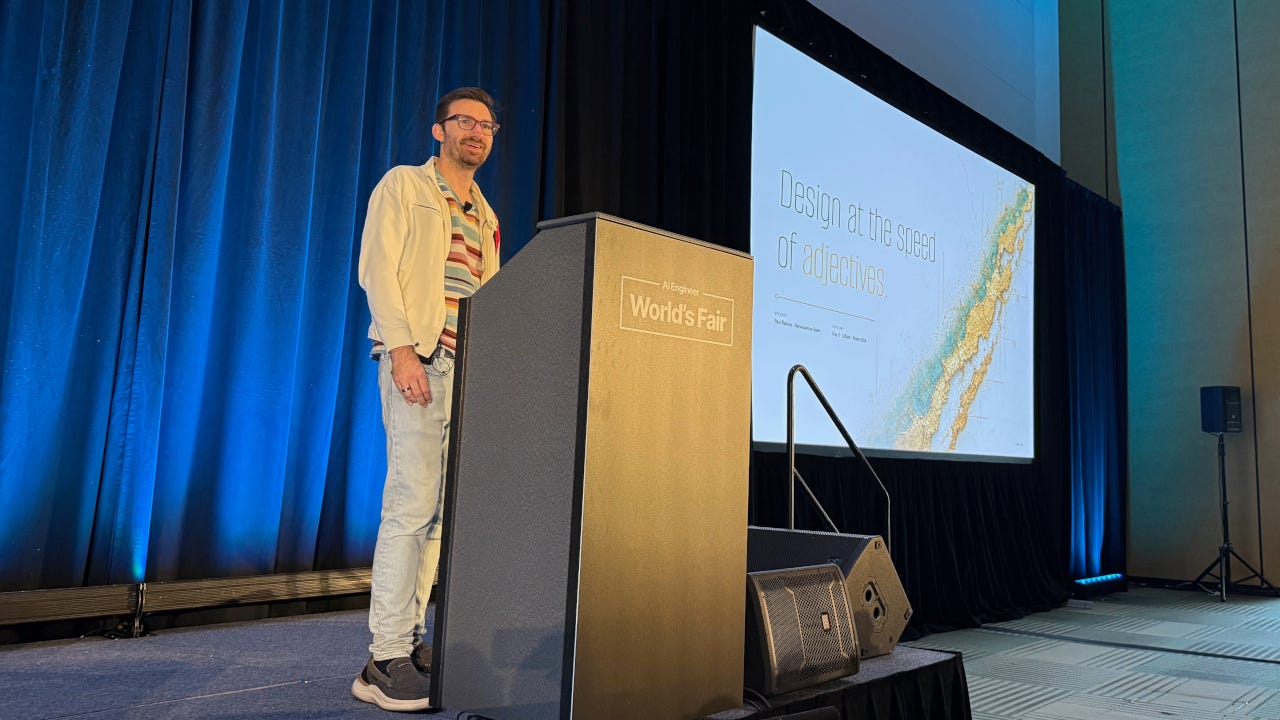
Impeccable’s Paul Bakaus at the AI Engineer World’s Fair.

Paul Bakaus thinks the emerging discipline of “skill engineering” can make AI agents more capable — but he absolutely does not want to remove people from the creative process. He chats to Latent Space about his approach to design in the AI age.

Bakaus is the creator of Impeccable, an open-source design skills system that gives coding agents a vocabulary for improving interfaces. Instead of asking an agent to redesign an entire website in one shot, users can tell it to make a section “bolder,” “quieter,” “denser,” or more polished.

Behind those apparently simple commands is a larger argument about how AI products should be built. Agents need more than instructions, Bakaus said: they need domain knowledge, context and carefully defined ways for humans to steer the result.

“The point is to give you a way to steer what you want to end up with,” he said during a session at the AI Engineer World’s Fair. “It’s never going to be a tool for one-shot design. That’s not the intent.”

The emerging craft of skill engineering

Impeccable began as a relatively simple extension of Anthropic’s frontend design skill. As its audience grew, Bakaus expanded it into a more complex system with multiple components and workflows.

That process led him to start thinking of skill engineering as a discipline in its own right. His workshop at the conference explored what he called the “dark arts” of building skills.

“One of the interesting topics was that most skills — [and] most models — are not very creative,” Bakaus told me. “They converge in one direction, and if everybody uses the same skill to do frontend design work or something like that, everything ends up looking the same.”

Skill engineers must also account for differences between agent harnesses and models. Codex and Claude, for example, do not necessarily handle subagents or permissions in the same way. A skill intended to run across Claude Code, Cursor, GitHub Copilot and Codex cannot assume they all provide identical capabilities.

Bakaus has also experimented with routing inside a skill, allowing it to combine several capabilities and direct a task toward the relevant instructions. He compared this to a mixture-of-experts model, with routing used both to conserve tokens and improve effectiveness.

Giving agents a design vocabulary

Impeccable’s core innovation is to take terms familiar to designers and give them a more precise operational meaning for an agent.

An unassisted model asked to make a page “bolder” may add gradients, neon effects or glass-like surfaces. Impeccable instead defines boldness through concepts such as hierarchy, scale and decisive typography — changes that attract attention without necessarily breaking the existing design system.

“An adjective with nothing behind it is just a nice apostrophe,” Bakaus said. “You really have to tell the agent what you mean.”

He described these terms as words that have been “imbued with meaning.” The model already has some conception of what words such as “bold” or “quiet” mean, but the skill translates them into a specific professional domain.

This is the key, because experts often possess a vocabulary that non-experts do not. Bakaus said he had observed large differences between the work produced by a designer and an engineer using the same model, simply because the designer knew how to articulate the desired result.

“I’ve been trying to put that language — basically compress it into a skill and into a system — to be able to express yourselves better,” he said.

However, he does not believe every part of design can be controlled from this level of abstraction. Directly manipulating spacing may still be the fastest option for a small adjustment, while open-ended prompting can be useful during initial exploration.

The objective is not to replace every tool with an agent, he insisted. It is to determine “the exact level of control” and insert the person at the point where their judgment is most valuable.

Designers and engineers move up the stack

Bakaus sees the boundaries between design, engineering and product management becoming less distinct.

“Designers are moving into code, engineers are moving into design, and vice versa,” he said. “These worlds are all colliding.”

That shift will be uncomfortable for people whose work primarily consists of translating an existing artifact into another form. Engineers who mainly turn Figma designs into code face growing automation, while designers whose contribution is limited to making an existing interface look competent face similar pressure.

“Designers all have to move one layer up the stack to think more about the what,” he said. “I think the role of the product manager and designer is actually converging.”

At the same time, designers are moving closer to implementation — into code. Bakaus initially expected Impeccable to appeal mostly to engineers and assumed professional designers might resent that. Instead, he estimates that designers now make up at least half of its audience.

“So rather than moving directly into code and, you know, having no help,” Bakaus said about designers, “they use Impeccable as a bridge, because it communicates the way they communicate. And that was not obvious to me when I first built it.”

Impeccable also has a live mode that combines visual selection with an underlying coding agent. A user can select a section inside a development environment and request several alternative layouts or (for example) ask for a bolder or quieter treatment. The system operates within the project’s existing code and design system rather than exporting an isolated mockup from a third-party design tool.

Bakaus described this as a potential “design harness” at the intersection of chat and direct visual manipulation.

There will be no auto mode

The AI industry often treats complete automation as the natural endpoint of product development. Bakaus rejects that premise.

He sees two dominant camps: people trying to preserve the traditional Figma-centered workflow, and on the other side advocates of “loopmaxxing” who want agents to work with as little human intervention as possible.

“The truth is somewhere in the middle,” he said.

His preferred model is for AI to produce the first 80% quickly: the competent layout and basic implementation that would otherwise consume a lot of time. The person then owns the final 20%, where taste, context and a distinctive point of view enter the product. This is a key part of Bakaus’s design philosophy in the agentic era.

“People need purpose, and they want to play a role in whatever they create,” Bakaus said. “When you work with the agent, then you feel more ownership of the product.”

Users regularly ask him to add an automatic mode to Impeccable so that the system chooses the commands itself. He has no intention of doing so.

“There is no auto,” he said, “and there will be no auto.”

Asked about the language of software factories and other visions that appear to remove people from engineering altogether, his response was unambiguous.

“I’m squarely against that.”

Woman With Alzheimer’s Shows Striking Improvement After Taking Magic Mushrooms

2 July 2026 at 14:00

A single observational case suggests psilocybin may ‘awaken’ cognitive reserve in dementia. But scientists caution controlled trials are needed to know if the drug was the cause.

For five years, Alzheimer’s slowly stripped away a Japanese-American woman’s ability to speak more than one syllable at a time. The woman, now in her 80s, was diagnosed roughly a decade ago, and her condition steadily worsened. She struggled to walk and recognize family members.

Then, under medical supervision, she took a large dose of mushrooms containing the psychedelic psilocybin. Within three days, her symptoms had improved. She began spontaneously recounting memories and initiating conversations in full sentences. Her alertness returned, and she could move around independently.

A week later, she was recognizing family members, asking where they were, and pointing out cars that seem out of place.

Psilocybin has been maligned for decades. But renewed interest in its unique effects on the brain has pushed it into mainstream research. Early studies suggest it may help treat depression, anxiety, addiction, post-traumatic stress disorder, and other psychiatric conditions. A clinical trial is underway to gauge whether it can protect the aging brain.

The case study, conducted in Brazil, adds to that momentum. The team emphasizes that it describes a single patient and is purely observational. Because of the severity of her disease, they could not perform brain scans, measure biomarkers, or conduct standard cognitive tests. Exactly why her symptoms improved remains unknown.

Even so, they propose that psilocybin may have temporarily unlocked brain function in late-stage Alzheimer’s, potentially allowing dormant neural networks to rewire.

Brain Under Fire

Alzheimer’s is often synonymous with memory loss. Sadly, symptoms range far beyond forgetting names or misplacing glasses.

As the disease progresses, people gradually struggle to find the right words or follow conversations. Their ability to tackle everyday tasks—cooking, managing finances, planning ahead—erodes. Depression, irritability, and anxiety often emerge. Over time, their personalities flatten, leaving them less outgoing, engaged, or empathetic.

These stories are far too common. According to the World Health Organization, roughly 57 million people worldwide were living with dementia in 2021. Alzheimer’s may account for up to 70 percent of cases. As populations age, that number is expected to climb.

Alzheimer’s has no single cause. Genetics likely play a role. Some gene variants are linked to early-onset forms of the disease, an area scientists are now tackling with gene therapy.

Another hallmark of the disease is a buildup of abnormal protein clumps, or plaques, in and around neurons, which disrupts normal function and wrecks their ability to form neural networks supporting memory and cognition. Years of efforts to remove plaques have largely failed, though the FDA recently approved two antibodies that reduce them and modestly slow cognitive decline.

Then there’s inflammation. In Alzheimer’s, the brain’s immune system can become overactive. Rather than responding only to damage, inflammation drives disease progression, spreading toxic protein clumps through the brain and further damaging its ability to form new connections.

Here’s where psilocybin, the active ingredient in magic mushrooms, may help. Psilocybin alters serotonin signaling, a brain chemical involved in mood, perception, and cognition. But its effects likely extend far beyond that.

Studies in mice suggest the chemical boosts the brain’s ability to rewire, a process known as neuroplasticity. Human brain imaging studies have found that the psychedelic temporarily reorganizes communication between large brain networks, changing how distant regions interact. In some participants, supervised treatment has been linked to greater cognitive flexibility, deeper self-reflection, and improved well-being.

Other studies hint at a protective role. Psilocybin triggers the release of “nurturing” proteins. This process helps neurons survive stress and extend their branching connections. It’s these delicate structures that build up neural networks, and they wither away during depression, aging, and dementia. Inside the hippocampus, a region crucial for learning and memory, the drug stimulates the birth of new neurons, at least in mice.

Given its positive effects on brain plasticity, psilocybin is now being tested in multiple psychiatric disorders characterized by unusually rigid patterns of brain activity. Older adults remain largely absent from these studies, even though they could benefit the most.

Tale of One

Before treatment, the woman struggled with everyday life. For five years, she could communicate using only single-syllable words. Her mobility was severely limited, and she struggled with incontinence.

With the consent of her caretaker, she received five grams of the Enigma strain of Psilocybe cubensis. Because psilocybin levels vary widely between mushrooms, the exact dose is unknown. But compared to other clinical trials, it was relatively high.

The team chose the dose “based on prior experiential observations regarding depth and duration of psychedelic-induced neurobehavioral effects,” wrote the team.

Initially, the woman fell into a deep sleep-like state accompanied by elevated body temperature and heavy sweating. Roughly 19 hours later, she suddenly awoke and began speaking to caregivers in complete sentences, recounting memories from her life. The conversation lasted around four hours.

Over the following days, she became increasingly alert and engaged. She recognized family members, regained mobility, and could pick out matching clothes to dress herself. A week later, she was noticing small details in her environment, including a rental car parked outside the house. When a family member was absent, she asked, “Where did Celso go?” She also seemed to rediscover her love of social interactions, making eye contact, smiling back, and actively starting conversations.

A month after the initial session, she returned for a second supervised dose of three grams. After the second dose, she became even more verbally expressive, displayed a sense of humor, and described memories of surfing with her son on a peaceful island. Throughout the trial, the drug alleviated incontinence and improved her quality of life.

The results come with major caveats. The improvements were observational and largely reported by caregivers, leaving room for bias. The team didn’t administer standardized tests for cognition, dementia, depression, and anxiety. Nor did they perform brain scans or monitor sleep, making it impossible to determine what brain changes were behind her apparent “awakening.”

“Causality cannot be established, and spontaneous fluctuations inherent to neurodegenerative disease cannot be completely excluded,” they wrote.

But the study touches on a provocative idea in Alzheimer’s: Cognitive reserve. The theory proposes some people can tolerate greater levels of harm to the brain and continue functioning despite significant damage. Psilocybin may have temporarily tapped into these reserves, allowing dormant neural circuits to engage and rewire to compensate for impaired ones. The hypothesis is highly speculative and needs to be rigorously tested.

Meanwhile, a clinical trial is investigating whether psilocybin can reduce depression and improve quality of life in people with mild cognitive impairment or early Alzheimer’s disease, moving the needle beyond a single case study.

For one family, however, the benefits are already substantial. At a follow-up visit, the woman spontaneously said to everyone in the room, “It is pleasant to come here.”

The post Woman With Alzheimer’s Shows Striking Improvement After Taking Magic Mushrooms appeared first on SingularityHub.

Building the foundation for an autonomous enterprise

Artificial intelligence may have captured the public imagination through chatbots and image generators, but some of its most consequential use cases are unfolding far from consumer-facing tools. In industries where physical infrastructure, operational continuity, and safety are paramount, AI is becoming a core operating layer. With its sprawling industrial systems and constant stream of operational data, the energy sector offers a glimpse into what that future could look like.

At Woodside Energy, AI adoption did not begin with generative models or enterprise copilots. The company has spent years building predictive analytics, optimization systems, and machine learning tools across exploration, drilling, maintenance, and plant operations. “We’ve always had very large volumes of operational data coming from the equipment and the plants and the assets that we operate,” says the company’s vice president for digital Andrew Melouney. “Those have created really clear, quite high-value use cases for us.”

That long-term investment in infrastructure and governance is now enabling a broader shift toward agentic AI systems that can support complex industrial workflows. Rather than replace human operators, Woodside designs AI systems to augment expertise in high-stakes environments. A prime example is its “Startup Advisor,” an AI copilot that helps operators manage the complex process of starting liquefied natural gas (LNG) plants. “We’re really thinking about, how does it support the people in the organization in terms of empowering them to make better decisions, to make faster decisions,” Melouney explains.

The company’s approach reflects a wider evolution taking place across industrial AI: graduating from isolated experiments to enterprise-wide systems built on standardized platforms, governed data, and repeatable deployment patterns. That transition, Melouney argues, requires organizations to rethink both their technology stacks and how work itself gets done. “We’re not just bolting AI onto an existing process,” he says. “We’re deeply thinking about how that work needs to be reimagined.”

Melouney’s motto has become: “Think big, prototype small, and scale fast.”

As AI systems become more autonomous and interconnected, the companies poised to succeed may be those that spent years building the operational foundations beneath the hype.

“Our ambition is really for an autonomous enterprise, where we have agents with agency that are able to really deeply interact with our core workflows,” says Melouney.

This episode of Business Lab is produced in partnership with Infosys.

Full Transcript:

Megan Tatum: From MIT Technology Review, I’m Megan Tatum, and this is Business Lab, the show that helps business leaders make sense of new technologies coming out of the lab and into the marketplace.

This episode is produced in partnership with Infosys.

Now, when people think about artificial intelligence, they often picture chatbots or productivity tools, but some of the most sophisticated and high impact uses of AI are actually happening far from consumer apps, inside complex industrial environments where safety, reliability, and physical systems matter. The global energy sector is a prime example.

Companies like Woodside Energy, a global energy producer headquartered in Western Australia, have been applying AI for more than a decade now, from advanced analytics and operations, to remote decision support, to smarter maintenance, and energy efficiency across large scale assets. Today, Woodside is scaling that experience, embedding AI more deeply across its operations and the enterprise with a strong focus on governance, data quality, and human accountability.

Two words for you: technological fuel.

My guest today is Andrew Melouney, vice president for digital at Woodside Energy. Welcome, Andrew.

Andrew Melouney: Thanks, Megan. It’s great to be here.

Megan: Lovely to have you. Now, Andrew, as I said there, the energy sector has approached AI quite differently from technology or consumer businesses. Early value has emerged in operational and industrial environments, rather than consumer-facing generative AI tools. Why is that? And what differentiates the energy sector’s AI journey?

Andrew: Megan, I think it really comes down to the nature of the work we do. Energy operations and what Woodside does is very asset intensive, it’s very safety critical, and it’s highly physical. And when you think about how Woodside operates, we operate across the full value chain. We do exploration through to drilling and subsurface work, to project development, all the way through to operating assets, which are often operated in harsh and remote locations, and then global energy portfolio marketing and trading as well.

We’ve always had very large volumes of operational data coming from the equipment and the plants and the assets that we operate, and those have created really clear, quite high-value use cases for us. When you think about reliability, when you think about safety and efficiency, those are really critical things for a company like Woodside. We’ve been doing traditional AI for many years now. If you think about analytics, if you think about optimization, if you think about things like predictive models, those techniques we’ve been applying to our data sets and to our business since around 2015.

And more recently with the advent of generative AI, we’ve really found that we’ve got a pretty strong and awesome foundation to build on top of and to really solve problems in the service of improving the business. And again, whether that is keeping people safe, keeping the environments we operate in safe, or improving returns for the organization.

Megan: Fantastic. I mean you touched on it there, but how has this reality shaped your own AI strategy at Woodside? Where did you start, and where did the technology prove most impactful in those early days?

Andrew: Well, like I said, we’ve had a very long journey, in terms of understanding our operational data, recognizing the value of it, and collecting it at scale so that we can use it. And we’ve been very deliberate in that approach, Megan. We’ve really thought about where the value is and where the risks were manageable. And we’ve started looking at, in today’s world from an agentic AI perspective, we’ve started looking at the problems that were solved with traditional AI and machine learning and data science in the past. And we’ve started to think about, where can we then layer agentic AI over the top to provide an even better outcome?

For our asset intensive industry and organization, we’re looking at areas such as maintenance optimization. We’re looking at areas such as, how do we ensure our LNG plants start up reliably, consistently, and safely? And we’re considering really our frontline workforce and making sure that we’re giving people on the frontline the tools required to do their jobs. When we think about AI, we’re really thinking about, how does it support the people in the organization in terms of empowering them to make better decisions, to make faster decisions? I think over time, this has just evolved from what has been traditional analytics to now artificial intelligence and generative AI. And we’ve learned along the way that the technology is important, but it’s about aligning people, processes, and the technology together.

We’ve spent a long time not only in collecting the data and having a well-curated data set that we can build on top of, but we’ve also spent a lot of time teaching people how to work in agile ways, how to do design thinking, how to problem solve, and how to really make sure that the technology that, say, my team can bring to bear to the organization is adopted effectively and purposefully. And I think once we had that solid foundation in place from a technology perspective, from a data perspective, once we got strong trust built between our digital teams and the organization, we really saw quite a material uptick and the scaling of technology occur more broadly across the enterprise.

Megan: Fantastic. That people piece so important, isn’t it? It’s just a tool, technology, that needs to be in the right hands. And you touched on data there; industrial AI obviously depends on vast amounts of data. Can you walk us through how you’ve approached data at Woodside in a little more detail? How it’s structured and governed, and how tools like maintenance intelligence as well fit into that.

Andrew: Well, data is really foundational and fundamental to everything we do, particularly from a technology perspective. It gives us the ability to innovate at pace when we are building over the top of a strong foundation. As I said before, we’ve had the benefit of a long-term investment in our underlying operational data. I think the way we think about data is that it’s an asset for us.

And when you think about operating a facility where you’ve got sensors everywhere, you’ve got data streaming in real time, you’ve got operators needing to make decisions in real time, we have consciously made a decision over many, many years to invest in that enterprise scale data platform to make sure that it’s secure. We’ve got well-structured data assets, and we’ve got strong governance over the top of that data so that when it is used, when it’s built in a data science application or an AI agent, that we’ve got a level of trust in it that it’s going to be used responsibly. And that when it’s used, it can be trusted to give the outcome that we expect.

We have developed platforms that continuously ingest really high frequency data from the assets and from our enterprise systems. Once we’ve been able to develop solutions on top of that, parts of the business that might own the systems that collect that data, they see the value in it.

When you look at something like maintenance intelligence is a really good example of how we’ve been able to take something that we’ve been working on for a long time. Woodside does a lot of maintenance, it’s a very important part of our business, and it occurs across all of our operating assets. But we have been looking at how we do predictive analytics and predictive maintenance for a long time across that data set that we own. And something like maintenance intelligence is a solution that gives us the ability to optimize how we do that maintenance. And what it does is it analyzes historical maintenance records, alongside the performance of the equipment. And again, by having that data set well-governed and in one place, we get the ability to correlate different data sets, such as maintenance records out of SAP, alongside say equipment and performance coming from our time series data lake.

And when we build over the top of that, something like maintenance intelligence gives us the opportunity to recommend to the assets what the optimal timing for maintenance activities might be, and really give what is quite a simple aim, which is do the right work at the right time. And with something like maintenance intelligence, we have seen the opportunity, and we have the opportunity to reduce maintenance hours by up to 15% over five years on one of the assets that we’ve piloted this on. And as we’ve built out that underlying analytical model, we’re now able to put agentic AI over the top of that and provide better insights and optimize that solution more.

It really comes down to providing our asset teams and our operational teams with the right decision support capability that ensures they’re still accountable to make the decision and to ensure the right work is being done, but we are giving them the best possible opportunity to use their judgment and experience with the data that we provide to make the right decision.

Megan: Sounds like a really impactful change. Last year also marked a milestone in moving from early AI learnings to scale, using AI more deliberately as a force multiplier. What transition were you trying to make and how did you approach it?

Andrew: Well, Megan, we’ve had a philosophy for a long time in Woodside from an innovation perspective, where we really want to think big, we want to prototype small, and we want to scale fast. We want to find big opportunities that we can go after, but we want to ensure that we look at how we deploy those on a small scale first, and then provide the right learning and insight that then can scale it everywhere. Something like maintenance intelligence is a good example of that, or our Startup Advisor, where we know that we’ve got multiple plants that we need to start up. We know that we’ve got multiple assets that need to do maintenance, so we have a big, bold ambition about how we can improve and optimize that. We start with a small prototype; it might be one subsystem, it might be just a part of an asset, and then we scale it out, we learn, and we scale faster.

I think from an AI learning perspective, one of the key things we’ve learned is really the transition from moving from isolated AI solutions to a more coordinated enterprise-wide capability. If you look back maybe 18 months, two years, in our generative AI journey, we rarely started by deploying AI as broadly as we could in the organization from a personal productivity perspective. And probably being quite open in terms of the problems that we will solve, the business problems that we’ll solve with AI. That had a lot of benefits for us in terms of allowing our organization to get to know AI, get to know the capabilities, to build the trust in it.

What we’ve learned though is that we’ve needed to pivot from that to being a little bit tighter in terms of where we are going to invest our time and resources and more higher value solutions. How do we then enable and empower the rest of the organization so that they can actually effectively problem solve with technology in their domain or in their personal productivity without having to come to a central team?

When we think about that, think big, prototype small, scale fast, has been something really important for us. The transition from a more broader approach to use case development and solution development to now a narrower focus on the high value priorities. We’ve seen that paying dividends to us and allowing us to go after solutions and opportunities, things like Startup Advisor.

And so our Startup Advisor is a agentic AI solution that really aims to optimize and empower and better support our operators that sit in front of a panel and have to start up LNG plants, which are incredibly technical facilities and require really specialist skills to start up. And so our Startup Advisor is almost like a copilot that sits alongside those operators, and it gives them the ability to be able to play back previous startups. It gives them the ability to look at how the current startup is progressing, and it provides them better insights to optimize how they start up that facility. And again, starting up an LNG facility is incredibly complex.

Megan: I can imagine.

Andrew: When we think about opportunities like Startup Advisor, again, it goes back to that think big, prototype small, and scale fast. We started with a very bold vision of, how do we start up all of our LNG plants in a much more structured and optimized fashion? How do we better support our panel operators? How do we make, say, a more junior panel operator have a copilot that can help them almost like an experienced panel operator sitting next to them? And when we think about that vision and the ability then to prototype on a small scale and then scale fast, I think it’s been really successful for us.

As we scale, we’ve just naturally expanded into more agent-based solutions. Today, we’ve got around 50 AI agents in production, supporting both our operating assets and our enterprise workflows. These tools have been proven in live environments, and we have really seen the benefit of being able to shift from point solutions that maybe solve small scale problems in specific areas, to AI and agentic solutions with agency that can really work across our workflows.

We’re able to do this because we’ve standardized on the platform that we build on and we’ve got repeatable patterns. That’s been another really important learning for us, is that we don’t want to build 50 solutions in 50 different ways. We really want to be empowering our organization and our technical teams and the users of our solutions to roll them out quickly, to roll them out safely, and to do it in a patternized and platform manner.

But the last point I’ll make, Megan, from a learning perspective is that we’ve really understood that a strong governance around how AI is deployed and developed is critical for us, and it’s critical for us to go fast as well. The traditional ways of governing how we roll out different solutions or digital systems isn’t going to scale to the breadth that we need when we are thinking about AI. Being able to have a clear philosophy around how we innovate, transitioning from isolated solutions to that enterprise-wide capability, and making sure that we’ve got strong platforms with strong patterns and clear governance are the three really critical things that we’ve learned.

Megan: Such important pillars, all of them. And you’ve been working with Infosys on this journey. How has that partnership helped accelerate scaling and embedding AI across the business?

Andrew: Well, Infosys is our managed service provider, and so they play a really critical role in the operations of our core business. One of the things that I like to say is that our license to innovate is based on our license to operate. And so, for my team to be able to turn up to an operating asset or a corporate function and have the trust that’s needed to be able to innovate and reimagine and redesign how work gets done, to be able to do that, we need to make sure that our core platforms, our core systems, our applications are running really reliably, safely, and consistently every day. Having an experienced partner like Infosys looking after those core operations in partnership with our internal teams is really, really important to us.

As we move from pilots to enterprise-wide deployment, the ability to partner with someone like Infosys also gives us the ability to scale. And so being from Perth and Western Australia, while we’ve got a really strong local team in Western Australia, and we’ve also got a very strong team in some of our other operating locations, like everyone, we’re struggling to find people that can fill AI roles. Being able to partner with Infosys and have a number of different operating models at our disposal becomes really important for us. Having co-mingled teams where they are staff, they are Infosys staff, Woodside staff, and some of our other partners, really just brings diversity of thought and experience to how we solve problems.

Fundamentally, the partnership has allowed us to operate and innovate with more confidence. While Woodside always retains ownership of the strategy and where we’re going and the governance and my teams remain accountable for the outcomes, we can’t do what we do without strong partnerships like the one we have with Infosys.

Megan: Fantastic. And as AI adoption scales, you mentioned yourself, governance becomes increasingly important. How challenging has that been, and what guardrails have you put in place at Woodside?

Andrew: So, Megan, governance is really important to us, and we operate in a well-regulated environment. That means we’ve got to make really deliberate and well-reasoned decisions when we’re thinking about how we deploy technology into our organization, whether it’s artificial intelligence or anything else, for that matter. And so, governance is really central to how we approach the execution of our AI strategy at Woodside.

We’ve got maybe two or three really key things that we’ve put in place. The first one is just making sure that every AI use case goes through a structured assessment, and that’s making sure it meets our privacy controls, our cyber controls. We’re also asking the question, not just, could we do this, but should we do this? We’ve really got to bring together safety, ethics, transparency, accountability, and make sure that we make an informed decision. When an AI solution is going through that structured assessment, if there are concerns about how we might use that solution, it then goes to an AI council that’s made up of senior leaders across the organization. That council and that group really oversee some of the prioritization and risk management. That’s where we can have really strong, robust debates around, again, could we do something, should we do it, and how do we mitigate any of the risks that we might introduce here?

I think the last one, Megan, is really around lifecycle management. When you start thinking about, we’ve got 50 at the moment, but if we had 500 agents working in our organization, really amplifying the experience and the decision-making and the value creation of our staff, we really want to have an ability to manage the lifecycle of how those agents operate. We want to know, how many people are using them? What’s the efficacy and the outcome? Is there model drift? Do we need to retune or retrain? I think that’s an area where many organizations, including Woodside, are still leaning into and still figuring out the best way to do this. We can do it quite easily with 50 agents, but 500, 5,000, 50,000 becomes an opportunity for us. Again, thinking about how we partner with others, solving problems like that really present an opportunity to co-create and to co-solve with some of our partners, like with Infosys.

Megan: Fantastic. Just to close, what’s your long-term vision for AI at Woodside? How do you see this evolving over the years ahead, and what could it unlock for the sector in your view?

Andrew: So Megan, I think our ambition is really for an autonomous enterprise, where we have agents with agency that are able to really deeply interact with our core workflows. The outcome that we want to get from that is to protect our people, to protect the environments we operate in, and to be able to provide energy at a lower cost to the world. When we think about that ambition, we can really see that being applied to almost all of the areas that Woodside work in. Whether that’s from exploration through to project developments, through to operations or marketing, the scale of the opportunity in front of us and the ability for us to really change the way that work flows through the organization is really exciting.

For us, there’s three things that we have to get right in terms of being able to execute on that ambition. The first one is really thinking about how the work gets done in the organization so that we’re not just bolting AI onto an existing process, but we’re deeply thinking about how that work needs to be reimagined. We’ve also got to think about how we enable our workforce to work differently. Providing them with the skills and the tools and the ability to really harness the power of the technology that we provide.

Secondly, we’ve got to continue to move from and restrain ourselves from deploying point solutions that solve very narrow problems, to having more connected, agentic systems of systems that can interact with each other. To do that, and if we do that successfully, that’s where we really get the high value unlock from agents being able to interact with workflows and really change how the work gets done.

And lastly, Megan, it’s about how we must continue our philosophy of thinking big, prototyping small, and scaling fast.

Megan: Which is a fantastic lens to which to make all these decisions. Thank you so much, Andrew. That was Andrew Melouney, vice president for digital at Woodside Energy, whom I spoke with from Brighton in England.

That’s it for this episode of Business Lab. I’m your host, Megan Tatum. I’m a contributing editor and host for Insights, the custom publishing division of MIT Technology Review. We were founded in 1899 at the Massachusetts Institute of Technology, and you can find us in print, on the web, and at events each year around the world. For more information about us and the show, please check out our website at technologyreview.com.

This show is available wherever you get your podcasts. And if you enjoyed this episode, we hope you’ll take a moment to rate and review us. Business Lab is a production of MIT Technology Review, and this episode was produced by Giro Studios. Thanks ever so much for listening. Goodbye.

This content was produced by Insights, the custom content arm of MIT Technology Review. It was not written by MIT Technology Review’s editorial staff. It was researched, designed, and written by human writers, editors, analysts, and illustrators. This includes the writing of surveys and collection of data for surveys. AI tools that may have been used were limited to secondary production processes that passed thorough human review.

Z.ai launches ZCode to challenge Cursor, Claude Code and GitHub Copilot in AI coding

Z.ai, the Beijing-based artificial intelligence lab formerly known as Zhipu AI, on Wednesday officially launched ZCode, a free desktop application it describes as an "Agentic Development Environment" purpose-built for its flagship GLM-5.2 large language model. The move marks the company's most aggressive push yet into the fast-growing AI-powered coding tool market, where it now competes directly with Cursor, Claude Code, GitHub Copilot, and Google's Antigravity.

"Introducing ZCode, the official development environment for GLM-5.2," the company wrote on X, noting the tool is available on macOS, Windows, and Linux, supports bring-your-own-key (BYOK) configurations for third-party models, and offers a 1.5x usage-quota bonus for subscribers to its GLM Coding Plan.

Read one way, ZCode is simply another entrant in a crowded market. Read another, it is a single product that crystallizes three of the most consequential trends in enterprise software today: the race-to-the-bottom pricing of frontier AI models, the geopolitical balkanization of the AI stack, and the rapid maturation of agentic coding agents into what Gartner now estimates is a roughly $10 billion market.

An AI coding tool designed to think in projects, not prompts

Unlike traditional IDEs that bolt on AI through a chat sidebar or autocomplete extension, ZCode is best understood as an agent-first development environment. Its core design is built around long-horizon tasks: the user describes an outcome, the agent plans the work, edits files, runs checks, reviews progress, and continues across multiple iterations until the goal is met.

ZCode organizes the development experience around the ZCode Agent, deeply tuned for GLM-5.2, with emphasis on deep integration: the model, tools, and execution workflow are tuned together so the Agent fits continuous, multi-step real-world development tasks. The environment supports continuous follow-up across devices: desktop, mobile Remote, and Feishu / WeChat Bot can all keep the same workspace task moving. Sensitive commands, file changes, and high-permission actions go through confirmation before execution.

That remote-control feature — the ability to steer a running coding agent from WeChat, Feishu, or Telegram on a phone — is a differentiator that speaks directly to the Chinese developer market, where those messaging platforms dominate professional communication. You can keep checking progress and adding instructions while long-running work continues, from any device with these messaging apps.

The tool is free to download. Revenue flows through Z.ai's GLM Coding Plan subscription tiers, which start at $16.20 per month for a "Lite" plan and scale to $144 per month for "Max" — prices that undercut Anthropic's Claude Code and Cursor's comparable tiers by significant margins.

Through July 31, ZCode is offering a promotional 1.5x effective quota bonus for Coding Plan subscribers, with off-peak token consumption charged at a 0.67x coefficient. The platform also supports multiple AI models and agents, including Claude Code, Codex, Gemini, and OpenCode — a pragmatic concession to the reality that no single model wins every task.

GLM-5.2, the open-source model trained entirely on Chinese chips, powers the whole experience

ZCode's value proposition is inseparable from GLM-5.2, the model it was designed to showcase. Z.ai released GLM-5.2 on June 16, first to its Coding Plan subscribers and subsequently as open-source weights under the MIT license on Hugging Face — a sequencing decision that prioritized distribution over the traditional benchmark-led launch.

The model's specifications are formidable. GLM-5.2 is a 744-billion-parameter mixture-of-experts architecture with 40 billion active parameters, a genuine one-million-token context window — five times the 200K limit on its predecessor — and training on 28.5 trillion tokens. It ranked second globally on Code Arena as of mid-June, trailing only Anthropic's Claude Fable 5, making it one of the highest-performing publicly available models for coding tasks.

Critically, the model was built entirely without American chips. As Decrypt reported, GLM-5.2 "runs entirely on Huawei silicon." Stability AI founder Emad Mostaque estimated total training costs at roughly $25 million, with 80 percent spent on post-training — a figure that, if accurate, would make GLM-5.2 extraordinarily cheap relative to Western frontier models.

On benchmarks, GLM-5.2 performs within striking distance of the best proprietary systems. It trails Anthropic's Claude Opus 4.8 by just one percentage point on FrontierSWE, a benchmark measuring multi-hour autonomous engineering projects, while edging out OpenAI's GPT-5.5.

Its API pricing — $1.40 per million input tokens and $4.40 per million output — are a cost reduction of up to 82 percent compared to Anthropic's Claude Opus 4.8 at $5 and $25, respectively. Because ZCode is a first-party tool from the same company that makes the model, it requires no manual endpoint configuration — the model is wired in.

The Anthropic export ban gave Chinese AI its biggest opening yet

ZCode's arrival cannot be separated from the geopolitical drama that has roiled the AI industry over the past three weeks. On June 12, the U.S. government, citing national security authorities, issued an export control directive suspending all access to Anthropic's Fable 5 and Mythos 5 models by any foreign national, whether inside or outside the United States, including foreign national Anthropic employees. Enterprise clients in finance, healthcare, SaaS, and critical infrastructure found their core intelligence services abruptly disabled, without exception, prior warning, or effective recourse.

While the Trump administration lifted those controls just yesterday — Anthropic confirmed on June 30 that the Department of Commerce had rescinded the directive — the episode sent shockwaves through the developer community and accelerated interest in open-source, self-hostable alternatives. The government's crackdown on Anthropic coincided with a swift rise in Chinese open-source models that are proving to be almost as capable and significantly cheaper than some of the most powerful U.S. models.

Z.ai's timing was surgical. On the same day the Trump administration ordered Anthropic's most advanced models blocked for foreign nationals, Zhipu announced the open-source release of GLM-5.2 with no usage restrictions. The South China Morning Post reported that GLM-5.2 would be available to all users of Zhipu's new GLM Coding Plan subscription, "priced at just a tenth of Anthropic's premium Claude Code and Claude Max tiers."

The market responded accordingly. Zhipu AI's market capitalization crossed HK$1 trillion (US$128 billion) on June 22, driven by a 42 percent intraday share surge. JPMorgan raised its 2026–2030 revenue forecast for Zhipu by between 7 and 16 percent following the launch, projecting an over 534 percent revenue surge for 2026 and expecting the AI firm to turn a profit by 2028.

Why vendor lock-in now carries a geopolitical risk that no SLA can cover

The Fable 5 episode did more than embarrass Anthropic. It introduced a new risk category into enterprise AI procurement: sovereign access risk. When a government can disable a commercially deployed AI model overnight, the traditional evaluation criteria of developer experience, benchmark scores, and pricing become secondary to a more fundamental question: Will this tool still work tomorrow?

The event exposed the inadequacy of standard enterprise contract language. An investigation by FifthRow found that almost all standard Data Processing Addenda, SaaS agreements, and procurement SLAs "relied on vague 'force majeure' or 'compliance with law' catch-alls, not on precise, actionable regulatory suspension or kill-switch clauses."

ZCode's BYOK architecture and GLM-5.2's MIT-licensed open weights offer a partial answer. A development team can download the model, host it on its own infrastructure, and run ZCode against it without ever touching Z.ai's cloud — eliminating both American export-control risk and Chinese data-sovereignty concerns in a single move. The catch is that anyone using Z.ai's cloud API remains subject to Chinese law, a consideration that evaporates only with pure self-hosting.

Gartner analysts have warned that governance, pricing, support, workflows, commercial maturity, and market durability matter as much as developer experience and model capabilities when evaluating coding agent vendors for enterprise-wide adoption. By that measure, ZCode faces a steep climb. It is not open source itself; Linux support remains in beta; and security reviewers have flagged the need for careful evaluation of its credential handling, particularly for remote development over SSH and messaging-platform-triggered tasks — an agent that can be summoned from WeChat involves access paths that should be mapped before trusting it with anything sensitive.

Inside the $10 billion race where model labs are becoming full-stack IDE companies

ZCode enters one of the most crowded and fastest-moving markets in enterprise software. Enterprise AI coding agents are capturing a growing share of enterprise software engineering spend, with the market estimated at roughly $9.8 billion to $11.0 billion annualized as of April 2026, according to Gartner. A defining shift this year, the analyst firm noted, is "the movement of frontier model providers into direct competition with application-layer vendors" — precisely the pattern ZCode embodies.

Gartner codified this evolution in May when it renamed its annual Magic Quadrant from "AI Code Assistants" to "Enterprise AI Coding Agents," defining the category as "autonomous or semiautonomous software engineering solutions that perceive context, translate human intent into multistep plans, and execute and verify those steps across code, tests and related engineering artifacts." The 2026 Magic Quadrant names Anthropic, Cursor, GitHub, and OpenAI as Leaders. Z.ai was not among the 12 vendors evaluated — an absence that underscores both the company's nascent enterprise sales presence outside China and the Western-centric lens through which the analyst community still views the market.

The competitive landscape is daunting. Cursor is the $2 billion ARR IDE that feels like VS Code with a supercharger. Claude Code reached approximately $2.5 billion in annualized revenue by early 2026. Google relaunched Antigravity 2.0 at I/O in May, and Cognition retired the Windsurf brand, relaunching the IDE as Devin Desktop with the Agent Command Center as the default surface.

Against these entrenched players, ZCode's pitch rests on three pillars: deep first-party integration with GLM-5.2 that no third-party editor can replicate, aggressive pricing that starts at a fraction of Western competitors, and MIT-licensed open weights that allow enterprises to self-host — eliminating the regulatory kill-switch risk that the Fable ban made viscerally real.

Z.ai's real challenge is turning a $128 billion valuation into a global developer tools business

Z.ai controls the model (GLM-5.2), the subscription layer (the GLM Coding Plan), and the IDE (ZCode) — a tightly coupled stack that optimizes for performance but concentrates switching costs. For the company, the business logic is clear. Its most reliable revenue stream has been on-premises deployments for Chinese government agencies, state-owned banks, and energy conglomerates. In full-year 2025, on-premises deployment revenue reached RMB 534 million, growing over 100 percent year-over-year and accounting for 73.7 percent of total revenue with a gross margin of 48.8 percent. ZCode and the GLM Coding Plan represent the company's bid to build a comparable revenue engine in cloud-based developer tools — globally, not just in China.

The early signals are encouraging for Z.ai, if anecdotal. Community reception on X was enthusiastic, with one early user calling the tool "super stable" and others clamoring for more Coding Plan capacity. "Bro, can't snag your family's Coding Plan? When are you gonna stock up on more cards?" one user wrote in Chinese, suggesting demand is already outstripping supply.

But the hard questions loom large. Can a Chinese AI company build trust with Western enterprise buyers amid escalating technology tensions? Can ZCode's ecosystem mature fast enough to compete with Cursor's polished UX, Claude Code's deep agent primitives, and GitHub Copilot's unmatched distribution? And can Z.ai sustain a company valued at $128 billion while still losing money? 

What is no longer in question is the competitive dynamic itself. Three weeks ago, a U.S. government directive proved that access to the world's best coding model can vanish overnight. Today, a Chinese lab is shipping a free IDE, an open-source model trained on zero American chips, and a subscription plan that costs less per month than a single lunch in Manhattan. The AI coding agent market did not just become global this summer. It became a market where the fallback option might be better than the thing it's falling back from — and that changes the calculus for every engineering leader choosing a toolchain in the second half of 2026.

Empowering biomedical evidence exploration and synthesis with deep knowledge graph research

Nature Machine Intelligence, Published online: 02 July 2026; doi:10.1038/s42256-026-01266-0

Wang et al. develop DeepEvidence, a biomedical deep research agent for exploring and synthesizing evidence across various knowledge sources to support drug discovery, clinical trials and evidence-based medicine.

Reshaping biomolecular structure prediction through strategic conformational exploration with HelixFold-S1

Nature Machine Intelligence, Published online: 02 July 2026; doi:10.1038/s42256-026-01264-2

Liu and colleagues introduce HelixFold-S1, a guided sampling strategy for biomolecular complex structure prediction that targets high-probability interaction regions. The method achieves higher accuracy than traditional unguided methods while reducing computational costs.
❌