
❌

Normal view

5 Trends That Defined AI Engineering at World’s Fair 2026

14 July 2026 at 23:21

swyx’s note: thanks to Richard for covering AIE while I was working on the conference itself! Make sure you have opted into the AINews feed to get our weekday updates. AIE next returns to NYC, Oct 12-14, with a heavy focus on AI in Finance this year.

AI engineering has come a long way in three years. When swyx coined the term “AI engineer” in June 2023, he was giving a name to a new kind of developer emerging from the big bang of large language models. It seems like ancient history now, but remember when we called the intersection of AI and software development “prompt engineering”? That was just months before swyx’s reframing.

The latest AI Engineer World’s Fair showed just how much the field has matured. Whether or not “AI engineer” has become a formal job title everywhere is almost beside the point. The engineering practices that have developed around AI over the past three years — building coding agents, designing harnesses, managing context, evaluating model outputs, and orchestrating increasingly autonomous systems — are becoming part of mainstream software development.

Rather than focusing on individual announcements at AIEWF, this post will pick out five larger trends that show where AI engineering stands in 2026.

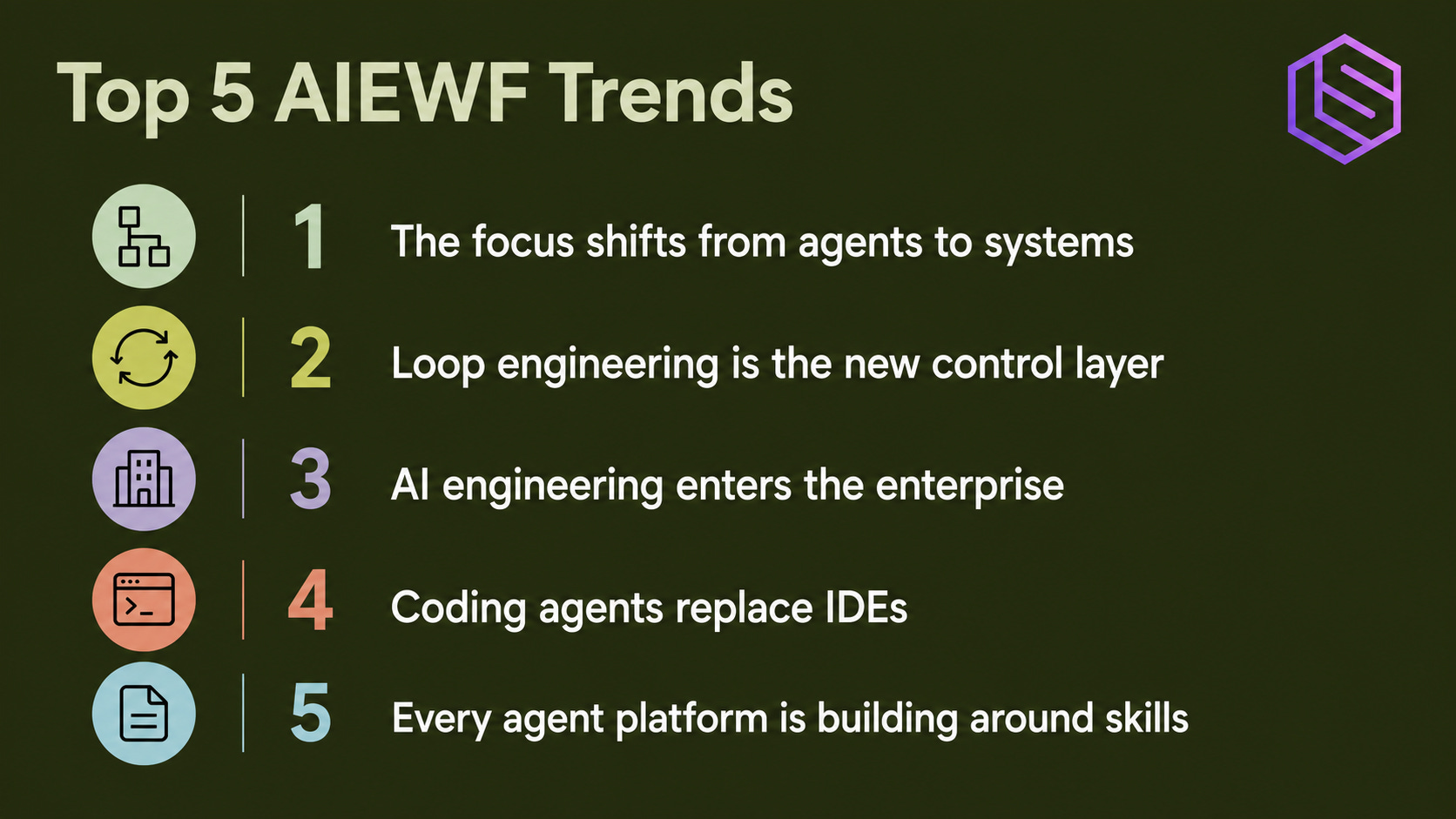
1: The focus shifts from agents to the systems around them

One of the clearest ways to see how AI engineering has evolved is to compare two essays by former OpenAI researcher, and now co-founder of Thinking Machines Lab, Lilian Weng. Her influential 2023 article, LLM Powered Autonomous Agents, described the anatomy of an LLM agent in terms of planning, memory and tool use. AutoGPT, BabyAGI and GPT-Engineer were among her examples — proof-of-concept systems that suggested autonomous agents might soon become practical.

Her new 2026 essay, Harness Engineering for Self-Improvement, takes a very different perspective. Rather than focusing on the agent itself, Weng argues that the system surrounding the model has become just as important: the harness that manages workflows, context, permissions, evaluation, persistent state and continuous improvement. In other words, AI engineering has moved beyond prompting models toward engineering reliable systems around them.
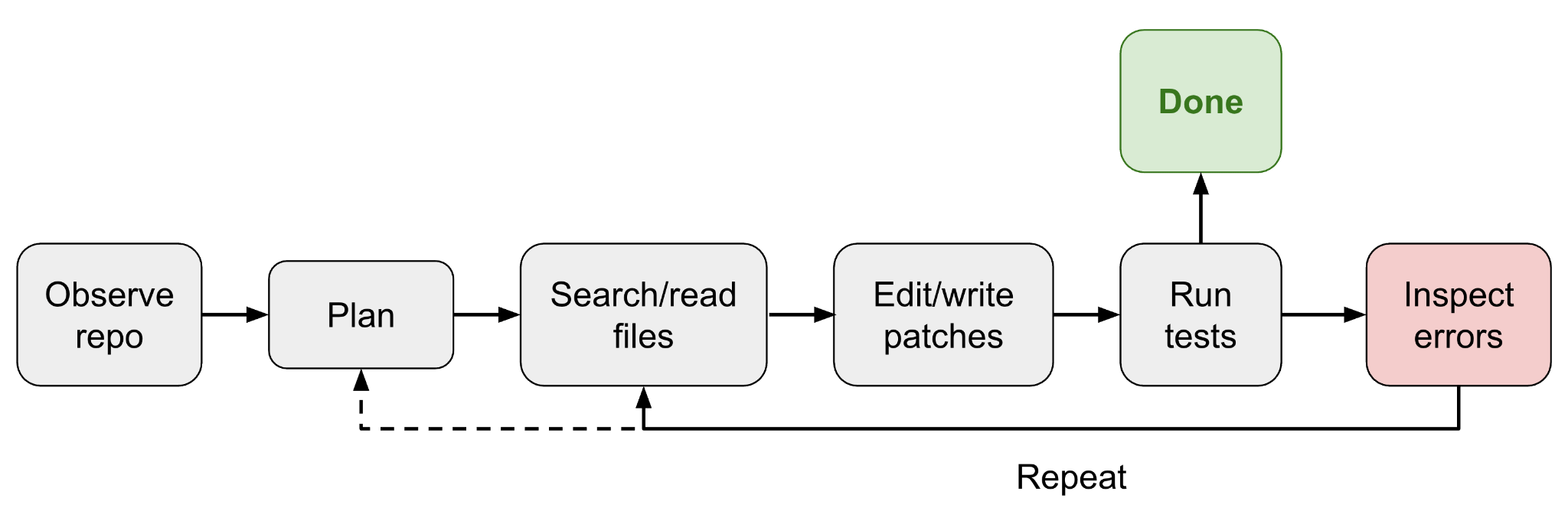
Coding agent loop; Image by Lilian Weng

This shift was very much top of mind at AIEWF. I don’t think AutoGPT — the buzzy autonomous agent project everyone was talking about in 2023 — was even mentioned this year. Instead, the conversation revolved around Claude Code, Codex, Gemini CLI, Cursor, Warp and all the infrastructure needed to make coding agents dependable in production.

I remember being turned off by the AutoGPT buzz at the 2023 event, mainly because all the discussions seemed to focus on removing humans from the equation. But over the past few years we’ve learned that complete agent autonomy is not only unreliable, it isn’t even desirable — especially at scale. So it was a relief that at AIEWF, agents were largely positioned as augmenting the AI engineer, rather than replacing them.

During the OpenAI keynote on day 2 at AIEWF, Romain Huet emphasized this point. Using tools like OpenAI’s Codex, Huet argued, engineers can more easily collaborate with agents. As he put it, “software ate the world, and then AI ate software, but now what we’re here to say is that the AI engineers are eating the world.”

Despite the growing power of AI engineers, there’s also a sense that even the frontier companies don’t fully understand how their models are evolving — and so how much control can engineers truly have over them? In a separate keynote, Anthropic’s Thariq Shihipar talked about how their latest model, Claude Fable, is like an organic system — “models are grown, not designed.” There’s a “capability overhead,” he said, where “Claude gets smarter in a spiky way.”

All the more reason to build systems for agentic development, so that we can evaluate and monitor the outputs.

2: Loop engineering is the new control layer

By the end of the first morning of keynotes at AIEWF, it was clear that “loops” was the buzzword du jour of the event. Overuse of the term aside, it did highlight a key point of tension around AI engineering: how much control should agents have, and where should humans remain in the loop?
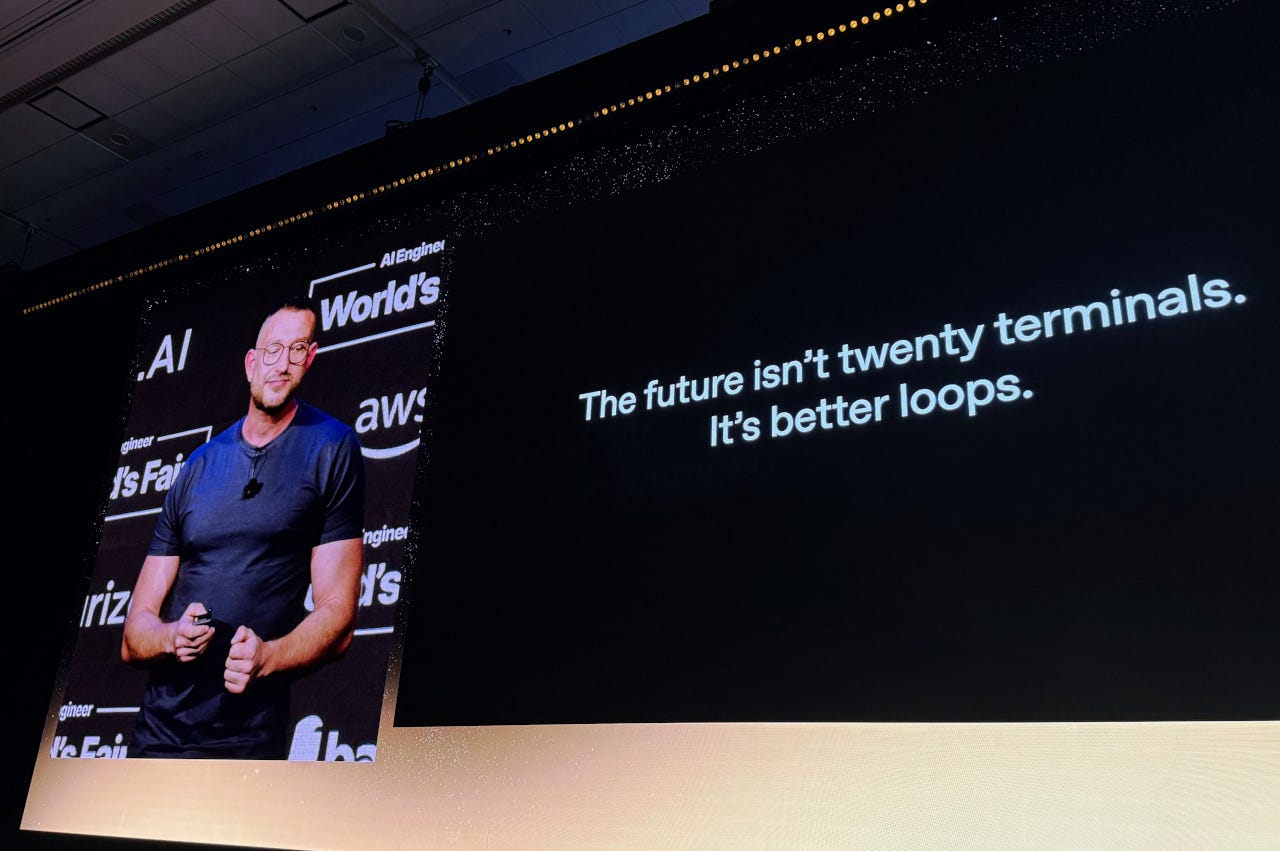
OpenClaw creator Peter Steinberger advocating for better loops.

One approach a lot of leading engineers are now taking is putting themselves in an “outer loop” — to oversee the largely autonomous work being done by agents in an inner loop.

Roland Gavrilescu is co-founder and CEO of Introspection, a new company building infrastructure for deploying self-improving systems. In an interview with Latent Space, he explained how the concept of “autoresearch” provides the necessary feedback structure for agent loops:

“You can think of the system as having an inner loop and an outer loop. The inner loop is the primary system interacting with users and performing the work. Autoresearch is more concerned with the outer loop: another system that studies and maintains the primary system.“

The outer loop can include feedback signals, evals and human input. So it might still be largely autonomous, but the point is it is a method of oversight for the primary agent loop. Former Google engineering leader Addy Osmani had a nice line relating to this, saying that “agents can run much more of the inner execution loop, but that outer loop is still engineering.”

The term “loop engineering” came up multiple times during AIEWF, suggesting that it’s the human AI engineer’s responsibility to build these loop systems. Even the “ClawFather” Peter Steinberger, creator of OpenClaw, makes a point of putting himself in the outer loop. In the OpenAI keynote, he explained that “the agent runs the inner execution loop; I set the direction and I make decisions in the outer loop.”
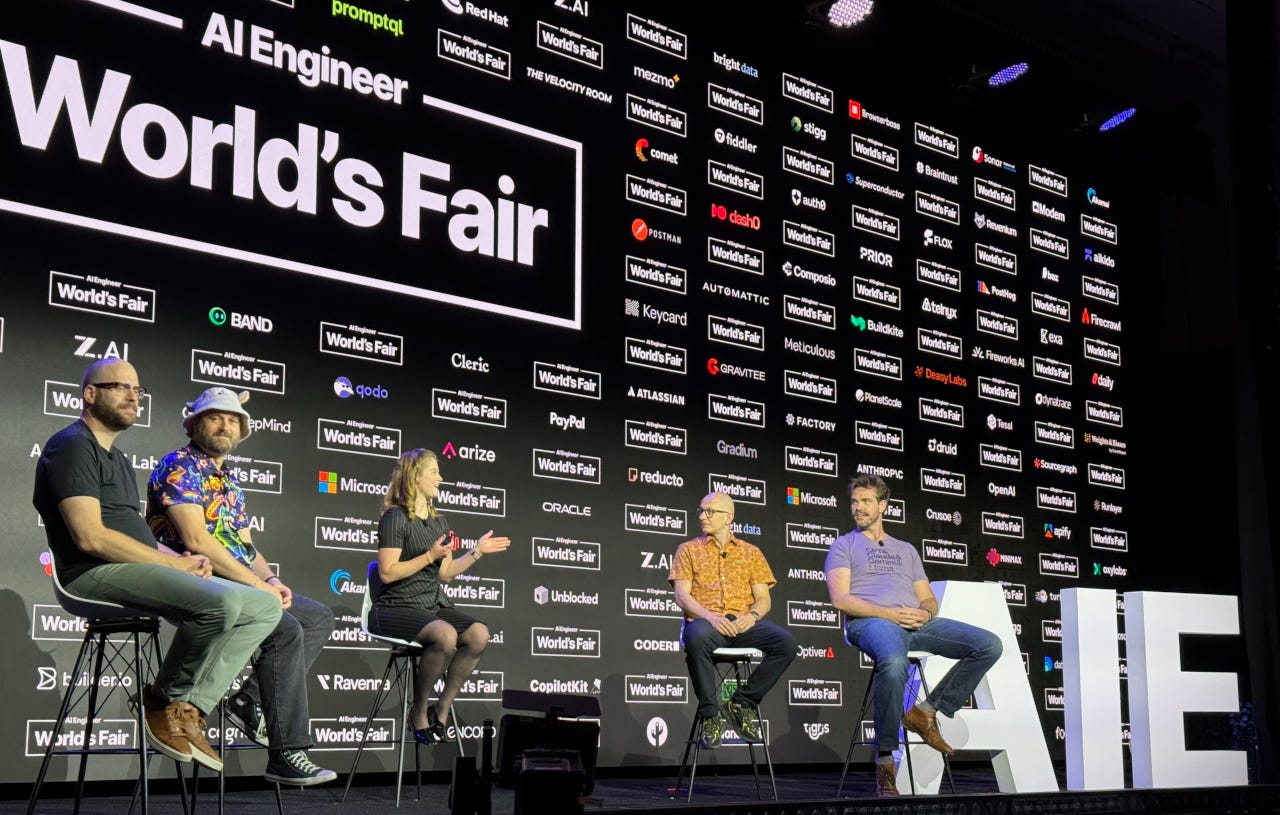
The Loop Debate at AIEWF.

On the final day, an on-stage debate was held to determine whether fully autonomous agents were capable of managing loops in reality. Dex Horthy from HumanLayer claimed that “the hype is outrunning the discipline.” He wasn’t against loops, per se, noting that Kubernetes is built on control loops — “but they’re deterministic loops.” Geoffrey Huntley, creator of the Ralph Loop, admitted that loops were “frontier thinking,” but he had a wonderful analogy for the audience to ponder:

“[We’re] kind of like locomotive engineers now. That’s our job: to keep the locomotive on the rails.”

3: AI engineering enters the enterprise

This way of working with AI tools is starting to make its way into enterprises, typically via a new role called a “forward deployed engineer” (FDE) — where engineers work directly with organizations to implement AI capabilities.

Natalie Meurer, who leads FDE at Sierra, told Latent Space that implementing AI into organizations typically requires a lot of orchestration. “Every enterprise we work with wants to know how it can maintain everything its agentic ecosystem is capable of doing,” she said. “It needs to manage all the integrations and all the teams that contribute to the agent.”
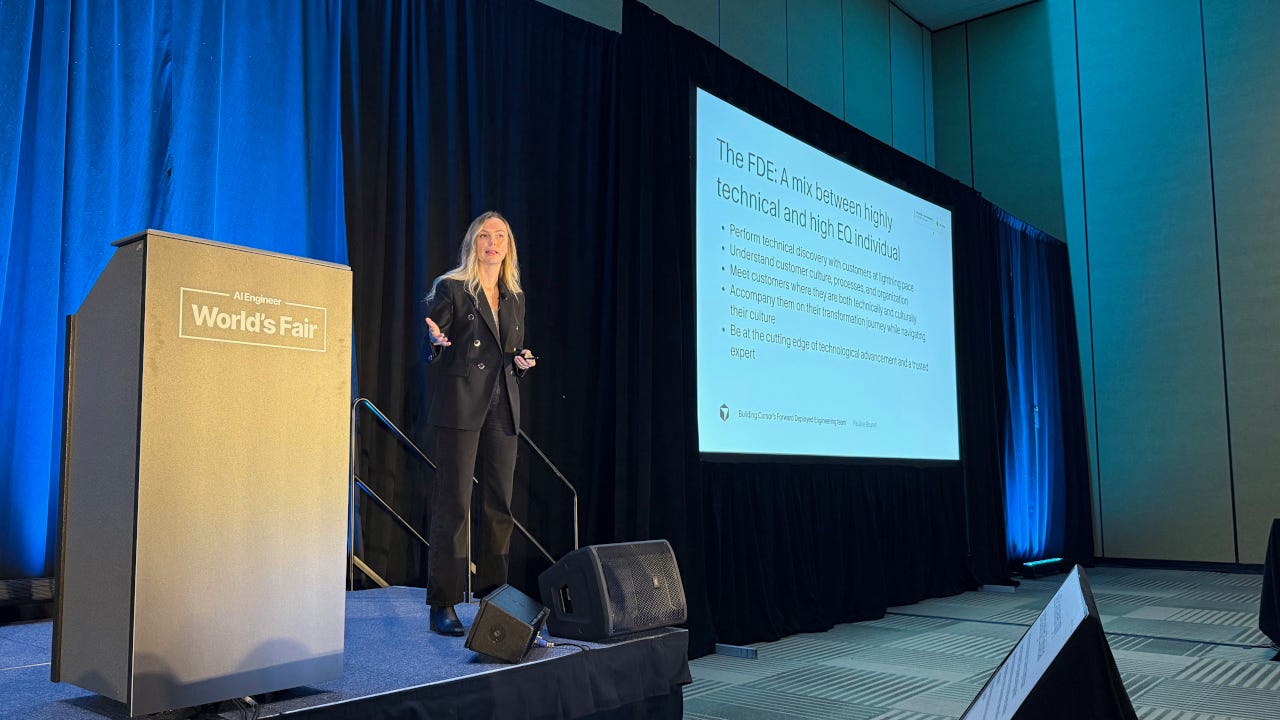
Cursor’s Pauline Brunet talking about FDEs in an AIEWF session.

In her session at AIEWF, Cursor’s Pauline Brunet spoke about what their FDEs look to achieve in each engagement:

“When [we] walk away at the end of the engagements — and we, in our case, have deployed cloud agents, long-running agents, automations, [and] we’ve built applications on top of our Cursor SDK — that when we walk away, it is a strict ROI for them. That means they’re not gonna turn things off when we leave.”

Another term used regularly at the conference was “software factory.” At Cursor, “a software factory means long-running agents helping people throughout that entire process,” said Brunet. This is basically what her team of FDEs is responsible for implementing, sitting alongside their customers’ engineers.

Where human engineers fit into a software factory is a key issue for enterprises. Warp CEO Zach Lloyd explained that organizations need to choose which parts of the lifecycle to automate, and where humans should be brought into the loop.
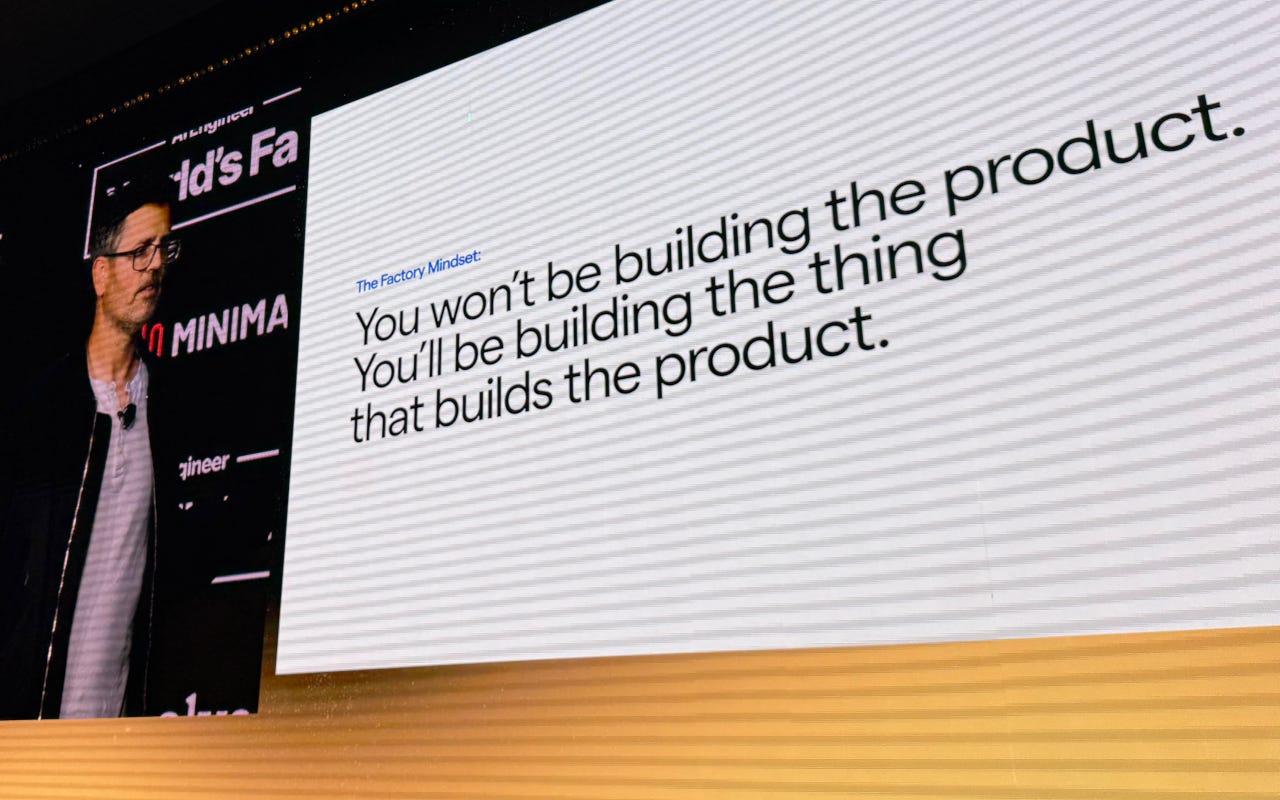
Warp’s Zach Lloyd on building the thing that builds the product.

“You choose your repositories, the parts of the software lifecycle you want to automate, and the points where humans should be brought into the loop,” Lloyd told us, regarding his company’s new software factory platform, Oz. “Different organizations and codebases will have different preferences. Do you fully automate code review? Do you have humans review certain high-risk changes?”

Another concern for enterprises is managing their unique organizational data in AI systems. Prukalpa Sankar from Atlan spoke at the conference about “context engineering,” explaining in a tweet that it’s important to consider “​​how context flows from your business systems into a shared company brain, then out to agents, copilots, and apps through MCP, APIs, and retrieval.”

Finally, lest we think enterprises are all-in on agents, Cursor’s Brunet pointed out that enterprise adoption of AI “is still concentrated among early adopters.” So finding “the right champions inside an organization” is a challenge for FDEs at this stage.

4: Coding agents replace IDEs as the developer interface

Perhaps the biggest practical change since the first AI Engineer Summit is how developers interact with AI on a daily basis.

In 2023, AI-assisted programming largely meant GitHub Copilot completing the next few lines of code. Most developers were still writing almost everything themselves, using AI as an intelligent autocomplete. But now we have tools such as Claude Code, Codex, Gemini CLI, Cursor and Warp. These “coding agents” can typically understand a broader objective, explore a codebase, modify multiple files, run tests, debug failures and iterate on their own work before presenting it back to the developer.

In Barr Yaron’s AI engineering survey, coding agents was a key trend.

The trend of coding agents now extends to web development too — with the recent release of Vercel’s eve, which the company calls an “agent framework,” comparable to its popular open source React framework, Next.js.

Vercel’s Chief of Software, Andrew Qu, told Latent Space at AIEWF that agents are effectively a new type of software. “They [agents] are not as predictable as web applications,” he explained. “The infrastructure can look similar, but the interaction, interface and outputs are much more dynamic.”

Qu added that the job of building a framework for agent development is far from over. “A year ago, we did not know sandboxes would become so important, or how much demand there would be for secure code execution and long-running jobs,” he said. “As we learn more from production, there will be much more to build.”

A for agents? Andrew Qu flashes the Vercel triangle logo.

This brings us back to the software factory trend, when developers are managing multiple agents. Charlie Holtz, CEO of Conductor, reminded the AIEWF audience that regardless of the coding harness, human engineers should always remain in control.

“I don’t want the future to be built around factories,” Holtz said. “I want to feel like a human, I want to be in the flow, I want to be in front of an orchestra, waving my baton.”

There was a sense during the conference that AI engineers aren’t yet aligned on which term is more appropriate: software factories or orchestras? Even Geoffrey Huntley, a loopmaxxing advocate, cautions about getting ahead of ourselves when it comes to automation:

“My biggest concern is that this time next year at the conference, we’re going to see a whole bunch of folks saying, our factories failed, our loops failed. These are things that we are still yet to figure out.”

5: Every agent platform is building around skills

One of the talking points of the conference was “skills,” a concept Anthropic popularized when it introduced “agent skills” to Claude last October. To borrow Addy Osmani’s definition, skills “encode the workflows, quality gates, and best practices that senior engineers use when building software.”

At AIEWF, Vercel’s Andrew Qu said that skills were “useful as portable, on-demand knowledge.” Introspection co-founder Roland Gavrilescu declared that AI engineering has shifted “from agent tools to agent skills.”

In a session on the main stage, Philipp Schmid from Google DeepMind showed how using skills (and other declarative Markdown files) allows developers to use “agents without code.” His main point was that skills reduce the need for orchestration code, which up till recently was typically done using Python. His conclusion:

“Agents are just files. We write markdown files to extend capabilities. Agents can learn from those, can create their own files.”

Paul Bakaus, who used to work for Google but now runs a company called Renaissance Geek, has created an entire project around agent skills. Impeccable is an open source design skills system that gives coding agents a vocabulary for improving interfaces. He even advocates for “skill engineering” as a discipline in its own right.
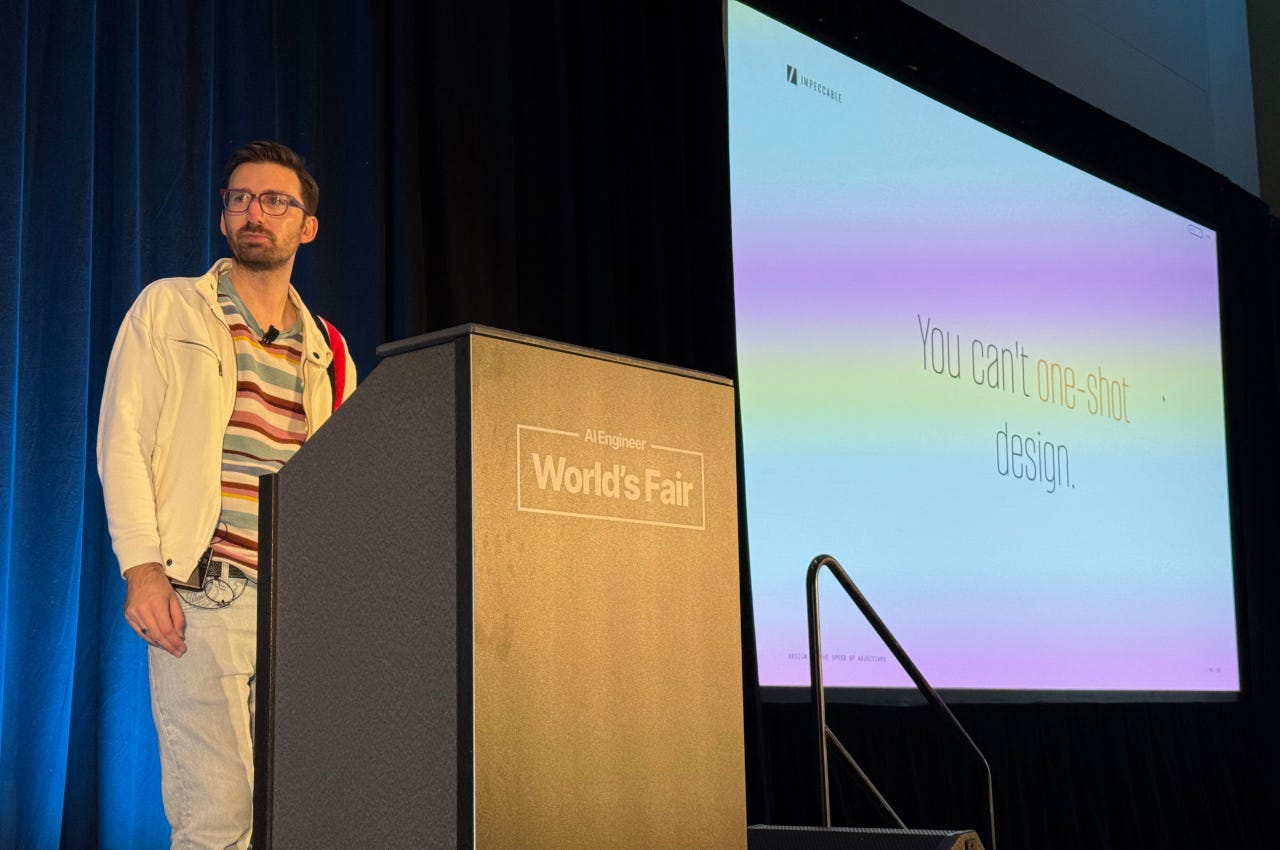
Paul Bakaus: “You can’t one-shot design.”

In an interview with Latent Space, Bakaus argued that most skills — and indeed most models — are not very creative. “They converge in one direction, and if everybody uses the same skill to do frontend design work or something like that, everything ends up looking the same,” he said.

Apparently there’s also such a thing as “skills hell,” which Matt Pocock said is comparable to previous developer frustrations — like frameworks hell. In a virtual presentation, Pocock provided a detailed checklist for writing skills, which you can see in the video below. In a nutshell, he advises writing fewer and smaller skills, and putting more thought into structure.

In a closing keynote, Y Combinator president Garry Tan implored the audience to use skills and other “AI native” approaches at their own startups or employers. Talking about business functions like sales, support and finance, Tan said that “the AI native companies that I see inside YC encode all of that as skills, written procedures that their agents execute, and they hire engineers whose job it is to maintain those skills, to do the work the skills can’t do yet.”

But again, there’s a danger in relying too much on what agents autonomously do. As AIEWF attendee Tyler Brown noted on X, “autonomy without structure creates as much slop as leverage.” One of his learnings from the conference was to “re-visit and re-implement your skills”:

“Each time there’s a new model release, it’s as if you have a kid that grows from middle school to high school. You have to change the curriculum for them to get the benefits of the new model.”

Agent engineering at scale

It’s been three full years since The Rise of the AI Engineer and the first AI Engineer Summit. Looking back, it really is striking how much the conversation has evolved. Three years ago, the focus was on proving that LLMs could act as autonomous agents at all (and the answer at that time was usually no). AutoGPT, prompt engineering, and early orchestration frameworks like Langchain dominated the discussion back then.

Now that agents not only work, but have proven they can scale, this year’s AI Engineer World’s Fair was able to concentrate on the bigger problems: building reliable systems, orchestrating teams of agents, managing context, evaluating outputs and integrating AI into production software.

Agents are everywhere now…even on the back of San Francisco buses.

The term “AI engineer” may have started life as a new job title, but at AIEWF 2026 it felt more like a description of where software engineering itself is heading. Whether developers call themselves AI engineers, software engineers or Forward Deployed Engineers, they’re increasingly working with the same set of ideas: coding agents, harness engineering, designing loops, and orchestration.

Microsoft’s Secure Boot has been broken for a decade and no one noticed until now

14 July 2026 at 22:20

An industry-wide standard Microsoft invented to protect Windows, and later Linux, devices from firmware infections has been trivial to bypass for 13 of its 14 years of existence. The discovery was made by researchers at security firm ESET after identifying 11 firmware images, at least one from 2013, that were known to be defective but remained signed by the software company anyway.

The images are known as shims, which were invented to extend Secure Boot to Linux devices and utility software. Using a technique simple enough to be performed by novice hackers, these old, forgotten shims can be used to completely circumvent the protection, which is embedded into the UEFI (Unified Extensible Firmware Interface) of the device's motherboard. The gaffe is the result of the failure by Microsoft, which oversees the signing of shims, to revoke the publicly available images once vulnerabilities were found in them.

Threat extends to Windows and Linux users

The threat extends to Windows and Linux users alike, since the shim can be installed on devices running both operating systems. From there, an attacker can subvert the mandated chain of digitally signed firmware to install malicious firmware that loads early in the boot process and persists after either the OS is reinstalled or a hard drive is replaced.

Read full article

Comments

© Getty Images

Scientists Find a Surprising New Way Stress Cascades From Brain to Body

14 July 2026 at 21:48

A newly discovered brain-gut-bone marrow highway in mice could inspire strategies to protect immunity from chronic stress.

Stress does more than take a toll on mental health. After a particularly taxing week or month, it’s easier to catch a cold and harder to recover. Health issues build up as stress lingers, raising the risk of heart disease, diabetes, cancer, and a weakened immune system.

Chronic stress is often treated as an unavoidable part of modern life. While therapy can help people cope, researchers are increasingly asking a deeper question: How do stress signals in the brain ripple through the rest of the body, and can that damage be stopped?

A new study offers one of clearest answers yet. In mice modeling chronic stress, activity dropped in two brain regions governing emotional resilience. By way of a large nerve to the digestive track, the change wiped out a beneficial bacterial strain key to a healthy microbiome.

Without those microbes, the gut produced less of a crucial molecule that helps cells clear damaged proteins and other molecular  junk. These effects impacted the bone marrow, where stem cells generate oxygen-carrying blood cells and components of the immune system. Over time, these stem cells dwindled, leaving signs of premature immune aging in stressed mice.

“One surprising finding of our study was that suppression of only two specific brain regions was sufficient to produce many of the hematopoietic [blood stem cell] defects caused by psychological stress,” study author Linjia Jiang at Sun Yat-sen University said in a press release.

By tracing a direct pathway from brain to gut microbiome and bone marrow, the results could inspire new ways to blunt the biological toll of stress, from targeted probiotics to non-invasive brain stimulation.

Three-Piece Puzzle

De-stressing has become synonymous with self-care. Whether it’s work, family obligations, or a stream of notifications stressing you out, escaping into a good book or a walk in the woods feels like a deep mental exhale.

Stress has its perks. A product of the “fight-or-flight” response, it activates the sympathetic nervous system, a kind of highway connecting brain and body. In extreme cold, the system redirects blood from the skin to vital organs and temporarily slows digestion to prioritize muscles during a marathon. Brief bursts of stress aren’t detrimental. They’re an evolutionary survival hack.

But chronic stress is another story. Decades of research have found that prolonged or repeated mental strain disrupts brain activity and increases the vulnerability to a range of diseases. This is largely related to stress hormones released by the brain. But direct electrical signals traveling to the gut—which is often nicknamed the “second brain”—may also play a major role.

The garden of microbes in our gut roughly matches the number of cells in the body. These bacteria regulate digestion, metabolism, and immunity. They also communicate with the brain. When the ecosystem falls out of balance, it contributes to conditions ranging from diabetes to brain disease.

These beneficial effects can be traced to chemicals gut microbes manufacture. Lactobacillus reuteri, for example, boosts production of spermidine, a molecule that helps cells and tissues clear toxic debris. The process, called autophagy, is essential for the maintenance of healthy tissues but declines with age.

Stress also makes blood stem cells less resilient. Studies have linked prolonged stress to shortened telomeres, the protective caps at the ends of chromosomes, and an accumulation of senescent “zombie” cells. Both are hallmarks of accelerated biological aging.

The brain, gut microbiome, and bone marrow all respond to chronic stress. The new study aimed to find out if they’re connected.

Chain Reaction

To trace how chronic stress ages the body, the team tested four mouse models. Some experienced mild nerve injury. Others faced subtle disruptions to their daily routines, such as lights switching on earlier than expected or their home cages gently rocking at unpredictable times.

The changes put the mice on edge based on established behavioral tests. Mapping brain activity, the team zeroed in on two regions that consistently quieted. One, the medial prefrontal cortex, orchestrates executive control, or the ability to keep ideas in mind while reaching towards a goal. The other, the periaqueductal grey, coordinates attention to potential threats.

As activity decreased in both regions, blood stem cells struggled to divide and replenish immune cells. Inflammation and other toxic pathways flared up, and the cells developed molecular signatures similar to those seen in much older animals. Silencing either brain region with genetic tools reproduced many of the same symptoms, suggesting neural changes are a cause, not just a correlation.

But how was the brain communicating with the bone marrow? The answer lay in the gut microbiome.

Comparing the levels of chemicals surrounding the bone marrow in stressed and unstressed mice, the team zeroed in on spermidine. The molecule is made by gut bacteria and boosts autophagy, a process that’s linked to healthy aging.

Spermidine levels plummeted in stressed mice due to the loss of Lactobacillus reuteri, a beneficial strain of bacteria in the gut ecosystem that supports spermidine production. Stress-related nerve signals from the brain depleted these microbes, which caused spermidine levels to collapse and leaves blood stem cells unable to maintain themselves.

In another test, transplanting gut microbes from a stressed mouse into a happy-go-lucky mouse triggered early blood stem cell aging in the recipient—even though it didn’t experience stress itself. The results strengthen the case that the gut microbiome is a major link between the brain and bone marrow.

Rather than stress hormones, the pathway seems largely driven by electrical signals traveling from stress-sensitive brain regions to the gut. This means targeted brain stimulation could interrupt the cascade. Supplementing Lactobacillus reuteri as a probiotic or directly providing spermidine in a pill may also restore the missing molecule and slow blood stem cell aging.

This is just speculation though. Stress is deeply personal, and mice can’t capture the entire human experience. The team is now investigating whether the same brain circuits operate in people and if targeting this brain-gut-bone marrow axis can benefit the immune system.

“Our findings raise the possibility that managing psychological stress may not only improve mental well-being but also help preserve immune function and promote healthy aging,” said Jiang.

The post Scientists Find a Surprising New Way Stress Cascades From Brain to Body appeared first on SingularityHub.

“We did not adapt and move quickly enough”: What IBM’s earnings miss says about enterprise AI spending

Dealing with Distributed Data When Training AI Models

IBM’s value has plunged after the company issued a preliminary second-quarter earnings update that fell short of Wall Street’s expectations.

Ahead of next week’s full earnings report, IBM CEO Arvind Krishna issued a statement on Tuesday warning that second-quarter revenue will miss expectations as customers continue to redirect IT budgets toward AI initiatives.

Why it matters for developers: The double-digit drop in IBM stock highlights another consequence of the AI buildout: Enterprise spending is shifting faster than some incumbent vendors can adapt.

Here’s what developers and platform teams should know.

IBM surprised investors on Tuesday by releasing a preliminary look at its second-quarter results, more than a week before its scheduled earnings report on July 22. The company now expects second-quarter revenue of $17.2 billion, up 1% year over year, with non-GAAP diluted earnings per share of $2.93, up 5%.

Those figures fell short of Wall Street’s expectations: FactSet analysts had forecast revenue of $17.86 billion and earnings per share of $3.01, the Associated Press reported. The early update did little to calm investors, sending IBM shares sharply lower.

But the miss itself wasn’t the full story. Management’s explanation for the weaker outlook may be even more important for developers and platform teams.

Capex shifts toward AI hardware

IBM now derives much of its business from enterprise software and infrastructure. As a major player in the enterprise (B2B) market, it provides software solutions ranging from security and data analysis to “middleware,” the software that lets myriad apps, databases, and platforms interconnect.

Software enterprise products are generally high-margin, making them great for a company’s bottom line. The problem for IBM is that the AI boom is causing many of its largest customers to cut spending on software services, enabling them to transfer funds toward purchasing the hardware components needed to build large AI data centers.

“In the last few weeks of June, we saw clients shift their quarterly capex spend toward servers, storage, and memory purchases to secure supply-constrained infrastructure ahead of expected price increases,” Krishna writes in the announcement. “This dynamic impacted client buying patterns.”

“In the last few weeks of June, we saw clients shift their quarterly capex spend toward servers, storage, and memory purchases to secure supply-constrained infrastructure ahead of expected price increases.”

However, Krishna also points out that IBM itself dropped the ball because it “did not anticipate the magnitude of the capex reprioritization.”

“These conditions require our teams to execute perfectly, and this quarter we faltered. We did not adapt and move quickly enough, and numerous large deals failed to close on the timelines we expected, driving the majority of our shortfall.”

“These conditions require our teams to execute perfectly, and this quarter we faltered. We did not adapt and move quickly enough, and numerous large deals failed to close on the timelines we expected, driving the majority of our shortfall.”

Middleware costs fall on developers

For software developers, the chain reactions of this capex reallocation will be felt nearly immediately. When enterprises freeze spending on high-margin middleware and off-the-shelf software from IBM and its competitors, the burden of consolidation falls entirely on internal engineering teams. To address the lack of expensive vendor solutions, platform engineers will be tasked with paving “golden paths” and building Internal Developer Portals (IDPs) using open-source tools.

If a company refuses to license the software required to connect legacy databases smoothly to new, expensive AI environments…developers will have to build those bridges manually.

Building bridges without vendor tools

If a company refuses to license the software required to connect legacy databases smoothly to new, expensive AI environments — like building ETL pipelines to feed legacy mainframe data into vector databases for Retrieval-Augmented Generation (RAG) — developers will have to build those bridges manually. This means more time writing custom APIs, maintaining brittle integrations using open-source alternatives like Apache Kafka or Envoy, and stitching systems together by hand.

What follows the infrastructure buildout

One way to interpret IBM’s warning is that many enterprises are still building AI infrastructure. Rather than expanding software budgets, organizations are prioritizing spending on servers, storage, memory, and other hardware needed to support AI workloads.

Once that infrastructure is in place, executives will expect it to generate business value. For engineering teams, the next phase is likely to focus on building AI applications, agentic workflows, retrieval systems, and production services that justify the billions already invested in compute.

In the near term, that could leave developers balancing two competing priorities of integrating new AI infrastructure while working within tighter software budgets.  Whether those software budgets rebound later this year remains to be seen.

The post “We did not adapt and move quickly enough”: What IBM’s earnings miss says about enterprise AI spending appeared first on The New Stack.

Systems Engineering Playbook: Optimizing Qwen 3.5-397B MoE on Ironwood (TPU7x)

14 July 2026 at 20:15
To serve the 397B-parameter Qwen 3.5 Mixture-of-Experts (MoE) model on Ironwood TPUs, engineers developed a modular JAX/Pallas optimization stack that achieved up to a 4.7x inference speedup for prefill-heavy workloads. The team bypassed severe hardware sharding constraints by deploying a hybrid Data Parallelism and Expert Parallelism (DP+EP) topology, paired with custom low-level communication fusions like a hierarchical reduce-scatter to optimize cross-device token routing. Finally, by executing hardware-aware custom kernels—such as Batched Ragged Page Attention and a fully-fused Gated DeltaNet (GDN) block—they successfully saturated HBM bandwidth and TensorCore MXUs to push system throughput near its theoretical roofline limits.

Lessons From the Leaderboard: What 5,000+ Kagglers Taught Us About Improving AI Reasoning

14 July 2026 at 18:20
The NVIDIA Nemotron Model Reasoning Challenge invited the Kaggle community to explore a focused question: What techniques can improve reasoning accuracy when...

The NVIDIA Nemotron Model Reasoning Challenge invited the Kaggle community to explore a focused question: What techniques can improve reasoning accuracy when everyone starts from the same open model, benchmark, infrastructure and evaluation constraints? The response was massive. By the close of the competition, more than 5,000 active participants across 4,000 teams had generated thousands of…

Source

Unlocking the Next Era of On-Device AI with Google Tensor and Pixel

14 July 2026 at 16:30
At Google I/O Connect India, Google showcased the future of 100% private, on-device AI powered by the custom Tensor SoC and TPU for the new Pixel 10 family. The event debuted the lightweight Gemma 4 E2B model, which runs natively on the device to enable completely offline multimodal features like AI chat, real-time image recognition, and personal agent tasks. Developers can start building these secure, edge-based applications today by accessing the newly announced Tensor SDK beta and its accompanying open-source resources.

How to Run an Autoresearch Workflow with RL Agent Skills and NVIDIA NeMo

14 July 2026 at 16:00
Coding AI agents are becoming practical operators for long-running machine learning (ML) workflows. They can inspect repositories, set up runtimes, resolve...

Coding AI agents are becoming practical operators for long-running machine learning (ML) workflows. They can inspect repositories, set up runtimes, resolve build issues, launch experiments, monitor execution, analyze metrics, and summarize results. For reinforcement learning (RL) research, this matters because meaningful metrics often appear only after the essential experiment infrastructure…

Source

Post-Train NVIDIA Cosmos 3 in One Day Using Agent Skills

14 July 2026 at 16:00
What if autonomous coding AI agents could push your vision reasoning models above 90% accuracy with almost no manual effort? When adapting vision reasoning...

What if autonomous coding AI agents could push your vision reasoning models above 90% accuracy with almost no manual effort? When adapting vision reasoning models to production video tasks, developers often lose days to data formatting, container setup, training scripts, baseline evaluation, and hyperparameter sweeps before they even know whether post-training improves accuracy.

Source

Building a Foundation Stack for General-Purpose Robots

13 July 2026 at 10:19


This article is brought to you by X Square Robot.

Large language models gave artificial intelligence a working recipe. Pretrain a large model on broad data, and general capability follows. Robotics has no such recipe. Robotics systems have long been assembled from separate perception, planning, and control parts that rarely add up to intelligence a robot can carry from one task to another, or one machine to another. The central problem in embodied AI is to find the equivalent recipe, and the field does not yet agree on what it is.

X Square Robot, a Chinese embodied-AI company, has made an unusually explicit bet. It argues that the recipe is an integrated stack, spanning the data a robot learns from, a world model for predicting changes in the physical world, and an action model that brings together perception, planning, reasoning, and decision-making to generate executable robot behavior. The company also believes that the stack should be built and released in the open.

X Square Robot shares its vision of bringing robots into real homes.X Square Robot

X Square Robot’s embodied AI stack

What holds the stack together is a small set of principles rather than a single overarching model.

  • The first is that the basic unit of robot data is an interaction, not a trajectory; a demonstration is successful only if it changes the world as intended, not simply because the joints moved.
  • The second is that pretraining should yield usable capability, not just an initialization for later fine-tuning.
  • The third is that behavior should be modeled around physical events rather than fixed slices of time.

These principles make the layers interdependent, since the same robot-free data that trains the action model is also structured to feed the world model. It is worth being precise, though. The company describes the world model and the action model as complementary but independent model families that share a code base. Both sit within its broader World Unified Model, which it has presented as an architecture for training vision, language, action, and physical prediction together.

Robot learning data: Engineering for quality and cost, not scale

For the X Square Robot team, one of the biggest constraints on general-purpose robots is the cost and quality of interaction data, not the number of parameters. To address that, the company built its Universal Manipulation Interface (UMI) data collection system, QUANXTA Zero Series. It works by collecting demonstrations from people wearing a rig with dual grippers rather than teleoperating a robot. This approach is not itself new, and builds on established methods for robot-free data capture. What sets it apart are two engineering choices.

Person using VR headset and handheld controllers to teleoperate a dishwashing robot system X Square Robot emphasizes data quality control, recording trajectories and replaying them on a real robot, with only those that actually complete the task counted as valid.X Square Robot

The first is quality control, and it is the most distinctive part. Rather than accepting recorded trajectories as they are, the system runs a closed inspection loop, and its notable step is physical playback. A sample of trajectories is replayed on the real robot, and only those that actually complete the task count as valid. That makes the validity rate a measured quantity rather than an assumption. For example, a gripper that closes a fraction of a second too early still looks like a grasp in the data, yet it has pushed the object away, so it shouldn’t be classified as valid. A smaller clean dataset can be worth more than a larger noisy one.

The second choice is how lower-cost human data and scarce robot data are combined. The company pretrains on a large volume of robot-free demonstrations to build general representations, then adds a small amount of real-robot data as an anchor to the specific machine’s dynamics. It reports that this reaches performance comparable to an all-robot dataset at roughly a 20-fold lower cost of collection, driven mainly by how much cheaper the wearable rig is than a teleoperation setup.

The resulting dataset is deliberately model-agnostic, formatted to feed both action models and world models. The caveat is that the strongest results are measured on the company’s own robots and data-collection pipelines. Broader independent testing will help confirm and extend these promising results across a wider range of settings.

A world model organized around events

In developing its world model, called WALL-WM, X Square Robot took a differentiated approach. Most action models predict a fixed-length chunk of motion from the current image and instruction. That is convenient, but it segments behavior into fixed-duration windows, so the boundaries fall where elapsed time dictates rather than where one action ends and the next begins. WALL-WM instead treats an action-grounded semantic event as its unit: a coherent piece of behavior such as reaching, grasping, or placing, something that can be named in language, seen in video, and executed as motion.

Collage of robot arms manipulating kitchen objects with charts of multimodal AI performance X Square Robot’s world model, called WALL-WM, treats an action-grounded semantic event as its unit: a coherent piece of behavior such as reaching, grasping, or placing, something that can be named in language, seen in video, and executed as motion.X Square Robot

WALL-WM’s design reflects a specific concern about not discarding what large video models already know. To achieve that, a text-to-video model is coupled to a freshly initialized action network that reads from the video features without overwriting them, which preserves the visual prior. From that one process, it offers two modes. An event mode runs in variable-length segments and suits reasoning over long horizons, while a fixed-length mode produces the steady, real-time output a controller needs. That places WALL-WM between mainstream chunk-based action models and pure video world models, keeping the predictive character of a world model while still yielding executable control.

In a series of experiments, the company relied on a generalization test that is more specific than most. A model trained on a limited dataset was evaluated on long-horizon tasks in unseen settings and, on the company’s real-robot benchmark, reportedly outscored baselines that had been fine-tuned on related data. That is a meaningful result if it holds. For now, it is measured on the company’s own benchmark. With the code now being released, the broader community will have the opportunity to test, reproduce, and build on them across more settings.

A policy that runs before fine-tuning, and action tokens with meaning

The action layer carries two connected ideas. The first is a requirement the company sets for itself with Wall-OSS-0.5, its vision-language-action model: The pretrained model should run on a real robot before any task-specific fine-tuning.

The interest is less in the scores than in the design behind them. The model trains three objectives together, namely discrete action tokens, language grounding, and continuous action generation. And it keeps gradients flowing through all of them rather than freezing parts of the network as some rival designs do. It’s also a more strict method, since it reports untuned behavior such as approaching, grasping, and recovering, including on a deformable task held out of training.

Dashboard of robot training metrics with charts and photos of a robot sorting objects As part of X Square Robot’s Wall-OSS-0.5 vision-language-action model design, the pretrained model should run on a real robot before any task-specific fine-tuning. X Square Robot

The second idea is the action interface itself, called X-Tokenizer. Most systems that turn continuous motion into discrete tokens produce codes that the language model cannot interpret. X-Tokenizer reframes tokenization as learning a semantic interface, so that the top-level code stands for the intent of a motion while lower-level codes carry finer detail, all aligned with the language model’s own features.

A useful consequence is stability. Adding noise to an action barely moves the intent code, which is what lets one tokenizer to be reused across robots without re-tuning. The tokenizer inside the production action model is a related variant of this approach. Together, the two ideas give the action layer something rather powerful: capability that transfers.

The future of embodied AI stacks

X Square Robot is betting that its unique approach combining three layers, each specialized in solving a key part of the problem, will stand out from other embodied AI stacks. The physical-playback step that grounds data quality is uncommon and sensible. The reframing of world modeling around events, with one backbone serving both reasoning and control, is a genuinely distinct approach. And the pairing of a deployable pretraining standard with a tokenizer designed as a semantic interface gives the action layer unusual coherence.

X Square Robot’s valuation has climbed above 20 billion yuan (about US $2.9 billion), suggesting that investors increasingly view data infrastructure, foundation models, and scalable training systems as long-term differentiators in embodied AI.

The next phase will bring broader validation. Much of the current evidence comes from X Square’s own robots and benchmarks. With the world model code now being made public, and as the community begins to test, reproduce, and build on the work, the reported capabilities will be tested across more robots, tasks, and settings.

X Square Robot’s recent funding rounds reflect similar confidence. The company’s valuation has climbed above 20 billion yuan (about US $2.9 billion), suggesting that investors increasingly view data infrastructure, foundation models, and scalable training systems as long-term differentiators in embodied AI.

What’s next for X Square Robot

To learn more about its future plans, the following Q&A with the X Square Robot team further explores the company’s technology, strategy, and vision.

What made now the right moment, technically, to commit to this stack? What recently became possible that wasn’t possible a couple of years ago?

It is not one breakthrough but several trends maturing together. Foundation models gave us a shared representation across vision, language, and action, so we can model what a robot sees, what it is asked to do, and how its actions change the world in one framework, rather than as separate perception, planning, and control modules.

Compute and infrastructure are finally sufficient for large-scale pretraining over long-horizon, multi-embodiment data. Just as importantly, we realized that data, not model size, is the real bottleneck for general robots—what is scarce is diverse, high-quality, reproducible interaction data. And world modeling has become practical. The useful question is no longer how to predict a few seconds of video, but how to understand the ways actions change objects, contacts, and task states. Two years ago these ingredients existed separately. Today they are mature enough to work as one system.

“We realized that data, not model size, is the real bottleneck for general robots—what is scarce is diverse, high-quality, reproducible interaction data. And world modeling has become practical.”

Your data system captures demonstrations with a wearable VR rig and custom grippers rather than teleoperating robots. What was wrong with standard teleoperation?

Teleoperation is built around controlling the robot. It forces the operator to work within the machine’s kinematics, latency, and viewpoint, and the resulting demonstrations are slower, stiffer, and less diverse. We built our system around capturing human skill instead. Manipulation is really about contact, timing, finger coordination, and recovery, not just the path the hand takes, and a wearable rig records those before the behavior is compressed onto one particular robot. It also breaks teleoperation’s expensive scaling law, in which every demonstration needs a robot.

People can generate rich data independently of any robot, and the crucial property is that those demonstrations can still be replayed and executed on a physical robot through the model. Mobility is convenient, but that replay is the real point, because it is what lets the same data be reused across different platforms.

Robot and person loading a washing machine together in a modern laundry room. In X Square Robot’s approach, demonstrations can be replayed and executed on a physical robot through the AI model, allowing the same data to be reused across different platforms.X Square Robot

X Square Robot reports that its pipeline has roughly an 85 percent data-validity rate. Why is quality control such an underrated bottleneck?

Because errors in robot data are far more expensive than in language data. A small timing or contact error can change what a demonstration means. If a gripper closes a fraction of a second too early, the motion still looks like a grasp, but physically it has pushed the object away. A dataset that mixes failures and accidental successes teaches ambiguity, not skill, because the real unit is the interaction, not the trajectory.

So we run automated inspection, kinematic checks, and physical replay, where we play a sample of trajectories back on the real robot and count only the ones that actually complete the task. Data quality sets the ceiling on how good a policy can be. In our experience a smaller, cleaner dataset often beats a much larger, noisier one, which is why we treat quality control as part of the model, not a preprocessing afterthought.

The model runs in both “event mode” and “chunk mode.” When does each matter?

Both matter, for different reasons. The physical world changes through events—when contact occurs, a grasp forms, or an object slips—not in fixed-frame windows. Event mode concentrates the model’s attention on those moments, and it matters most for long-horizon tasks, like clearing a table, where progress is a sequence of semantic events rather than a smooth stream. It runs in variable-length segments that follow the task rather than a clock. Chunk mode matters for deployment. Real controllers need a stable, real-time interface, and fixed-length chunks integrate cleanly with existing control systems.

We organize learning around events in the first place because a fixed window can split one motion in half or merge two together, which turns training into short-horizon pattern matching and weakens the model on long tasks. So the world model’s job is to connect event-level understanding, which is where the reasoning happens, with a fixed-length output a real robot can actually run.

Why make “deployable before fine-tuning” the criterion?

Pretraining should produce capability, not just a good starting point. If a model is only useful after heavy fine-tuning, then most of the intelligence still lives in the downstream supervision, not in the foundation model. Deployable before fine-tuning is a more honest test of what pretraining actually learned. A well-pretrained robot should already know how to approach, grasp, move, avoid obstacles, and correct itself. Fine-tuning should adapt it to a specific task or robot, not create the ability from nothing. It is also a practical requirement. A robot in a home or a workplace shouldn’t need a brand-new dataset and a new policy every time the task changes, so a foundation model that already carries general skill, and some ability to recover, is the minimum bar for something genuinely useful in the real world.

What is the most challenging part of cross-embodiment learning?

Robots differ in control frequency, delay, compliance, sensing precision, and contact dynamics, so the same instruction can require different action decompositions and recovery strategies, and a behavior that works on one arm cannot simply be copied to another. Cross-embodiment learning needs an intermediate abstraction, lower than language but higher than joint angles: how you approach an object, how you make contact, how you apply force, and how you recover from a mistake.

When we say cross-embodiment, the main capability we mean is multi-embodiment generalization: transferring across robots, training on many embodiments at once, and adapting to different kinematics. Human-to-robot transfer and other techniques are specific approaches to that goal.

“A robot in a home or workplace shouldn’t need a new dataset and policy every time the task changes. A useful foundation model should already carry general skills and the ability to recover.”

What would you most like to see other researchers attempt to reproduce or stress-test?

Three things, above all. Whether event-level representations really generalize beyond our own datasets, across more tasks, scenes, objects, embodiments, and failure conditions. Whether pretraining stays effective on robots the model never saw during training, or whether its capability is still too tightly coupled to what it has already seen. And whether real-robot evaluation can become a shared language for the field, so that we compare not just success rates but the reasons systems fail, where an instruction was misread, where perception broke down, or where recovery fell short. Robotics has been driven too often by impressive demonstrations, and real progress comes from results that are reproducible and diagnosable.

What capability is still missing before robots become dependable in homes?

Benchmarks measure competence, like whether a model can finish a task. Homes demand reliability, safe and consistent operation over time in a place that changes every day, with objects moving, instructions that are vague, and people interrupting. The missing piece is not a higher one-time success rate: it is robust recovery. A dependable home robot has to know when it is uncertain, when to slow down, when to ask for help, and how to bring the world back to a safe state after it drops something or misunderstands a request.

In a real home, failure recovery matters more than raw success, because the home does not reset itself. Homes also demand careful personalization, learning a household’s routines and preferences over time, with safety and trust as first principles. That combination, not any single skill, separates a capable demonstration from a robot people can live with.

Humanoid service robot stands by a table in a modern living room. X Square Robot’s approach is that, in a real home, failure recovery matters more than raw success, because the home does not reset itself and it demands careful personalization, with safety and trust as first principles. X Square Robot

How do the open-source components fit into X Square Robot’s World Unified Model direction?

We see these releases as layers of the World Unified Model direction rather than isolated projects. Wall-OSS-0.5, the action model, asks whether an open vision-language-action model can gain directly measurable capability from large-scale pretraining, so it is the capability layer. WALL-WM, the world model, asks how a robot should understand change in the world, shifting from fixed windows to event-level modeling, so it is the representation layer. The data system supplies the interaction data that both of them learn from.

Together they form a loop in which models produce capability, world models organize understanding, and the open-source community drives reproduction and improvement. World Unified Model is the broader architecture those layers support, bringing vision, language, action, and physical prediction together.

We are releasing these pieces openly because embodied intelligence cannot be solved by one organization; it needs many embodiments, many real tasks, and broad feedback, and the long-term goal is a stack that keeps learning and ultimately moves robots from laboratory demonstrations toward reliable everyday use.

1Password moves into AI cost management, betting that token spend is the next enterprise budget crisis

1Password on Tuesday launched AI Spend and Consumption Management, a new capability embedded in its SaaS Manager platform that gives IT and finance teams a unified, real-time view of how their organizations consume and spend on AI services from vendors including Anthropic, Cursor, and OpenAI.

The move marks the latest strategic expansion for a company that built its reputation on password management for consumers and, over the past three years, has aggressively repositioned itself as a broader identity security and SaaS governance platform for enterprise buyers. With this release, 1Password is staking a claim in one of enterprise technology's newest and most chaotic budget categories: the consumption-based cost of large language models.

"Executives want teams to build faster with AI, but that speed is creating a new kind of spending pressure," Greg Henry, 1Password's chief financial officer, said in an exclusive interview with VentureBeat. "Developers are consuming tokens at a pace that traditional budgets weren't built to manage, and IT and finance teams are being asked to forecast and justify AI investments without a clear view of what's actually driving costs."

The product, now in public preview with broad availability planned for fall 2026, connects directly to vendor admin APIs to pull token-level consumption data daily. It normalizes that data across providers into a single dashboard and allows organizations to set vendor-level spend limits, configure threshold-based alerts via Slack and email, and break down usage by team, user, vendor, and model.

Why traditional software budgets can't keep up with AI token pricing

The core challenge 1Password is targeting is structural. Traditional SaaS pricing operates on a per-seat, per-year model that is easy to budget and reconcile. AI pricing does not. Every API call to Claude, GPT-5.6, or a Cursor-powered coding assistant consumes tokens, and the cost of those tokens varies by model, by input versus output, and by the complexity of the task. A single engineering team running agentic workflows can burn through a prepaid token budget in weeks — and the finance team may not notice until the invoice arrives.

Henry drew a sharp analogy to a problem enterprises have already lived through once. "Consumption-based pricing isn't new," he said. "We saw it arrive with cloud infrastructure, and it took years to build the tools and disciplines to manage it. AI is the next version of that shift."

That comparison resonates across the industry. When Amazon Web Services, Microsoft Azure, and Google Cloud popularized consumption-based pricing for compute and storage in the 2010s, enterprises initially lacked the tooling to monitor and optimize their cloud bills. That gap spawned an entire FinOps ecosystem — companies like CloudHealth, Spot.io, and Apptio built multi-billion-dollar businesses helping organizations understand what they were spending on cloud and why. Henry is explicitly betting that AI token spend will follow the same trajectory, and that organizations that fail to build visibility now will end up, as he put it, "paying far more than they needed to, for far longer than they should have."

The scale of the coming wave lends credibility to that bet. Goldman Sachs has estimated that token consumption from AI agents alone will grow 24 times by 2030, a projection driven by the expectation that autonomous AI systems will increasingly execute multi-step workflows — booking travel, writing and deploying code, managing customer service interactions — that generate vastly more API calls than a human sitting at a chat interface.

How 1Password's new dashboard tracks every token across Anthropic, Cursor, and OpenAI

The new capability extends 1Password SaaS Manager's existing foundation of application discovery, license management, and spend analytics. It is not a standalone product. Existing SaaS Manager customers can activate it by connecting their supported AI vendor API keys, at which point consumption data flows into a dedicated AI Consumption Management dashboard. Henry confirmed that there is no separate product or add-on fee: "AI Spend and Consumption Management is available to all 1Password SaaS Manager customers."

The system provides four core functions. First, it aggregates token usage and spend across Anthropic, Cursor, and OpenAI into a single, normalized view — eliminating the need to toggle between three separate vendor dashboards with three different reporting formats. Second, it enables budget controls: organizations can set vendor-level spend limits, configure percentage-based thresholds, and receive automated alerts when prepaid balances approach depletion. Third, it disaggregates consumption by team, user, vendor, and model, allowing finance and IT to understand not just how much is being spent, but where and by whom. Fourth, it situates AI spend within the broader SaaS portfolio, helping organizations see how token costs relate to their total software investment.

Notably, the system captures consumption regardless of whether a human or an AI agent generated it. "Token consumption is captured at the API level regardless of whether a human or an agent is generating it," Henry explained. "Organizations get the total consumption picture, including the spikes that agent loops can create, which can be some of the hardest usage to catch before it becomes a problem."

That agent-level visibility matters because autonomous AI systems can generate runaway costs in ways that human users typically cannot. An agentic coding assistant stuck in a retry loop, for example, can consume thousands of dollars in tokens in minutes — with no human in the loop to notice. For now, the product alerts but does not enforce. When asked whether 1Password will eventually give organizations the ability to automatically cut off spending when a threshold is crossed, Henry said the company is "actively evaluating" automatic enforcement but emphasized that visibility must come first: "You can't enforce what you can't see."

The choice of launch partners reveals where enterprise AI budgets are under the most pressure

The decision to start with Anthropic, Cursor, and OpenAI — rather than casting a wider net — reflects where enterprise AI adoption and budget strain are most concentrated right now. Henry said the choice was driven entirely by customer demand. "Anthropic, Cursor, and OpenAI are where we're seeing the highest adoption, and where token consumption can move fast and get ahead of the teams responsible for managing it," he said. The company plans to add additional vendors based on customer demand, API availability, and budget impact, though it has not committed to a specific timeline or vendor list.

The inclusion of Cursor alongside the two major foundation model providers is telling. Cursor, an AI-powered code editor that has rapidly gained traction among developers, represents a category of AI tool where consumption is particularly difficult to forecast. Unlike a chatbot interface where a user consciously types a prompt, Cursor integrates AI suggestions directly into the development workflow, generating token consumption continuously as developers write code. That ambient, always-on consumption pattern makes it especially prone to budget overruns.

Henry also addressed who inside an organization should actually own this problem — and acknowledged that the honest answer right now is no one. "When spend is fragmented across vendor dashboards and finance teams are reconciling it monthly, you're always behind," he said. "AI spend can't be treated as a finance-only or IT-only problem." He noted that the pricing differences between models have become significant enough that the choice of which AI model a team uses is now a meaningful financial decision, one that is pulling CFOs into conversations with IT, product, and engineering leaders "in ways they never had to before."

Steve May, director of IT at ServiceTrade, a 1Password customer that has been using the capability, said it addressed a concrete planning gap. "Forecasting tools for AI consumption and spend was one of our biggest gaps in planning because we didn't have a reliable way to track it," May said. He added that the visibility has "prevented overages that would have cost far more to fix after the fact."

Where 1Password fits in the fast-consolidating SaaS management market

1Password is not the only company racing to solve the AI cost management problem, but the competitive landscape is still fragmented and the category is far from mature.

Zylo, a SaaS management platform that Gartner has also recognized as a leader in the space, published its 2026 SaaS Management Index in January showing that AI-native application spend surged 393% year over year in organizations with more than 10,000 employees and 108% overall. Zylo's data also revealed that ChatGPT has become the most expensed application in enterprise environments, highlighting how AI tools are entering organizations through employee credit cards and expense reports — outside formal procurement and governance workflows. Zylo has added its own token-level cost tracking for AI vendors including Anthropic, OpenAI, Cursor, and Perplexity.

Meanwhile, according to a comparison published by Coommit in May, Vendr — which focuses more on SaaS negotiation than discovery — tracks AI tools at the contract level but does not yet offer consumption-level visibility. And the FinOps Foundation reported in its 2026 State of FinOps survey that 98% of organizations now actively manage AI costs, up from just 31% in 2024. The broader SaaS management market is also consolidating rapidly. In May, Deel acquired Sastrify, a German SaaS management vendor, and began folding it into its HR platform — a signal that SaaS management capabilities are increasingly being absorbed into adjacent enterprise platforms rather than remaining standalone products.

1Password's approach differs from pure-play SaaS management competitors in one important respect: it is building AI cost management on top of an identity security platform, not a FinOps or procurement tool. The company's SaaS Manager product grew out of its 2025 acquisition of Trelica, a UK-based SaaS access management startup whose technology enabled the discovery of unsanctioned applications — so-called shadow IT. As BetaKit reported at the time of that deal, 1Password co-CEO Jeff Shiner described Trelica as "a pioneer in modern SaaS access management" and said the acquisition would accelerate 1Password's Extended Access Management product roadmap by more than a year. CRN noted that Trelica brought more than 300 SaaS integrations to the platform. That identity-first lineage gives 1Password a natural advantage in connecting spend data to specific users and teams — a linkage that matters when the question shifts from "how much are we spending on AI?" to "who is spending it, and is it delivering value?"

From password manager to platform company: 1Password's $6.8 billion bet on enterprise identity

The launch raises a question that Henry addressed head-on: whether a company that started as a consumer password manager can credibly compete in enterprise AI cost management.

"It doesn't feel like a stretch to us. It feels like a natural progression," he said. "For more than 20 years, 1Password has evolved alongside how our customers work. We started by protecting passwords. Then we helped organizations manage secrets, control access, and get visibility into the applications their teams rely on."

The company's evolution has been rapid. 1Password raised a $620 million Series C in January 2022 led by ICONIQ Growth, reaching a $6.8 billion valuation — at the time, the largest funding round ever raised by a Canadian company, according to Crunchbase. The round also attracted celebrity investors including Ryan Reynolds, Scarlett Johansson, and Robert Downey Jr. As of early 2025, BetaKit reported that 1Password had surpassed $250 million in annual recurring revenue, with B2B sales accounting for nearly three-quarters of total revenue and the company claiming to be cash-flow positive.

In May 2024, 1Password launched Extended Access Management, a platform designed to secure sign-ins across both managed and unmanaged applications and devices. That same year, it acquired Kolide for device trust and, in early 2025, Trelica for SaaS discovery. In June 2026, Gartner named 1Password a Leader in its Magic Quadrant for SaaS Management Platforms. According to 1Password's own blog post on the recognition, its SaaS Manager now supports over 400 integrations and provides visibility into a library of more than 40,000 pre-populated application profiles. Each step has moved the company further from its consumer roots and deeper into enterprise infrastructure. The AI Spend and Consumption Management launch extends that trajectory into financial operations territory — a domain where 1Password will compete not only with SaaS management vendors but potentially with dedicated FinOps platforms and the AI vendors' own billing dashboards.

Why high AI token consumption doesn't always mean wasted money

Perhaps the most revealing part of Henry's commentary concerns what organizations should actually do with the consumption data once they have it. He pushed back forcefully against the assumption that high token consumption automatically signals waste.

"A team burning through tokens may be building something genuinely valuable," he said. "A lower-usage project might not be moving the business forward at all. What matters is whether that consumption is producing enough business value to justify the spend."

Henry drew a distinction between personal productivity — "having a bot summarize your meeting or draft a quick email" — and genuine business outcomes. "What organizations need to see is where consumption is actually driving revenue, efficiency, or something that moves the needle."

That framing positions AI Spend and Consumption Management not just as a cost-cutting tool but as a decision-support system for AI investment allocation. If a CFO can see that one engineering team's heavy Claude usage is powering a product feature that drives revenue, while another team's OpenAI spend is funding low-value internal automation, the organization can reallocate budget accordingly rather than imposing across-the-board cuts.

"When costs rise faster than expected, the instinct is to cut," Henry said. "But most organizations can't yet tell which teams, models, or tools are responsible for the increase, so they end up cutting across the board rather than directing investment toward the AI projects that are actually delivering business value. Blunt cuts on a technology you're counting on for competitive advantage is not a management strategy, it's a missed opportunity."

The next enterprise budget crisis is already here — and it's priced per token

The product's current scope — three vendor integrations, alerting but not enforcement — is clearly a starting point. Henry signaled that automatic spend limits are on the roadmap and that additional vendor integrations will follow based on customer demand.

But the broader trajectory he described suggests 1Password sees this launch as a wedge into a much larger opportunity. "As traditional SaaS products add AI capabilities, their pricing models are going to follow," he said. "Organizations that build visibility and management discipline around consumption now are going to be in a much better position when that happens across the rest of their software portfolio."

If Henry is right, the chaos currently confined to AI token budgets is not a temporary growing pain but a preview of how all enterprise software will eventually be priced. A decade ago, companies scrambled to understand their cloud bills. Today, they are scrambling to understand their AI bills. The question is whether the organizations building the dashboards this time around can get ahead of the curve — or whether, as Henry warned, they will end up where so many companies ended up with cloud, realizing too late how much they were overpaying, and for how long.

AI Spend and Consumption Management is available now in public preview for 1Password SaaS Manager customers. Broad availability is planned for fall 2026.

Canva launches Code 2.0, offering AI website building to every user — including free accounts

Canva on Tuesday launched Canva Code 2.0, a major upgrade to its AI-powered coding tool that lets users build interactive websites, apps, and experiences using plain-language prompts — and then edit the results as easily as tweaking a Canva presentation. The feature is now available to all of the company's more than 265 million monthly users across every pricing tier, including free accounts.

The move is Canva's most aggressive push yet into the fast-growing "vibe coding" market, a category that barely existed 18 months ago but has already minted billion-dollar startups and reshaped how non-developers think about building software. But where rivals like Lovable, Replit, and Bolt.new have focused primarily on generating functional code from text prompts, Canva is making a different bet: that the real bottleneck isn't creating the code — it's making the output actually look good.

"Most vibe coding tools stop at functional — generating output that looks the same as everyone else's," Canva states in its announcement. "You might get a working prototype, but making it actually look like yours requires a complex editing surface, a separate design tool, a developer, or endless back-and-forth prompting that rarely lands where you want it.”

Danny Wu, Canva's Head of AI Products, framed the product's positioning in stark terms during an exclusive interview with VentureBeat ahead of the launch.

"We are deliberately targeting non-technical users," Wu said. "Canva Code isn't a tool we're building for developers. What we're trying to do is bring the power of AI coding — and really lightweight coding — into the Canva platform, while answering our users' requests for more interactivity, more customization, and more flexibility, from websites to interactive presentations."

Canva Code 2.0 brings drag-and-drop editing, HTML import, and 75% faster generation to AI-built websites

The update introduces several capabilities designed to collapse the distance between generating code and publishing a polished interactive experience. Users can now create Canva Code projects directly inside other design projects — embedding interactive elements within a whiteboard, presentation deck, or standalone page. Canva has also added more than 50 new templates specifically designed for interactive designs, along with the ability to import raw HTML files from other AI coding tools and convert them into editable Canva designs.

The performance improvements are significant. Canva says it has reduced average code generation time by 75 percent and cut the median time from initial prompt to a published site by 30 percent. The company also reports that integrating Canva Code into the broader Canva editor — allowing users to treat coded outputs like any other design element — has increased active Code users by 25 percent.

Perhaps the most distinctive feature is the editing experience itself. Unlike most AI coding platforms, which require users to re-prompt or modify raw code to make visual changes, Canva Code 2.0 lets users click directly into generated elements to change text, drag and drop images from Canva's built-in library of over 120 million templates and assets, update colors and fonts through a familiar toolbar, or select a specific element and refine it through conversational AI. Every output is fully interactive and automatically adapts to different screen sizes, with a built-in mobile preview.

Wu demonstrated the drag-and-drop editing during the interview, showing how a generated conference website could be modified in real time — swapping in photos, changing fonts to branded alternatives, and editing text directly on the canvas. "The key differentiator with Canva Code is the editability and the kindness of the outputs it generates," he said, though he noted one current limitation: "We don't support moving elements around. You still have to re-prompt for that."

How Canva plans to compete with Lovable, Replit, and Bolt in the booming AI app builder market

Canva's entry into vibe coding at this scale arrives at a pivotal moment for the category. According to market research published by Luminix AI in May 2026, the vibe coding and AI app builder market has reached an estimated $4.7 billion in 2026, with projections pointing toward $12.3 billion by 2027 at roughly 38 percent compound annual growth. The research also estimates that AI-generated code now comprises approximately 41 percent of all code written globally — a figure that would have seemed inconceivable even two years ago.

The competitive landscape has grown ferocious. Lovable, which focuses on conversational, design-forward app generation for non-technical founders, has achieved what may be the fastest revenue ramp in the category's history — reportedly reaching approximately $400 million in annual recurring revenue by early 2026, according to Luminix's analysis. Replit, which transformed its browser-based IDE into a full vibe-coding engine through successive AI agent releases, has tripled its valuation to $9 billion and is targeting $1 billion in run-rate revenue by the end of 2026, per the same report. Bolt.new, which runs a full Node.js environment entirely in the browser, scaled from $4 million to $40 million in ARR within months of launching.

And then there is Canva, which brings something none of those platforms possess: a quarter-billion-user design ecosystem where brands, teams, and individuals already store their visual identities, collaborate on projects, and publish content.

Wu positioned Canva Code not as a direct competitor to these developer-focused tools but as something that fills a gap none of them have addressed. "A lot of the requests that we have been getting and the usage we're seeing is actually with using Canva Code not necessarily as just one artifact, but as part of an overall design, the visual communication they're trying to tell," Wu said. "Like when you have a sales deck, you're able to add a calculator, you're able to add a visualizer of what exactly your product does. That's something where an interactive slide can be worth a thousand pictures."

Why Canva's HTML import feature could turn it into a 'finishing layer' for every AI coding tool

One of the most strategically interesting features in Canva Code 2.0 is its HTML import capability, which allows users to take code generated by any AI tool — including ChatGPT, Claude, Lovable, or Bolt — and bring it into Canva as a fully editable design. The implication is unmistakable: Canva is positioning itself as the place where AI-generated code gets its finishing touches, regardless of where it was originally created.

When asked directly whether this amounts to positioning Canva as a "finishing layer on top of vibe coding," Wu offered a diplomatic but revealing response. "It's really a continuation of our goal to make all design as easy as possible," he said. "We've supported importing PDFs and translating them into docs, importing PowerPoint files — so in one way, it's an expansion of that. But in another way, it's really just listening to what our users want and making Canva both the most useful and the most compatible platform.”

He paused, then added: "It's not that we're deliberately positioning ourselves as a specific layer, say like a finishing layer after vibe coding. We just really want to make our platform the most accessible and the most pluggable."

That language — "most pluggable" — suggests a platform strategy that doesn't require Canva to win the AI code generation race outright. If Canva becomes the default destination for making AI-generated code look professional and on-brand, it captures value from the entire category regardless of which code generation engine users prefer. The strategy also echoes the broader import capabilities that already allow Canva to ingest PowerPoint decks and PDFs from competing platforms, gradually pulling users deeper into the Canva ecosystem without demanding they abandon existing workflows.

What Canva Code can build — and where Danny Wu says it hits its limits

Wu was notably candid about the product's boundaries — a refreshing departure from the typical Silicon Valley product launch. "Canva Code is great for anything that works as a front-end app, and it's especially good when you want to leverage data, data submissions, and interactivity at small to medium scale," he said. "I'll be honest about the limitations. Canva Code is probably not going to be suitable if you're trying to build a website with complex backends, or if you're handling hundreds of thousands of visitors per day."

This candor effectively draws a line between Canva Code and the more ambitious platforms in the space. While Lovable and Replit are pushing toward full-stack application development — complete with databases, authentication, and production-grade hosting — Canva is deliberately limiting its scope to interactive front-end experiences at modest scale. The question is whether that's a strategic weakness or a disciplined focus. For the teachers, small business owners, and marketing teams that make up the bulk of Canva's user base, complex backends and high-traffic scalability are irrelevant concerns. What matters is whether they can create an interactive event page, a property listing website, or a classroom hub that looks professional and works on mobile — without hiring a developer or learning a new tool.

When asked about the AI models powering Canva Code, Wu confirmed the company uses a combination of proprietary and third-party models, including those from OpenAI and Anthropic, but declined to specify the exact mix. "We don't share the exact mix, and it does change over time," he said. "We also route differently depending on what you're asking for and which model family we think is best for handling certain requests."

Canva's AI acquisition spree — from Affinity to Leonardo.ai — now powers its vibe coding push

Canva's broader AI infrastructure has been significantly bolstered by an acquisition strategy that has accelerated over the past two years. In March 2024, the company acquired Affinity, the British creative software suite popular with Mac users, in a deal that Bloomberg reported was valued at "several hundred million pounds." Canva at the time positioned the deal as a way to compete with Adobe's flagship products — Illustrator, Photoshop, and InDesign — by gaining ownership of Affinity's Designer, Photo, and Publisher applications.

Just four months later, Canva acquired Leonardo.ai, an Australian generative AI startup with over 19 million registered users and more than a billion images generated. Canva co-founder Cameron Adams said at the time that Leonardo.ai's technology would be integrated into Canva's Magic Studio generative AI suite.

Together with these acquisitions, Canva Code is the company's attempt to layer interactive, code-driven capabilities on top of a visual design platform that has already been enhanced by professional-grade design tools and generative AI models. The company reports over 32 billion uses of its AI products to date — a staggering figure that underscores how deeply AI is now woven into everyday Canva workflows, even for users who may not think of themselves as using artificial intelligence.

Six million sites published, but Canva's retention data remains an open question

Canva's announcement highlights an impressive traction metric: users have created and published more than six million websites using Canva Code since the feature was first introduced a year ago. But the number deserves scrutiny.

Wu clarified in the interview that the six million figure represents published websites over the past year — meaning sites that were either made public or shared via password-protected or private links. "They may have published publicly, or behind a password, or as a private link. But that's the number of published websites," he said.

When asked about active retention — how many of those sites are still live and being maintained — Wu acknowledged the gap in his data. This is a meaningful distinction. In the vibe coding market, raw creation numbers can be misleading because the barrier to generating a site is so low. The more telling metric — which Canva does not yet provide — would be how many of those six million sites receive regular traffic or have been updated after initial publication.

The early use cases, however, suggest genuine utility beyond novelty. Educators and school administrators are using Canva Code to build classroom hubs, with one teacher creating bespoke webpages for each of their classrooms to keep students and parents updated on announcements. Small businesses, like Alt Marketing School, have built mini apps for fundraising training and interactive roadmaps for their members. For World Book Day, 50 readers created educational games across different subjects, complete with pedagogical guides for classroom use.

Canva Code pricing, data governance, and what enterprise customers need to know

Canva Code 2.0 is available across all of Canva's pricing tiers, including its free plan — a notable decision given that competitors like Lovable, Bolt, and Replit reserve their most capable features for paid subscribers. "As you go from, say, free to pro to business to enterprise, you would get more AI credits and be able to have higher usage of Canva Code," Wu said. "But it is available and it is usable — even free Canva accounts as well as education and not-for-profit accounts."

This credit-based approach mirrors the pricing evolution happening across the entire vibe coding category, where platforms have converged on token or credit systems that meter AI generation capacity rather than gating features behind subscription tiers. The difference is that Canva's free tier serves as an acquisition funnel for a much larger design platform, not just for the coding feature itself.

For the institutional customers Canva increasingly courts — school districts, real estate brokerages, enterprise marketing teams — data governance is a threshold concern. Wu addressed this directly. "All users and customers have full control over how their data is used," he said. "They can choose whether their prompts and data are used for AI training in the settings. For businesses and enterprises, team admins can manage this at the organizational level and guarantee that their inputs, content, and outputs won't be used for training." This opt-out approach reflects a lesson the broader industry has learned the hard way. As The Verge reported when Canva acquired Leonardo.ai, Adobe suffered significant backlash over a policy update regarding user data and AI model training — a controversy Canva appears keen to avoid.

Canva's long-term vision: closing the gap between imagination and what non-technical users can actually build

When asked where Canva Code fits into the company's long-term trajectory — and whether Canva is building toward a full-stack app development platform — Wu steered the conversation back to the company's core audience.

"A huge part of it is reducing the gap between your imagination and what's possible, especially for everyday users — people who don't have a lot of time," he said. "They don't have time to figure out deploys or MCPs or APIs. They just want to design more interactive and more dynamic communication."

He pointed to the rapid improvement in AI model capabilities as a key accelerant. "The kind of things you can create today in one shot — like a 3D visualization of a solar system — you really couldn't have trusted the output a year ago. But today, you have a really high success rate."

Whether Canva Code becomes a durable product category or a feature that gets absorbed into the platform's broader AI workflow will depend on how quickly the company can close the gap between its current front-end focus and the full-stack capabilities that increasingly define the competition. Lovable is shipping Supabase-backed apps with authentication and databases built in. Replit's agents can execute autonomous long-running builds. Bolt.new runs entire Node.js environments in a browser tab. These are fundamentally different ambitions than making a conference landing page look good.

But Canva has never won by matching the technical depth of its competitors. A decade ago, it didn't try to out-feature Adobe — it made design accessible to the 99 percent of people who would never open Photoshop. Now, in a vibe coding market where every tool can generate a working prototype from a prompt, Canva is making the same wager it made in 2012: that for most people, the hardest part was never the building. It was making it look like it came from you.

AI can finally read your handwriting — here’s why enterprises care

The seemingly unquenchable thirst of the AI data ingestion pipeline spans language, numerical, and tabular data in the first instance, while other tangential platforms have been building large audio, image, and video models at the same time. 

Straddling potentially all of these domains are the file structures where complex documents and forms of unstructured data reside; this is the road less traveled in terms of the source DNA modern AI draws from.

The schema-less, freeform, uncurated data lake

In a bid to bridge connections to the schema-less, freeform, uncurated information that all organizations naturally harbor, enterprise visual intelligence company Valantor announced its acquisition of unstructured information RAG specialist EyeLevel on Tuesday. The acquisition formally launches Valantor’s Enterprise Visual Intelligence platform, combining EyeLevel’s document intelligence with its own operational expertise.

Benjamin Fletcher, CEO and co-founder of EyeLevel, tells The New Stack that where organizations fail to adopt visual intelligence, human-only processing breaks down pretty quickly in the age of AI.

“About 80% of corporate knowledge is in millions of pages of visually complex PDFs, PPTX, and DOCX files,” Fletcher says. “This information is far beyond the capacity of any LLM context window and is effectively inaccessible to LLMs and agents.” 

“We’ve found the golden datasets that teams build by hand routinely carry 10 to 25 percent error rates. Ironically, those same teams often hold AI to a far higher standard than their own people.”

Humans are slow, expensive & prone to errors

He explains that transactional workflows (such as invoice and claims processing) typically involve documents “so visually complex and diverse” that enterprises still rely on humans to process them, who can be slow, expensive, and error-prone. 

“We’ve found the golden datasets that teams build by hand routinely carry 10 to 25 percent error rates,” Fletcher says. “Ironically, those same teams often hold AI to a far higher standard than their own people. If data sovereignty matters to a business, everything gets harder now: solving these problems with AI while your documents stay inside your own infrastructure is the hard mode version of the job, and very few tools can do it.”

Where does invisible corporate information live?

Valantor has noted that while most AI companies concentrate on models, the company itself is “focused on the information those models can’t see” today. The suggestion is that this unseen morass of valuable data is locked inside documents, claims files, contracts, engineering drawings, reports, forms, presentations, and other visually complex content.

Valantor’s flagship platform product, GroundX, operates where data resides, including private cloud, sovereign infrastructure, on-premises deployments, and fully air-gapped environments. 

“GroundX is the ingestion and retrieval layer for unstructured documents,” explains Fletcher. “It is one tightly tuned system where retrieval consumes exactly what ingestion produces. Everything is exposed through REST APIs, SDKs, and MCP. It ships as REST APIs, SDKs, and MCP, and the Helm chart drops straight into a team’s existing deploy pipeline, and our agent harness gives coding agents like Claude and Codex the skills to build the integration themselves.

As part of the acquisition announcement, Valantor is introducing GroundX Studio. The harness capabilities within GroundX Studio integrate with modern AI development environments, enabling developers to build secure AI applications that operate on enterprise knowledge while remaining within existing infrastructure. 

GroundX Studio also extends capabilities to business users, allowing organizations to create AI-powered workflows and applications without extensive custom development.

“Each agent does one small task, so cheaper models are often good enough, and teams that want direct control over cost can run the whole stack on their own hardware with Helm.”

Risk of latency-laden performance and spiraling costs?

If it feels like this new data ingestion stream is going to place a new burden on cloud workloads, application execution latency, database retrieval times, and (of course) overall token usage, then Valantor and EyeLevel say that this consideration has been taken into account by dint of their own platform’s orchestration layers.

“We never send a whole schematic to a language model; our vision model splits each page into its elements first,” Fletcher confirms. “Processing runs in multiple passes at different levels of the document, and everything inside a pass runs in parallel, so there’s a minimum processing time, but it does not scale linearly with page count. Each agent does one small task, so cheaper models are often good enough, and teams that want direct control over cost can run the whole stack on their own hardware with Helm.”

The intersection of AI and handwriting

sWhile we already know that AI and handwriting do mix in the same cocktail glass — the ViWoods AiPaper digital e-ink handwriting tablets have a useful set of AI functions on board, and similar products are available from manufacturers including reMarkable — it’s not a widely deployed use case yet. Valantor claims that its underlying data models and custom heuristics bridge the “data comprehension gap” when processing handwritten annotations.

“Our proprietary vision model, fine-tuned on more than a million pages of enterprise documents, sees the page the way a human does: tables, paragraphs, and figures,” underlines Fletcher. 

He says that handwritten marks are captured as page elements with their layout context intact. Narrow agents then distill each element into a contextual object tuned for both search and LLM completion. 

“Smaller pieces, less cognitive load — that’s how we close the gap, with better accuracy at lower cost, driving better performance and significant cost advantages,” he adds.

Working examples of this technology include Air France-KLM, which used GroundX to develop an AI-powered customer service assistant trained on thousands of policy documents, achieving 96+% accuracy on complex policy-related questions. AskVet used the platform to operationalize more than a decade of proprietary veterinary data, enabling autonomous resolution of up to 85% of customer inquiries while significantly improving operational efficiency.

Is document management sexy now?

Taking all of this on board, are we at the point where we can ask whether document management has just become interesting, compelling, and sexy? 

No, of course it didn’t; it will arguably always suffer from a degree of stigmatized disdain. That may change in the future as we interact more directly with AI tools that begin analyzing the unstructured information we know organizations have been sitting on for so long. For now, it may still remain the corporate equivalent of eating your vegetables — pass the Brussels sprouts and steamed turnips, please.

The post AI can finally read your handwriting — here’s why enterprises care appeared first on The New Stack.

A unifying framework from neural superposition to sparse interpretable codes

Nature Machine Intelligence, Published online: 14 July 2026; doi:10.1038/s42256-026-01259-z

Kindt et al. present a unifying framework for superposition in neural networks. Their three-step approach clarifies how latent features can be identified, disentangled and assessed.

Request for Information, Training and Care Delivery Models for Safe Administration of Potential FDA-Approved Psychedelic Therapies in Ambulatory Clinical Settings

On April 18, 2026, President Trump issued Executive Order (E.O.) 14401, "Accelerating Medical Treatments for Serious Mental Illness", acknowledging that individuals suffering from serious mental illness may not always respond to existing therapies. This request for information (RFI) solicits stakeholder feedback on training and care delivery models that could be used to ensure safe and effective delivery of potential future Food and Drug Administration (FDA)- approved psychedelic drugs, including drugs administered in ambulatory clinic settings, such as health centers and rural health clinics.
❌