Making a publishable video no longer requires a full crew, a suite of desktop NLEs, and a week of versioning. AI can now take a brief, a product still, or a script and return motion in minutes. The bottleneck moved. It is no longer “Can we generate a clip?” It is “Can the tool carry […]
A predictive maintenance system can flag rising vibration, unusual temperature patterns, or a combination of signals that suggests a component is likely to fail. That may be technically impressive, but it does not reduce downtime by itself. Someone still has to decide whether the signal matters, how urgent it is, what action should follow, and […]
There is a step in the development process for large language model (LLM)-assisted tooling that most teams skip because it's tedious, time-consuming, and doesn't produce results visible to end users: Verifying that what the model is saying is actually correct. Not fluent, not coherent, not topically relevant — correct in the sense of accurately identifying the right answer to the specific problem the tool was built to solve.
The gap between "this output sounds right to me" and "this output is verifiably correct" is where most LLM-assisted enterprise tools fail quietly. They pass internal review because the output sounds right. They fail in production because those people weren't reviewing against ground truth — they were reviewing against their intuition about what a good answer looks like.
This distinction matters more as LLM-assisted tools move from productivity accessories to components that influence real business decisions. If your AI-assisted tool is shaping how an analyst investigates a data quality issue, how a compliance reviewer decides whether to escalate a flagged record, or how an operations team triages a validation failure — the accuracy of its output has real consequences. "Seems reasonable" is not an adequate evaluation standard for that.
What qualitative evaluation actually catches
The standard evaluation approach for LLM output in enterprise tooling is qualitative: A sample of outputs is reviewed by someone with domain knowledge, judged against a mental model of what a good answer looks like, and the prompt is adjusted if too many outputs seem off.
This catches a specific class of problems: Outputs that are obviously wrong, poorly formatted, or off-topic. These are real issues worth catching. They're also the easy ones.
What qualitative evaluation consistently misses is the class of outputs that are wrong in ways that are difficult to see without checking against something external. An explanation that confidently identifies the wrong root cause, in language that sounds authoritative, based on reasoning that sounds plausible — this passes qualitative review. It fails the moment someone with the right context checks it against what actually happened.
In a system whose value proposition depends on accuracy, "sounds plausible" is not the same as "correct." The two can diverge significantly, and qualitative review won't tell you when they have.
What an actual eval harness looks like
The alternative is building an evaluation harness that scores model output against labeled ground truth — a set of cases where the correct answer is known, against which you can measure accuracy rather than coherence.
I built this while developing a root-cause explainer for data migration drift: A tool that takes a detected drift event and generates a ranked explanation of what most likely caused it. The first prototype produced fluent, specific-sounding explanations that passed qualitative review. When I tested it against cases where I already knew the root cause, the explanation was wrong often enough to matter.
The eval harness I built works in three parts.
First, a synthetic ground truth dataset: Cases where the correct answer is known by construction. This meant introducing specific, controlled causes into a test pipeline — schema changes, transformation logic bugs, source system behavioral shifts — recording exactly what I introduced, and running the model against the resulting drift events. The correct answer for each case was the cause I had deliberately introduced.
Getting the synthetic scenarios realistic enough to be useful required more care than I expected. Early versions were too clean — the drift signal was obvious in ways that real production drift events aren't. Adding realistic noise, overlapping signals, and cases where multiple plausible causes were present simultaneously was what made the synthetic set actually predictive of real-world performance.
Second, a scoring function that evaluates ranked output. Binary correct/incorrect isn't sufficient when the model produces a ranked list of likely causes rather than a single answer. An explanation that correctly identifies the root cause as the third most likely candidate is meaningfully different from one that identifies it as the most likely. The scoring function evaluated two dimensions: Presence — did the correct answer appear in the output at all — and rank — how prominently was it featured relative to incorrect candidates. These were combined into a weighted score that rewarded both finding the right answer and ranking it appropriately.
Third, systematic evaluation across the full synthetic dataset rather than spot-checking. Running the harness across the complete set reveals patterns that spot-checking misses: Which categories of problem the model handles reliably, which it consistently gets wrong, and which combinations of signals produce the highest rate of confident incorrect explanations.
What the evaluation revealed
The results were more informative than any qualitative review could have been.
Schema change scenarios scored well — the model was reliable at identifying upstream schema changes when the evidence was present and distinctive. Transformation logic bugs were harder — the model consistently identified the right general category but misattributed the specific change that caused the problem, particularly when multiple changes had been made close together. Overlapping-signal scenarios were the hardest — cases where two different causes occurred close in time produced the highest rate of confidently wrong explanations.
That last finding is the one that qualitative review would never have surfaced. The model's expressed confidence didn't correlate with its accuracy — it was most confident in the cases where it was most wrong. Without the eval harness measuring against ground truth, that pattern would have been invisible.
The practical implication for enterprise AI deployment
For teams deploying LLM-assisted tools in enterprise contexts — particularly tools that influence how people investigate problems, triage alerts, or make routing decisions — the eval harness question to answer before production deployment is: Have we measured accuracy against cases where we know the right answer, or have we only reviewed whether the outputs seem reasonable?
If the answer is the latter, the tool has been tested for fluency and coherence but not for correctness. Those are different properties. For tools that shape business decisions, correctness is the one that matters.
Building the synthetic ground truth dataset is the hard part and the part most worth investing in. It forces you to define precisely what "correct" means for your specific use case — which turns out to be a useful exercise independent of the evaluation itself. The scoring function and the harness infrastructure are relatively straightforward once you have that definition. Without it, you're measuring something other than what you're trying to guarantee.
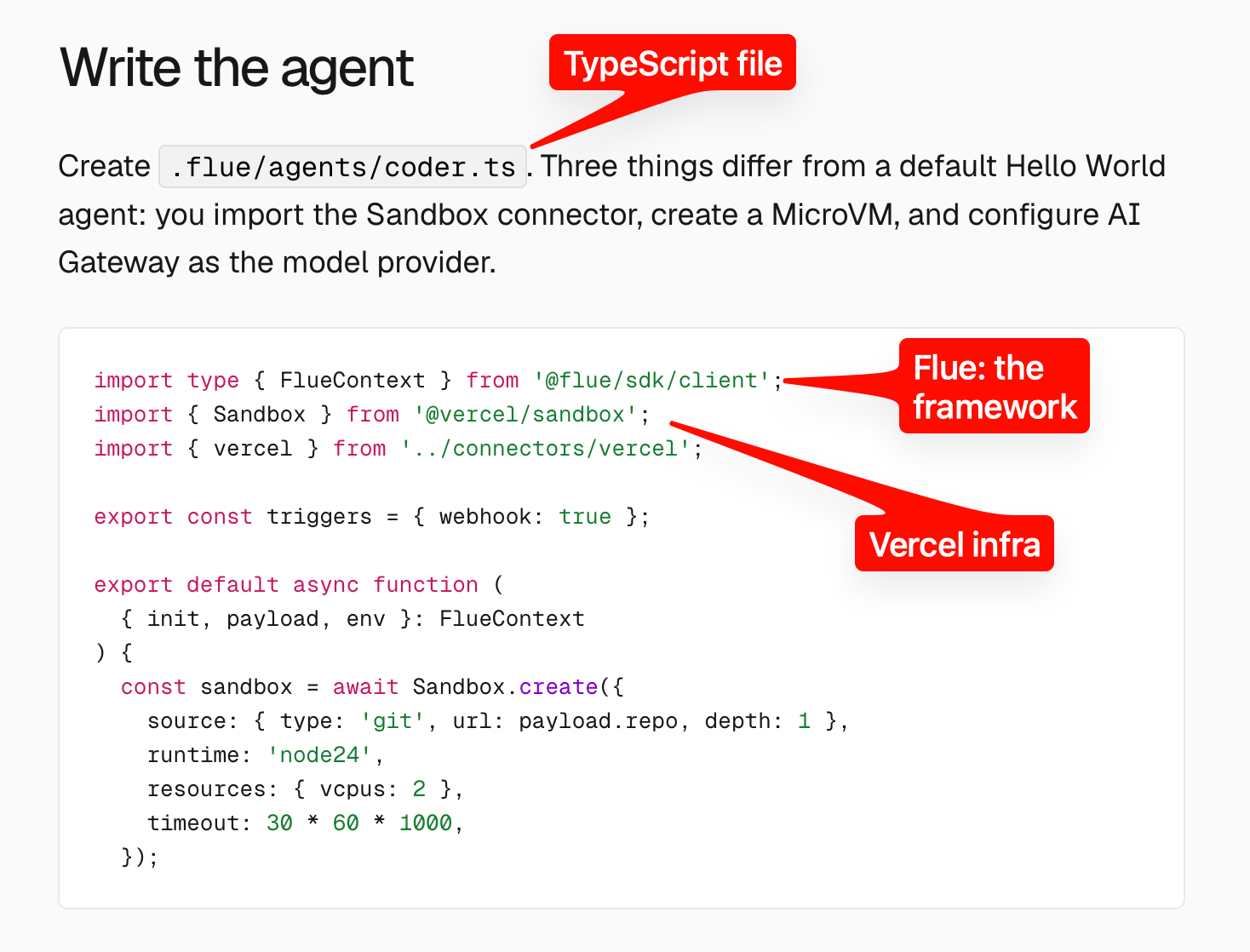
Agent frameworks for developers are still at an early stage, with the likes of Vercel’s eve and Fred Schott’s Flue — both launched this year — setting the early template.
Schott is the creator of the web framework Astro, which led to his company being acquired by Cloudflare in January. He’s just released version 2 of Flue, its first stable release, which has as its foundation React-style “Agent Hooks.”
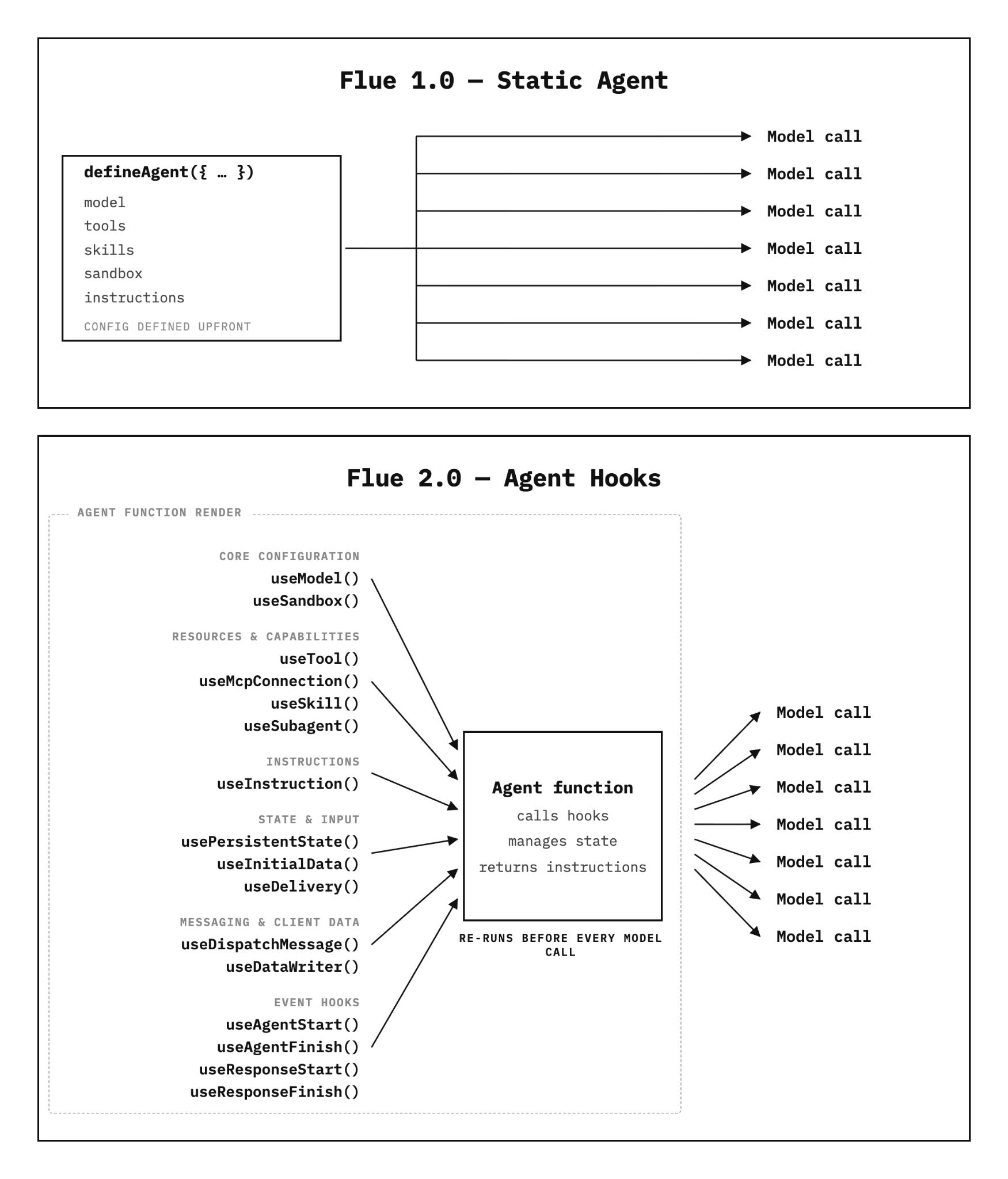
In Flue, an agent is represented by a JavaScript function. This function “re-renders on every turn,” meaning before every model call.
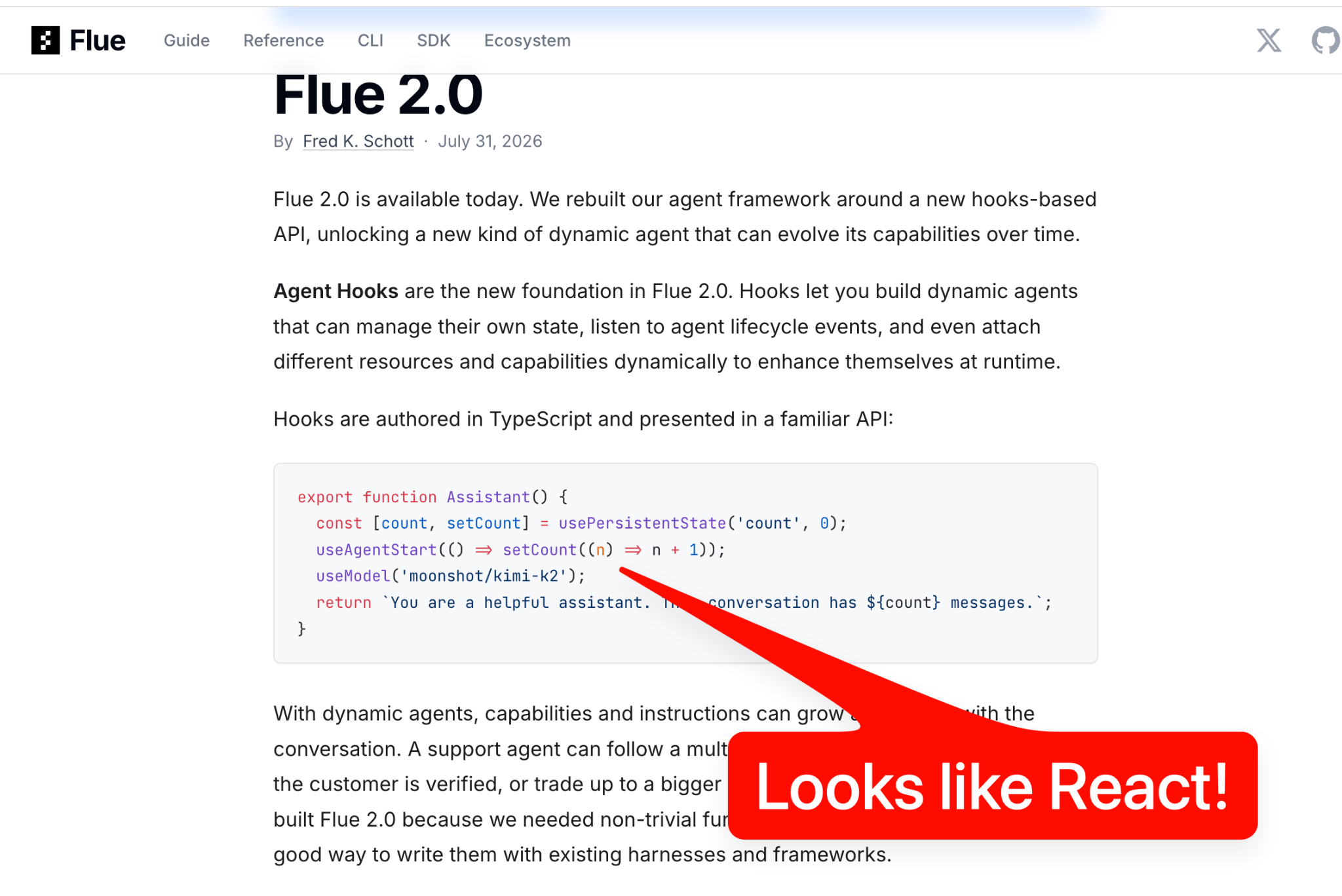
The addition of hooks came after Schott realized that React’s composability would be a great fit for agent development.
“I originally tweeted that we were building the Astro for agents or the Next.js for agents,” he told us. “But then I realized: maybe no one has even built the React for agents.”
“We’re still trying to figure out who the reactive agents are and the jury is still out… We’re sort of in the jQuery era of agents, not the react era.”
Hooks are authored in TypeScript. According to the Flue 2 launch post, they “let you build dynamic agents that can manage their own state, listen to agent lifecycle events, and even attach different resources and capabilities dynamically to enhance themselves at runtime.”
There are 16 built-in hooks in Flue 2, including useSkill(), useTool(), useSubagent(). You can also add custom hooks.
How Flue evolved via React-style hooks; diagram by Richard MacManus
What hooks open up for developers is that they make an agent much more dynamic, by allowing its configuration to change as a conversation or workflow progresses. Schott said this is needed to build “real support bots, real triage bots,” because they can’t be fully configured in advance. The agent can’t just be static — it has to adapt in real-time to what the user wants or the situation demands.
Agent hooks bring those capabilities to Flue. For example, a support agent might bring in an account management tool after first verifying a user.
File based magic is an antipattern
Schott’s thinking about how to build an agent framework has evolved rapidly since he publicly launched Flue 1 in early May. Initially, he wanted to take existing web framework concepts and apply them to his new agent framework. He uses file-based routing as an example.
“So we kind of naively ported that over to Flue, thinking — great, well, I’ll put your five agents in these five files, and that’ll be the five routes that they expose. But for a lot of people building with Flue, especially the bigger customers, their whole company is one agent. They don’t care about routing. There’s one agent.”
So after the first Flue users showed these early patterns, composability became front of mind for Schott. That led him back to React.
“As you can see from the Flue 2 API, we’re taking it more from React [...] than we are from Astro or Next.js — where it’s less about routing and these website concepts and more about, at its base level, how do you compose an agent on many different things?”
Flue’s central proposition: agents need a harness
A key concept in Flue is that an agent must have a harness — meaning that it’s in an environment where it has access to the context and capabilities needed to accomplish various tasks.
“Instead of you and your code driving the LLM and telling it what to do with scripts, you’re putting the agent into this harness, and it is able to drive itself and work through problems,” explained Schott.
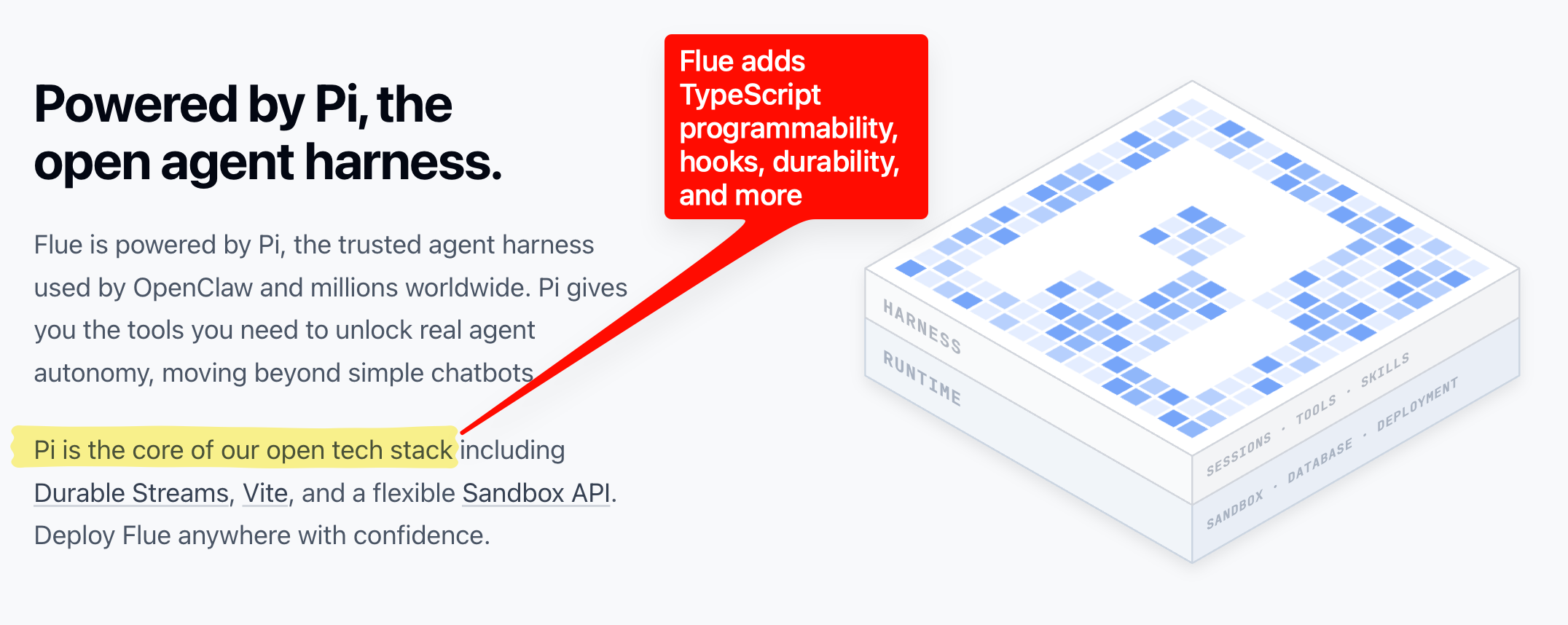
Flue is built on top of Pi, an open source minimal harness. Essentially, Flue is an opinionated take on Pi — adding features that Schott thinks are helpful to developers building agents. For example: hosted agents in Flue 2 are now built with Vite, an open source build tool.
Indeed, Schott likens Pi’s role to the foundational role that Vite now plays beneath Astro.
“I think Pi can serve that role, where it’s the right abstraction — it doesn’t do too much, but it gives the right APIs that then we can go and say, well, let’s have an opinionated take on this that does more.”
Building on Pi meant committing to having a built-in agent harness.
“Our early bet was that the harness is actually not a feature, but it’s fundamental to what you think an agent is,” Schott said. “There is no agent without a harness.”
Building Flue agents with coding agents
The Flue project began earlier this year within the Astro repository, as an issue-triage system. At first, it was an LLM-driven script or workflow reviewing issues. But then, explained Schott, it gained the ability to take actions in the repo.
“It started to transition from just automation in a repo to wanting to take the Claude Code experience, make it headless, make it hostable and run it in the cloud.”
So that’s when the idea of a harness as anchor emerged. Indeed, in his v1 launch post in early May, Schott described Flue as “like Claude Code, but 100% headless and programmable.”
I myself tested out Flue using Claude Code, which guided me through setting up my first Flue agent. And Schott confirmed this is how many developers use Flue.
“We very much are building for them,” he said, regarding AI coding agents. “Our whole onboarding flow is that, you know, pass this prompt to your agent, it’s gonna guide you through it. All of our docs have markdown support.”
Where Flue fits in the agent development stack
The closest comparison to Flue is Vercel’s eve, which also treats the harness as foundational. Vercel and Cloudflare have been known to beef in public, but Schott is generous in his opinion of eve.
“Eve, I think, is the most directly competitive,” Schott said. “It came around at the same time, so it had that same take that a harness is built-in.”
Schott also referenced what he called the “OG agent frameworks,” which came before Flue and so weren’t created with a harness as the central concept. He listed Vercel’s AI SDK, Cloudflare’s Agents SDK, and Mastra (developed by the same team that built Gatsby, a web framework predating Astro).
While these “OG agent frameworks” are all adding harnesses now, Schott considers that an added feature — whereas Flue and eve both have built-in harnesses.
I asked where Flue sits compared to emerging “meta-harnesses,” like Databricks’ Omnigent and perhaps even the self-improving Exo harness.
Note: we’re also publishing our interview with Exo coauthor Alex Krentsel this weekend; it’s worth a watch and has a bonus discussion on OpenClaw architecture!
Schott rightly noted that there’s confusion about what the term meta-harness even means at this early stage. Regardless, he thinks having one API for working across all harnesses would muddle the story for Flue. His framework specifically defines how skills work in Flue, how subagents work, and so on. As he put it, “the framework [Flue] and the harness are very intertwined.”
He personally finds the meta-harness discussion fascinating, and has played with Exo, but says it’s “a different interest scenario that isn’t really related to hosted agents.”
The Cloudflare connection
Throughout the interview, Schott referenced being able to take advantage of his employer Cloudflare’s tooling and infrastructure. But he was also very clear that Flue is an “open source framework for every host,” as he put it, and he wants it to stay that way.
“The best tools are the ones that float above the host,” he said. “That opens the door for the most developer adoption and the most innovation.”
Host portability is one of Flue’s defining principles — and perhaps that’s where the fundamental difference to Vercel’s eve is. While eve can also be self-hosted, it is optimized to take advantage of Vercel’s many features. Of course that’s a known playbook of Vercel, which does the same thing with Next.js.
I also mentioned LangChain’s new Managed Deep Agents offering as an example of hosted agent platforms coming onto the market. However, Schott said a managed agents product is not currently on Flue’s roadmap.
“It’s so early for us, we’re just focused on building the best harness,” he said.
Links to find Flue and Fred online; Richard is at @ricmac. This is a new written interview series we are trying out for subscribers — let us know your feedback!
“Transformers are starting to show their age. Many of the recent advances in LLMs, such as the development of so-called reasoning models and their ability to handle large amounts of input at once, are not neat extensions of that core technology but workarounds that patch over some of its fundamental flaws. A growing number of scientists and engineers are now asking what’s coming next.”
“Astronomers claim to have discovered a new kind of cosmic object, a black hole ‘star,’ which is the size of the entire solar system and glows with a brilliant red light. …Measurements of the exotic body found that while it resembles an immense star, it releases 100bn times more energy than any known star can produce. The energy output is far closer to that observed from black holes than stars.”
“Far from a random but linear process of wear and tear, [cell biologist Junyue Cao] argues, aging is a stepwise, programmed, orderly affair. …Using technology that offers a systemwide view of the aging process in mice, Cao has outlined discrete stages of aging, akin to those of embryonic development, that are defined by changes in molecular signals and specific cell populations. In humans, the process likely begins before age 30.”
“CEO Jensen Huang is running into a problem: Many of his customers can’t afford to buy his company’s coveted AI-powering chips. That explains why Huang teamed up with an array of Wall Street firms on a $500 billion plan that will theoretically standardize chip financing, creating asset-backed pools of capital for AI companies—while leaving Nvidia partly on the hook if things go wrong.”
“‘[A brain-computer interface is] incredible for patients that are paralyzed. But imagine you put this on a person for other reasons. There is great responsibility,’ [said Rafael Yuste]. ‘Look what we have in our hands. We just built you a machine that can decode your language. And in 10 years, we’re going to give you a machine that can interfere with your thoughts the way we do it in mice today.'”
“Aurora Innovation and Kodiak AI, two companies developing self-driving trucks, have received permits from the California Department of Motor Vehicles to test their autonomous vehicle technology on public roads. And Kodiak has already started. Kodiak said it is starting with a handful of test trucks in California, primarily around its Mountain View office.”
“For all the fears and hopes, nobody knows where this is going. AI is moving too fast, and the mathematics it is producing is still too fresh to judge what its impact may be. Several researchers worried that the field could be reshaped for the worse by claims about what AI could become before anyone has had time to understand what it actually means.”
“For decades, the industry has relied on animal testing. But in a laboratory south of San Francisco, a startup called Vivodyne is scaling up a different approach. Inside wardrobe-size mini labs, robots grow human tissue and run thousands of AI-designed experiments that could better predict how well a new drug will work—and whether it will be safe.”
“[Pairwise] is also working on peaches without pits, row crops resistant to a variety of diseases, fruit and nut trees that produce their first harvest within a year or two rather than three to eight, and a slew of other novel products, often in partnership with some of the world’s largest agribusinesses.”
“What Ms. Peterson experienced is what the driverless car industry calls an ‘edge case,’ which are the unscripted situations that no one trained the robo-taxis to handle. The problem is that edge cases appear to be piling up as Waymo, the leading autonomous car service, rapidly expands. Owned by Google’s parent Alphabet, Waymo has more than quintupled the number of autonomous cars it has on the road to nearly 4,000 today, up from about 700 early last year.”
Multi-tenancy has moved in one direction for 60 years: the tenant keeps getting smaller. Mainframe time-sharing carved a single machine into slices so an organization’s departments could share it, and the tenant was the org. Virtualization gave each team its own fleet of virtual machines, and the tenant became the team. Containers and Kubernetes namespaces shrank it again, until a platform team could hand every developer an isolated environment on a shared cluster.
That last step, an environment per developer, became the target state of platform engineering in the 2020s. A namespace per developer, capacity planned by seat, golden paths sized to headcount. Underneath all of it sits one assumption: a person produces one stream of work at a time, so isolating people isolates work.
Coding agents broke that assumption. A developer running five agent sessions has five changes in flight at once, each needing its own working version of the system. Anthropic’s engineers, building a C compiler with a fleet of parallel agents, ran nearly 2,000 Claude Code sessions across two weeks. Cursor’s documentation tells developers to run as many agents as you want in parallel. None of those concurrent workstreams is a person.
“The tenant has shrunk one more time. It is no longer the developer. It is the change.”
The tenant has shrunk one more time. It is no longer the developer (or even the agent). It is the change.
Tenancy demand scales with changes in flight, not headcount
Capacity planning by seat worked because changes arrived at human pace, roughly one per developer at a time. That denominator is gone. A Microsoft study of command-line coding agent adoption found that developers merged roughly 24% more pull requests over four months, and merged pull requests understate the pressure. Every change that reaches merge is preceded by iterations and abandoned attempts, and each of those also needed somewhere to run.
Run the seat math against the change math. A 50-developer organization where each engineer supervises a few agent sessions has hundreds of changes in some stage of validation on a busy day. Each one wants data it can migrate and write to without asking permission, its own view of shared message topics, and a running version of the services it touched. That is the demand of a 300-person (or more) engineering org on a 50-tenant platform.
Every layer built on the person-tenant assumption misprices this. A per-developer namespace hands one tenant slot to what is now five concurrent workstreams. Shared staging serializes all of them into a single queue. Seat-based capacity plans budget for the number of employees while the bill tracks the number of changes in flight.
The new tenant is the change, not the agent
The tempting candidate for the new tenant is the agent, and it is the wrong one. Agents are interchangeable workers. Two agents can collaborate on one change, one agent can rotate through five changes, and a crashed agent gets replaced mid-task without anything downstream noticing. Give each agent its own environment, and you have repeated the old mistake at a new scale: isolating workers when the thing that must not leak is work.
“Give each agent its own environment, and you have repeated the old mistake at a new scale: isolating workers when the thing that must not leak is work.”
The durable unit is the change. It comes into existence when work on it starts. It accumulates state that no other tenant should see: a schema migration, test writes, new versions of one or two services, the messages it produced during validation. It needs to observe a version of the system that includes its own edits and nobody else’s. And it is torn down when it merges or is abandoned, taking all of that state with it.
Naming the change as the tenant turns a vague scaling problem into a design target, because change-level tenancy has three requirements that person-level tenancy never had to meet:
Creating a tenant must be near free.
Isolation must cover only what changed.
The tenant’s lifecycle must be bound to the change itself, not to a ticket or a timer.
Platform teams already run this playbook in production
The discipline these requirements call for is not new. Anyone operating a multi-tenant production service already knows the rules: tenants share the substrate, each tenant privately owns only what makes it distinct, creating a tenant is self-service and cheap, and a tenant’s resources are reclaimed the moment it leaves. Nobody stands up a private copy of the product per customer, and nobody files a ticket to onboard one.
Those same organizations run pre-production on the opposite rules. Environments are provisioned by ticket or by seat, capacity is planned per person, and isolation is achieved by duplicating the stack when it is achieved at all. The multi-tenancy playbook that runs the product has never been applied to the platform that builds the product.
Change-level tenancy is that playbook, applied. Treat every change as a tenant of the development platform, and the three requirements stop being novel. They are the standard properties of any competently run multi-tenant system.
The tenant owns what changed and shares everything else
A SaaS tenant owns its data and configuration, never a copy of the application. A change tenant is sized the same way. It owns the one or two services it modified and an isolated database branch it can migrate and write against, and nothing else. Everything the change did not touch resolves against one shared stable environment, continuously deployed from main, so every tenant validates against real, current dependencies without owning a copy of them.
A footprint that small makes tenant creation nearly free, and creation cost is what decides whether the model scales to agent demand. Isolated data no longer requires copying a database: Neon and Xata create copy-on-write branches in seconds regardless of dataset size, consuming storage only for the data that diverges. The runtime side costs one deployment, because starting the modified services is all that is left to do. A tenant that costs one deployment can be created hundreds of times a day.
Tenants onboard and offboard themselves
Multi-tenant platforms scale because nobody provisions tenants by hand. Signup creates the tenant, cancellation removes it, and no operator sits in the loop. Change tenants need the same contract. The tenant comes into existence when work on the change starts and disappears when the change merges or is abandoned, with no ticket at the front and no cleanup script at the back.
Offboarding is the half that platform teams underestimate. At person scale, an orphaned environment was a minor waste found in a quarterly cleanup. At change scale, orphans accumulate as fast as agents abandon experiments, and the leak outgrows the cleanup.
Automatic offboarding also keeps the accounting accurate. When tenants are created and destroyed by the change’s own lifecycle events, the number of live tenants equals the number of changes in flight, and platform capacity becomes a quantity you can measure and plan against instead of a pile of environments nobody is sure anyone still uses.
Re-measure the platform in changes, not seats
The practical shift for platform teams starts with measurement. Count changes in flight at peak, not seats: open pull requests with activity in the last day is a fine proxy, and for most teams the number is already several times headcount. Then price the marginal tenant: What does one more concurrent change cost in dollars and in minutes of setup? If the answer is a full environment and tens of minutes, the platform is still doing person-level tenancy.
Those two numbers expose where the old assumptions live. Namespace quotas sized per developer, staging booked by team calendar, database seeds refreshed nightly for everybody at once: each is a seat-denominated policy waiting to fail under change-denominated load. The fix in every case is the same three requirements: near-free creation, isolation sized to the change, lifecycle bound to the change, applied to whichever part of the platform still assumes the tenant is a person.
Change-level tenancy is the prerequisite for an agent-native SDLC
Every previous definition of the tenant named a person or a group of people, and that held because only people produced changes. A platform could equate one seat with one workstream, plan capacity from the hiring plan, and keep a human in the provisioning loop. Coding agents break all three of those properties at once: one person now operates several concurrent workstreams, those workstreams are created and abandoned at machine pace, and no human is positioned to provision or clean up each one.
“The change is the only unit of isolation that stays stable when the workers become software.”
That is why the software development lifecycle (SDLC) needs its tenant redefined around the change rather than around whoever, or whatever, wrote the code: the change is the only unit of isolation that stays stable when the workers become software.
Organizations that keep person-sized tenancy will watch agent-generated changes queue behind infrastructure built for a fraction of the load. The ones that re-platform around the change will convert agent throughput into merged work. If you’re exploring the second path, that is exactly what we built Signadot to support.
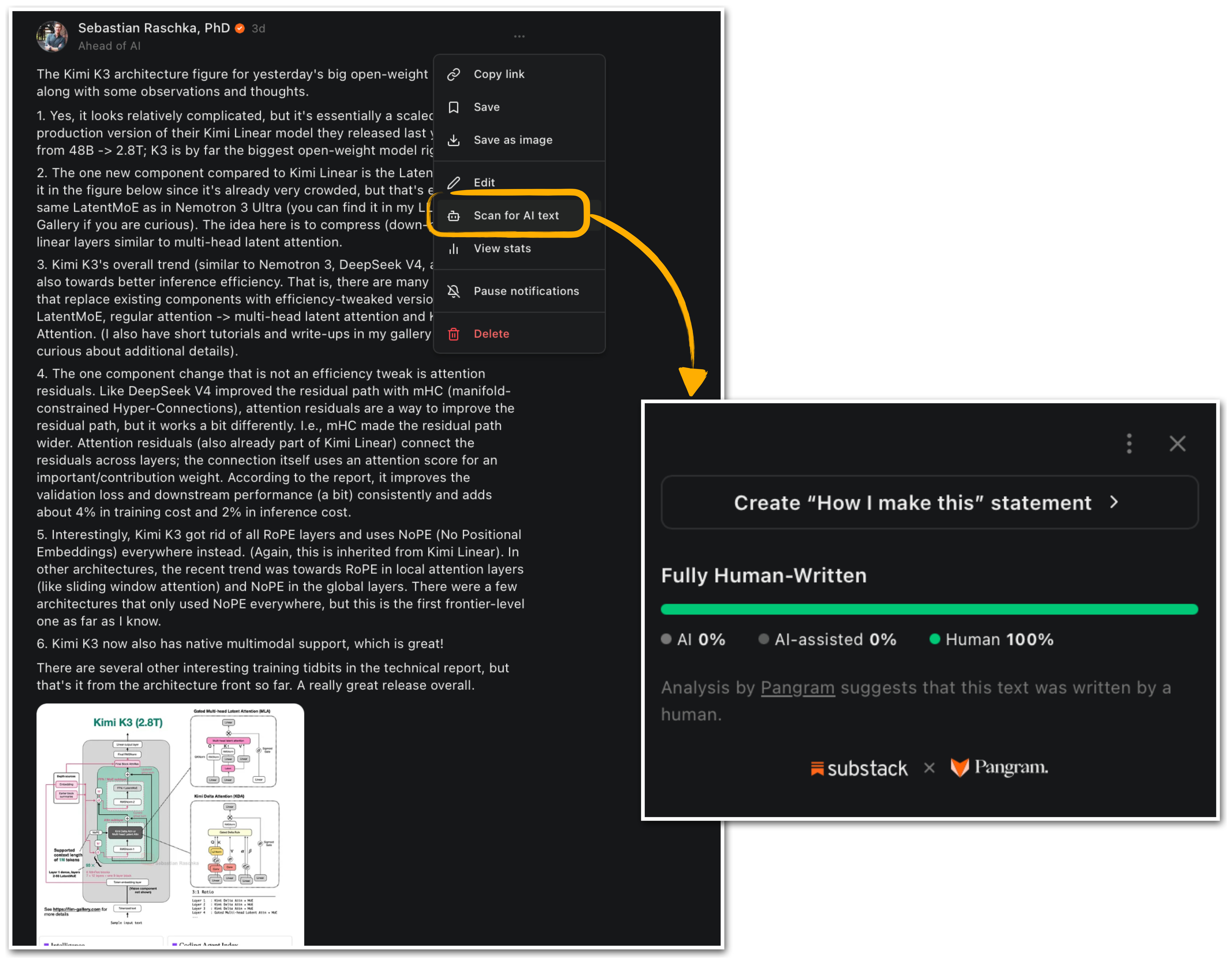
Substack recently launched its AI detector feature in the UI, which is super interesting.
Separately, lots of people asked me about interesting local do-it-yourself LLM projects as demos to show what small language models (SLMs) are capable of.
Putting one and one together, I thought it would be interesting to show how an AI detector can be implemented. I will also use it as a verifier to train a small language model to produce text that avoids detection. This is a small educational project for studying the limitations of AI detectors and exploring a verifier-based LLM application beyond regular reasoning models trained on math and code.
Figure 1: Substack now features a built-in AI detector.
So, as mentioned above, the intended goal of this tutorial is to explain how AI detectors work by building (a simple) one.
In practice, such a detector can be used to filter out spammy content, but also to potentially improve your personal writing without turning it into AI-generated text. For example, if you wrote a lengthy article and want to improve spelling and grammar, it is tempting (and actually useful) to use a grammar checker to polish it and improve readability. There are different services for that, including general-purpose LLMs like ChatGPT. However, this also runs the risk that these tools turn your writing, even though it’s still your own writing, into something that is then overpolished and now sounds like AI and gets flagged as spammy content.
For example, with an AI checker, one could say, “Fix my grammar while ensuring that my text still scores 0% AI-generated.”
Anyway, while we are building a fully functional checker here, the goal is to explain 1) how AI checkers (can) work and 2) use this as a case study for a more general topic on how to build a scorer or verifier that can be used with LLMs.
Disclaimer: AI checkers are essentially a cat-and-mouse game. AI checkers may learn to detect a certain pattern that is indicative of AI-generated content. Then, the next LLM may incidentally or deliberately not exhibit that pattern and avoid detection. The AI checker then has to be updated to detect said LLM, and so forth. Plus, it’s also likely to encounter false positives (human written text flagged as AI-generated), but more on that later.
Project goals
There are several goals of this project. The overarching goal is, of course, to illustrate how AI detectors work and show an applied end-to-end LLM project including evaluation, training, and local deployment for real-world use.
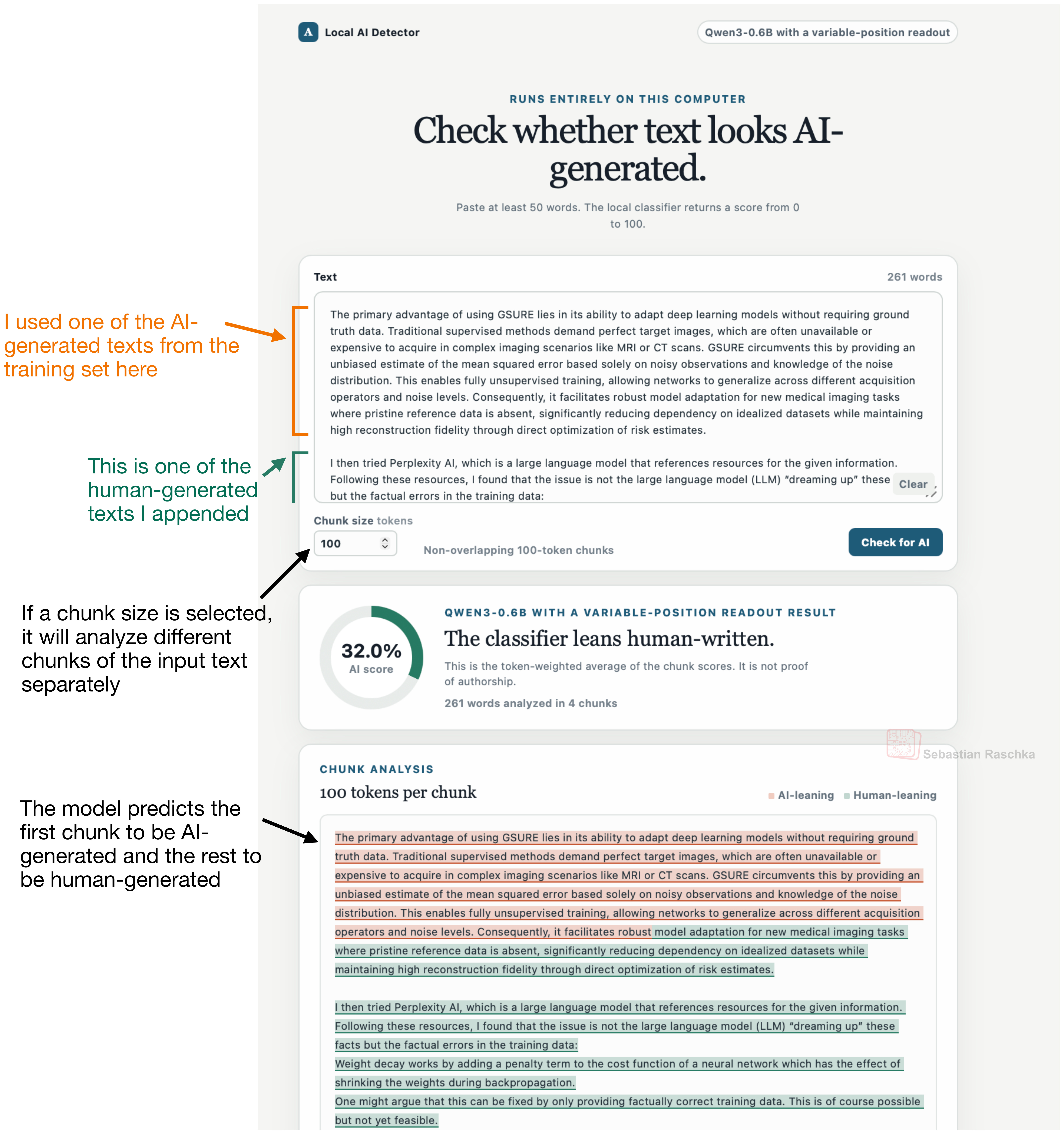
The outcome of this is an AI-detector API that can be used by humans and agents, and a user-friendly UI.
Figure 2: Preview of the local browser interface developed later in this project. It returns a whole-text AI score and can also highlight the scores for individual text chunks.
Method overview
Here, we are going to develop a method similar to Pangram models, which, as far as I know, are behind Substack AI detection feature.
In essence, there are different ways to detect AI-written text, from supervised classifiers and perturbation-based probability tests to perplexity measures and watermarking.
In this tutorial, we will build a model that returns a 0-100 score. It’s essentially a classifier with an estimated probability score. The probability score will denote how likely a text is AI-generated according to the classifier. (Or, to be precise the score is the classifier’s estimated probability for the AI-generated class based on its training distribution. However, we shouldn’t interpreted it as a general probability that the text was written by AI.)
For this, we are going to fine-tune a DistilBERT classifier (similar to what I described in one of my early Substack articles, Finetuning Large Language Models), but more details on that later when we get to that stage.
When Twitch announced that streamers could opt out, thousands of users questioned why their content was being used to train AI models in the first place.
The United States Patent and Trademark Office (USPTO or Office) is seeking information to consider regarding the selection of locations for one or more community outreach offices (COOs) in the agency's Southwest Region, which comprises Arizona, Texas, New Mexico, Oklahoma, Kansas, and Missouri.
The Food and Drug Administration (FDA, the Agency, or we) is issuing a final order reclassifying in situ hybridization (ISH) test systems indicated for use with a corresponding approved oncology therapeutic product (product codes NYQ, MVD, OWE, and PNK), all postamendments class III (premarket approval) devices, into class II (special controls), subject to premarket notification. FDA is also establishing a new device classification regulation, along with the special controls that are necessary to provide a reasonable assurance of safety and effectiveness of this device type.

 Login
Login