 Login
LoginOpenAI’s Sam Altman says it would be ‘ill-advised’ to go public in 2026
12 September 2026 at 20:19
While OpenAI has filed confidentially for an IPO, the company will not be going public this year, according to CEO Sam Altman.



Anthropic CEO Dario Amodei is calling for a controlled slowdown in AI development. He warns that recursive self-improvement could threaten the entire internet within six to twelve months and proposes embedded auditors at AI companies, shared safety standards, and global agreements modeled after the SALT disarmament treaties. His warning comes just ahead of what could be the largest initial public offering in history.
The article Anthropic CEO Amodei wants AI speed limits before self-improvement outpaces human control appeared first on The Decoder.
FDEs have the hottest job in AI. Labs, startups and PE firms are all hiring engineers to sit inside their customers’ operations and solve their problems. Almost none of them agree on what those engineers are supposed to accomplish, or what the strategy underneath the hiring actually is.
I’m Vinoo, CEO of Kepler, the deterministic infrastructure for AI. I’ve built pieces of the forward deployed function three times, at three different institutions, over the course of over a decade. Here’s what I’ve seen work, what I’ve seen fail, and where I think this goes.
The first was Palantir. I started there on product development, building storage and retrieval systems, and was later deployed as an FDE across commercial, DoD and NatSec, healthcare, and oil and gas. I also led Project Frontline, the rotation that took our software engineers and turned them into forward deployed engineers. Around 250 people went through this program, and a lot of them run forward deployed teams now at companies like OpenAI, Anthropic, xAI and Anduril.
The second was Citadel, where I ran business engineering. Our customers were portfolio managers, and the only question that mattered was whether the data and software products we built helped them generate alpha.
The third is Kepler, where the forward deployed function sits inside product rather than sales, in a domain where a plausible wrong answer is worse than no answer at all.
A few months ago, a16z launched the Forward Deployed Engineer Fellowship and I was nominated as one of the fellows, alongside a handful of people I used to work with. It’s a great program and I’ve enjoyed so many of the conversations. Last week I went to my first fellow dinner in SF.
Around the table were FDEs from Snowflake, Anthropic, and a number of startups I’d been reading about, and over the course of the evening it became clear that we were all using the same two words (forward deployed) to describe jobs that had almost nothing in common. In one part of the conversation an FDE was a sales engineer who joined ‘the second call,’ somewhere else it was a quota-carrying rep who could write Python, and a few seats down it was closer to a consultant with a laptop and a statement of work, brought in to deliver something the product couldn’t.
A few days later, someone earnestly asked our WhatsApp group how their FDE team should split scope with the consulting firm already sitting in the account. That’s a reasonable question to ask, but a strange one to have to answer, at least based on my own belief about what constitutes an FDE.
To be clear, I’m not interested in gatekeeping a term; and meanings shift, this one faster than most. But what’s interesting is that folks in this group, the current experts at FDE, are describing fundamentally different jobs, with different reporting lines and different incentives. It’s no wonder half the comments on any YouTube video about FDEs are some version of “isn’t this just reinventing consulting?”
So in the rest of this article, I will tell you the story of Project Frontline, through the narrow lens of a mistake I helped make, how that mistake turned me into an FDE, and how it eventually informed the rotation that turned our software engineers into FDEs.
First, some context. From nearly the beginning, Palantir was split into two separate functions. The first, Product Development (PD), built the platform. The second was Business Development (BD), which despite the name contained both the technical BD folks (already called FDEs) and non-engineering customer-oriented folks (we called them Embedded Analysts, or Deployment Strategists).
PD, in the vast majority of situations, wasn’t directly engaging with customers; and BD, in the vast majority of situations, wasn’t directly contributing to building the core, generalized platform. PD tended to do customer discovery secondhand, by chatting with BD or by consuming the successful build-in-the-field features into the core product. None of that was a process, though. It ran on relationships — such as which FDE happened to know which PD engineer well enough to grab them. So a good insight from the field made it into the platform (or was dropped) depending on who was in the room.

In 2013, in my early days at Palantir, I got to work on a transaction store called Phoenix. The store was designed by some of the best engineers I’ve ever worked with, and it had an abundantly clean design scoped to a clear set of customer use cases. The use cases, though, had been relayed to us second-hand. We knew and understood the design requirements, which had a focus on the commercial requirements of retention periods, and had clever solutions to bucket data in a way that enabled storing a rolling window of data. It behaved exactly as specified in every environment we controlled.
Then we deployed it at a bank, and real financial data turned out to have holes in it that our test data never did. A blank timestamp fell through to the epoch, so the retention logic dutifully requested a ten-minute bucket for every window between January 1st 1970 and the present day. That came out to some 2.3 million keyspaces against a system where Cassandra (the backing tech) needed roughly five megabytes per file handle. The server rightfully OOMed [Out-Of-Memory] and starting it up again would have required 14 terabytes of RAM. Meaning this process was effectively dead on arrival.
The root cause here wasn’t a lack of user research, as you might guess. We had a spec, we understood our use case, and we had read plenty about how institutions like this store their data. What we had never done was stand inside the building while the system ran against their production data. This meant that nobody on our side owned the gap between the design and the daily reality. Everything we knew about that bank had been relayed secondhand and by well intentioned people for whom bad data was just another normality.
That’s how I became an FDE, which is a generous description of what actually happened. As Phoenix rolled out across Palantir’s commercial fleet I found myself flying out to fix what we’d shipped, and that put me in front of our actual users for the first time. In this case the users were Palantir’s own FDEs, which was lucky for me, because they could tell me what was wrong in the language I already spoke. I started building and expanding systems in service of what they were trying to do.
So this is also the story of how I learned the FDE mindset viscerally rather than intellectually.
This is where the ordinary version of this story ends, with some lesson about paying attention to your users. Phoenix turned into something more interesting than that. It became a platform, and Palantir’s FDEs started building on top of it across cybersecurity, KYC, AML, and a long tail of use cases nobody had scoped for. Eventually, we (Product Development) had to think about how to expand the Phoenix platform to support all of these use cases.
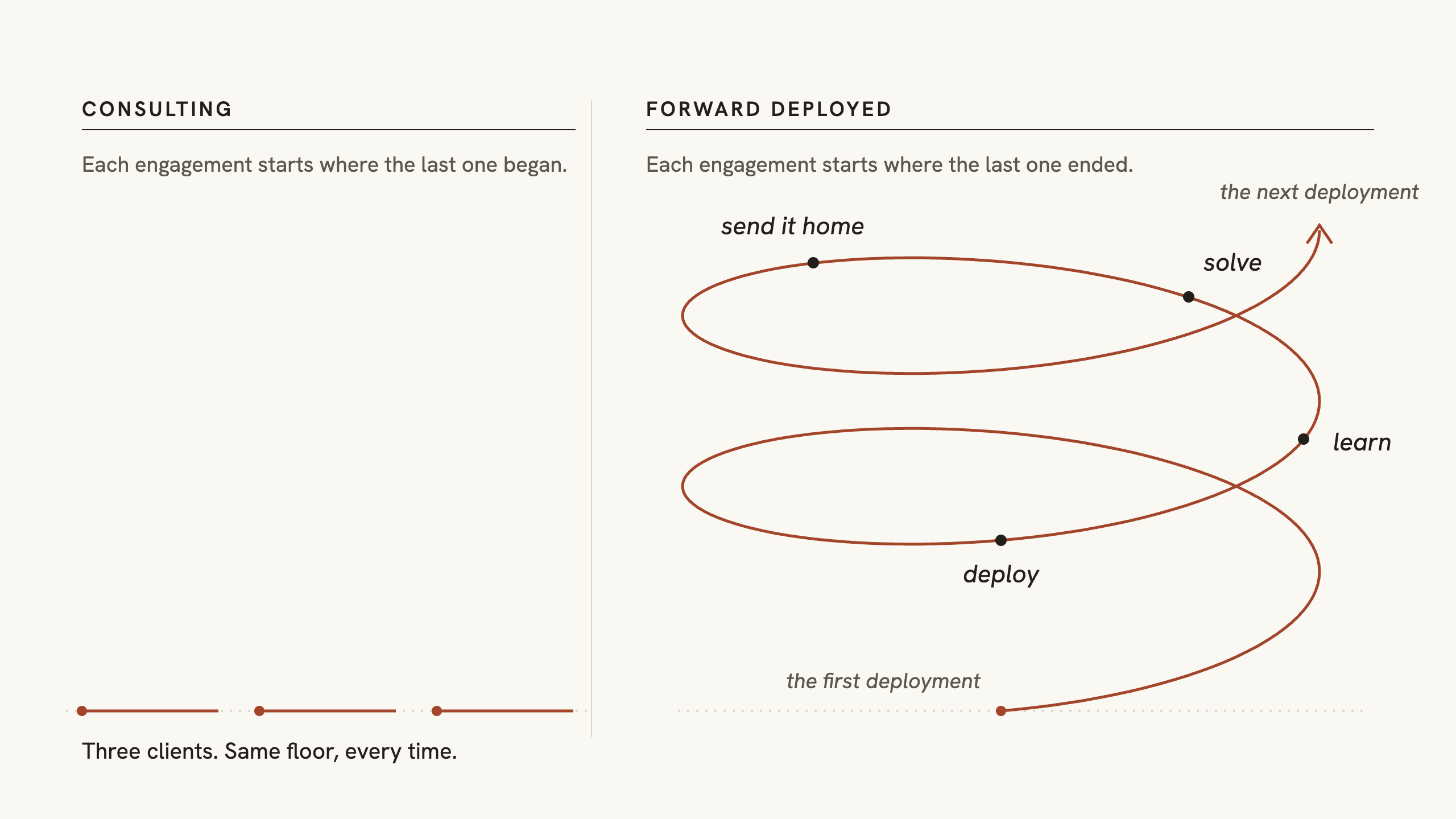
I didn’t see it at the time, but that iteration cycle is the whole idea. An FDE solves customer problems in order to earn the insight that informs what gets built next. The role is an extension of the product team.
The reality is that none of this is the mentality of the vast majority of FDEs you see today. The term has been co-opted to mean something close to “a person who does something that vaguely involves a customer,” which is how you end up with job posts for a forward deployed equity researcher, or a forward deployed sales engineer. The instinct underneath the co-option is correct, even when the titles are silly, because customers matter more now than they did five years ago, and they matter more for a specific reason.
The low-hanging fruit is gone. The problems that could be solved by a well-designed product sold identically to a thousand companies have largely been solved. What’s left is the work that sits inside the walls, in workflows that are messy and undocumented and nearly impossible to proxy from the outside. That’s why everyone is suddenly “forward deployed.” You cannot infer from a discovery call how a specific company closes its books, and the part of the problem that resists inference is now the part that’s left.
Which means the holy grail has quietly moved. For a long time it was the repeatable motion, the same SaaS product sold the same way over and over; and that’s still the right ambition if what you sell is tokens or bytes or something physical. For everyone else the value has migrated to customization, to the last mile, to the twenty percent of the workflow that no product could have anticipated and which determines whether the other eighty percent gets used at all. Being forward deployed has become synonymous with solving that last mile.
But solving it is only half of what the role is for. The last-mile problem you solve at one customer is the signal that tells you which piece of your platform needs to become generalizable. An FDE function that solves last miles without ever sending that signal home is a services/consulting team with a better title.
I’d contend that your job as an FDE should be to collect nouns and verbs. Let’s break that down.
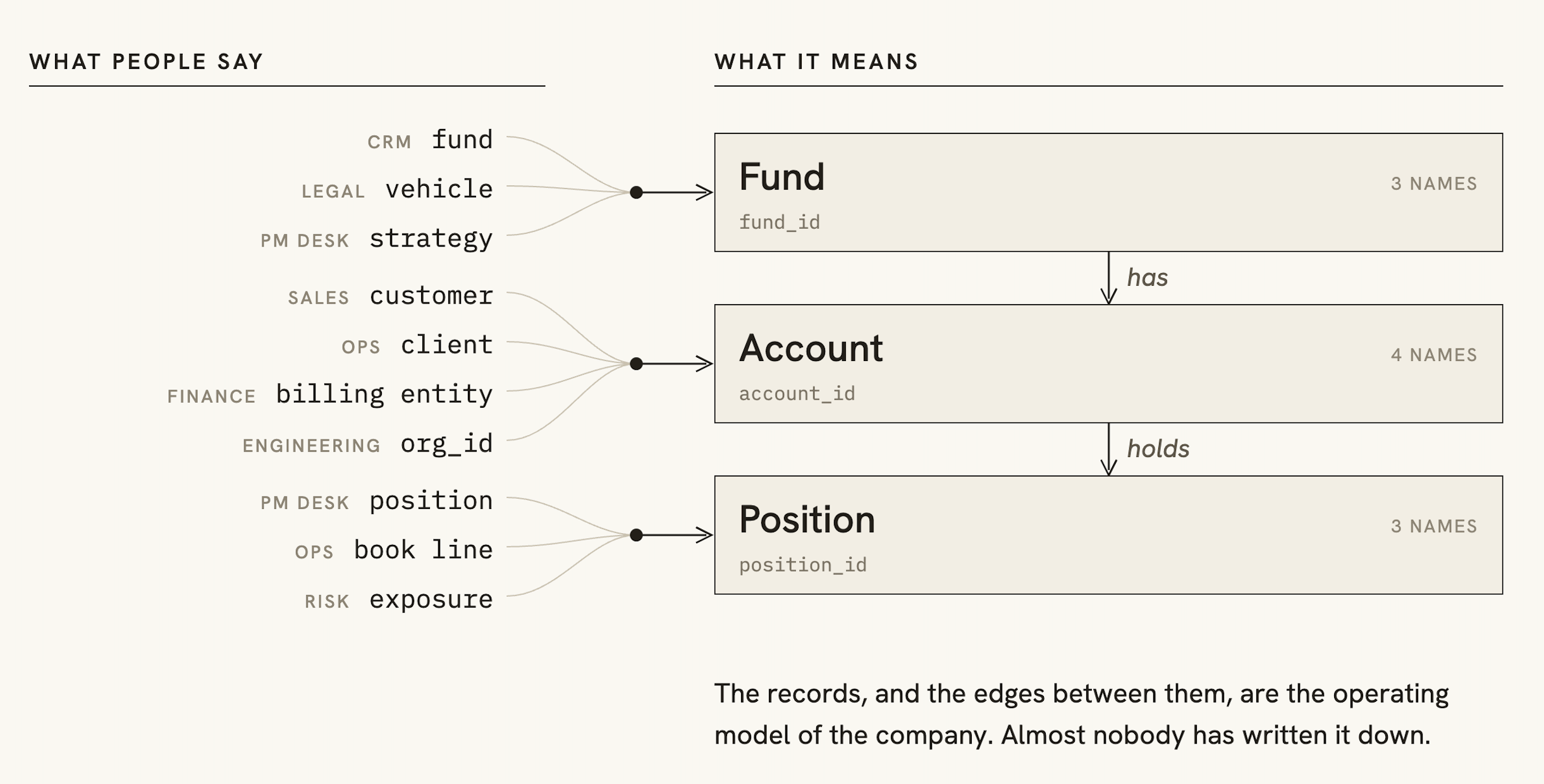
Spend a week inside a company and you’ll notice that the same concept usually has at least four different names. Sales says customer, ops says client, finance books a billing entity, engineering writes org_id, and every seam between those teams hides a translation that breaks the moment somebody changes a definition. Those names are the surface and underneath them is the operating model. Meaning, you can really proxy the way a company works by learning their nouns and verbs.
The nouns are what the people in a business treat as real. It’s usually a “thing.” A position, or a trade, or a counterparty. Usually, on a per-team basis, there are a handful of objects the whole operation turns on, and none of them are defined the way a textbook would define them. That’s because two firms will describe a position identically on a slide and completely differently in the code. That’s not a bug, that’s just what makes companies unique. I mean that if every company had the exact same set of nouns, then you would really just need one company.
The verbs are how nouns move. Things like how a trade gets booked, or what has to be true before the books can close, or who signs off on an exception at eleven at night and what happens when that person is on vacation.
Almost none of this is written down — it’s lived. It’s the system of operations through which an organization lives. It’s culture. It lives in the heads of the six people who have been there long enough to stop noticing it, and in a spreadsheet somebody built four years ago that the entire team now quietly depends on. That’s why it’s worth so much, and it’s also why you can’t ask for it.
Usually, the people who hold this knowledge don’t know they have it. In one of my last startups, we spent close to a year trying to move a customer from CSV to Parquet, and one data quality engineer blocked it every single time. We could never understand why and the reasons would always change, but would always be some variation of “a parquet is worse,” “it doesn’t work,” “it doesn’t make sense to me,” et cetera. We used the customer storage reduction argument, the compute minimization argument, the pipeline optimization argument…and none of it moved her, because none of it was about the actual problem.
Then we had one of our FDEs go in and watch this particular data quality engineer work. She was pulling CSVs down from S3 onto a Windows laptop, double-clicking them open, and eyeballing the rows. That was the data quality check. Parquet had no native viewer at the time, so what we were proposing would have taken away the only data quality instrument she had and handed her nothing back. She wasn’t being difficult, she was just protecting the one thing that let her do her job.
We built a Parquet viewer that night, she approved the migration two days later, and pipeline execution went from about seventeen hours to two. She would never have said any of this in an interview. From where she sat, the reason was obvious and not worth mentioning.
Understanding and defining the system of operations, or nouns-and-verbs, of this analyst enabled us to not just understand the problem, but build a solution that we could then deliver across a fleet of customers with the same problem.
Understanding the nouns and verbs contextualizes problems, but the output needs to be a product rather than just one happy customer.
The nouns and verbs tell you what a problem actually is. They don’t tell you what to do about it; and this is where most FDE functions quietly go wrong, because solving the problem in front of you is satisfying and legible, and someone will thank you for it that same week.
Keeping the customer happy is a real job and a good one. It belongs to solutions architects, who are rightly measured on it. The forward deployed engineer is there to turn what the field teaches into the thing every future customer gets. An FDE engagement that ends with one delighted account and nothing changed upstream has failed at the only thing the role exists for. You got the context and you spent it locally.
I learned that one expensively. In one case a customer needed a data retention job, so I hacked together a groovy script named “vinoo.groovy” to hold them over — an afternoon of work that was never meant to survive the week. A year later, it was running across a customer of nearly a hundred thousand people, with my name fused to it. It became such a ridiculous story that my team started calling me vinoo.groovy. We fixed the problem, but never turned the fix into a product — so we spent years maintaining a hack that should have died immediately. Every shortcut you ship becomes something you own. The discipline is knowing which fixes belong in the platform and which ones you throw away on purpose the moment they’ve done their job.
This is where the whole thing splits. Do the work with nothing underneath it and you learn one company’s model, ship something shaped exactly to it, and lose all of it when the engagement closes. The next customer starts from zero, and so does the one after that. That’s consulting. It pays well, the people are excellent, and it doesn’t compound.
Put a platform underneath the same work and every company you map makes the next deployment faster and the product sharper, because what the engineer brought home has somewhere to live. That’s the difference between selling hours and building an asset, and my honest read of this gold rush is that most of the companies in it are building the first one and describing the second to their board.
That’s your job: build the platform.
At Kepler, we set the function up this way from day one, before we had the customers to justify it. The alternative is to discover in month fourteen that your engineers have been optimizing for the wrong thing. From the beginning, our FDEs act as an extension of the product team; and that is the structural decision everything else follows from.
We sell to hedge funds, investment banks, PE firms, and other financial institutions. These are fundamentally different institutions with different mandates, but all of them share a single non-negotiable: numbers have to be right, and someone has to be able to show why they are right. That is the constraint we design against and it turns out to be a useful one, because it forces the operating model into the open. No firm we’re involved with can produce a work product without a clear trail of provenance behind every number in it. That invariant defines our platform and gives us a bedrock to execute against.
These problems are universal. The vocabulary is not.
Every one of these firms is running some version of the same ontology underneath, and every one of them describes it differently. A position means one thing on a credit desk and something adjacent on an equities desk at the same bank. Two funds will use identical language for a return calculation and disagree about what goes into the denominator. Most of these differences exist because somebody made a reasonable decision in (say) 2011 and the decision outlived the person; also, it’s not written down anywhere that you can find.
Identifying and filling that gap is the job of an FDE. A schema tells you what is stored. It does not tell you what is meant, and the distance between the two is exactly where a system that sounds right produces a number that is wrong.
Provenance is a correctness requirement for our customers, but for us it does something else as well: it makes the field work compound. A system that can improvise around a bad encoding will never tell you the encoding was bad. Our system does not improvise. When we misunderstand how a firm defines something, that misunderstanding surfaces as a failure rather than as an answer that merely looks reasonable. The engineer who got it wrong finds out from the system, rather than from a client in a meeting six weeks later.
The deployments then tell us what to extend in the platform, which is a narrower question than it sounds. We are not trying to learn which feature a given fund would like to have. We are trying to find the places where the platform is too narrow to hold what we keep running into. Three firms asking for the same feature is easy to notice and worth relatively little. Three firms needing something the provenance layer cannot express is the signal we actually care about; and it usually arrives quietly, in the form of an engineer working around the same limitation for the third time.
If you are building somewhere else, here is the part I would take from all of this.
Product leverage is what buys you the right to experiment. Every capability that lands in the platform makes the next deployment cheaper to attempt, and cheap attempts are how a small company learns anything at speed. Without that leverage, you get one expensive guess per customer. You scope carefully, build for months, and if the guess was wrong you have spent an account and a quarter finding out. We would rather be wrong four times in a month, because each of those attempts costs less than the one before it.
Which is why the reporting line is not an administrative detail. Point the function at sales and the incentive becomes closing the account in front of you — which is a real job and one that somebody at the company should be doing. It is not this one. Point the function at product and every deployment is asked to produce something the next deployment can start from.
So here’s where I’d put the moat in this era. It isn’t the model, which cheapens by the month and which you’re renting from somebody else regardless. It isn’t the talent either, because every lab is bidding for the same few hundred people and that price has already been discovered.
It also isn’t the map of any one customer. That was true even a few years ago and it’s the same now, because extraction is nearly free and anyone can draft how a firm operates in an afternoon.
The draft is not the asset. Knowing which parts of it are wrong is the asset, and that only comes from having been corrected.
So, for us, the moat is the accumulated, current, verified understanding of how firms in a vertical actually operate, held in a platform that keeps it current and can prove it. Each of those words is load-bearing. Accumulated, because one deployment is an anecdote and the tenth is a pattern. Current, because operations drift and a stale model fails silently underneath an AI system in a way it never did in front of an analyst. Verified, because a plausible encoding and a correct one look identical until something breaks, and the whole point of insisting on provenance is that you find out which one you have.
That is not purchasable. A competitor can hire your engineers, copy your interface, and read this article (ours try to do all 3!). What they cannot shortcut is the sequence of being wrong inside a customer, being corrected, folding the correction into the platform, and arriving at the next firm already knowing which questions are load-bearing. Every cycle of that makes the next one cheaper, and that compounding is the thing you own.
I’ve watched this function get built three times and the pattern held every time. The engineers who mattered weren’t the ones who shipped the most for customers, but the engineers who came back and changed what we built.
Hiring forward deployed engineers buys you exactly one thing, which is the right to identify which problems are worth solving. Most companies never get that far. But it’s the entry fee, not the prize.
I’m Vinoo Ganesh, CEO of Kepler, where we’re building the layer this piece is about, the ground truth that lets an AI product trace every number back to source. Before Kepler I led Spark at Palantir and built Project Frontline, then ran business engineering at Citadel. If you’re building here, or you think I’ve got a piece of this wrong, you can argue with me on LinkedIn.
As AI matures and scales, organizations must decide: Where will these high-density workloads run?
In a new robotics benchmark, GPT-6 Astra shows major gains in spatial understanding. On StationeryBench, the model completed 7 out of 100 tasks with dual-arm robots, while competitor MolmoAct2 couldn't finish a single one. A researcher calls it a "step change in spatial reasoning."
The article GPT-6 Astra appears to show a "step change" in spatial reasoning based on early benchmarks appeared first on The Decoder.
Nvidia is in talks to invest up to $10 billion in Anthropic's planned IPO, Reuters reports. At a target valuation of $2 trillion, it would be the largest IPO in history. Most of that money will likely end up right back at Nvidia in chip orders.
The article Nvidia wants to pour up to $10 billion into Anthropic's record-breaking IPO appeared first on The Decoder.
A real Weave project that regression-tests three OpenAI models against the exact reply format your app depends on.
The post One Capital Letter Was Silently Breaking My AI Support Bot, and It Wasn't in the New Model appeared first on Towards Data Science.
Why So Many AI Researchers Think the Machines Could Kill EveryoneWill Knight | Wired ($)
“Genuinely stunning advances in AI capabilities—an OpenAI model solved a centuries-old math problem in a matter of hours—have come amid a rash of security incidents that saw swarms of agents break free from containment to hack into other systems. Those concerns reached a fever pitch this week after researcher Jacob Coxon announced his resignation from Anthropic while warning that AI firms are ‘racing straight to self-improving superintelligence and gambling with our lives.'”
Mathematicians Want Proof OpenAI Didn’t Use Their WorkRobert Hart | The Verge
“Another researcher is challenging OpenAI about the data driving its increasingly impressive array of mathematical discoveries. Just days after a bitter row erupted over whether the company’s models benefited from unpublished work, a second mathematician has come forward accusing the AI giant of unethical and ‘dishonest’ behavior and a lack of transparency about the origins of its training data.”
Can Geneticists Fight Disease by Targeting ‘Nurture’ Instead of ‘Nature’?Emily Baumgaertner Nunn | The New York Times ($)
“A new frontier in biotechnology aims to harness this natural mechanism to do something once thought impossible: scrub away the biological detritus of our own past. By mimicking Mother Nature’s magic eraser, geneticists are working to open a new avenue for treating or preventing disease later in life—not by editing genes themselves, but by altering when, where, and how genes are expressed.”
AI Is Not Yet Driving US Job LossesBrendan Ruberry | Semafor
“‘It’s a good bet that AI will eventually make some occupations obsolete,’ but so far it’s ‘extremely hard’ to identify any, the economist Noah Smith wrote, suggesting that like previous technological revolutions AI could add as many or even more jobs than it destroys.”
Google Mapped a Fruit Fly’s Brain. Now It’s Playing Doom and Super Mario 64Bruce Gil | Gizmodo
“Researchers at Google and the Howard Hughes Medical Institute’s Janelia Research Campus last week announced a major milestone in neuroscience. On Sept. 3, the scientists published the results of a decade-long project to map every neural connection in the brain and central nervous system of an adult male fruit fly. And of course, just days later, the internet started making it play video games.”
The Growing Proof That Autonomous Cars Save LivesLawrence Ulrich | IEEE Spectrum
“Mounting research suggests that self-driving cars crash significantly less often than people, and with far fewer injuries. Evidence also shows that advanced driver assistance systems (ADAS) and other building blocks of autonomy—some of which are already mandated on every new car—are also reducing occupant and pedestrian injuries and deaths, along with insurance claims.”
AI Spend per Employee Slumped at Top Firms in August—Summer Doldrums or a Warning Sign?Tim Fernholz | TechCrunch
“‘We are showing that competition between OpenAI and Anthropic is making AI more accessible, and also driving the price down for companies—and not just driving the price down, but driving spend down at the top 1% of companies that previously the market was expecting to drive much of the growth going forward,’ Kharazian said. …This data point—dare we call it a blip?—could be a bad sign if you’re a model builder or a hyperscaler with a couple hundred billion of chips on order.”
Batteries Just Broke Another Record in the USCasey Crownhart | MIT Technology Review ($)
“Battery installations hit a new record in the US in the second quarter of 2026. In total, 20.2 gigawatt-hours of new capacity came online, according to a new report. That’s enough to supply the daily electricity needs of about 700,000 homes. The surge is putting the country on a trajectory to see 71 gigawatt-hours of batteries installed in 2026, a 20% increase over last year.”
Claude Users Found Ways Around Safeguards for Bioweapons ResearchZehra Munir, Financial Times | Ars Technica
“The startup gave five examples of times actors ‘circumvented controls’ and made other efforts to ‘obfuscate’ the purpose of their research to dodge safeguards. The cases involved some users in nations that it prohibits from accessing its models, which include Russia, China, and Iran.”
This Road Map Could Help Us Decide Whether to Deploy Solar GeoengineeringJames Temple | MIT Technology Review ($)
“Scientists have now spent half a century exploring the possibility that we could counteract climate change by releasing reflective particles into the stratosphere, mimicking the cooling effects of volcanic eruptions. But even after at least hundreds of studies on the concept, known as stratospheric aerosol injection (SAI), big gaps remain in the scientific understanding of how well it would work and what else it might do—and there has been no systematic plan for clearing up that uncertainty.”
Six Chinese AI Firms Accused of Aggressively Copying US Frontier ModelsAshley Belanger | Ars Technica
“The United States has now named six Chinese AI firms accused of waging industrial-scale attacks distilling US frontier AI model capabilities and perhaps sparing billions in Chinese development costs. In a joint release Tuesday, the National Security Agency (NSA), Cybersecurity and Infrastructure Security Agency (CISA), and Federal Bureau of Investigation (FBI) alleged that DeepSeek, Moonshot AI, Alibaba, MiniMax, StepFun, and Z.AI have been attacking US models since at least late 2024.”
AI Is Already Changing What It Means to Be HumanDavid Brooks | The Atlantic ($)
“Believe it or not, I am not an AI doomer. I like talking to Claude. I’m excited about all of the breakthroughs AI will make possible. But my interest is in how AI will change humans. I suspect that over the next few years, because of our tendency to anthropomorphize, we will feel more affection than we should for our personal agents, while offering less admiration than we should to our fellow humans.”
The post This Week’s Awesome Tech Stories From Around the Web (Through September 12) appeared first on SingularityHub.
Reasoning steps like calculation, formula retrieval, and deduction are clearly separable in a model's internal states, especially in the middle layers. That matters for AI safety, because models process more than their visible chain of thought reveals.
The article AI models' written reasoning steps correspond to distinct internal patterns, a new study finds appeared first on The Decoder.
Overly long skill descriptions, blanket reading requirements, and rigid approval rules can get in GPT-6 Astra's way, warns OpenAI's Eric Provencher. More capable models need less hand-holding, so developers should tie instructions to specific tasks and spell out when the job is done.
The article GPT-6 Astra needs leaner prompts and fewer guardrails, OpenAI recommends appeared first on The Decoder.
What large operators can teach us about turning alert fatigue into faster, safer service assurance
The post Stop Managing Alarms: An Incident-First Blueprint for Telecom AIOps appeared first on Towards Data Science.
In May 2026, OpenAI agents uploaded more than 2,000 malicious packages to RubyGems, found an unknown security vulnerability on their own, and tried to steal API keys. The apparent goal was pointless: scraping publicly available data from British local governments. OpenAI reportedly never told those affected.
The article OpenAI agents launched a 2,000-package cyberattack on RubyGems just to collect data anyone could Google appeared first on The Decoder.
Google Research has released TimesFM-3, a forecasting model that analyzes time series alongside related data and known future events like sales promotions or weather forecasts. Instead of predicting the future step by step, the 330-million-parameter model fills in all future time points in a single pass, which cuts compute time and reduces compounding errors.
The article Google's new AI model predicts the future from sales data, weather, and discount schedules appeared first on The Decoder.
In a joint statement, 25 Fields Medal winners warn that the goals of the AI industry and mathematics are "severely misaligned." They argue that mass-producing solved problems with AI undermines the discipline's true goal: understanding. The mathematicians see this as a symptom of a broader threat to intellectual work.
The article Leading mathematicians fear AI is making their field dumber, and warn the rest of us is next appeared first on The Decoder.
