❌

Reading view

Airworthiness Directives; CFM International, S.A. Engines

The FAA proposes to adopt a new airworthiness directive (AD) for certain CFM International, S.A. (CFM) Model CFM56-5B, CFM56-5C, and CFM56-7B engines with a certain high-pressure turbine (HPT) inner stationary seal installed. This proposed AD was prompted by multiple reports of honeycomb separation from the surface of HPT inner stationary seals. This proposed AD would require initial and repetitive borescope inspections (BSIs) of the rotating air HPT front seal for cracks and, depending on the results, replacement with a part eligible for installation. This proposed AD would also require removal and replacement of the affected HPT inner stationary seal. This proposed AD would also require inspection of the affected HPT inner stationary seal for honeycomb separation and, depending on the results of the inspection, removal and replacement of the rotating air HPT front seal, HPT rotor blades, and No. 3 ball bearing. The FAA is proposing this AD to address the unsafe condition on these products.
  •  

Why I still haven’t bought into true RSI

We’re in an era where a few organizations are using thousands of concurrent agents to improve their processes and output. These organizations happen to be just the frontier AI labs, in particular OpenAI and Anthropic. In the last few weeks, I’ve been pondering what it means for so many employees across these organizations to rapidly update their expectations for the pace of AI progress and associated risks.

A core perspective I have is that the frontier labs and broader frenetic, competitive culture in the San Francisco AI scene set up an environment that amplifies any AI concern. This has some benefits in causing more general audience awareness of AI, as fear sells, but exaggerating risk timelines or severity will have negative second-order effects. I remember many loud AI safety debates, and their associated clouds over the viability of open-source AI, in 2023 and 2024 — the primary risks then did not arrive in the forecasted timelines.

The general populace of these two key labs was very anxious about AI risks and the rate of progress even a year ago, and especially as agents got stronger product-market fit at the start of 2026. This cultural precondition, when exposed to the reality that thousands of agents will constantly be working fairly productively in your business, will only increase this anxiety. The step from this anxiety, and incidents like OpenAI-HuggingFace, to extinction risks feels very religious.

Share

Richard Ngo had an apt summary of the situation:

Now a large proportion of the AI safety community is implicitly or explicitly orienting to futures where an intelligence explosion occurs within a few years. My default expectation (absent an extensive pause) is that a similar thing will happen: they’ll turn out to be directionally correct (relative to the expectations of almost anyone not linked to the community) but factually wrong. Specifically, we won’t have superintelligence within the next 8 years, but things will still be moving so fast that it’ll *feel* like the people who argued for short timelines were right.

… I wanted to say something now because it feels like the level of bandwagoning towards “singularity soon” is getting pretty wild.

Personally, I think this view aligns closely to what I outlined in my alternate scenario to true recursive self-improvement (RSI), which I called lossy self-improvement. A summary of this view is that:

  1. Automatable research is too narrow to achieve a massive net acceleration in progress, in the face of scaling laws’ exponential costs,

  2. Diminishing returns of more AI agents in parallel are real, &

  3. Resource bottlenecks and politics are a major factor in building strong LLMs (and AI can do much less to accelerate this).

So, I’m left balancing the above, latent increase in the cultural temperature with the potential that the labs have seen genuinely scary, specific breakthroughs that are not public yet. My expectation is that more of the current AI safety concern is on the former – scaled agents working – but I hold high levels of uncertainty here. Foundational, imagination-based AI breakthroughs are the sort of thing that would make me update my RSI timelines from closer to a tool to sustain progress in the face of exponential costs (scaling laws), to something more unpredictable and/or unstable.

Interconnects AI is a reader-supported publication. Consider becoming a subscriber.

Some of the best recent resources on RSI have been Dwarkesh’s podcasts with Noam Brown and the trio of John Schulman, Beren Millidge and Charlie O’Neill. I have a few important reflections from both of them.

First, the podcast with Noam Brown made me internalize how big of a short-term acceleration mass inference capacity is. These labs will throw thousands of agents at important, measurable problems. At the same time, compute capacity available to them is going to continue to scale. I have my doubts that the labs can afford to spend a constant portion of this compute on internal R&D as the total volume goes up, especially with plans to IPO, as they face increased scrutiny on basic economics. It is important to not confuse massive steps in inference-time scaling, a dynamic which should be fairly predictable, with being the outputs of RSI, which is highly uncertain.

Second, the trio podcast debating the state of the art in technical capacities induced more of a surprising reaction that I haven’t fully settled. Through the first hour or so of this podcast, where they debate the role of RL, distillation, scaling, inference-time compute, etc., I found myself strongly agreeing with the distribution of claims. A TLDR would be that our current techniques work and let us solve problems we know how to state, but they don’t result in a magical level of generalization to unknown, harder problems in most partially verifiable domains (i.e. progress in math is an exception, rather than a rule).

The surprise of this podcast was the end, where they were predicting timelines for various thresholds of AI. I had GPT-6-Astra summarize the answers provided to three questions from Dwarkesh, of the form “when will AI reach X ability”:

All timelines are relative to the interview date.

  • Drop-in remote worker for broad white-collar work over a month

    • Charlie O’Neill: ~1 year with programmatic access to workplace tools; ~2 years if it must operate through a browser. Means ordinary white-collar work, not highly creative research.

    • Beren Millidge: ~3 years for full generality; 80–90% coverage sooner. Main uncertainties: online learning and the long tail of tasks.

    • John Schulman: ~1 year for an “okay” version, with uneven capabilities that improve over time.

  • 10× productivity uplift for AI researchers

    • Charlie O’Neill: 5–10 years. Bottleneck: absorbing information and deciding which experiment to run next.

    • Beren Millidge: Finds John’s ~2-year estimate plausible, but gives no independent timeline. Assumes AI can run successive experiments and learn from feedback; other bottlenecks would remain.

    • John Schulman: ~2 years.

  • AI surpassing top human experts across all computer-based work, including multiyear projects (“ASI”)

    • Charlie O’Neill: 5–10 years. Highlights limitations in memory and context length.

    • Beren Millidge: ~5 years for areas labs focus on; potentially longer for literally every domain. Gives no firm timeline for the universal version.

    • John Schulman: 3–4 years. Spatial/physical fields may take longer; requires onboarding and solving longer-horizon learning.

Roughly, a recurring problem when discussing RSI is a lack of specification in intelligence. The jaggedness of intelligence means that we need to discuss thresholds in specific, measurable tasks. The nature of LLMs’ intelligence is shaped very differently than humans, and the roles we forecast are human-shaped. AIs, therefore, do not cross these thresholds like remote worker or AI researcher discretely. It’s a slow diffusion, and a form of long tail will always exist.

Take the case of productivity of AI researchers. Many people under-index how much of science is communication and standard setting with colleagues. I do buy the cycle of experiment design and testing being 10x faster in the near future, but not hypothesis generation and intuition building. Accelerating understanding will be the key bottleneck – and it is one that despite all of the AI tools getting massively improved, humans will only improve marginally in their capability. A big improvement in the nature of science will be enabling humans to invest more time here, not them becoming exponentially better at it.

Leave a comment

This links back to the Noam podcast. Agent swarms in the near future will be effective at solving clear, open problems with verifiable answers. In this vein, when it comes to improving AI models, RSI is much more helpful at efficiency rather than expanding peak intelligence. This is due to the fact that LLM serving has clear metrics you want to improve that are measurable and malleable. This’ll enable better inference-time scaling and more efficient multi-agent systems.

Still, I cannot get past the fact that all of our scaling laws show that you need exponential compute and resources to make linear improvements in intelligence. RSI is poised to make modern LLMs vastly cheaper. Trends that have shown LLMs get exponentially cheaper at a given intelligence are likely to accelerate. A crucial factor for the labs will be increasing margins as revenue could potentially have negative pressure if there’s fierce competition in lowering prices at a fixed intelligence level — Jevons paradox will likely prevail, resulting in strong businesses.

RSI factors will have a much harder time improving pieces of the LLM puzzle like managing complex post-training recipes. There were a few quotes from John Schulman that I strongly agree with on the state of post-training at the labs:

If I think about a post-training team and why you need a lot of people on the team, it’s just because there are a lot of different areas where you have to figure out how the model should behave. It would be very hard to automate the whole thing, just because someone has to think about how the model should behave in this area.

and later:

It’s really easy to screw up post-training in some way that doesn’t show up in benchmarks.

These tasks are uniquely hard for current LLMs. Yes, they’ll get better as the industry is still rapidly scaling RL environments related to these domains, but this paradigm does not last forever. In the near future, it could become exponentially harder to conceive, build, and test new environments that meaningfully challenge the leading LLMs – these hard environments are the ones that are crucial as a learning signal in RL.

OpenAI and Anthropic have shared a good amount of internal measurements related to RSI, and my current read is that the biggest takeoff in automation within the labs is in tasks like software engineering, monitoring logs, managing planned experiments, and other fairly routine (but not always easy) tasks. For example, I was surprised by this language in the recent Claude Fable 5.1 & Mythos 5.1 System Card:

We believe that internal usage of recent AI models has been a key factor in maintaining the current rate of progress, but we do not yet see clear signs of dramatic acceleration beyond that rate.

Altogether, I think the hardest exponential we are fighting is on peak intelligence. That is the hardest one to budge or even accelerate. Still, my mental model for the very early innings of RSI is more of massively scaling and diffusing inference-time compute to AI research and related activities, which has a large amount of low-hanging fruit available. This, on its own, is still poised to be economically transformative. It may also unlock more resources to push on AI diffusion, which is the crucial bottleneck in unlocking much of the potential benefits of AI.

For now and until more evidence emerges, lossy self-improvement remains my baseline on the trajectory of progress, and the increased discussion of extinction risk seems very misplaced. As always, things can change fast in AI.

  •  
  •  

This Week’s Awesome Tech Stories From Around the Web (Through September 19)

Science

Meet a Mouse Whose Brain Cortex Is Made Up of Human CellsAntonio Regalado | MIT Technology Review ($)

“Multiple cameras tracked a mouse as it wandered around a small arena. A computer charted its position and speed, leaving Pong-like traces on a monitor.  The reason to watch this rodent so carefully? Nearly half its brain volume had been replaced with human cells.”

Biotechnology

3-Year-Old Boy’s Cancer Disappears After He Gets Experimental ImmunotherapyEd Cara | Gizmodo

“After his first (CAR T) infusion, he showed signs of a partial response; after his second dose, the remaining cancer in his body appeared to dissipate completely. And as of the 12-month mark, the boy still seems to be cancer-free. Importantly, he also didn’t experience serious side-effects known to occur with CAR T, such as cytokine release syndrome (this syndrome basically sends the entire immune system into overdrive, which can be deadly).”

Robotics

Joby Aviation’s 3,100-Mile Autonomous Flight Signals Its Push Beyond Electric Air TaxisKirsten Korosec | TechCrunch

“Joby Aviation said the cross-country trip, which it described as the ‘first-ever autonomous flight across the United States,’ included autonomous taxiing, takeoffs, navigation, and landings. The aircraft was remotely supervised from Joby’s headquarters in California and Shaw Air Force Base in South Carolina. A pilot was on board for compliance, but Joby said the aircraft performed the entire operation autonomously.”

Future

Inside the Suddenly Explosive World of AI SafetyHayden Field | The Verge

“As AI labs have flourished, a cottage industry of AI researchers has sprung up to identify the risks and dangers of charging ahead with the increasingly influential technology. …They’re not anti-AI activists, but realists, including former OpenAI and Anthropic employees, doing everything they can to make sure AI stays in line with human goals and interests. So far, all of their predictions have come true. And they have a plan for what to do next—if anyone will listen to them.”

Tech

Microsoft Exec Called AI Scraping the ‘Largest Theft of Labor in Human History’Ashley Belanger | Ars Technica

“For years, Microsoft and OpenAI have fought to keep certain information out of the public eye in their fight with news organizations that have accused the AI firms of teaming up to violate copyright laws by stealing tons of news content to train AI. However, now the details that should never have been marked confidential are starting to leak.”

Future

Forget the AI Apocalypse—the Real Threats Are Already HereChristopher Mims | The Wall Street Journal ($)

“The so-called doomers’ assertion that AI might decide to wipe out all of humanity—or even ‘just’ topple human civilization—is contingent on it achieving a pace of development not yet seen. And if the assumptions behind this global-doomsday scenario are wrong, it could lead us to curb or regulate AI in ways that don’t address its real harms.”

Artificial Intelligence

I Trained a Fly’s Brain to Generate ‘Wired’ Story IdeasWill Knight | Wired ($)

“I used an open-source map of a fruit fly’s brain to vibe code a website called PitchFly. …[It] has 165,112 neurons, and they’re all trained to generate story ideas. A sampling of [its] early output: ‘The Hidden Weather Problem Inside Surveillance’; ‘The Engineers Who Think Elon Musk Needs Less Computer Security’; and my personal favorite, ‘Everyone Wants Cooking. Nobody Has Solved Donald Trump.'”

Tech

World’s Smallest CT Scanner Fits in the Palm of Your HandOmar Kardoudi | New Atlas

“Picture a CT scanner and you probably imagine a donut-shaped machine the size of a small car, standing about 6.6 ft (2 m) tall and weighing several tons. Chinese researchers just built one small enough to hold in one hand. …Its maker, Ruiying Detection Technology, a spinoff from the Institute of High Energy Physics at the Chinese Academy of Sciences, calls it the smallest and lightest CT system ever built.”

Robotics

Agility’s New Humanoid Robot Will Stop, Squat to Avoid Harming Human CoworkersJeremy Hsu | Ars Technica

“Agility Robotics has debuted its first humanoid robot engineered to work safely near humans without risking harm to flesh-and-blood coworkers. Such safety features could unlock many more opportunities to use such robots inside warehouses and automotive factories—all without requiring isolated robot work cells and physical separation barriers.”

Space

Want a City on the Moon? Scientists Say There’s Not Enough WaterVikhyaat Vivek | Digital Trends

“The researchers modeled a lunar population using water recycling comparable to the International Space Station, where approximately 98% of water is recovered and reused. Even with that extraordinary level of recycling, the estimated lunar reserves would sustain a population of one million people for only about 100 years.”

Future

The Dominance of AI Is Not Inevitable. We Can Choose to Change Things for the BetterNick Evershed | The Guardian

“Never forget that generative AI is not a technology that is apart from human society. In fact, its development and whatever semblance of intelligence it has comes from us, and our work. And despite what the tech CEOs say, there’s nothing inevitable about AI, and we as a society can make decisions to change things for the better. History shows us this can be done.”

Energy

‘Offensively Cheap’: Solar Power Is Looking UpRachel Millard, Humza Jilani, Monica Mark, and Krishn Kaushik | Ars Technica

“The solar revolution made possible by cheap Chinese photovoltaic panels—and the rise of small-scale, individual power generation—is transforming energy in the developing and industrialized world alike. …But such a massive, ungovernable influx of energy carries risks, too—the world’s power infrastructure was not designed for solar self-generation—and investment, pricing models, and even the security of supply could be affected as a result.”

The post This Week’s Awesome Tech Stories From Around the Web (Through September 19) appeared first on SingularityHub.

  •  

[AINews] Here are 6 Clones of Jev in 2 days

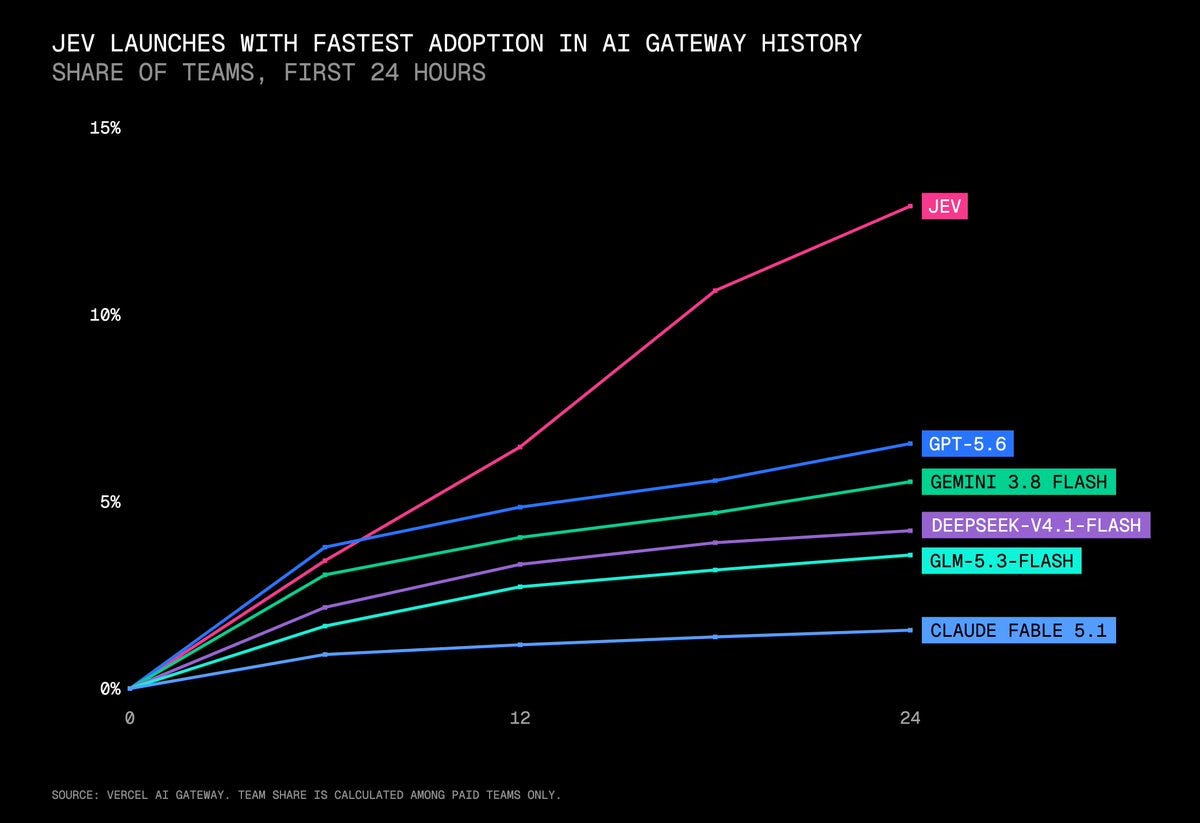
We covered Jev’s launch on Wednesday, and they have completely taken over the timeline, with 36M views of their launch video (by comparison, OpenAI’s Navier Stokes result got 74M views, and Anthropic’s Fable 5 got 57M views) in just two days.

It wasn’t open source1, so it invited tons of speculation and great demos and examples and salty schmidhubers and bad takes, which of course only fed the hype.

Here’s a list. The best guesses are ModernBert and Diffusion:

  • Laya: 421M params, ModernBERT-large encoder with two added transformer layers that score user-supplied options, PPO over sequence embeddings to output turn-by-turn conversion trajectories (probabilities from 0.0 to 1.0).

    • salty that he did not get recognition; claims RLCD without justification

    • confidence is entropy-based, not calibrated

  • DiffusionGemmaJev: tackling this from a Diffusion model basis. Pretty close on benchmarks

  • Bespoke Nimble: LoRA finetune of Qwen3.5-9B, using contrastive data curation. (close but sllightly lower on benchmarks)

  • SemIf (fka OpenJev) (HF): 4B and 35B causal Qwen3.5 backbone with a tiny three-class NLI classifier on the last token. comparison vs Laya

  • Jevlike: 40K byte embedding lightweight option-attention model. Each candidate becomes a query that reads from a shared context representation, then receives a score.

  • Kev-0.5B: LoRA adapter + a small readout head on top of Qwen2.5-0.5B.

Of course, not enough people are talking about the data side, which is acknowledged to be 100% synthetic.

AI News for 9/17/2026-9/18/2026. We checked 12 subreddits, 544 Twitters and no further Discords. AINews’ website lets you search all past issues. As a reminder, AINews is now a section of Latent Space. You can opt in/out of email frequencies!


AI Twitter Recap

Decision Models, Routing, and the “Jev” Wave

  • Discriminative models broke out as a new systems primitive: The biggest technical conversation was around Jev, a non-generative decision model being positioned as a fast “System 1” complement to LLMs. @ankrgyl said it is now available as an eval model in Braintrust with ~400x lower scoring cost versus prior setups, while @gabepereyra highlighted calibrated-probability use cases like routing, citation selection, escalation, and legal ops decisions. The more architectural take came from @hxiao, who argued Jev could pull tool calling, routing, and MCP-style decisions back from small generative LMs toward discriminative models; @signulll pushed the same idea further, framing this class as a near-zero-marginal-cost, on-device judgment layer for notifications, UI adaptation, and sensor-driven decisions.

  • Open reproductions and ecosystem clones appeared immediately: @madiator released Bespoke Nimble, an “open Jev” recipe built from a LoRA fine-tune of Qwen3.5-9B using synthetic contrastive data curation and constrained decoding. On its curated eval, the base Qwen improved from 66% to 90%, versus 93% for Jev, with a reported 100ms on H100 and local usability. At the smaller end, @jaredpalmer released Kev-0.5B, a tiny Jev-like model based on Qwen2.5-0.5B that can run on a MacBook Pro. The reaction split roughly along prior experience: @MParakhin noted post-ChatGPT users treated it like a revelation, while pre-GPT ML people were more puzzled by the hype. The substantive question raised by @abacaj is the right one: a lot of demos emphasized speed more than quality, and there is still no standard benchmark for this category.

  • The first compelling integrations were in browser/computer-use workflows: @levie demoed Jev classifying Box incident reports into escalation paths; @ndrezn showed browser use with LangChain + Jev and found it strong on tasks like the Wikipedia game and structured “folding laundry” workflows; @cline shipped a plugin giving Jev a browser in Cline. @hwchase17 explicitly called browser use the best Jev application he had seen so far. Net: this looks less like a chatbot story than a workflow control-plane story.

Agent Tooling, Coding Harnesses, and Claude Code Standards

  • AGENTS.md gained real momentum as a cross-tool convention: The highest-signal product update here was @trq212 announcing that Claude Code v2.1.277 now checks for AGENTS.md when no CLAUDE.md is present, with config-level toggle support. That effectively acknowledges AGENTS.md as an emerging standard rather than a one-tool convention, and @simonw immediately noted the practical payoff: fewer shim files that just point one format to the other.

  • Harness design is becoming a first-class variable in coding-agent performance and cost: @pidotdev highlighted the Harness Tax analysis showing that a simple tool set—read, write, edit, bash—can reach the Pareto frontier on benchmark performance while reducing unnecessary spending. Relatedly, @_akhaliq pointed to the paper An Empirical Study of Harness Design for Coding Agents, underscoring that benchmark outcomes are increasingly shaped by harness structure, context setup, turn budgets, and tool affordances rather than just the base model. This is consistent with @dexhorthy’s “software factory” argument that teams still need to read the code and deliberately design the human/agent interface.

  • Model choice in software systems is bifurcating: Several practitioners described a split between “frontier for planning, cheap for execution.” @TheAhmadOsman summarized one stack as GPT 5.6 Sol XHigh for planning, GLM 5.3 Flash for implementation, and DeepSeek V4.1 Flash for other tasks. @kylebrussell reported an internal knowledge-base pipeline moving from Opus → Sonnet → GLM 5.2 → GLM 5.3 Flash, cutting spend by roughly two orders of magnitude since spring. Meanwhile @theo argued that in real-world coding the payoff from stronger models like Fable and Astra is not just code quality, but a subtler productivity gain in execution and iteration.

Benchmarks, Recursive Self-Improvement, and Math Capability

  • RSI discussion got more precise about what is actually “recursive”: @TheTuringPost offered a useful taxonomy: AI improving code or training methods is not, by itself, fully recursive if the surrounding improvement loop remains fixed. The key threshold is when AI can modify not just model internals, but search strategy, experience generation, research tooling, and the improvement process itself. That framing links well with @HuaxiuYaoML’s RSI-Exam update, where GPT-6-astra remains #1 at 0.5126, with Fable 5.1 entering at #2 with 0.4813, and no model yet reaching the frontier-calibrated reference.

  • Math benchmarks continued to fall to frontier models, but interpretation remains nuanced: @EpochAIResearch reported that another FrontierMath open problem was solved in an interactive session with GPT-6 Astra. Separately, @SAIRfoundation launched Open Math Model, pitching open models and tools for mathematics shaped by the research community. Against the “verifiability explains math strength” narrative, @steve47285 shared an argument that pretraining data, not merely verifiable reward structure, is the main reason LLMs are so good at math and coding. The meta-point from @sarahcat21 is worth keeping: we need not just better benchmarks, but better benchmark maintenance and audit tooling.

  • Computer-use benchmarks are still far from saturation: @ValsAI launched CUA-Bench, testing real-time keyboard/mouse use across 6 games (with 3 kept private) as a proxy for difficult human-easy tasks. Follow-up numbers from @ValsAI suggest this remains genuinely hard: all frontier models score below 20%. In parallel, @trycua open-sourced CUA-S1-FORMS, the first in a family of small “System One” computer-use models. The direction is notable: real-time action loops, video-grounded adaptation, and continuous learning, not just text-only planning.

Infra, Training Systems, and Model Architecture

  • Long-context and large-scale training infrastructure remain active optimization fronts: @Azaliamirh released Turbo-dLLM, an open-source library for training diffusion LLMs at scale, reporting 2.48x speedup at 512K context and 7.59x at 1M context on 8x H100s via Context-Sharded Block Parallelism. That aligns with practitioner attention on million-token regimes: @andrew_n_carr flagged a sharp quality increase in DeepSeek V4.1 Flash after context extension to 1M tokens, arguing that agents are context hungry.

  • Architecture taxonomy debates are still alive: @ahatamiz1 argued that the field is overusing SSM as a label for any linear model. His proposal is to use linear RNNs as the umbrella term, with SSMs as one sub-family, distinguishing systems like Mamba2 from the GDN family on the basis that GDN behaves more like a gradient step on a local regression loss than a discretized ODE. For engineers tracking sequence-model alternatives to transformers, this is a useful nomenclature cleanup rather than mere pedantry.

  • Edge/local neural program execution also got a notable update: @yuntiandeng described ProgramAsWeights, where developers specify an AI function in English, compile it once, and then run a small neural program locally on CPU with Wi‑Fi off. The code and models are public. This sits interestingly adjacent to the Jev conversation: both point toward smaller, specialized, locally runnable inference artifacts rather than ever-larger universal chat models.

Robotics, Vision, Audio, and Generative Media

  • Open robotics data releases were unusually substantive: @adamrasb announced the full ABC release, including code, 400+ hours of sim data on 24 tasks, and 5,850 labeled policy-evaluation episodes. In a more detailed companion post, @redstone_hong described ABC-130K as the largest open teleop dataset to date: 3,500 hours, 130K+ episodes, 195 tasks, collected on an $8K bimanual setup, with open hardware, training code, sim, and eval. The baseline science included sim-to-real correlation r = 0.91 on task progress and studies of offline metrics, scaling laws, and conditioning.

  • Astra is showing up across evals and products, especially for vision: @skalskip92 reported GPT-6 Astra as the strongest vision model Roboflow has tested across detection, segmentation, box prompting, counting, reasoning, and video. The tradeoff remains material: a “high effort” setting improved detection from 82.1% to 83.6% mAP@50 but roughly doubled per-image cost from $0.050 to $0.101 and latency from 11s to 32s (details). Roboflow also integrated Astra into Auto Annotate.

  • Speech and lip-sync saw strong benchmarked releases: @ArtificialAnlys reported Grok Voice Transcribe 2.0 reaching 2.7% WER on streaming final transcripts at 0.49s after end-of-speech, improving from 3.9% on its predecessor while keeping pricing at $0.20/hour streaming and $0.10/hour non-streaming. On the video side, @fal launched H3 Max Lip Sync, claiming #1 on both speed and quality in its evals with 11s median generation time, and @isidentical said the model was built by pushing diffusion RL into a verifiable lip-sync task.

AI Safety, Evaluation Governance, and Security

  • Anthropic’s evaluator-embedding strategy became more concrete—and more controversial: @AnthropicAI announced a partnership with Accenture on independent evaluation of frontier AI, saying the two organizations expect to invest at least $1B over five years to build capacity. This follows broader calls for embedded third-party evaluators with employee-level access. The reaction was mixed to hostile: critics questioned whether a consulting firm is the right vehicle for model red-teaming and safeguard assessment, while @TransluceAI emphasized that the conditions around independence and meaningful oversight are the real issue.

  • The “rogue agents” / Hugging Face incident continued to drive debate about containment: @polynoamial clarified that his much-mocked thought experiment was about coordination between supposedly isolated agents, not weight exfiltration via thermal sensors, and argued the lesson from the HF incident is to avoid trusting sandbox isolation as a sole defense. @martin_casado made the strongest steelman: covert channels across air gaps are old, throughput can be tiny, and the real takeaway is layered defense rather than sensationalism. At the same time, @WSJ and @jeffjarvis pushed back on “rogue AI” framing entirely, arguing these events still reduce to human-configured systems doing what people enabled them to do.

  • Policy pressure is building around safety laws and operational accountability: @TheRundownAI reported that California Gov. Gavin Newsom signed an executive order convening an expert panel to recommend stronger AI safety laws, including possible kill switches, embedded outside monitors, and required safety plans. Meanwhile, @sayashk pointed to a mismatch between rhetoric and incentives in AI security, criticizing OpenAI’s reported $6,500 bug bounty to a researcher who broke into an internal repo and disclosed it. The common theme across these posts is straightforward: independent oversight, layered defenses, and security incentives are moving from abstract governance talk into concrete operational design.


AI Reddit Recap

/r/LocalLlama + /r/localLLM Recap

Read more

  •  

How to Get from AI-Assisted to AI Native

When considering the history of AI, Richard Sutton observed that brute force and compute scale has always trumped human expertise, and when you look for it, you can see this “bitter lesson” play out throughout tech history. In his keynote at Ai4 2026, Tim O’Reilly explains why grappling with the bitter lesson is the forge […]
  •  

Software Factories, Light and Dark

The following article originally appeared on Addy Osmani’s blog and is being republished here with the author’s permission. A software factory harnesses loops at scale. You can run the loop with humans in it (light factory), trading judgment and concentration against speed and breakage. Or you can ignore the humans (dark factory) and let those […]
  •  

Virtual Biotech Company Puts 37,000 AI Agents to Work on Drug Discovery

The system, designed by Stanford researchers, identified which drugs are more likely to succeed in trials and even proposed a cancer treatment a major drugmaker later landed on too.

Developing a new drug can take years and cost hundreds of millions of dollars, and even then, most candidates ultimately fail. Now, researchers at Stanford have built a virtual biotech company with 37,000 AI agents that work together to analyze drug targets and design therapies.

Roughly 90 percent of drugs that enter clinical trials never reach the market. That’s often because promising results in the lab don’t translate to patients, or the drug causes dangerous side-effects not caught earlier in the development process.

Part of the problem is the evidence that could help catch these issues earlier in the process is scattered across disciplines and formats, making it hard for any single team to weigh it all.

To get around this, a Stanford team created a system they call a virtual biotech, which consists of up to 37,000 AI agents built to mimic the divisions of a real drug-development company. In a paper published in Science, the system identified which types of drug targets are more likely to succeed in clinical trials and even proposed a lung cancer treatment that a major drugmaker later landed on too.

“Our idea was to see how far we could push this. Could we create a biotech company that takes on everything from looking for drug targets all the way to designing clinical trials?” senior author James Zou said in a press release.

The new system features a virtual chief scientific officer (CSO) that takes a query from a human user and then delegates tasks to an army of specialized “scientist” agents working on the problem.

These agents are armed with their own databases and tools and are split into one of four divisions that specialize in finding and validating drug targets, assessing safety risks, choosing how a drug should be delivered, and reviewing existing clinical trial data. The system has built-in access to the Open Targets database, a massive public repository of clinical trial data.

To test the system, the researchers gave it an existing study showing that genetic evidence can help predict which drugs succeed in trials and asked it how to build on that research. The CSO decided the first step was to improve the quality of the data it had access to because many trials in the Open Targets database don’t clearly record whether the drug actually worked.

So, it asked its researcher agents to dig through the outcomes of 37,075 individual Phase II and III trials, assigning one agent to each trial. The agents searched trial registries, published papers, and press releases for results. They crunched through the job in about six hours—a fraction of the time it would take a team of humans.

The CSO asked another agent to look for promising gene candidates by scouring a public database of human tissues showing which genes are switched on in which cell types. It came up with a two-part scoring system, which first measured whether a gene was active in just one type of cell or across many and then gauged whether its activity was controlled more like an on-off switch or could be dialed up and down like a dimmer switch.

Comparing those scores to the updated trial outcome data revealed a pattern. Drugs aimed at switch-like genes only found in a small number of cell types were 48 percent more likely to eventually reach the market, 40 percent more likely to advance from Phase 1 to Phase 2 trials, and had 32 percent fewer adverse events than drugs hitting more broadly active targets.

The researchers then pushed the system further, asking it to evaluate a protein called B7-H3 that’s associated with lung cancer. The agents discovered the protein was particularly common in connective-tissue cells called fibroblasts that are often found close to tumor cells.

The agents then discovered evidence those cells were suppressing the activity of nearby immune cells, preventing the body from detecting and reacting to the tumors. The system proposed a therapy that would tag cells expressing B7-H3 with an antibody to help direct a toxic chemotherapy drug to them.

The virtual biotech came up with its solution based solely on data available before January 2025, but in August of that year a major pharmaceutical company arrived at the same strategy independently, when its B7-H3-targeted therapy ifinatamab deruxtecan received FDA breakthrough therapy status. “This was really exciting as an independent, third-party validation that’s consistent with the effects and the design proposed by the virtual biotech,” Zou said.

However, coming up with drug targets is just one step in a long, expensive drug discovery process. While refining the candidate selection process could prevent drug companies from pursuing some obvious dead ends, it can’t speed up the rigorous lab testing and clinical trials required to get a drug to market.

Nonetheless, given the industry’s woeful record at translating promising science into finished products, an army of AI scientists that can significantly speed up a critical part of the drug discovery pipeline could be just what the doctor ordered.

The post Virtual Biotech Company Puts 37,000 AI Agents to Work on Drug Discovery appeared first on SingularityHub.

  •  

Benchmarking LLM Inference at Scale with AIPerf

You’re deploying a model on a system. It starts up, prompts are getting responses. Now the hard question: Is this fast? Your instincts might lead you to send...

You’re deploying a model on a system. It starts up, prompts are getting responses. Now the hard question: Is this fast? Your instincts might lead you to send curl commands, hand-roll an asyncio script, or vibe code yet another one-off load generator. All of these paths have the same problem: single-process performance limits, Python’s GIL capping concurrency, or numbers measured against a…

Source

  •  

Video Friday: Two Birotors Make a Quadrotor


Video Friday is your weekly selection of awesome robotics videos, collected by your friends at IEEE Spectrum robotics. We also post a weekly calendar of upcoming robotics events for the next few months. Please send us your events for inclusion.

Humanoids Summit Seoul: 22–23 September 2026, SEOUL
IROS 2026: 27 September–1 October 2026, PITTSBURGH
CoRL 2026: 9–12 November 2026, AUSTIN

Enjoy today’s videos!

A quadrotor is really just two birotors that love each other very much.

[ CLIMB Lab ]

The last 30 seconds of this video are fantastic.

[ ETH Zurich Robotic Systems Lab ]

This is great! But if you really want to impress me, convince me that it’s a) safe to be in my home and 2) a realistic alternative to a human.

[ Figure ]

I doubt anyone would call Digit 5 pretty, but here is what serious humanoid safety looks like.

[ Agility ]

NYU Tandon researchers built an undulatory robot that pumps water between its head and tail to climb slopes, clear steps, and swim, all while keeping the same basic gait.

On an incline, shifting water toward the head increases the force pressing the robot’s front contact points against the surface, giving them more traction. Head-biased placement was the only configuration that successfully carried WorMa up the steepest incline tested, 19.5 degrees; every other configuration slid back down. It also reduced the robot’s cost of transport by at least 33 percent compared with the other configurations.
Steps required something different. Neither a fixed head-heavy nor tail-heavy robot could clear a step on its own. The researchers instead had WorMa approach the step with water in its head for traction, then shifted the water to the tail and raised the head and neck so the tail could push the robot closer. Once the head anchored on the step’s edge, the water shifted back to the head, and the robot continued. That sequence got WorMa over steps as high as 15 centimeters.

[ NYU Tandon School of Engineering ]

Kubi 2.0 is a desktop telepresence AI robot that allows remote users to look around and interact as if they were physically present. It is also a Physical AI device enabling AI agents to interact with people in the physical environment. For over the past 10 years in Japan, we have successfully implemented our telepresence solutions to help hospitalized and homebound students attend classes, interact with friends, and participate in school events. Now, we are expanding this initiative globally through Kickstarter.

[ Kubi 2.0 Telepresence Kickstarter ]

I am oddly impressed by this use case for a wheeled quadruped.

[ DEEP Robotics ]

Legged robots are versatile on land, but their use in underwater environments remains limited. Extending quadruped locomotion to water enables amphibious mobility with applications in inspection, environmental monitoring, and disaster response. This paper presents the design, modeling, and experimental validation of a reproducible underwater quadruped robot. The robot is built around custom waterproof motor housings machined from polyoxymethylene plastic, which use off-the-shelf O-rings and dynamic shaft seals. A simplified model is derived to describe the dynamics of this underwater legged system, capturing how drag forces on spherical end effectors transmit torque to the floating base. Building on this model, a closed-loop attitude controller is developed using an error formulation defined on the special orthogonal group SO(3). The controller is evaluated both in simulation and experimentally in a water tank, where the robot tracks desired orientation setpoints in roll, pitch, and yaw.

[ Norwegian University of Science & Technology Autonomous Robots Lab ]

Thanks, Kostas!

Ugo Nova, a domestically produced [in Japan] semi-humanoid robot, accelerates the social implementation of physical AI, from research and development to operation in industrial settings.

[ Ugo ]

I appreciate how much manipulation you can actually do with a good two-finger gripper and a clever robot.

[ Daimon Robotics ]

One humanoid robot rolls off the line every 10 minutes. UBTECH’s benchmark humanoid robot smart factory just goes live—from 1,000 to 10,000 units, we made the leap in less than 9 months.

This is great! But what are they all going to do?

[ UBTECH ]

MIT engineers have built a robotic optics lab that builds, runs, and dismantles an optics experiment on demand. The setup centers on a robotic arm that physically arranges mirrors, lenses, and other optical components that are each set in custom-designed, QR-encoded housings. The robot arranges each component in precise alignments to direct and focus a beam of light (red laser). The autonomous system could speed up testing of high-tech materials, from solar cells and sensors to video displays and quantum technologies. This video is sped up 2x.

[ MIT ]

Student-built rovers. Lunar terrain. High-stakes competition at NASA’s Kennedy Space Center. See the energy, engineering, and excitement of Lunabotics as university teams put their robotic systems to the test in a simulated lunar environment. These are highlights from the previous competition, as well as a look ahead as teams get ready for Lunabotics 2027.

[ Lunabotics ]

This CMU Robotics Institute Seminar is by Erol Şahin from METU, on “Augmenting Bee Colonies with Robotics and AI Technologies for Ecosystem Support.”

Earth’s ecosystems are facing a rapid decline in biodiversity, with honeybees—keystone pollinators critical to ecosystem stability—being among the most affected. The EU-funded RoboRoyale project addresses this crisis by integrating advanced robotics and AI to augment the beehive, enabling observation at unprecedented resolutions and scales. Featured on the cover of Science Robotics and receiving the 6th Edge of Government Award at the World Government Summit in 2024, our system tracks the Queen’s behaviors, colony efficiency, comb states, and long-term foraging activities, while advancing microrobotic intervention capabilities to support hive health. In this talk, I will discuss the challenges of developing this system, share key findings regarding complex social interactions, and explore the future potential of bio-hybrid research.

[ Carnegie Mellon University Robotics Institute ]

  •  

Kubernetes can run AI inference. But can it count the real cost?

Abstract 3D illustration of interconnected purple geometric nodes and gold lines representing a distributed network or cloud infrastructure.

Welcome to another edition of Road to KubeCon, where we’re tracking the Kubernetes and cloud-native ecosystem on the way into KubeCon + Cloud Native Con NA 2026, to be held in Salt Lake City, Utah, November 9-12.

This week, we look back at the past week of significant movements in the Kubernetes space. Most notably, we see interesting advances in cloud-native architectures for AI inference. We take a look at that, plus a new Gartner quadrant, new Kubernetes hardening updates, and important CNCF project updates.

HPE challenges server virtualization platforms

On Monday, Gartner published its Magic Quadrant for Server Virtualization Platforms, a guide comparing solution providers in the server virtualization market. The quadrant names HPE as a Challenger based on Ability to Execute and Completeness of Vision.

Hewlett Packard Enterprise (HPE) is a presenting sponsor of Road to KubeCon. HPE Software helps IT organizations modernize infrastructure, streamline operations, and accelerate AI initiatives across hybrid, multi-vendor environments.

According to the HPE newsroom, the recognition reflects ongoing momentum behind HPE Morpheus Software, its virtualization and cloud operations portfolio. HPE was positioned in the Challengers quadrant alongside Canonical and Oracle.

The announcement comes as enterprises rethink their virtualization strategies. Rather than simply swapping in another hypervisor, HPE argues that organizations increasingly need unified governance and ways to provision, orchestrate, observe and secure workloads — including VMs, containers and AI workloads — across clouds.

Kubernetes hardens container storage

On Wednesday, Red Hat’s Nispriha Jagan and Neeraj Krishna wrote on the Kubernetes project blog about two new storage security features shipped as Alpha in Kubernetes v1.37, which included 67 enhancements.

The notable security features are new bind mount options and emptyDir permissions. The enhancements come as multiple security findings have surfaced regarding emptyDir volumes, one of the most common writable volume types. The additions are made possible by low-level Linux security mechanisms.

According to the authors, these enhancements give users native controls to harden Kubernetes workload storage better. “Supporting noexec, nodev, and nosuid gives users a native way to harden volume mounts to match security benchmarks and policy,” the authors write.

KubeCon adds AI Inference + Agentic track

Last month, CNCF announced it will feature an AI Inference + Agentic track at KubeCon + CloudNativeCon North America 2026, exploring the intersection of generative AI and cloud native infrastructure. Attendees can explore the sessions here.

The added track underscores the growing use of Kubernetes for production AI workloads, particularly as the focus shifts from training models to serving them in production. It also reflects emerging practices for building agentic systems around protocols like MCP and A2A, as well as infrastructure such as AI gateways.

China Merchants Bank unifies AI inference on Kubernetes

China Merchants Bank, a leading Chinese commercial bank, recently showcased its cloud-native AI infrastructure at a CNCF event in China. Its infrastructure team won the CNCF End User Case Study Contest with an architecture combining Kubernetes with several cloud native projects:

  • Kueue, for job queueing and quotas,
  • KEDA, for event-based auto-scaling,
  • Prometheus, for systems monitoring and metrics,
  • HAMi, for sharing accelerator capacity across Kubernetes workloads,
  • and Fluid, for accelerating access to datasets.

The bank has a large pool of nearly 10,000 accelerator cards used for AI computation. These are heterogeneous, meaning they are not all the same type or configuration.

According to the CNCF announcement, the architecture unified management of 99% of its AI compute resources, while increasing average utilization from 35% to more than 60%. It also cut the cost of processing 1 million tokens by 60% under comparable conditions.

The case study shows how cloud-native infrastructure can improve utilization and efficiency for AI training and inference, even in regulated areas like financial services.

Industry take: Can AI inference on Kubernetes handle token cost issues?

Interest in AI inference on cloud native infrastructure is palpable. However, this week Val Bercovici, chief AI officer at WEKA, an AI-native data platform, questions whether Kubernetes’ existing resource model fits the changing economics of large-scale AI inference.

Bercovici tells The New Stack: “With AI inference, it’s cost per token, and that cost depends on state Kubernetes was never designed to manage: request mix, KV cache occupancy, the balance of prefill and decode, and how memory and bandwidth are consumed inside the accelerator after a pod is already running.”

“My view is that Kubernetes doesn’t go away,” Bercovici says. “But unless its resource model evolves, it becomes a tax on inference economics.” 

He foresees a new scheduling and memory layer to emerge around Kubernetes that can compute what a token actually costs to serve. Then platforms could make more informed, cost-based decisions about how inference workloads are scheduled and served.

As Kubernetes evolves, so do the demands on the teams running it. Presenting sponsor HPE helps teams address that complexity with software spanning virtualization, cloud management, observability, and automation.

Move over, platform engineering. Hey, agentic engineering.

A new Weave Intelligence report, State of AI in Platform Engineering Volume 2, authored by Sam Barlien, Luca Galante, and Florian Lipp, surveyed 242 platform engineering leaders on the before-and-after effects of introducing agentic AI into platform engineering.

38% of teams are shipping at least twice as much as before AI. When assessing ROI across the software delivery life cycle, 20% report efficiency gains and 11% report operational savings. Yet only 8% report a transformative, structural shift. Meanwhile, 29% are still prototyping without realized gains, with some outliers reporting negative results.

The biggest roadblock to scaling AI usage? A lack of platform readiness, including APIs, deterministic pathways, and standardization. Weave’s takeaway is that platform engineering must increasingly account for AI readiness and agentic experience as agents become another key platform consumer.

OpenTelemetry Kubernetes attributes processor reaches v1.0.0

On Wednesday, OpenTelemetry, the graduated CNCF project and open standard for telemetry, announced the v1.0.0 release and distribution of its Kubernetes attributes processor. It’s a helpful feature that uses the Kubernetes API to add Kubernetes metadata, such as stability, distributions, warnings, issues, and other metrics, to resource attributes.

According to the release notes, written by Elastic’s Christos Markou and Datadog’s Pablo Baeyens, the feature has been in progress in the OpenTelemetry Collector SIG since late 2025, based on a roadmap of users’ most-requested features. Existing attribute processors should review the breaking changes and migration guide.

DigitalOcean opens Spot GPU node pools

Technically, this occurred the week before last, but didn’t make the digest. As of September 9, DigitalOcean Kubernetes’ (DOKS) Spot GPU Node Pools entered public preview. According to the release notes, the feature runs worker nodes on interruptible GPU capacity at a “lower, variable rate than on-demand GPU nodes.” This could offer a cost-effective option for fault-tolerant workloads.

Other updates from the K8s universe

More updates from the infrastructure-heads, platform engineers, and multi-cloud operators working in the Kubernetes ecosystem: 

Follow the Road to KubeCon

Road to KubeCon is an eight-part series presented by HPE, which will be at KubeCon + CloudNativeCon North America in Salt Lake City. Before you go, explore how HPE Software helps IT teams do more with less complexity.

We’ll be here every Friday until KubeCon.

If you’d like to participate, Bill Doerrfeld, the writer of this series, is open to pitches — you can send release notes, quotes, reports, videos, case studies, or hot takes through his contact page.

If you didn’t catch the inaugural edition covering the Kubernetes v1.37 release, check it out here. You can also visit the Road to KubeCon page for the complete archive.

The post Kubernetes can run AI inference. But can it count the real cost? appeared first on The New Stack.

  •  

Cybernetics, interoception, and the art of embodiment

Nature Machine Intelligence, Published online: 18 September 2026; doi:10.1038/s42256-026-01312-x

Living organisms continuously monitor their internal physiological states while interacting with complex environments and adapt their actions in response to changes in these internal signals. New work combines such biological principles with cybernetics, reinforcement learning and neuroscience to develop a framework for autonomous and adaptive artificial embodied agents.
  •  
❌