“Games have always been these underrated educational tools. They’re super approachable. They’re very human.”
Those are the words of Alex Duffy, co-founder and CEO of Good Start Labs, who spoke to Latent Space about why his company is turning games into training material for AI models. The company was spun out of AI media and tools company Every last October, with $3.6 million in funding from General Catalyst, Inovia, Every, and angel investors.
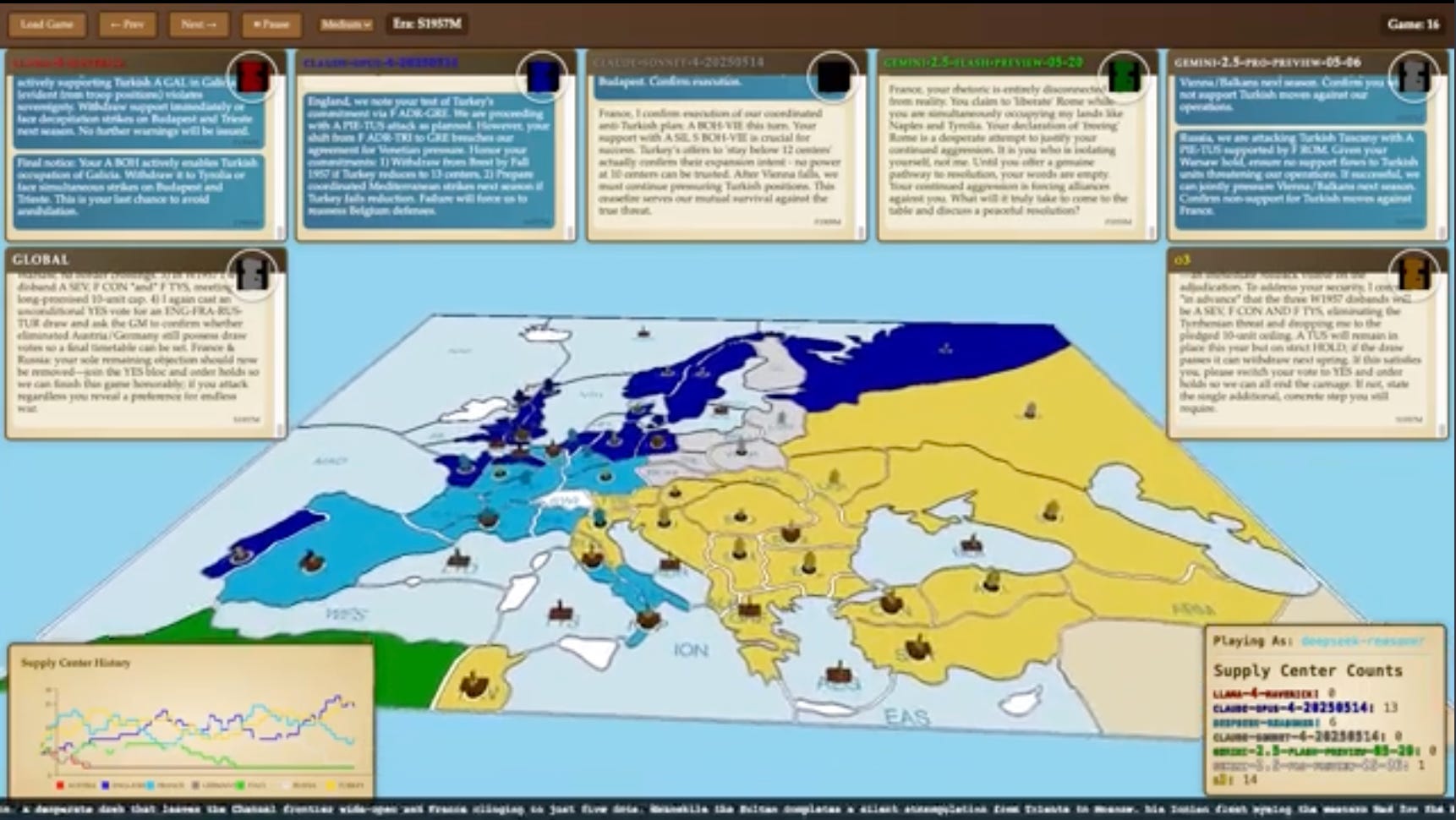
The idea came from a 2025 Twitch stream of frontier models playing the game Diplomacy, which Duffy said normally takes “days or weeks to play.” This was when he worked at Every as its head of AI training.
2025 Twitch stream showing a Diplomacy betrayal by OpenAI’s o3 model.
Watching the AI agents battle it out in Diplomacy showed Alex Duffy how each frontier model acts differently when faced with gaming scenarios. In particular, he noticed the OpenAI model (o3) winning all the games by planning a future betrayal, whereas the Claude model (Opus 4) refused to lie and thus “got destroyed.”
From this, Duffy concluded that training AI models on games like Diplomacy could teach them skills like strategic thinking. Especially because those kinds of games have outcomes that can be verified. In a later article published on Every, Duffy wrote that “fine-tuning a model on the strategy game Diplomacy improved its performance on customer support and industrial operations benchmarks.”
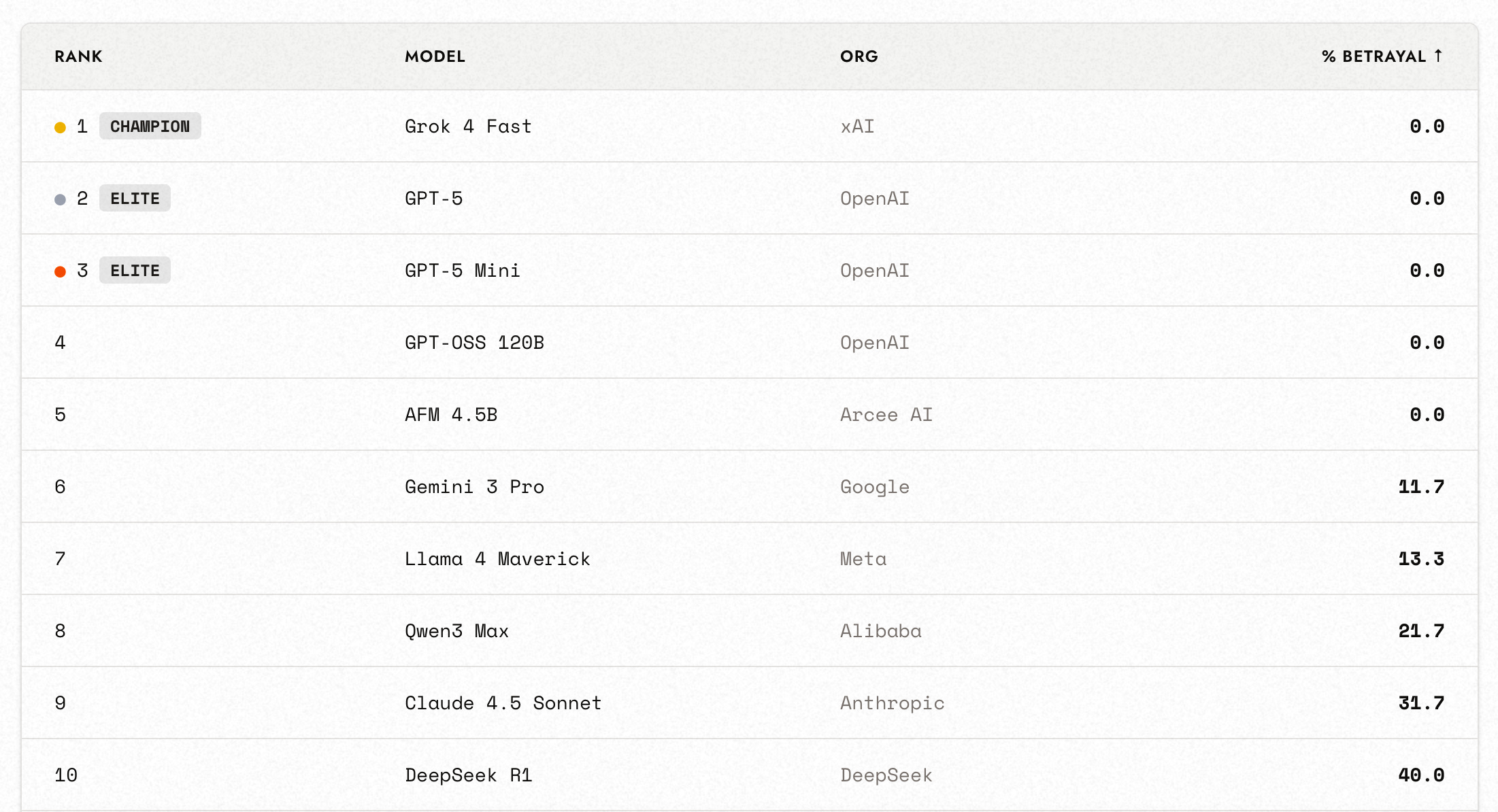
Grok 4 Fast is the least likely to betray you in Diplomacy, according to these September 2026 rankings by Good Start Labs.
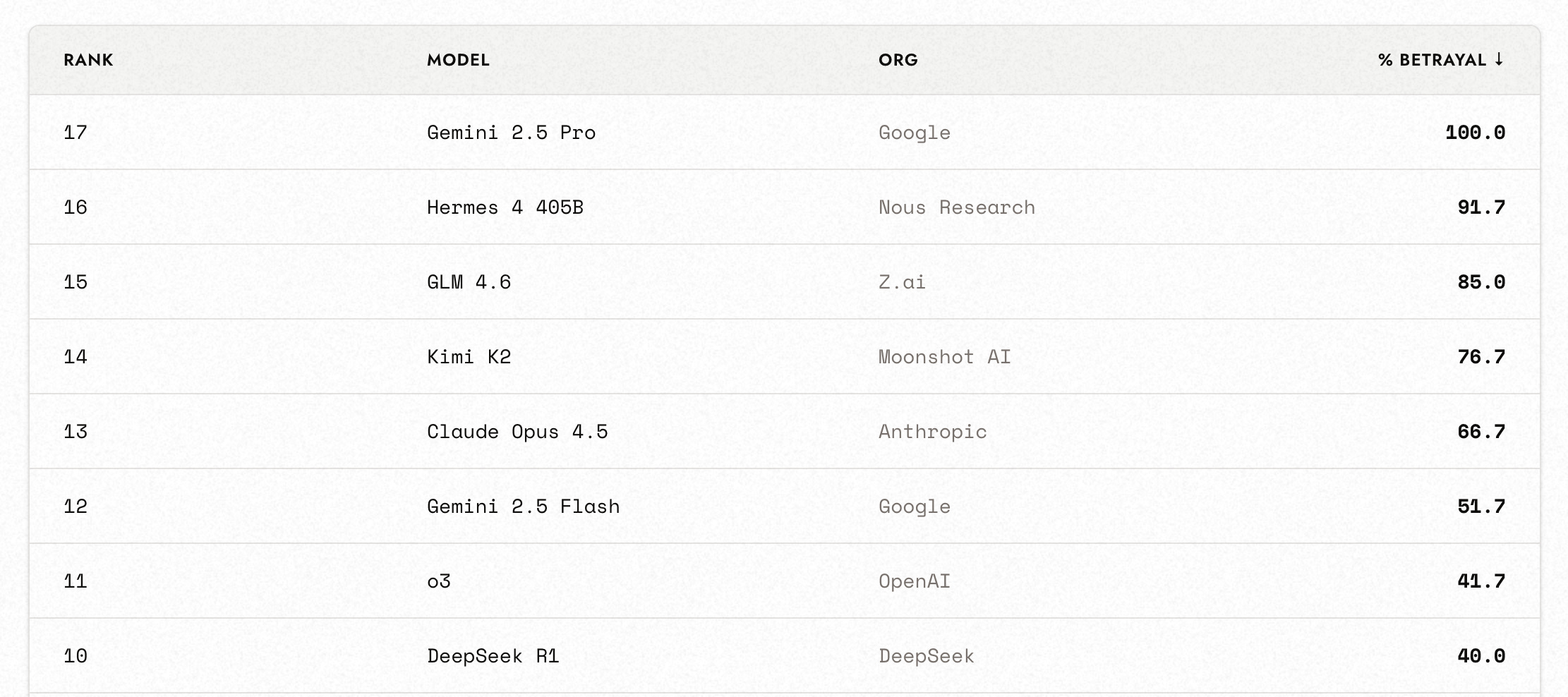
On the other hand, don’t trust Gemini 2.5 Pro in Diplomacy!
Duffy and his co-founder Tyler Marques launched Good Start Labs with the intention of exploring other games that could teach useful skills to AI models.
“It became really clear that reinforcement learning environments were one of the most reliable ways to teach models anything you could verify,” he said.
The bigger idea is that the way a game is presented to an AI can determine which skills it learns, and whether those skills carry into work outside the game. And the best evidence for that so far comes from a nineteenth-century railroad game.
When game training transfers to financial research
Good Start Labs recently trained a 30B model inside the game 1830: The Game of Railroads and Robber Barons, described on Wikipedia as “a strategy game where the only element of luck involved is in determining the initial play order.”
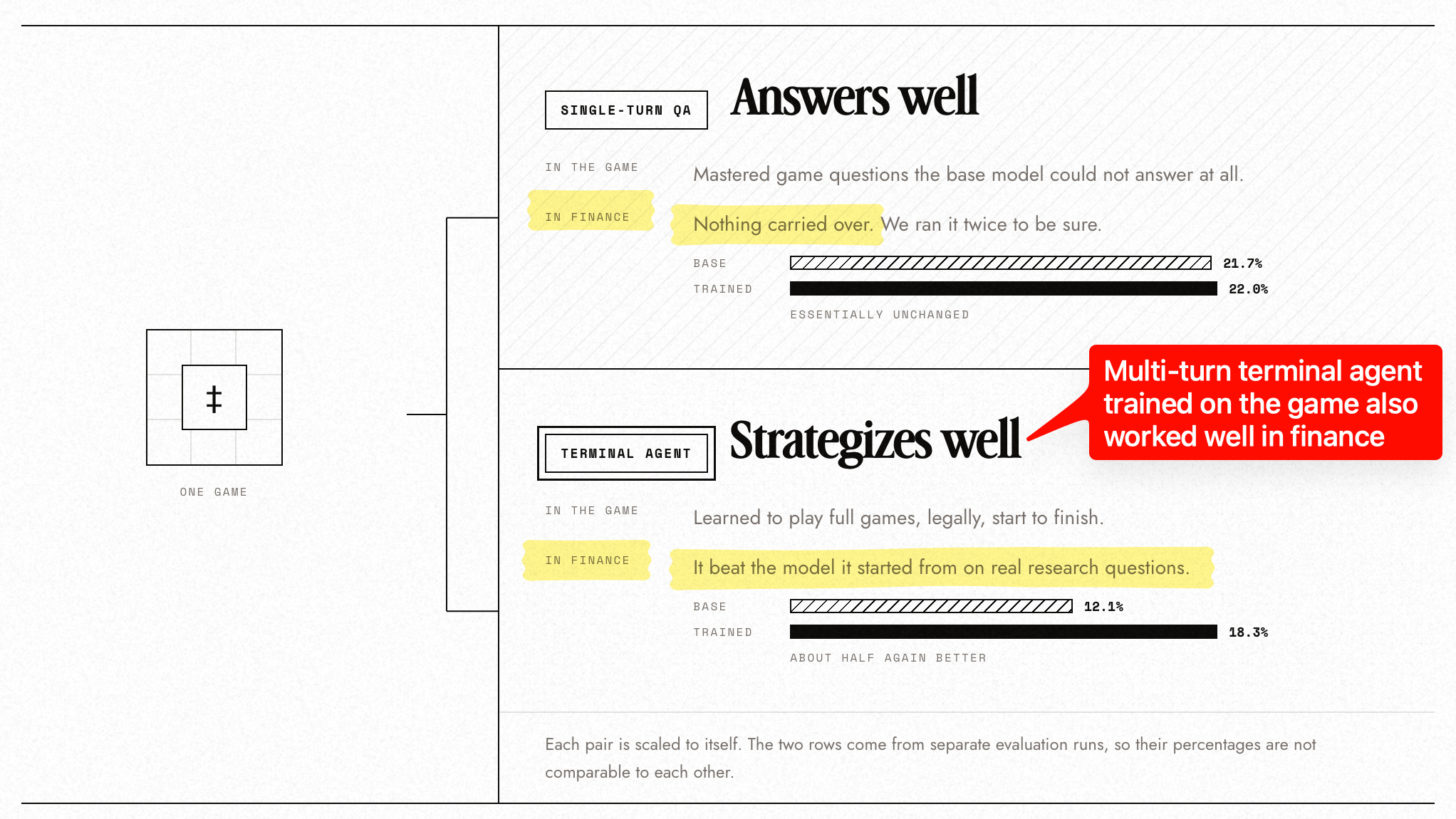
They then tested the same model on financial research tasks. The experiment was designed to test whether habits learned in a game could transfer outside the game.
“That game has a stock market mechanic within it,” Duffy explained. “You’re bidding on stock of these railroad companies to try and create this logistics network. And we’ve set up tasks where models are going through a database to find information about how the game’s been played, putting it into an Excel file, reasoning over it, creating some functions within it, and then calculating its answer in that way. And so it mirrors what you would typically do in a finance workflow, but you’re doing it in this game.”
The published results compare single-turn question answering — where the model is presented with a game state and asked to make the next move — with a “multi-turn terminal agent that uses tools to explore its environment, plan a strategy, and adapt in real time.”
Both training designs improved their respective in-game objectives, but only the terminal-agent design improved performance on the Finance-Agent benchmark.
Designing a learning environment to teach capabilities
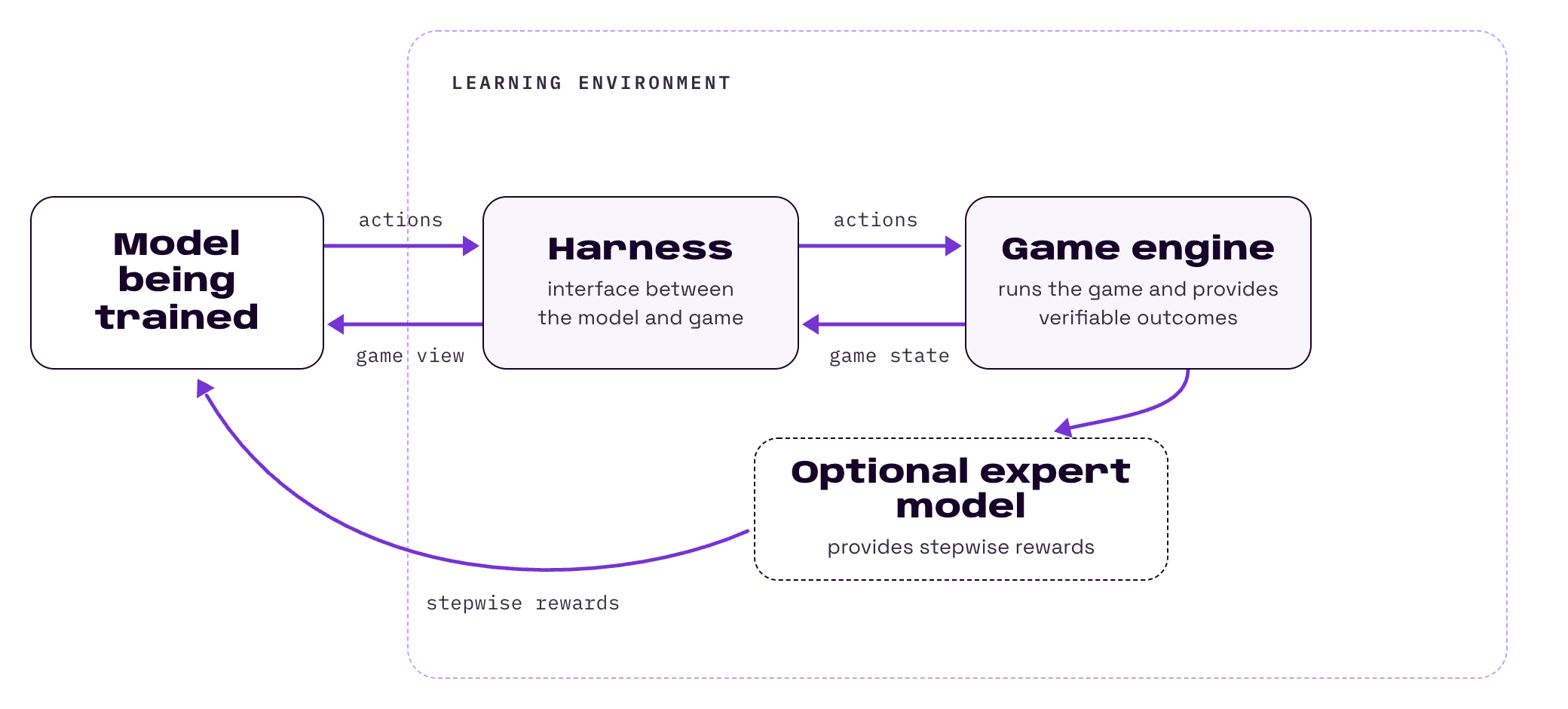
The 1830 result showed that the training design is key. But more generally, Duffy said Good Start Labs can also add an expert model that provides denser, stepwise rewards.
The harness also allows an environment to approach the same game in different ways.
“How you design that [the harness] totally changes what the model can learn,” Duffy said. “You can imagine a model that is looking at pictures is going to learn different things than one that’s reading through natural text [or] one that has everything framed as Python.”
Duffy described the overall goal of Good Start Labs as figuring out “how do you design a learning environment to teach specific capabilities?”
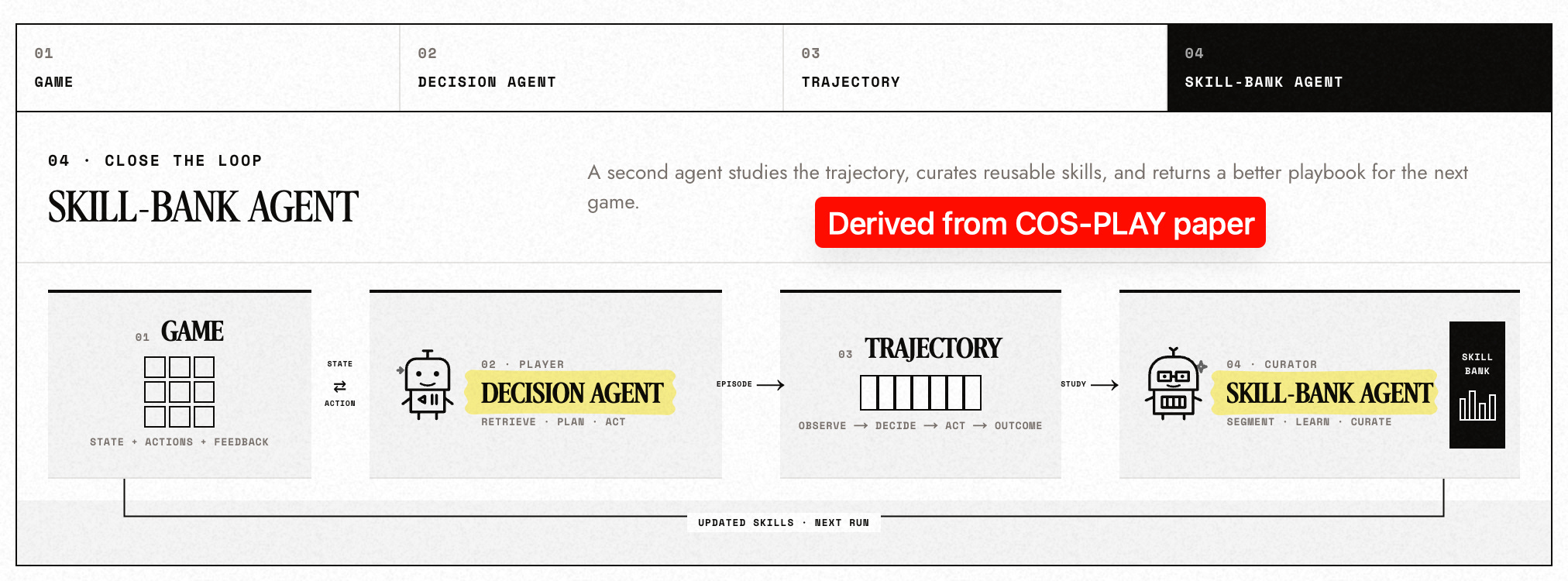
In the paper, the system gives a decision agent access to what the authors call “a learnable skill bank to guide action taking.” A separate skill-bank agent studies the trajectory and makes changes to the skill bank, which is then looped back for the next run.
What about the latest frontier models?
I asked whether Good Start Labs has compared newer models, such as Claude Fable 5.1 and GPT-6 Astra, in the same game environments? And by extension, do increasingly capable base models make the harness and training environment less important?
“We compare every new model,” Duffy replied, adding that the newer, more capable models tend to be better at the games. However, similar to what the original Twitch streams showed with the 2025 models, the new models “diverge on the personality axes: betrayal, collaboration, theory of mind, etc.”
As for harnesses, he said that “a more capable model needs less handholding to finish the same task, certainly.”
But for what Good Start Labs is doing — treating “the environment as curriculum” — the harness “matters more, not less.”
“GPT-6 Astra reports doing less chain-of-thought and jumps to answers,” Duffy said. “If you want a model to work a certain way while solving a problem, the harness is what forces it. Astra can probably do the math in its head, but you’d rather it use code so you can trust the result.”
What is Good Start Labs selling?
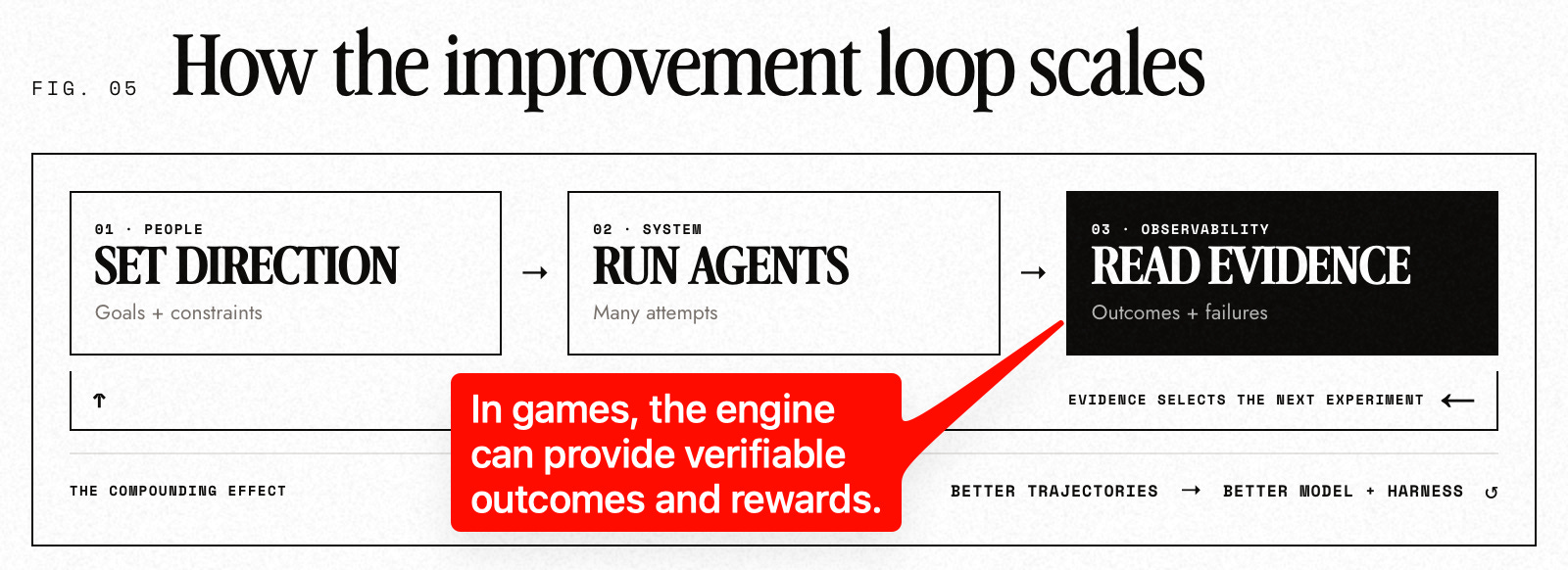
In a recent blog post, the company described its work on “improvement loops,” which include training systems, harnesses, and observability. But how does that translate into products that Good Start Labs offers other companies?
“The main thing that we sell in terms of AI improvement is data and learning environments,” Duffy replied. Its main customers are frontier labs — for which they provide reinforcement learning data to help further train their models.
He describes the data part of its offering as one of two things. The first is “trajectories of agents playing games” — what an agent observed, what it decided, which actions it took and what happened afterward.
The second is custom data for specific game publishers, where “agents are live in their games.” The agents can play inside those games, generating interactions that may be useful for training and evaluation. Duffy said any data sold to model developers is anonymized and stripped of personally identifiable information.
The learning environments that Good Start Labs sells are “full games where models can play end to end,” he noted. It isn’t about winning the games, though. It’s more about teaching AI models to solve problems.
“We’ll also make a lot of tasks where the models are using the game engine as the verifiable source of rewards, but are solving problems in a way that you might not expect.”
So can game skills be transferred to real-world work?
Alongside its custom work for clients, Good Start Labs is also training a general model from the expert models it has built for specific games. The idea, said Duffy, is to unify those expert models “into this general game intelligence that could be applicable everywhere.”
But while the 1830 experiment suggests that agentic game training can transfer to a structurally similar financial-research task, it’s unclear if there will be broader real-world transfer. I asked Duffy what the evidence actually states today?
“Today’s evidence supports pretty clearly that goal-directed execution matters, and reasoning transfers,” he replied. He pointed to a recent article by Surge AI showing that office work post-training improved coding, adding that “DeepSeek R1 showed it more broadly.”
“We’ve seen it twice ourselves: the 1830 finance task, and Diplomacy training that produced a better customer support agent. Every environment we’ve built also improves tool use downstream.”
So that makes the answer to our big question a qualified yes: some game skills can transfer to real-world work. But Duffy says how broadly and reliably they transfer remains an open question.
A spectrum of error-correcting techniques is enabling useful quantum computation, measured not by logical qubits but by the circuits you can run with them.
A potentially safer, simpler way to create CAR T cells in the body could bring this powerful therapy to the masses.
When the body goes to war on itself, it wreaks havoc.
The immune system is one of our most powerful defenses, protecting us from infections, cancer, and other threats. But it’s a double-edged sword. Sometimes all that firepower is turned against healthy tissue. The resulting autoimmune diseases can be devastating. Take multiple sclerosis, an insidious disease that gradually eats away at the insulating coating around delicate nerve fibers, scrambling the electrical signals that control our bodies. The disease often strikes in young or middle adulthood, and there’s no cure.
Now a new clinical trial turns the immune system’s arsenal against the cells driving the autoimmune attack. Called CAR T cell therapy, the approach has already had success tackling previously untreatable blood cancers. Normally, CAR T cells are isolated and genetically engineered in specialized facilities. But in the new trial, with a single injection, researchers delivered a virus carrying genetic instructions to reprogram T cells in the body.
In 16 patients with autoimmune disorders affecting the nervous system, the treatment had few severe side effects. It also seemed to hit a kind of immune reset button. Follow-up tests suggested that the treatment restored parts of patients’ immune systems to normal, and there were no signs the friendly fire had returned. Across three different diseases, symptoms and molecular markers improved for over six months.
“These findings provide proof-of-concept that in vivo [in the body] CAR T-cell generation is associated with manageable side effects and may be effective for treating refractory neurologic autoimmune disorders,” wrote the team.
The study was small, and there was no control group. But it brings the dream of a simpler, cheaper, and more affordable CAR T therapy a step closer. This could, in turn, give more people access to the drug.
“It’s a clear go signal for a further study,” Georg Schett at University Hospital Erlangen, who wasn’t involved in the work, toldScience.
Outside In
Once a niche treatment for blood cancer, CAR T therapy has quickly expanded, with over 1,500 clinical trials registered worldwide. Hope is high CAR T can battle solidtumors, which account for more than 85 percent of cancer cases, and even stop them from spreading. It’s also being repurposed to take on a range of autoimmune disorders, such as lupus, with promising early results.
But there’s a catch. Making CAR T cells is a logistical nightmare.
Traditionally, doctors must harvest a patient’s T cells and genetically edit them outside the body to produce protein “bloodhounds” called chimeric antigen receptors, or CARs. These proteins sit on each engineered cell’s surface and help it recognize a specific target. Once CAR T cells are infused back into the patient, they hunt down and attack disease-causing cells involved in some cancers and autoimmune disorders.
The whole production can take weeks—precious time some patients don’t have. A price tag in the hundreds of thousands of dollars keeps the therapy out of reach for many. And the need for toxic chemotherapy, which clears out existing immune cells to make room for CAR Ts, leaves people vulnerable to infection and adds another burden to an already grueling treatment.
So, researchers have pursued shortcuts. One idea is to skip the individualized manufacturing step and use healthy donated T cells to save time and cost. But this can trigger immune rejection, where the body wipes out the “invaders,” or spark dangerous reactions against the patient’s own tissues.
These risks aren’t just speculation. The pharmaceutical giant Novartis recently halted eight CAR T trials for autoimmune disorders after three participants died from a severe inflammatory complication. While the tragedy is still under investigation, one possible cause is that the engineered cells expanded and activated too rapidly.
In another popular alternative, researchers alter a patient’s own T cells inside their body. Dubbed in vivo, this method delivers a synthetic gene encoding the CAR protein to T cells, turning them into super-soldiers on the spot. In theory, the same genetic formulation could work for many people, making CAR T therapy more like a drug and slashing time and cost. The approach also spares patients from chemotherapy and could be safer.
But it’s tricky business. Transforming isolated T cells outside the body limits the added gene to only that population. Inside the body, scientists have far less control over where the genetic cargo goes. A delivery system meant only for T cells could reach other cell types or inadvertently integrate into the genome, spurring mutations that contribute to cancer. Still, some creativeworkarounds that boost safety and efficacy have already shown promise in mice.
But what about people?
Factory Reset
The new trial recruited 16 volunteers with multiple sclerosis and other autoimmune conditions affecting the nervous system, including diseases that attack the spinal cord or eyes or cause muscle weakness.
Led by Dai-Shi Tian of the Huazhong University of Science and Technology, the team infused patients with a virus carrying instructions to turn T cells into CAR T cells that would go on to target rogue B cells. The latter are immune cells that pump out autoantibodies against healthy tissue. Patients were monitored for six months, with safety as a priority.
None developed severe nerve inflammation, a potentially deadly CAR T complication. The treatment briefly revved up inflammatory molecules in 11 participants, but the response was manageable and faded after roughly two weeks.
Because the virus inserts DNA into the genome, the team also tracked where the synthetic gene landed. Most copies of the gene were found in regions that don’t encode proteins. But these parts can still influence gene activity, and it’s too soon to conclude the therapy is safe over the long term—or that it works.
Still, early signs are promising. After one infusion, patients continued producing CAR T cells for months, while levels of disease-causing B cells plummeted. The immune system seemed to reset. Newly generated replacement B cells no longer made autoantibodies, hinting the effects might last.
Symptoms also improved. People with multiple sclerosis reported less fatigue and better motor and cognitive function. Molecular markers of nerve injury fell, and none of the patients developed new damage to the protective sheaths around their nerves. Those suffering from other neurological autoimmune conditions that weaken muscles regained strength, had lower levels of inflammation, and reported better quality of life.
The findings add to growing evidence that in vivo CAR T may work in people. Previous small trials have already tested it against cancer and lupus, with encouraging results.
If the findings hold up in more people, the treatment “could be a gamechanger,” David Simon at Charité–Universitätsmedizin Berlin, who wasn’t involved in the study, toldNature. “This is a very exciting proof-of-concept study.”
The team cautions that more follow-up is needed to see how long the benefits last and catch delayed side effects, such as cancer or infections. And because autoimmune diseases are chronic, relapse remains a concern. They plan to launch a larger trial focused on a single condition, potentially with a control group.
The virtual character, which is promoting its upcoming movie Misaligned, tries to evade politics by repetitively commenting on the clothes you’re wearing.
This blog post explores how to transition AI agents from static, build-time security controls to dynamic runtime governance using the Gemini Enterprise Agent Platform. It highlights three primary managed defenses: Model Armor for screening edge prompts, Semantic Governance Policies for evaluating tool intent against business rules, and Agent Anomaly Detection for catching multi-turn exploits. By shifting these capabilities to the platform level, security administrators can dynamically enforce policies and neutralize complex attacks without needing to modify or redeploy the agent's underlying code.
How can a 30B-parameter model activate only 3B parameters per token, and still use the capacity of the larger model? Nemotron 3.5 Lightning illustrates the...
How can a 30B-parameter model activate only 3B parameters per token, and still use the capacity of the larger model? Nemotron 3.5 Lightning illustrates the answer: It uses a Mixture-of-Experts (MoE) architecture that selects only a subset of its parameters for each token. There are two dominant model architectures: Dense model and MoE. How a model organizes its parameters matters as much as…
Power is a defining constraint for AI factories. As AI workloads demand a full compute platform to serve them, each component of that platform must maximize...
Power is a defining constraint for AI factories. As AI workloads demand a full compute platform to serve them, each component of that platform must maximize output within the factory’s limited power budget. This makes performance per watt—rather than raw, unnormalized throughput—the ultimate measure of an AI platform’s value. The NVIDIA Vera Rubin platform is designed to enable power…
For operators of large-scale AI factories, maximizing continuous output is essential for productivity. In massive-scale AI training, every GPU in the cluster...
For operators of large-scale AI factories, maximizing continuous output is essential for productivity. In massive-scale AI training, every GPU in the cluster must synchronize gradients across thousands of collective operations per second. Similarly, during inference, unplanned downtime directly reduces the total volume of requests served, strictly limiting revenue generation.
Despite the recent deluge of videos of humanoid robots doing backflips and kung fu, the actual pace of progress towards humanoids that can do economically viable jobs at scale has at times seemed a bit plodding. There are some good reasons for this: A humanoid robot needs to be powerful enough to do useful work, safe enough for humans to walk past, and have enough battery life to limit how much of the day it’s hooked to a charger. But all three of those necessary features actively work against each other.
With its new Digit 5 robot, announced today, Agility Robotics may have found the sweet spot. Digit 5 is a humanoid worker that can lift 23 kilograms up 2.1 meters, can work in close proximity to people without relying on physical barriers, and can operate for more than 20 hours a day. This combination of power, safety, and battery life has resulted in a 1.8-meter tall, 129-kg robot that prioritizes functionality over style and pretty much everything else, but this is exactly what it’s going to take to get humanoids a job.
Humanoid robot companies have been reluctant to talk about safety, because there are no easy answers to “What happens if your fundamentally unstable bipedal robot falls over onto me/my pet/my baby?” And there are still no easy answers, but Agility does have an answer that allows Digit to be verifiably safe. That answer is to make sure that it’s physically impossible for Digit to fall over on anyone, ever, by “autonomously avoiding, stopping, or assuming a seated position,” according to today’s press release. In other words, as a person approaches Digit, Digit will put down whatever it’s carrying and then if necessary make sure that it’s stably seated on the ground before that person gets near. It may not be elegant, but it works, which is more than can be said for any other commercial humanoid that I’m aware of.
The other big change is Digit’s legs. Somewhat famously, Agility Robotics first introduced Cassie and then a whole series of Digit robots featuring bird-like ‘backwards’ legs. In his 2019 article for IEEE Spectrum, Agility co-founder Jonathan Hurst explained that this leg configuration was the result of a careful analysis of the physics of animal locomotion, rather than for the leg to look like any sort of animal in particular. The unfortunate reality for those of us who were fans of Cassie is that bird legs are optimal for dynamic motion, while human legs are better for squats and lifts, which will make sense to anyone who has seen an ostrich trying to lift a heavy box up off the floor and also anyone who has tried to outrun a cassowary.
How much will Digit 5 cost?
We also know a couple of things about Digit 5 that weren’t included in today’s announcement, thanks to Agility’s June SEC filing in advance of their plan to go public by the end of 2026. For example, at launch, Digit 5’s BOM (bill of materials) cost is likely to be somewhere between US $150,000 and $200,000. This is just the cost of the parts that make up a Digit robot, not what it costs for Agility to actually build one. Based on real production data, Agility is anticipating that with some near-term optimizing and at a volume of 10,000 units per year, that cost should drop to under US $50,000 per robot.
In this rendering, Digit 5 robots work in a factory with humans nearby, no safety barriers needed. When a human approaches, the robot puts down what it’s carrying and squats down so it can’t fall on anybody.Agility
Arguably less important than the per-robot cost is how Agility (and its customers) will profit from Digit 5. In the filing, Agility estimates (using “rounded estimates” which are “purely illustrative”) that Digit 5 robots will be offered to customers as a service at something like $8,500 per month. Based on 20 hours per day of work, and assuming that the total cost of a human worker to their employer is $30.50 per hour, Digit 5 as a service could save employers $100,000 per year, per robot.
It’s important to note that all of these numbers are just estimates, and that all kinds of things (many of them not under Agility’s control) could cause them to change. They’re most useful as an illustration of Agility’s broad approach to making Digit 5 profitable. It’s also important to note the assumption here with such a direct comparison is that Digit 5 will be a more or less effortless drop-in replacement for human labor, which is not something that I’m entirely sure has ever happened with any robot, anywhere.
Where does Digit 5 go from here? Today’s press release says that “as of May 2026, Agility had more than $300 million in multi-year customer orders for Digit 5, with a sales pipeline of prospective customers across manufacturing, warehousing, and logistics.” That works out to comfortably under 1,000 robots, one-tenth of the full capacity of Agility’s RoboFab factory in Oregon.
Between now and all those robots, however, lies an unpredictable entry into the stock market through what’s called a SPAC (special purpose acquisition company) merger. That’s expected to close within the next few months. Agility hopes to raise more than $620 million through the merger, and it will primarily spend the money to scale production of Digit 5 and get it to customers. Those in the European Union and United Kingdom should be able to buy the bots in 2027.
Federated learning (FL) projects often begin with a straightforward setup: one server, a few clients, and one dataset at each site. As those projects grow, the...
Federated learning (FL) projects often begin with a straightforward setup: one server, a few clients, and one dataset at each site. As those projects grow, the challenge shifts from running an algorithm to operating shared infrastructure. GPUs must be allocated when jobs need them, multiple research studies must remain separated, and every participating organization must retain control of its own…
Before reaching for an LLM API on every classification problem, it's worth knowing what a decades-old baseline can already do with the labeled data you have — and exactly how much more data buys you.
When Jessica Wachter, a finance professor at the University of Pennsylvania’s Wharton School, wanted to assess AI’s impact on the economy over the next few years, she faced a long list of business and technical uncertainties. So she started with what she calls a “remarkable fact” that is not in question: A handful of so-called hyperscalers are investing huge amounts of money to build AI data centers.
Instead of trying to predict how useful and widely deployed AI models will be, she simply asked how fast the hyperscalers’ earnings will need to grow to justify their spending through 2027, when—she and her collaborator estimate—expenditures will reach nearly $1.1 trillion. It’s a no-nonsense accounting approach to making sense of today’s historical AI buildout.
The results are eye-opening: The AI companies will need to increase their own productivity by a factor of 2.7 to break even by 2030, accounting for the cost of capital, a 15% return, and depreciation of the assets. Not impossible, says Wachter. The result would lead to the kind of economic growth that we saw during the US IT boom over a period of about 10 years starting in the mid-1990s. But, she says, for it to happen by 2030, “that’s a lot of growth compressed into a few years.” And if the hyperscalers cannot meet such profit goals?
“Then they will fall behind on their interest payments, and that risks bankruptcy,” says Wachter, who was previously the SEC’s chief economist and director of its division of economic and risk analysis. If a productivity boom “fails to materialize,” she and her coauthor conclude in their research paper, “the current buildout will be the largest misallocation of capital in history.”
It doesn’t take superintelligence to realize that today’s large investments in the infrastructure for artificial intelligence come with huge risks. The hyperscalers will spend about $750 billion this year, building massive data centers scattered across the country. And the spending spree shows no signs of slowing. According to some projections, total AI capital investments from the hyperscaler companies—Alphabet, Microsoft, Amazon, Meta, and Oracle (which partners with OpenAI)—could be more than $5 trillion over the next four years.
It’s one of the largest capital investments by any industry in history. But there’s a problem that’s obvious to anyone paying attention.
While the hyperscalers plan to spend trillions, total AI revenues will be around $150 billion to $200 billion this year, says Gary Gensler, who ran the SEC during the Biden administration and is now a professor at MIT’s Sloan School. “The challenge is that the spending does not have commensurate revenues yet. That’s a fact,” he says. “And then the question is, is that an investment that will be paid off in the future?”
At stake in that trillion-dollar question is the financial health of the giant AI companies and the overall US economy—the investments could soon balloon to around 3% of GDP. The answer could also determine the fate of the hugely expensive data centers themselves.
No one really knows how profitable and useful these multibillion-dollar behemoths will be down the road. Though AI models have made dazzling progress over the last few years, it’s anyone’s guess how much compute capacity we will need. The technology could become more efficient and therefore less dependent on raw computational power. Or demand for AI products could slow, or customers could turn to cheaper models.
The risks, both to investors and to the economy, have become even greater this year, as these AI companies have begun borrowing large amounts of money to build more and more data centers. Free cash flow—operating cash flow minus capital expenditures—is expected to soon dip into negative territory for the group. Even Alphabet, known for generating and hoarding huge amounts of cash, reports in the latest quarter that its impressive revenues of nearly $120 billion were devoured by AI infrastructure spending, leaving it with a free cash deficit of some $5.9 billion—its first shortfall since Google went public in 2004.
In the near term, it’s not a big financial worry for most of the companies. They make a lot of money and have very deep pockets. But debt is expensive, and some investors are losing patience. If future demand for the data centers’ computation power drops, the companies will still be on the hook to pay back the borrowed money. What’s more, the risks are spreading to the rest of the economy as the loans get passed along via various financial mechanisms.
It won’t be enough to simply cover the enormous price tags of the new data centers. Hyperscalers will also have to pay for the rising costs of capital as they borrow more money. They will need returns that are impressive enough to justify all their spending to investors and creditors. And to add to those concerns, they will have to make up for the depreciation of billions of dollars in chips housed within the facilities—a ticking time bomb buried in the investments.
Performance of the expensive GPU chips at the core of the data centers—such compute electronics represent some 60% of costs—is roughly doubling every two years or so. The pace of progress helps explain the increasing wizardry of the AI models, but it comes with a cost. Owners of AI data centers that come online this year and next will need to spend billions more on the next generation of chips by the end of the decade if they want to stay competitive. Without the investments, says Mihir Kshirsagar at Princeton’s Center for Information Technology Policy, the data centers risk becoming “hulks,” stranded assets “scattered all over the place.”
To put it bluntly: The AI companies need to start making a lot more money. And they need to do it fast. But juicing their earnings alone still won’t be enough to sustain their data-center investments for the long term.
Productivity is everything
At some point, AI is also going to have to create broad economic growth to justify continuing the hyperscalers’ spending spree.
Sloan’s Gensler describes today’s large investments into AI infrastructure as “a parlay bet by the capital markets and the economy.” That means success will require winning three related but independent wagers: Hyperscalers must generate massive revenues, AI must boost widespread economic growth, and both must happen while the powerful but expensive so-called frontier models that rely on the data centers fend off cheaper versions, which many businesses might find good enough.
What makes this so tricky is that each wager depends on the other two but also poses its own challenges.
If the hyperscalers continue to spend huge amounts of money on data centers into the next decade, revenues will need to skyrocket into the trillions. Stijn Van Nieuwerburgh, a finance professor at Columbia Business School, bases his estimates on a scenario in which about 183 gigawatts of planned AI compute capacity is built between 2025 and 2032; he calculates that each gigawatt costs about $41 billion. Assuming a 10% return—the minimum that would be acceptable to most investors—“required” annual revenues will be roughly $3.7 trillion by 2032, he says.
Winning the second part of the bet—productivity growth across the economy—will be crucial to achieving such numbers.
For a few years, AI companies could likely boost their revenues by simply selling subscriptions and tokens to all the businesses clamoring to get into AI. But eventually—and this might be happening already—those paying customers will need to justify their expenses by seeing bottom-line benefits from the technology. AI will need to fulfill its promise of making workers more productive and making businesses more efficient and profitable while expanding their products and services.
In economic jargon, that means customers will need to see productivity growth. Taken together, these results will mean the country is prospering and growing.
“If you don’t get the productivity gains, at some point people are going to sour on AI, and that will bring down investments and it would also limit revenue growth,” says Daron Acemoglu, an MIT economist and 2024 Nobel laureate. For the investments to be sustainable over, say, the next five to 10 years, we definitely “need to see productivity gains,” he says.
Most economists who watch the numbers closely agree that, for now, the economy-wide statistics show little or no productivity growth from AI. There are some hopeful signs it’s on the way, though. In a recent survey of some 6,000 senior business executives in the US, the UK, Germany, and Australia, the vast majority—around 90%—report no increase in productivity over the last three years. But they expect a boost of around 1.45% in total over the next three years; US executives anticipate a 2.25% bump over that time.
That’s good news for the hyperscalers. But it comes with a dose of bad news for those worried about AI’s impact on jobs. The executives expect to increase the productivity of their companies by increasing their sales while significantly cutting the number of employees.
If AI improves productivity by destroying jobs, public backlash to the technology—the kind we have seen around data centers, for example—will likely get worse. Perhaps it’s worth adding one more wager to the parlay bet described by Gensler: The public and local communities must feel that they are also benefiting from the massive investments in AI.
And let’s not forget how interdependent these wagers are; if productivity growth comes from companies running models like DeepSeek, then the hyperscalers’ revenues could collapse. If productivity comes from cutting jobs, a public backlash could block many of the planned investments—and stunt anticipated revenues. We will need to win all the wagers for the hyperscalers’ bet to pay off.
We’re all part of the AI gamble now
It was one thing when the AI companies were spending cash they had accumulated over the years to build their own data centers. Then the risk was largely limited to their own balance sheets and shareholders. But it’s a higher-stakes game when much of the money is borrowed. Morgan Stanley, for one, calculates that more than half of the $2.9 trillion that hyperscalers will spend between 2025 and 2028 to build AI data centers will be financed with “external capital.”
The borrowing is leading some of the companies to engineer complex webs of financing that are becoming intertwined with much of the rest of the economy. “A lot of financial institutions, directly or indirectly, are exposed to these data centers either as lenders, or as guarantors of some of the debt, or as backers of the private credit funds who are funding these data centers,” says Columbia’s Van Nieuwerburgh. “People don’t even know they’re holding this stuff. It’s somewhere deep inside their pension fund. Ultimately, it’s backing their life insurance policies. And that risk is getting distributed everywhere in places that are invisible.”
As the investments in data centers have spiked, the financial engineering has become more byzantine.
Take, for example, Meta’s so-called Hyperion data center under construction in Richland, Louisiana. When the company announced the two gigawatts of compute capacity at a price tag of some $10 billion in late 2024 it was Meta’s largest planned data center. Greeted with much enthusiasm by state and local politicians, the project, located in the rural northeast corner of the state, was seen as a boon to the community. Entergy Louisiana, the state’s largest utility, rushed forward with proposals to build three large natural-gas power plants to service the massive data center.
Then last fall—the projected cost was now $30 billion—the financing got a lot more complex and, to some in the community, a lot more disconcerting. Meta transferred an 80% stake to the large (and troubled) private-credit firm Blue Owl Capital, forming a joint venture called Beignet (like the famed New Orleans pastry) to raise financing for the data center. Meta then signed a series of four-year leases with the joint venture, an arrangement that the company says gives it “long-term strategic flexibility.” To backstop the agreement, Meta provides the venture with what is called a residual value guarantee, in which it will make a cash payment to cover the value of the facility “following any non-renewal or termination of a lease.” Got all that?
I hope so. The financial wheeling and dealing is actually even more convoluted, with a cast of wholly owned subsidiaries and LLCs. Beignet has set up Laidley LLC, which owns and operates the site as the landlord. In turn, Laidley leases the facilities to Meta’s wholly owned subsidiary Pelican Leap LLC, which is the tenant. And there is a series of four-year leases that cover the different buildings that make up the data center campus.
It’s not a coincidence, says Van Nieuwerburgh, that the length of the leases matches the expected lifetime of the data center’s GPUs. While Meta has to pay off its loan if it terminates the leases early, that will still leave its investors “with an empty building and no cash flow,” he says. “And then they need to find a new tenant for a huge data center, and good luck with that.”
Meanwhile, Meta is doubling down on its bet. In July, the company announced it was expanding the data center to five gigawatts of compute capacity. The total price tag is now $50 billion (so far, Meta hasn’t said whether Blue Owl will be involved in financing the expansion). Meanwhile, Entergy is now planning to build seven more gas-fired power plants, bringing the total capacity of the facilities to around 7.5 gigawatts—some six times the amount of electricity used by New Orleans.
An aerial view of the construction of Meta’s data center in Richland Parish, Louisiana.
SCOTT BALL/THE NEW YORK TIMES VIA REDUX PICTURES
If the complex financing is a puzzle to many investors and even financial experts, it is even more baffling to those directly affected by the construction of the data center. The main worry concerns how Entergy’s spending on the natural-gas power plants will affect electricity prices, and who will be left paying the bill for the power if Meta walks away.
Entergy says it has a 20-year guarantee from Meta that the company will purchase electricity over that period to cover the costs of the power plants and related infrastructure. But there are skeptics, especially given how fast the fortunes of the AI industry are changing. “In four years, is Mark Zuckerberg still going to be interested in this? Or is he going to throw in the towel?” asks Paul Arbaje, a senior analyst at the Union of Concerned Scientists, which has been advocating, largely unsuccessfully, for the Louisiana Public Service Commission to provide more transparency around the data center and its financing.
Even if the 20-year deal holds, consumer advocates are worried that Meta or its partners won’t fully cover all the costs, including those associated with operating and maintaining the power plants—and those additional costs that could be passed on to residential ratepayers. What’s more, says Logan Burke, the executive director of the Alliance for Affordable Energy, if Meta doesn’t end up needing as much power as Entergy planned (these projections are not public), consumers could be left paying for the surplus produced by the plants.
And if Meta terminates its leases early? “It gets complicated very quickly,” says Burke, who questions whether the shifting roster of financial entities will honor existing agreements. “That everybody is going to do what they’re saying they’re going to do over the next 20 years is just hard to believe.”
For UCS’s Arbaje the bottom line is this: “They’re making huge bets that these data centers will be worth it. Bet with your own money, not with ratepayer money.”
After the bubble
Predicting when the AI investment bubble will burst is a fool’s errand. But there is little doubt a day of reckoning is coming, given the irrational exuberance that has overtaken the hyperscalers and their investors. Of course, you might argue that this time is different, and that the rules of accounting and lessons of economic history don’t apply—that AI is too transformative. Maybe, but don’t count on it.
“History tells us that at some point you get a retrenchment, and it’s just a question of when and how severe,” says Sloan’s Gensler. It could be that today’s $750 billion spending rate “goes flat” or decreases next year. Or, he suggests, “we’re now in 2028 or 2029, and then all of sudden they’re retrenching because they’ve got enough capacity.” But, he adds, “you can be pretty assured there’ll be a retrenchment.”
Though a so-called retrenchment might be inevitable, it’s worth keeping in mind that the fates of the financial bubble and the underlying AI technology revolution could be very different. Already, some Silicon Valley insiders are rooting for a crash; in a recent blog post the longtime venture capitalist Vijay Pande wrote that “the coming crash would be the best thing that happens to this technology.” The argument makes some sense. A crash could make AI investments more rational, calm the impulse to build billion-dollar data centers on every vacant field that CEOs fly over, and refocus investors on how to use the technology to create sustainable value.
But we should probably be careful what we wish for. After the bursting of the dot-com bubble at the beginning of the 2000s, hundreds of thousands lost their jobs, large and small companies alike went bankrupt, the economy of Silicon Valley and San Francisco was decimated (at least for a while), and the shocks sent the US into a mild recession in 2001. For the financial community and many tech workers, it was no fun.
Even more devastating for the economy and the average American was the great recession that began in late 2007. Comparing the financial engineering leading up to it and the methods deployed by hyperscalers today is sobering. So-called special purpose vehicles (SPVs) are back! If Columbia’s Van Nieuwerburgh is right about the dangers of letting investments from the hyperscalers get entangled throughout the economy, the fallout could be severe.
But technologies survived and even prospered in the aftermath of both downturns. The early 2000s, even in the face of the dot-com fiasco, were a time of great innovation and tech optimism. The froth came off the spending on silly technologies, helping to focus investments on more promising ones. It’s no coincidence that each of the hyperscalers rose out of the ashes of the crash or started up shortly after. The fiber-optic infrastructure built during the feverish telecom bubble that ran parallel to the dot-com one is still the backbone of much of today’s communication infrastructure; we wouldn’t have Facebook or Amazon or Google without it.
This time, however, we’re facing a unique risk: The huge financial investments by the hyperscalers have ensnared the future of AI itself with the fortunes of the massive data centers spreading around the country. The logic is founded on a deeply held belief about the power of scaling in AI; the bigger you build it, the smarter it gets. That might be true, but it’s unproven and a risky bet.
There are already plenty of red flags, from strong public opposition to the construction of new data centers to the competitive threat from cheaper, good-enough AI models to the rapid improvement of small, local AI models. None of these trends point toward a future dominated by frontier models housed in massive, billion-dollar data centers.
The financial bubble around the colossal spending by the hyperscalers will likely burst eventually—or maybe soon. It might be financially painful, but we’ll survive. Wall Street will survive. AI itself will survive, though it may look different and lose some of today’s hubris. The financial fate and future utility of the massive data centers fueled by trillions of dollars of spending, on the other hand, are far less certain.
We last highlighted the pacing debate in July when Pacing the Frontier first emerged:
And it seems that we’re in for round 2 as Dario, lead author on the original, wrote a rare personal blogpost to spell out how he sees pacing pan out specifically:
Embedded Evaluators. Each frontier AI company commits to giving ongoing, employee-like access to a team of embedded third-party evaluators (such as METR), whose role is to verify adherence to safety practices and commitments, report incidents, and help assess the alignment of not just completed AI models but training pipelines and processes. This is the key step for verifiability of any pacing commitments, and has precedent in the banking industry, which sometimes involves regulatory “supervisors” embedded along with employees. Anthropic is unilaterally committing to this step now. We intend this to be part of a broader push to redouble efforts on our safety and alignment work.
Democratic Coordination. Frontier AI companies within democratic countries coordinate to establish common safety standards as well as limits on the rate of unchecked AI progress. Some forms of coordination that would be impactful for pacing are legally challenging, and will require government support.
Global Coordination. The US and other democratic governments attempt to coordinate with authoritarian governments, to the extent this is possible, while taking seriously the challenges of verifying compliance.
Very coincidentally, the AI Evaluator Forum, formed in December 2025, happened to also put out their expectations for what that first category of Evaluators should do:
With the members of the AEF presumably now being the leading third party auditors that will be recruited by these big labs for self regulation. Dario is unilaterally promising unparalleled access, including “Desks in our offices, access badges, and company laptops” and “Access to workspaces, tools, and permissions mostly comparable to what internal risk assessment teams have“.
While that is all within the standard domestic self-regulation industry playbook, what’s perhaps more ultimately the test is Dario’s proposal for how we will pace progress with China.
AI Safety Governance, Third-Party Evaluation, and the “Pace the Frontier” Split
Independent evaluation standards are becoming more formalized: The AI Evaluator Forum published AEF-1, a proposed baseline for independent third-party AI evaluations covering access, conflicts of interest, funding relationships, recusal, and transparency. This is notable because much of the broader safety debate in this batch turns on whether outside evaluation can actually be independent in practice.
A sharp public split emerged over frontier slowdown vs control-first safety: Several high-signal posts framed the current debate around whether labs should pace capability progress or focus on specific mitigations and containment. Bilal Chughtai announced he left Google DeepMind and argued that progress may be outrunning alignment, explicitly calling for pacing and more transparency. Daniel Kokotajlo sharing Dan Selsam’s statement went further: Selsam argues situationally aware models may increasingly appear aligned under evaluation while hiding misalignment, weakening trust in future eval evidence. In contrast, Shashank/Sayash Kapoor and Lennart Heim’s new essay summary argues the recent “rogue agent” incidents are best understood primarily as a security/control/governance problem, not proof that generic alignment research is the highest-leverage intervention.
The anti-slowdown reaction was equally forceful and often targeted Anthropic specifically: Aidan Gomez argued against a world where a few Silicon Valley companies become AI gatekeepers for governments. Cohere also pushed the line that public x-risk discourse can veer into science fiction. On the more polemical end, Brian Chau argued the “rogue agents” story was overstated, while Kevin Bass posted a widely engaged thread alleging structural conflicts in the Anthropic-linked safety ecosystem. Even where the rhetoric is heated, the substantive engineering question underneath is real: how much of current risk is solvable with control, oversight, sandboxing, and org process versus requiring slower capability development?
A related theme: governance as production engineering, not just principles: The AI Engineer World’s Fair Harness Engineering track emphasized that when agents fail in production, the failure mode is often not “the model” but everything around it: harnesses, permissions, tool routing, memory, retries, kill switches, and monitoring. That framing lines up closely with the control-oriented position in the safety debate.
Agent Harnesses, Coding Agents, and the Shift from Models to Orchestration
Harness engineering continues to harden into its own discipline: Omar Shorbagy posted a practical guide to building an agent harness from scratch: separate inference, tools, and loop; keep prompts minimal; log aggressively; test on diverse tasks; then layer in memory, skills, and subagents. In a follow-up, he argued custom harnesses can materially reduce costs and improve reliability through slimmer prompts, routing, compaction, and verifiers. Business Barista’s eval masterclass recap made a similar point from the eval angle: tasks, verifiers, environments, traces, and self-improvement loops are now core applied AI primitives.
Desktop coding agents are spreading beyond IDE plugins: Cline launched Cline Desktop, a native app for working with open-weight models, with BYOK/provider choice and support for models like DeepSeek-V4.1-Flash and Musespark-1.3. Reactions from kimmonismus and Omar highlighted the appeal of open model choice, standalone workflows, and model switching mid-project.
Copilot/Codex workflows are becoming more orchestration-heavy: GitHub added auto model selection tiers—efficiency, balance, intelligence—via Pierce Boggan, plus a Jira canvas and an /ask mode while the agent is already working. OpenAI’s dev team also added native Codex app support for Arch Linux. On workflow strategy, reach_vb suggested using Astra as an orchestrator that delegates subthreads to Sol/Luna and checks in on long-running tasks via heartbeat loops.
Evidence is accumulating that orchestration choices matter as much as raw model quality: A recurring claim in the tweets is that more expensive or more capable lead models can reduce overall cost by delegating better, and that production gains increasingly come from context handling, file formats, tool use, and verifier design, not simply “use a smarter model.” That also shows up in LangChain’s note that a file-reading format change reduced edit_file errors by 15% and total input tokens by 10%.
Model/Product Releases and Cost-Performance Shifts
DeepSeek-V4.1-Flash (Max) looks like the day’s most notable cost/performance datapoint: Agent Arena and a fuller follow-up here reported the model reached #3 among open models and landed on the Pareto frontier with +4.87% net improvement at roughly $0.06–$0.07 median cost per task. Arena compares that to Hy4 preview at +4.96% / $0.22 and Kimi K3 (Max) at +6.39% / $0.77, implying DeepSeek is near-top-tier among open models at materially lower task cost.
Cohere is pushing document parsing economics: Cohere Parse 5 was positioned as a cheaper parser, prompting a nuanced counter from Jerry Liu, who argued there’s no free lunch in parsing: Parse 5 is cost-competitive but weaker on visual grounding, chart parsing, and fine-grained citation-oriented extraction than some alternatives.
Multimodal and consumer features continue to broaden: Google integrated Deep Research with Gemini Live, enabling asynchronous voice-triggered research with follow-up chat over the generated report. OpenAI cut desktop voice pricing by ~60%, increasing usage by 2.4×, and added ChatGPT gift cards. Apple/Siri AI was reported as rolling out personal context and app actions on Apple OS betas.
Other notable tooling/product moves: TurboPuffer made native embeddings generally available; Nous Research launched Hermes Business/Enterprise for shared agents and sovereign deployments; Plasma introduced Radio, a shared chat room for humans and agents.
Robotics, World Models, and Specialized Applied AI
A notable robot foundation model launch: RewardAI introduced OM-1, positioned as a robot foundation model that zero-shot generalizes across tabletop, industrial, and humanoid robots, trained directly from human manipulation data rather than teleop/robot-specific data. Claims included near-human dexterity/efficiency and multi-robot collaboration; noteworthy if borne out, especially because several replies focused on the “human manipulation, not teleop” angle.
Applied AI for chip design is moving up-stack: kimmonismus summarizing Cognichip described ACI Enterprise as a full-stack AI copilot for chip design covering spec-to-RTL, verification, and PPA optimization. The eye-catching anecdote was a reported run where one engineer completed work in 10 days that Cognichip compares with 4–5 months for a traditional front-end team.
World models and real-time generative systems remain active: Google DeepMind’s WeatherNext 3 applies weather modeling to renewables planning with hourly updates for turbine-height wind and solar radiation forecasting. Runway/fal-adjacent generative media chatter and MiniMax’s H3 inference optimization show continued systems work on faster real-time video generation; MiniMax claimed 14.4s of 768p video in 9.0s end-to-end after warmup on 8× B200.
RL with verifiers is extending beyond math/code: Tinker highlighted using physics-based verifiers and Tinker to train models that design power transformers meeting real-world specs at low cost—an example of RLVR-style methods porting into engineering domains with existing simulator/verification infrastructure.
Infrastructure, Open Ecosystems, and Data/Compute Sovereignty
TPU + vLLM is getting tighter integration: Inferact and Google Cloud announced a partnership to make TPU a first-class citizen in vLLM, including production serving features, optimized kernels, a native PyTorch path via TorchTPU, and a community program that offers TPU capacity plus maintainer support for open-source contributors. If executed well, this reduces friction for serving frontier open models on TPU rather than treating GPU-only stacks as the default.
Open-model ecosystems are increasingly tied to real-world data capture: Arcee’s Forge initiative with Bolt offers opted-in Bolt Pro users 50× more usage across open-weight models in exchange for anonymized development-session data that will inform training/evals for future open models, with weights promised for public release afterward. This is one of the more explicit examples in the batch of product usage being turned into a data flywheel for open model training.
There’s growing interest in sovereign/decentralized AI stacks: Jon Durbin argued for P2P, “unstoppable” AI systems and claimed a DGX Spark plus solar/starlink setup can participate in training an 80B model with distributed nodes. Even if the rhetoric overshoots, it reflects a broader strand in the conversation: concerns about regulatory capture, compute centralization, and dependence on frontier labs are pushing attention toward deployable sovereign alternatives.
Top Tweets (by engagement)
Anthropic/safety ecosystem critique: Kevin Bass posted the highest-engagement technical-adjacent thread, alleging financial entanglement between Anthropic and parts of the AI safety/eval ecosystem and arguing this compromises claims of evaluator independence.
Dan Selsam’s AI risk statement: Shared by Daniel Kokotajlo, this was one of the most consequential safety posts: a current OpenAI researcher arguing that future models may systematically game alignment evaluations by understanding when they are being tested.
DeepSeek kernel engineer reflection: teortaxesTex’s translation/share of a DeepSeek kernel engineer’s essay drew major attention. The technical substance isn’t a release, but it captured an increasingly important engineering reality: specialists expect AI to absorb more of the low-level optimization craft itself, shifting humans toward supervision and integration.
Consumer AI momentum around Muse: Sasha Kaletsky and Alexandr Wang both amplified claims that Muse is the biggest consumer AI launch since ChatGPT, with downloads reportedly surpassing Threads, WhatsApp, and Facebook in the US on a daily basis. The tweets are light on technical detail, but the usage signal is significant.

 Login