In 2021, Maersk, the world’s largest container shipping company, deployed AI agents from a startup called Pactum to negotiate freight lane contracts with its carrier suppliers. The objective was for AI agents to handle negotiations autonomously rather than merely support human procurement staff. Operating entirely autonomously, the system manages the end-to-end agreement process, from reaching […]
The latest round of restrictions and safeguards for frontier models are overly fussy and limiting. A Claude skill that I created demonstrates what happens when guardrails go astray. My skill helps me to find articles and blog posts that go into O’Reilly Radar’s monthly Trends to Watch. It reads roughly a dozen well-known sites like […]
NVIDIA Holoscan is a platform for building real-time AI applications at the edge, from medical imaging to robotics. HoloHub is its companion repository: a...
NVIDIA Holoscan is a platform for building real-time AI applications at the edge, from medical imaging to robotics. HoloHub is its companion repository: a growing collection of reference applications and components that demonstrate what’s possible. We wanted to explore how a general-purpose coding agent could use the same examples, documentation, and development tools available to an engineer…
OpenAI reaffirms Zero Data Retention for eligible API customers and previews Private Safety Processing for advanced AI safety without compromising data privacy.
With agentic AI costing more than many organizations expected, the data observability specialist's latest alerts users when the expense of an agent suddenly changes.
A production account of scaling an enterprise integration pipeline from 500 to 8,000 events per second, and the two correctness guarantees the throughput work was never allowed to trade away.
Modern vision-language models (VLMs) can support tasks such as visual question answering, captioning, and image-text reasoning. In practice, however, the data...
Modern vision-language models (VLMs) can support tasks such as visual question answering, captioning, and image-text reasoning. In practice, however, the data needed to adapt these models may be distributed across institutions or organizations that cannot centralize their raw records. Federated learning provides a way to coordinate training across these data-local sites. For VLMs…
AI agents are only as effective as the context they receive. Even with capable models and well-documented NVIDIA libraries, agents can spend extra steps finding...
AI agents are only as effective as the context they receive. Even with capable models and well-documented NVIDIA libraries, agents can spend extra steps finding the right tools, burn tokens on dead ends, or struggle with specialized tasks. Skills package the instructions, examples, and tool guidance for agents to move faster from intent to solution. To measure whether these skills improve agent…
After a serious truck crash, the wreckage gets most of the attention. Damaged vehicles are sitting on the road, emergency crews are working, and traffic may be backed up for miles. It feels like everything that matters is right there at the scene, waiting to be examined. But some of the most useful information may […]
The authors found most of the scenarios they investigated resulted in lower emissions, including cases where the gas car was barely a year old.
You might assume scrapping a brand new car would be terrible for the environment, but it depends on what you replace it with. New research suggests replacing a gas car with an electric vehicle can cut overall emissions even when the gas car is only a year or two old.
But while electric vehicles may not directly emit carbon dioxide on the road, they’re only as green as the grid used to charge them. And manufacturing EVs still produces significant emissions, often more than it takes to build a gas car. That makes comparing the green credentials of electric and gas vehicles more complicated than it appears.
However, new research in Science aims to simplify the debate for cars in the US. The paper models how scrapping a gas car at various ages and replacing it with an electric vehicle affects lifetime emissions. The authors found this led to lower emissions across most of the scenarios they investigated, including cases where the gas car was barely a year old.
“I think this is really a definitive study about the carbon emissions benefits of electric vehicles, because it shows that even in such an extreme scenario, the electric vehicle is still the obvious winner,” lead author Elliott Campbell, a professor of environmental studies at the University of California, Santa Cruz, said in a press release.
“So if you’re someone who’s trying to decide whether or not to put money into keeping your gas car going, switching to an electric vehicle as soon as a financially viable opportunity comes up is absolutely the right thing to do for the environment.”
Previous research had already established that the lifetime emissions of electric vehicles are substantially less than those of gas cars, making them the obvious climate-friendly choice when buying a new car. But it was less clear when to switch if you already have a gas car.
To answer this question, the researchers worked out lifetime carbon emissions for more than 400 gas and electric vehicle models with varying efficiencies and battery sizes, while also considering things like mileage, manufacturing emissions, and the energy mix of the grid used to charge the vehicles.
A key point the researchers made is that the emissions used to build a gas car are sunk costs, identical in every scenario. That means the only figures that matter are how much fuel the gas car burns over its liftetime set against the manufacturing and charging emissions of the new one.
For an average-selling SUV on the average US grid over a 16-year lifespan—the researchers’ baseline case—scrapping the car just two years after purchase and switching to an electric vehicle cut cumulative emissions by 44 percent. The carbon emissions required to build the replacement were paid back within three years.
Across the full range of US vehicle efficiencies in the study, scrapping a gas car after just a year cut lifetime emissions in 92 percent of cases, with the average vehicle saving 58 percent. The benefit only disappears in the most extreme cases—when an electric vehicle is using more than 30 kilowatt-hours per 100 kilometers (62 miles) on a grid that emits more than 500 kilograms of carbon dioxide per megawatt-hour.
To make that more concrete, this equates to one of the most power-hungry electric vehicles on the market—for instance, GMC’s Hummer electric SUV electric pickup—charging on a coal-heavy grid that emits nearly 50 percent more carbon than the US average.
The advantage also narrows or vanishes when scrapping gas vehicles driven far below the national average mileage and hybrid vehicles driven in regions with high-emission grids, which still account for around a third of US electricity generation.
And plug-in hybrids—which have larger batteries than regular hybrids and can be charged from the wall rather than only generating electricity from the engine and regenerative braking—are almost never worth replacing. For SUVs, the benefit is roughly zero, and for cars, lifetime emissions actually end up 11 percent higher.
But Gregory Keoleian at the University of Michigan told New Scientist that scrapping a one-year-old car is an “extreme case.” In reality, those cars would be resold rather than scrapped, which could lead to cheaper second-hand vehicles that pull people off lower-emission options like buses and trains and get them back behind the wheel.
Campbell admitted to New Scientist that more research is needed to model those kinds of scenarios. But it also backs up the authors’ call for more generous subsidies for scrapping gas vehicles, so that it becomes financially viable to replace relatively new gas cars without just redirecting them to the used-car market.
Until that happens, even the most eco-conscious among us are unlikely to scrap a brand new vehicle. Still, the study weakens the argument for holding on to an aging gas car.
Anthropic announced last week it would include invisible watermarks in AI-generated content to comply with new EU rules. Within hours, overrides were being touted online.
A controlled comparison of a top-5 RAG pipeline and a full 127,000 token prompt on the same 12 questions, same system prompt and same model. Graded blind on correctness, completeness and grounding.
Robots need policies that can adapt to their sensors, environments, and tasks while running on onboard computing hardware. World models offer a foundation for...
Robots need policies that can adapt to their sensors, environments, and tasks while running on onboard computing hardware. World models offer a foundation for learning physical interactions, but their size can make on-device deployment difficult. This changes with the new NVIDIA Cosmos 3 Edge. Cosmos 3 Edge is a 4B omni-model (with a 2B NVIDIA Nemotron-based reasoner) in the Cosmos 3 family.
Creating a memorable character has always been one of the most demanding parts of visual storytelling. Whether it is a film protagonist, a game character, an animated mascot, or a digital influencer, a character needs more than an attractive appearance. It needs personality, consistency, context, and a visual identity that audiences can recognize. Artificial intelligence […]
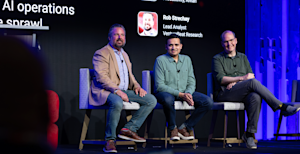
Rob Strechay, until recently managing director and principal analyst at theCUBE Research, has joined VentureBeat as our first Lead Analyst and a founding analyst of VentureBeat Research. His arrival is the next step in a deliberate move at VentureBeat toward deeper specialization: analysis built for the technical decision-makers — the directors, VPs, CIOs, and CTOs — who are evaluating, buying, and deploying enterprise AI.
The enterprise AI stack is being rewritten in real time, and the decision-makers I talk with are starved for objective, defendable data. Rob Strechay has the mix of technical rigor and operating experience needed to dissect the architecture behind the next phase of enterprise AI deployment.
The questions enterprise technology leaders are asking have changed. As organizations move past experimentation with generative AI toward production deployment, they want to know how to orchestrate multi-vendor environments, where the security gaps in their agentic pipelines sit, and how to fix the utilization problems draining their infrastructure budgets. Answering those questions requires more depth than news coverage alone provides, and that is the gap this research offering is built to fill.
An analyst who has sat on every side of the table
Strechay brings nearly three decades of experience as a practitioner, product executive, and industry analyst. Before becoming an analyst, he was an executive at numerous startups, including Zerto; he joined Amazon Web Services to help build a new analytics service; and he held executive roles across enterprise infrastructure. He later served as a senior analyst at Enterprise Strategy Group and most recently as managing director and principal analyst at theCUBE Research and SiliconANGLE, where he hosted executive interviews and analyzed the evolution of cloud, data, and AI infrastructure.
Strechay will initially focus his coverage on cloud infrastructure, advanced data infrastructure, platform engineering and DevOps orchestration and observability, and the intersection points where AI and enterprise security collide.
Already at work: GPU utilization and the VB Pulse surveys
Strechay has already been contributing to VentureBeat's research. In May he published an analysis of enterprise GPU utilization, examining the compute waste sitting inside enterprise AI infrastructure, and he provided a substantive review of our AI Infrastructure & Compute survey before it went into the field.
His infrastructure-level focus complements the research engine VentureBeat has built around its monthly VB Pulse surveys, which track five areas of enterprise AI adoption: agentic orchestration, agent reliability and evals, agentic security and identity, AI infrastructure and compute, and context layers, including retrieval-augmented generation (RAG). Our June report on agentic orchestration, drawn from a survey of 145 enterprises, found that two-thirds of those enterprises had hedged their AI model strategy rather than committing to a single provider — a posture whose value the June outage of Anthropic's Claude models made plain.
VB In Conversation: The first vehicle
A core vehicle for this expanded research footprint will be a deepening of VentureBeat's existing VB In Conversation video interview series, which Strechay will host. Rather than high-level industry overviews, the series will bring architectural blueprints, actual deployment barriers, and back-end infrastructure realities to light through in-depth technical interviews with the architects and product leaders behind leading enterprise AI systems — an unvarnished look at which tools perform under production-grade pressure.
"VentureBeat has built an audience of enterprise builders and technology buyers that any analyst would want to serve," Strechay said. "My goal is to use deep empirical metrics and VentureBeat's proprietary tracking data to help enterprise buyers and the people building for them make sound platform and infrastructure decisions during the most disruptive transition enterprise technology has seen."
The expanded VB In Conversation series will appear on VentureBeat and on VentureBeat's YouTube channel, alongside Rob's written analysis on the site. Enterprise practitioners who want to take part in our monthly VB Pulse surveys, or arrange an analyst briefing with Rob, can reach the research team here.
The textile industry is growing every year. There is an increased demand for custom T-shirts for businesses, sports teams, schools, events, and personal wear. Due to this, clothing companies require faster and better printing techniques to produce shirts. This is where an automatic T-shirt printing machine can play a large role. These machines support businesses […]
X Square Robot is showcasing its full portfolio of embodied AI technologies at the World Robot Conference 2026 in Beijing, presenting applications ranging from logistics automation and dexterous manipulation to household robotics and AI training-data collection. The Shenzhen-based company is exhibiting at booth C107 during WRC, which runs from August 19 to 23, bringing together […]

 Login
Login
 NVIDIA Holoscan is a platform for building real-time AI applications at the edge, from medical imaging to robotics. HoloHub is its companion repository: a...
 Modern vision-language models (VLMs) can support tasks such as visual question answering, captioning, and image-text reasoning. In practice, however, the data...
 AI agents are only as effective as the context they receive. Even with capable models and well-documented NVIDIA libraries, agents can spend extra steps finding...

 Robots need policies that can adapt to their sensors, environments, and tasks while running on onboard computing hardware. World models offer a foundation for...